Ljubostinja: A Serbian Orthodox Monastery and Centre of Female Monasticism


Site at a Glance
- Rating
- 4.9
- Popularity
- Medium
- Country
- Serbia
- Primary era
- Medieval
- External website
- Open
- Eras represented
- Medieval, Modern
- Civilizations
- Serbian Despotate
- Site type
- Religious
- Remains
- Monastery
On this page12 sections
History
Ljubostinja is a Serbian Orthodox monastery in Prnjavor, Serbia, built in the late fourteenth and early fifteenth centuries in the late Morava architectural style. Construction began in 1388, shortly before the Battle of Kosovo, and was completed by about 1405. The monastery is dedicated to the Dormition of the Mother of God, the Orthodox feast commemorating the death and assumption of the Virgin Mary, and belongs to the Diocese of Kruševac.
Foundation and royal patronage
Tradition identifies Princess Milica, widow of Prince Lazar Hrebeljanović, as Ljubostinja’s founder. It also places her first meeting with Lazar at this location. Three explanations have been given for the monastery’s name: a connection with the love of Milica and Lazar, an association with love of the ascetic life, or a derivation from a local expression meaning “lovely rock.” The first interpretation is linked to a tradition that an earlier small church dedicated to Saint Archdeacon Stephen stood here, although excavations have not confirmed that tradition.
The exact circumstances of the foundation remain debated. Some interpretations place Ljubostinja’s origin in the reign of King Milutin, while others maintain that Milica founded it in 1388. An earlier layer of fresco painting beneath later decoration has been cited in support of an earlier date, but this does not by itself disprove Milica’s role as founder. The monastery was established as Serbia’s first female monastery, intended to receive widows of Serbian noble families after the battles of Maritsa in 1371 and Kosovo in 1389. Jelena Mrnjavčević, widow of Vukašin’s brother Uglješa, was the first of these women. She entered religious life under the name Jefimija.
Milica, Jefimija, and the medieval monastery
After the accession of her son Stefan Lazarević, Milica entered monastic life at Ljubostinja under the name Eugenia and remained there. She was effectively the monastery’s first abbess while continuing to exercise considerable diplomatic influence. From 1389 until Stefan’s accession in 1393, she governed Serbia as regent. Even afterward, letters from Dubrovnik continued to address her according to court protocol.
In 1398, Eugenia and Jefimija travelled to Ser to seek Sultan Bayezid I’s pardon for Stefan, who had been accused of cooperating with Hungary. They returned with the sultan’s promise of pardon and with the relics of Saint Petka. The relics were first kept at Zupanjevac and then transferred to Ljubostinja. Despot Stefan later moved them to Kalemegdan, probably in 1406 or 1407. The exact place where the relics were kept between about 1400 and 1407 remains uncertain.
Near the ends of their lives, Milica and Jefimija took the Great Schima, the most rigorous form of Orthodox monastic commitment, becoming Euphrosyne and Eupraxia respectively. Milica died on 11 November 1405 and was buried at Ljubostinja. Jefimija died in 1406 or early 1407 and was also buried there, as was her son Stefan Mrnjavčević. Jefimija embroidered the Praise of Prince Lazar at Ljubostinja in gold thread. The work is regarded as a major achievement of Serbian medieval literature and is now preserved in Saint Petersburg.
From the late fourteenth century, Ljubostinja served as a refuge for surviving Moravian Serbian aristocracy and as a centre of Serbian political and diplomatic activity. The monastery became a male monastery in 1418. Its earliest known abbots include Simeon, recorded in 1481; another Simeon, recorded in 1576 and 1581; and Isaiah, recorded in 1643.
Ottoman-era continuity and decline
Monastic services continued from the foundation until the Serbian migrations of 1690. Ljubostinja declined at the end of the seventeenth century but was revived in the early eighteenth century. In 1732, it had a theological and monastic school under Father Arsenije, whose students included monks and priests from throughout Serbia. The monastery was counted among Serbia’s wealthiest in the eighteenth and nineteenth centuries.
Around 1780, Arsenije the Second cleared vegetation from the church roof, removed accumulated dirt from the interior, expelled sheep from the grounds, and reroofed the church with wooden shingles. During the Austro-Turkish War and the Kočina Krajina rebellion of 1788–1791, an uprising against Ottoman rule that supported the Austrian side, Ljubostinja sheltered Austrian soldiers, officers, and spies. Archimandrite Vicentije Jovanović, a senior monastic cleric, admitted that they had been hidden there between 1781 and 1788.
The Ottoman authorities burned and looted the monastery in early May 1788 in retaliation. Most of the original frescoes were destroyed, the monks left, and Ljubostinja became deserted. It was looted again in 1804. The fire exposed a concealed treasury in the church wall behind an icon, where Milica was believed to have kept valuables. Among the stolen objects was the crown of Prince Lazar, which was taken to Istanbul and remains there.
The monastery was not deserted throughout the entire seventeenth century. It was documented in 1643 and 1673, and worship continued until 1690. It is also uncertain whether the church was repainted in 1799. A surviving fresco from that year bears the inscription “Dimitri Basa, servant of God,” but the painter’s identity and the monastery’s exact condition at that time are unknown.
Uprisings and nineteenth-century restoration
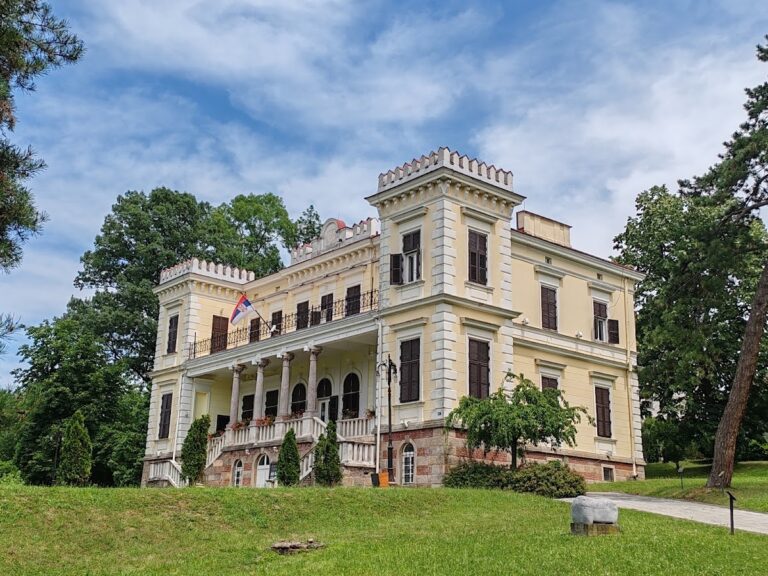
During the First Serbian Uprising, the militant priest Nastasie, known as Kazak or Kozak, organized hajduk bands with Karađorđe and attacked Ottoman forces while defending monastery property. By 1807, Priest Spasoje administered Ljubostinja. Under Prince Miloš and Abbot Arsenije Stefanović, the monastery was restored during the nineteenth century. Arsenije built an additional residence, now called Miloš’s Residence, a watermill, and a new iconostasis in 1822 with the help of Priest Nićifor.
In the 1830s and 1840s, Archimandrite Meletije Marković acquired agricultural land, bought three watermills, built another, began a protective enclosure wall, and reroofed the church with tiles. In 1839, the relics of Stefan the First-Crowned rested overnight in the church during their transfer from Kalenic to Studenica. Between 1848 and 1851, the church was reconstructed, especially in its upper sections and the false domes above the narthex.
Archimandrite Janićije Mačužić administered the monastery from 1847 and guided it through its greatest period of prosperity. Additional service buildings, a kitchen, stables, a distillery, and a watermill were constructed. By 1852, Ljubostinja owned eight watermills, meadows, and orchards extending to the West Morava. In 1870 it belonged to the Jagodina District, Levač County, and the Diocese of Belgrade, and housed four monks. Its principal feast was the Dormition of the Mother of God, although the Transfiguration was temporarily adopted for another popular gathering.
In 1895, the monastery estate covered 1,078 hectares, including 990 hectares of forest, three vineyards, and seven orchards. Its net capital exceeded 18,000 dinars, while its immovable property was valued at 42,000 dinars. In 1903, on the order of King Peter I Karađorđević, the antiquarian Mihajlo Valtrović opened Milica’s sarcophagus while investigating medieval Serbian regalia. The body was found in a simple black monastic robe rather than royal clothing. The church subsequently promoted Milica’s canonization, and the feast of Venerable Eugenia has been observed on 1 August.
Archaeology, war, and renewed female monastic life
Valtrović began the first professional archaeological excavations around Ljubostinja in 1904. His findings, published in 1906, marked the beginning of systematic archaeological study of medieval sites and ruler burials in Serbia. During the Austro-Hungarian occupation, on 24 October 1915, soldiers accused Archimandrite Konstantin Popović, Hieromonk Ruvim, and the young Hieromonk Sebastian Putnik of concealing part of the Serbian government archive. Sebastian was sent to the Aschach camp.
During the occupation, Ljubostinja served nominally as the headquarters of the Forestry Administration but functionally as a detention camp for Italian and Serbian prisoners, who were forced to clear the monastery forest. Near the end of the war, the occupiers looted the monastery, removing metal objects, all four bells, utensils, and used towels.
Ljubostinja became a female monastery again in 1937. In autumn 1939, Mother Sara Đuketić became its abbess. The library in Miloš’s Residence then contained more than 1,000 titles, including a 1637 edition of Thomas à Kempis’s De Imitatione Christi, printed on the order of the Wallachian countess Elena Basarab.
During the Second World War, the monastery sheltered twelve homeless girls and later received refugees and monks displaced from Žiča after that monastery was burned. Bishop Nikolaj Velimirović was held under house arrest at Ljubostinja for eighteen months, from St Peter’s Day in 1941 until 5 December 1942. He wrote several works there, including the poem The Building of Ljubostinja, and left Mother Sara a notebook of spiritual advice for the sisterhood.
The community suffered accusations, violence, and coercion from Chetniks, Partisans, and German forces. In early 1943, Mother Sara was twice targeted for assassination and was eventually smuggled out in a hay-covered sleigh. Her sisters, the nuns Eugenia and Antonia, and the novice Milka were also attacked. Antonia was killed, Eugenia died of her wounds in hospital, and Milka was murdered after being assaulted and thrown into the West Morava.
Mother Varvara Milenović became the monastery’s superior in 1943 and its abbess in 1949, remaining in office until her death in 1995. She restored the organization and economy of Ljubostinja, established carpet-weaving and knitting workshops, and arranged for their products to be exported. Under her leadership, the monastery became a major centre of female monasticism in Yugoslavia, with more than 50 sisters.
Heritage and the modern monastery
In 1952 or 1953, Mother Sara returned the relics of her sister Eugenia to Ljubostinja, where they were placed beside those of Antonia. The 1945 agrarian-reform law and the 1958 nationalization law deprived the monastery of more than 1,400 hectares of forest and agricultural land. Restitution returned property in 2009 and 2016. In 1979, Ljubostinja was designated a Monument of Culture of Exceptional Importance, Serbia’s highest level of heritage protection.
Abbess Hristina Obradović has led Ljubostinja since 1995. The monastery remains an active female monastery and a centre of women’s monastic life. Its religious and cultural activities include gatherings for the Dormition and Transfiguration and the literary festival Jefimija’s Days, established in 1971, discontinued in 1973, and revived in 1991. The estate now covers 1,321.44 hectares, of which 1,298.90 hectares, or 98.3 percent, are forest.
Remains
Ljubostinja stands on the left bank of the West Morava, about 4 kilometres north of Trstenik, among the Ljubostinja and Sušica streams and the hills of the Gledić Mountains. Iver lies to the north, Tatarna to the west, and Kamadjore to the east. The monastery is also associated with Samar and Bogdanovo Hill. Its surviving complex is centred on a compact church, with burials, a medieval well, an ossuary, monastic buildings, and archaeological remains distributed through the surrounding grounds.
The church and its exterior
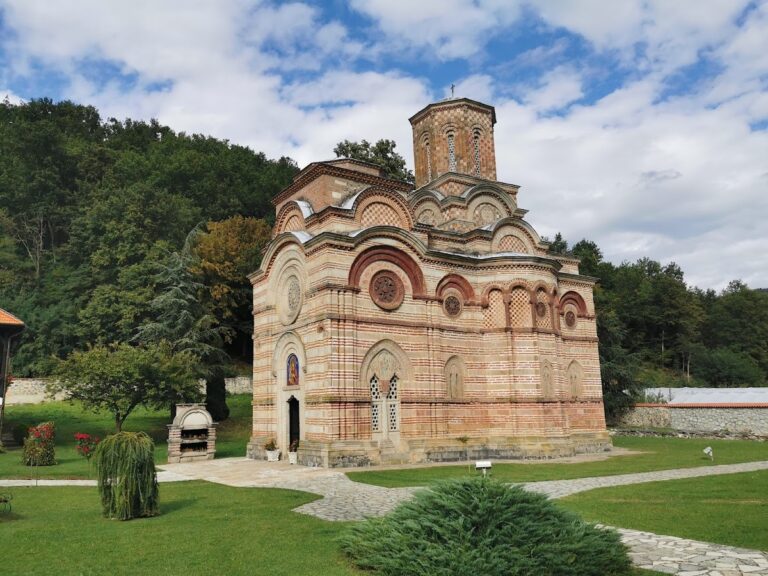
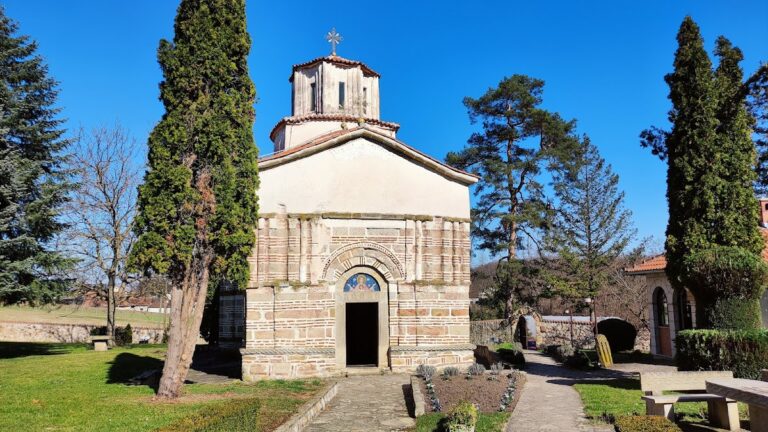
The monastery church has a compact developed trefoil, or three-conch, plan, with a rectangular narthex, the entrance vestibule, adjoining the nave, the principal interior space. A single dome rests on four pillars. The building is about 24 metres high, 20 metres long, and 6 metres wide. It follows the cross-in-square tradition and belongs to the late Morava style, but unlike many churches of this group it is relatively compact rather than strongly elongated. The structure is oriented with unusual precision toward the equinoctial east: on 20 March, the rising sun aligns with the easternmost point of the nave.
Rade Neimar, also known as Rade Borović, was the principal builder and worked with approximately 500 laborers. He carved his name on the threshold between the narthex and nave. The walls consist of roughly dressed sandstone from varied sources, shapes, and forms. Their coarse masonry was covered with painted façades that imitate orderly courses of stone and brick. Painted horizontal bands of three, and sometimes four, brick courses, together with a braided-band frieze beneath the cornice, enrich the exterior.
Carved stone lilies decorate the lower zone, while rosettes occupy the upper zone. There are 13 rosettes, seven large and six small. Most are enclosed by rope-like rings, and all except three small rosettes contain a central flower. The large rosettes also have rings with ceramic crosses. The three largest rosettes are on the narthex, including a southern example decorated with five-petalled lilies and strongly Venetian Gothic features.
Chessboard panels, pilasters, blind arcades, colonnettes, and interlaced carving surround the portals and windows. Rare bifora windows, each divided into two openings beneath trefoil arches, reflect Venetian and Dubrovnik Gothic models. Islamic floral and arabesque motifs were adapted into the painted and carved decoration. Lilies appear on rosettes, windows, blind niches, lesenes, and attached colonnettes, as well as on the founder’s sarcophagus. The architectural ornament contains no carved animal or human figures.
Frescoes and interior decoration
The original fresco cycle was probably painted between 1405 and 1409, although another inscription states that the church was fully painted on 14 August 1403. Fragments of an older cycle, probably made before the Battle of Kosovo, have been identified in the pendentives, the curved triangular supports beneath the dome, the lower drum, and other areas. The later medieval frescoes were painted by the Greek artist Makarije Zograf of Zrze. His signature survives on the arch above the doorway from the narthex to the nave.
The surviving painting uses a cool palette dominated by pale cinnabar red, malachite green, gray, and blue. The narthex contains portraits of Princess Milica, Prince Lazar, and their sons Vuk and Stefan Lazarević. Vuk wears blue and holds a cross without royal insignia or an identifying inscription. Stefan wears red and holds a cross-shaped scepter, while an inscription identifies him as despot, showing that this part of the decoration was painted after 1402. The narthex also includes depictions of ecumenical councils.
The nave’s decoration has spiritual and funerary functions. The Great Feasts appear on the vaults, scenes from the Passion occupy the upper wall zone, and Christ’s miracles and sermons fill the central zone. Surviving scenes include the Annunciation, indications of the Entry into Jerusalem and the Dormition of the Mother of God, and fragments of the Mocking of Christ, Peter’s Denial, the Deposition from the Cross, and the Entombment.
Among the surviving miracle scenes are the Healing of the Paralytic, Christ and the Samaritan Woman, the Healing of the Man Born Blind, and the Anointing at Bethany. The Healing of the Paralytic shows Christ with the apostles, the healed man carrying his bed, a cross-shaped fountain with a five-column portico, and a silent figure identified as the philosopher Socrates. The composition has been described as a masterpiece of Serbian fresco painting.
Figures of the prophets include Micah, Gideon, David, Ezekiel, Zechariah, Zephaniah, Jeremiah, and Hosea. Other surviving or partly discernible figures include the Archangels Michael and Gabriel, Saint Sava, Stefan Nemanja, Theodore the Studite, John of Damascus, Saint Jude, Saint Theodore, Ephrem the Syrian, Sava the Sanctified, and Emperor Constantine with Empress Helena. A rare image of the Persian saint Govdelai appears among the warriors in the northern choir. His head has not survived, and he is shown alone rather than paired with Saint Dada. The frescoes are generally in poor condition.
The present iconostasis, the screen separating the sanctuary from the nave, was painted between 1866 and 1870 by Nikola Marković, a Belgrade academic painter and student of Steva Todorović. It reflects Romanticism and the national revival.
Burials and archaeological evidence
The church contains the founder’s sarcophagus and other burials. Archaeological investigations identified two graves in the nave, including one measuring 2.58 metres long, 1.17 metres wide, and 1.67 metres deep. A later interpretation identifies this as Milica’s original grave and proposes that her body was moved to a sarcophagus in the northeastern part of the narthex during the eighteenth century. That sarcophagus contains Jefimija rather than Milica, is covered with carved lilies, and lacks the cross normally carved on such coffins. The reason for Jefimija’s burial there remains uncertain.
Excavations along the north side of the narthex revealed several parallel graves and ten skeletons. Most of the deceased had their hands crossed over their chests. One burial was oriented in the reverse direction, with the head to the east and feet to the west, while another skeleton had seven pale beads beneath its crossed hands. A burial beneath the southern part of the narthex floor contained several teeth and fragments of skin gathered together. In total, as many as 32 graves were identified around and within the church, reflecting the monastery’s role as a memorial burial place for its monastic community and Serbian nobility. Many recovered human remains are now held in the ossuary, a repository for human bones, in the southeastern part of the grounds.
The monastery grounds contain the graves of abbots, spiritual fathers, and nuns associated with Ljubostinja, including Arsenije the Ljubostinja abbot, Arsenije Stefanović, Janićije, Danilo, Venijamin, Sebastian, Varvara, Nikon, Damjan, Eugenia, and Antonia. A medieval well of unknown origin is traditionally called Empress Milica’s Well. Excavations in the church and on the estate indicate continuous human activity from antiquity and recovered denarii, Roman coins, dating to 82 BC.
Associated ruins and landscape
On Kamadjore Hill, northeast of the church, are the ruins of a church traditionally called Trebnica. It was supposedly built for a priest who could come to Ljubostinja to celebrate the liturgy and hear the nuns’ confessions. Another ruined church, known locally as Crkvina, stands on Veternik Hill above the monastery.
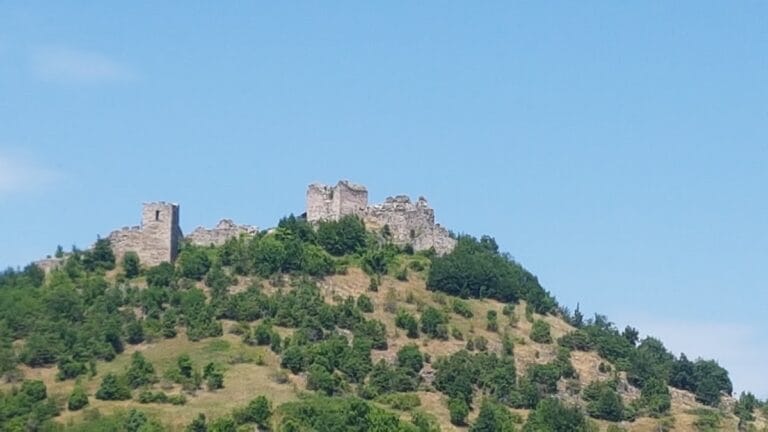
The wider archaeological landscape includes the medieval fortress of Grabovac, also called Jerina’s Town, on Tatarna Hill; Zupanjevac, formerly a large medieval court complex; Gradiste in Donji Dubic; and the late antique site of Grabak between Pocekovina and Donji Ribnik. Two other sites called Gradac are located at Brezovica and Ridjevstica. Together with the surrounding streams, hills, and monastery grounds, these remains place Ljubostinja within a wider landscape of medieval and late antique settlement.