Lincoln Castle: A Norman Royal Fortress and Historic Prison

Site at a Glance
- Rating
- 4.6
- Popularity
- High
- Country
- United Kingdom
- Primary era
- Medieval
- External website
- Open
- Eras represented
- Classical, Medieval, Early Modern, Modern
- Civilizations
- British, English, Norman, Roman
- Site type
- Military
- Remains
- Castle
On this page20 sections
History
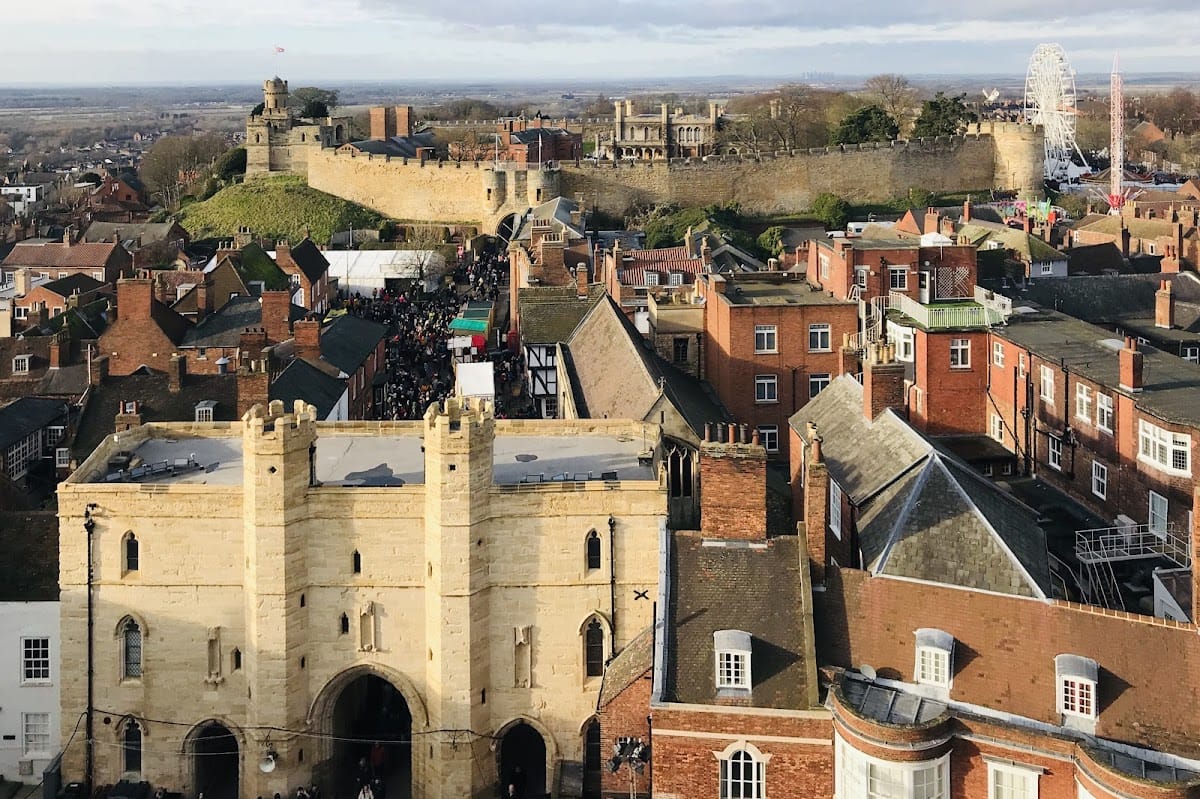
Lincoln Castle is a Norman stone fortification in the United Kingdom, founded in 1068 during the early Norman period on the orders of William the Conqueror. It formed part of a network of strongholds created to secure royal control over northern and central England, including the former Danelaw. Built on the site of the Roman fortress associated with Lindum Colonia, the castle occupied an elevated position above important routes and became one of the principal centres of royal authority in the region.
Roman and Norman foundations
The site had already been important for centuries. Lindum Colonia was a Roman settlement, and later Lincoln became a major Viking commercial centre with an estimated population of between 6,000 and 8,000. Its height gave control over routes connected with Ermine Street, the Fosse Way, the River Trent valley, the River Witham, and the Lincolnshire Wolds. A Saxon fortification may also have occupied the site between the Roman and Norman periods. This possibility has been connected with a record of William the Conqueror imprisoning hostages from influential Lindsey families at a place called Lindecollino castro.
The first Norman fortification was probably completed in 1068. It began with a wooden keep, later replaced by a more durable stone structure. The scale of the work altered the existing settlement, as 166 residences and a further 74 properties were removed to clear the castle and its approaches. The Domesday Survey of 1086 listed Lincoln Castle among the two castles in Lincolnshire. By 1115, the castle had outer stone walls, probably constructed during the reign of Henry I.
Civil war and medieval strengthening
Lincoln Castle remained involved in the political conflicts of the twelfth century. During the Anarchy, the civil war between King Stephen and Empress Matilda over the English succession, Matilda granted the castle to Ranulf de Gernon, Earl of Chester. Stephen later ordered Ranulf to retain and strengthen it. Ranulf, or his mother Lucy of Bolingbroke, probably arranged the construction of the keep now called Lucy Tower.
The castle played a direct part in the First Battle of Lincoln on 2 February 1141. Stephen was captured during the battle, which took place during the struggle between his supporters and those of Matilda. Lucy Tower was built in the period that followed, adding a substantial stone stronghold to the castle’s defences.
Lincoln was besieged before the Second Battle of Lincoln on 20 May 1217. This conflict formed part of the First Barons’ War, the rebellion against King John and later the government of Henry III that followed the sealing of Magna Carta in 1215. After the siege, new barbicans, or outer defensive structures protecting entrances, were added to the west and east gates, while Cobb Hall strengthened the north-eastern corner. An older tradition associated Cobb Hall and the eastern gate works with John of Gaunt, but he held the castle much later.
From noble custody to royal possession
From the later reign of Henry III, the earls of Salisbury administered Lincoln Castle. After William of Salisbury died in Palestine, his daughter’s family established the line of earls of Lincoln. The title continued mainly through the female line until the middle of the fourteenth century. When Alice de Lacy, 4th Countess of Lincoln, died in 1348, she left the castle by her will to the earls and later dukes of Lancaster.
Lincoln Castle returned to royal ownership in 1399, when Henry IV of Lancaster became king. It remained a Crown possession until 1832, when the local magistracy purchased it. Although its military importance had declined, the castle acquired a new role as a prison and centre of county administration.
Prison, court, and archaeological discovery
A county prison was built within the castle in 1787 to improve conditions in the underground prison areas. The complex also accommodated court sessions and occasional meetings of the county authority. A criminal court building followed in the 1840s. Public hangings took place on the mural tower at the north-eastern corner of the curtain wall until 1868. In 1872, William Marwood carried out his first execution at Lincoln, using the long-drop method to execute Fred Horry.
The castle served as a prison until 1878, when prisoners were transferred to a new gaol east of Lincoln. Prisoners had sometimes been executed on the castle earthworks and buried within the grounds, while others were transported to Australia. The former prison later housed the Lincolnshire Archives, and parts of it became a museum. A court building erected in 1823 as the Assize Courts remains in use as Lincoln Crown Court. Assize Courts were historic courts that dealt with serious criminal and civil cases.
Excavations during modern restoration revealed a late Saxon church dating to about 900. Nearby, archaeologists found a stone sarcophagus containing human remains and gold ornaments, together with eight further skeletons in wooden coffins. One of these was wrapped in a woollen shroud. The remains in the sarcophagus have possibly been identified with Blacca, an eighth-century ruler of Lindsey, but that identification remains uncertain.
Conservation and continuing use
Lincoln Castle became a scheduled ancient monument of national importance in 1979. It is owned by Lincolnshire County Council and continues to function as a Crown Court as well as a heritage site. The three-year Lincoln Castle Revealed renovation project began in 2012 and was completed in April 2015. It conserved parts of the walls, towers, prison, and Georgian and Victorian court buildings, while also opening further prison areas and creating an exhibition centre for Lincoln’s Magna Carta.
Lincoln preserves one of only four surviving original copies of the 1215 Magna Carta, the charter sealed by King John at Runnymede after negotiations with the barons. The Lincoln copy is regarded as the best preserved of the four. The castle also holds the Forest Charter, issued in the same broad historical context and concerned with royal control and use of forest lands. Lincoln is the only place where the two documents are held together. The renovation project created exhibitions explaining Magna Carta’s origins and later effects.
Remains
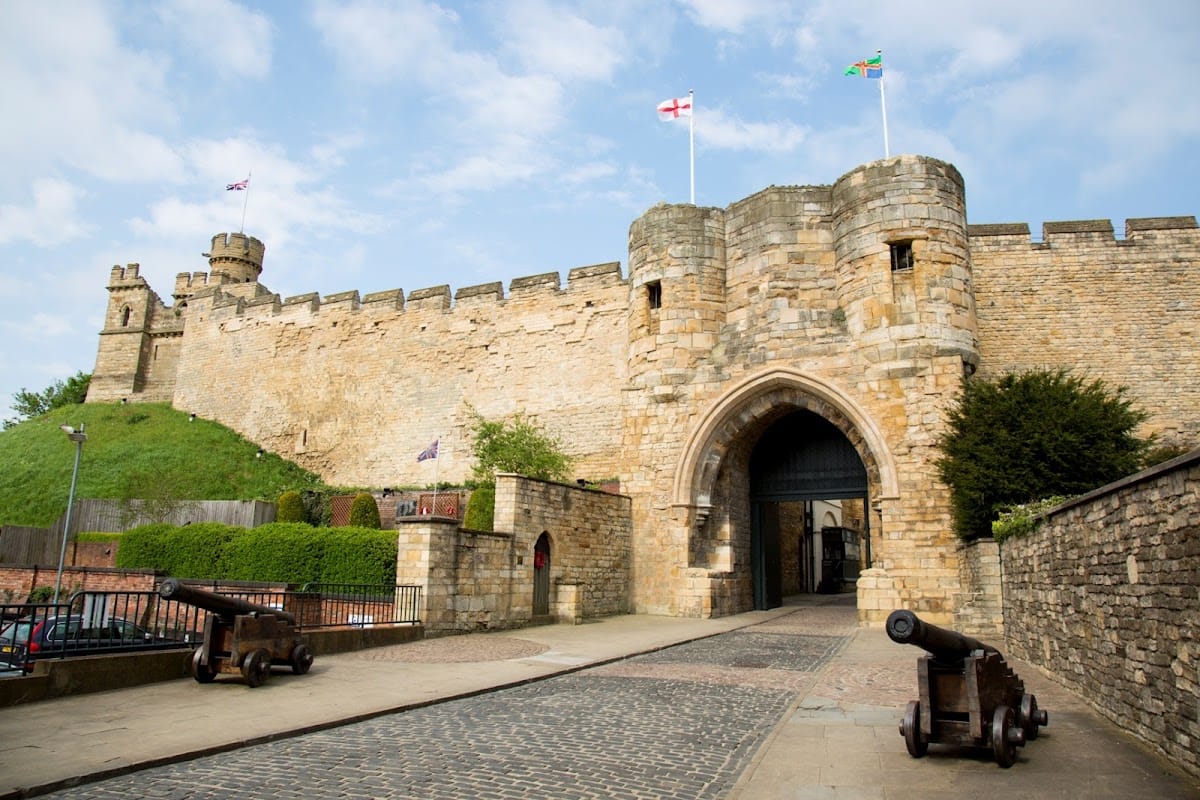
Lincoln Castle is a Norman motte-and-bailey fortification, combining an enclosed courtyard with raised earth mounds carrying defensive buildings. It was built in stone on the south-western part of the former Roman fortress. The roughly square inner bailey is enclosed by an earth rampart, a stone curtain wall, and a dry ditch on every side except the south. An artificial inner bank made the ditch harder to cross, while the keep stood separately within its own surrounding ditch. Lincoln and Lewes are the only surviving English castles with two mottes.
Mottes and keeps
Observatory Tower
The south-eastern motte probably belonged to William the Conqueror’s original castle. It carries the square Observatory Tower, a Norman structure dated to the fourteenth century. Its main building is topped by a later Victorian turret, bringing together medieval and nineteenth-century elements on the same raised mound.
Lucy Tower
The south-western motte supports Lucy Tower, a polygonal keep probably built in the twelfth century by Ranulf of Chester or his mother, Lucy of Bolingbroke. The keep originally had two storeys. Its second storey had been completely destroyed by the early modern period, leaving the surviving structure as a fragment of the castle’s civil-war period.
Walls and gateways
Roman and Norman walls
The medieval defences incorporated the Roman wall. Along the steep southern side, the Roman fabric survives partly as a curtain wall and partly as revetment supporting the mottes. On the flatter western side, it was buried within an earth rampart and extended upward to form the Norman wall. Fragments of the Roman wall survive today. The castle walls are irregular and roughly aligned, with uncoursed stone construction. Their strength was attributed to the quality of the mortar, despite the apparently rapid construction of the original fortification.
West gate and Sally Port
The Roman west gate stood on the site of the castle’s west gate. It was excavated in the nineteenth century, but exposure led to its collapse and the remains were reburied. Above the west entrance stands a simple Norman gate tower, also known as the Sally Port. This entrance was blocked for a long period while the eastern gate remained open.
Eastern gate and barbican
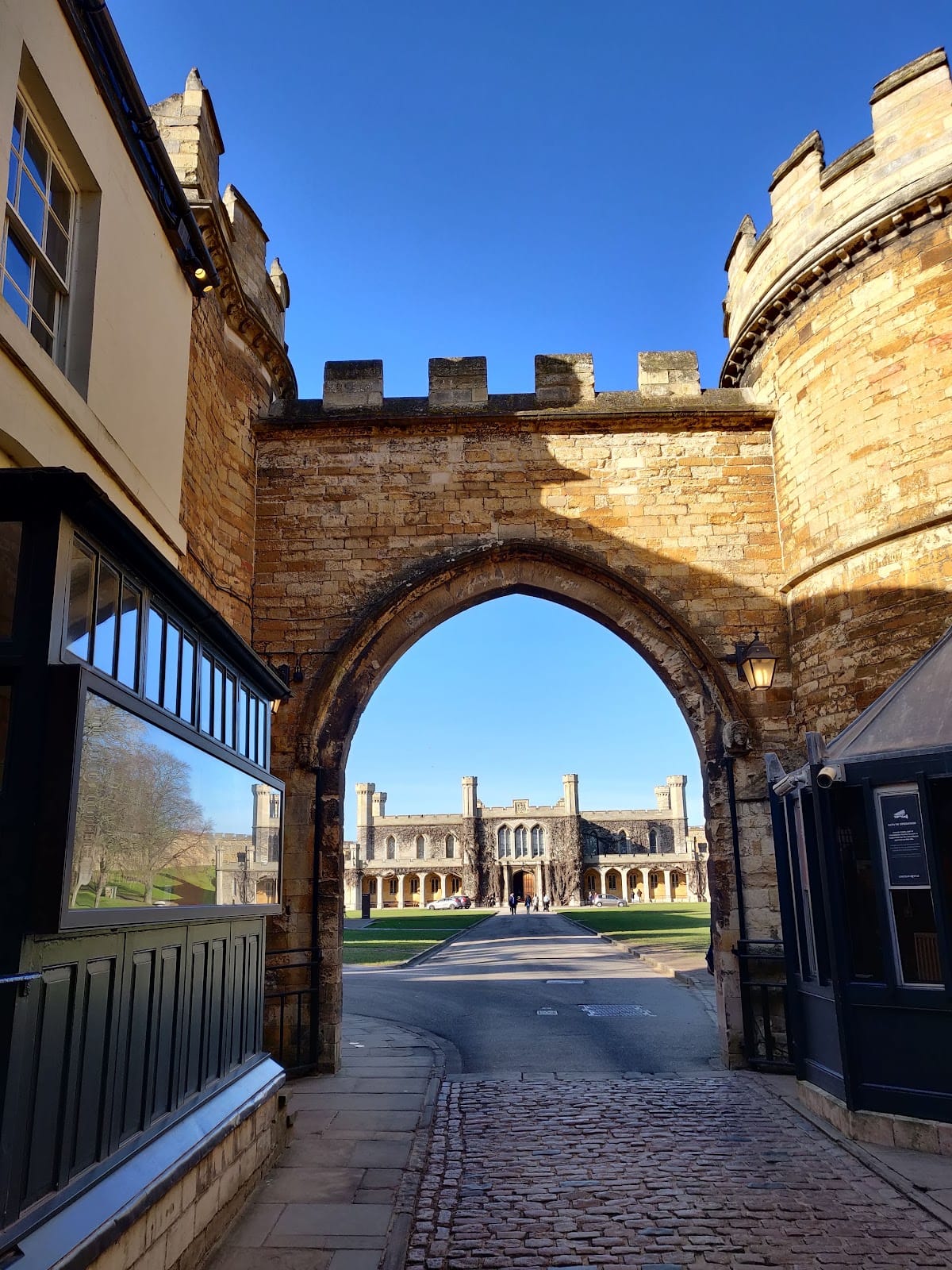
The eastern gate acquired a fourteenth-century arch flanked by small gate towers. The base of a barbican survives in front of it. On the courtyard side, a Victorian extension incorporates an oriel window transferred from Sutton Hall, a medieval building in the lower town. The grounds also contain the remains of Lincoln’s Eleanor Cross and a bust of George III originally made for the Dunston Pillar.
Cobb Hall
Cobb Hall is a horseshoe-shaped tower protecting the north-eastern corner of the curtain wall. It was built after the siege preceding the Second Battle of Lincoln in 1217 and is one of the castle’s four surviving towers. Two dragons, Lucy and Norman, were installed beside Cobb Hall in 2022 and 2023. Lucy takes her name from Lucy Tower, while Norman commemorates the Norman conquest of 1068.
Prison and court buildings
County prison
The inner bailey contains a T-shaped prison building dating from the late eighteenth century and a larger mid-nineteenth-century prison with a small women’s wing. The former county prison complex includes a three-storey, fifteen-bay stone prison connected to the eighteenth-century Governor’s House by a single-storey chapel.
Separate-system chapel
The prison chapel preserves the arrangement used by the separate system, a nineteenth-century regime designed to isolate prisoners from one another while allowing them to hear religious instruction. Its individually enclosed seats were positioned so that the preacher could see all the prisoners, while each prisoner could see only the preacher. The cells and chapel later became part of museum displays.
Assize Courts
The court building erected on the western side of the site in 1823 as the Assize Courts remains in use as Lincoln Crown Court. Its continued legal function forms part of the castle’s modern physical character, alongside the preserved prison buildings, medieval defences, and archaeological remains.
Siege earthworks and nearby defences
Two earthen banks associated with one or more medieval sieges formerly stood west of the castle in the area now known as the Lawns. Thorngate Castle, another medieval defensive work near the river and part of Lincoln’s south-eastern city defences, existed in 1141 and was demolished in 1151.