Leuven Charterhouse: A Carthusian Monastery in Belgium
Site at a Glance
- Popularity
- Low
- Country
- Belgium
- Primary era
- Early Modern
- Eras represented
- Medieval, Early Modern, Modern
- Civilizations
- Belgian, Duchy of Brabant, French, Holy Roman Empire, Spanish
- Site type
- Religious
- Remains
- Monastery
On this page12 sections
History
The Leuven Charterhouse is a Carthusian monastery in Leuven, Belgium, founded in 1491 by the Carthusian Order, a Catholic order whose members followed a largely secluded, contemplative life. It was the last Carthusian foundation in the Duchy of Brabant and the penultimate foundation in Teutonia, an administrative province of the order.
Foundation and early development
The monastery began with a gift in 1486, when Walter van Waterleet, a church canon, bought a small farm and its fields in Leuven and gave them to the Carthusians. The property lay inside the city’s second ring wall, in a sparsely settled part of the parish of Sint-Jacob. In 1489, Margaret of York, widow of Charles the Bold, Duke of Burgundy, obtained the city council’s consent to establish and endow a monastery there. She laid its first stone alongside Mayor Louis Pynnoc and other civic leaders.
Construction was entrusted to Hendrik van Duvelande, who led the Antwerp Charterhouse. The Delft Charterhouse also backed the new community: its former leader, Joh. Scullinc, became Leuven’s first head, followed by Joannes Petri in 1495. Petri also served as rector from 1494 to 1504. The house was dedicated to Saint Mary Magdalene, and its cemetery was consecrated in 1492, suggesting that monks had already arrived. It formally entered the Carthusian Order in 1504.
Private gifts helped finance the buildings. Johannes van Overhof of Antwerp paid for two monks’ cells, while Nicolas Dreyser of Zeeland, Jaspar van Turnhoudt, Simon Slusa, also known as van der Sluysen, and Nicolas de Ruister each funded one. The brothers Gisbert and Gautier Gillis of ’s-Hertogenbosch and their relative Wichmuet Zonneberch of Deventer contributed toward the church.
University ties and changing fortunes
The monastery became part of the University of Leuven in 1521. Its head later served on the governing boards of colleges, including Standonck College and the Trilingual College, and administered Leuven’s Godshuis of Heylwegen. In 1525, Emperor Charles V, a Habsburg ruler, gave the community a substantial sum for masses for his deceased father, Philip the Handsome, supplementing an earlier gift from Margaret of York.
Building work continued through the sixteenth century, but the community’s spiritual life did not grow at the same pace. Visitors criticized the monks for disobedience and breaches of their rules. In 1525, four of the fifteen monks were sent to another monastery to learn Carthusian practice. Conditions improved around 1560, then became materially difficult between 1560 and 1579. Assistance from other houses and money from suppressed monasteries helped sustain the community. The presence of monks from Sheen Anglorum, an English Carthusian community, added to its difficulties from 1578 to 1589.
Seventeenth- and eighteenth-century changes
In the seventeenth century, donations and newly acquired land improved the monastery’s finances. A fire in 1614 badly damaged the west wing in the lay brothers’ garden. Lay brothers were non-ordained members of the community who often undertook practical work. The monastery also had to house soldiers during wartime, and a new brick building was completed in 1627. At its height, the community included about twenty monks, around ten lay brothers, and other staff. Its holdings beyond Leuven included forest land at Chartreuzenbos and Chartreuzenberg in Holsbeek, as well as the farms Ter Elst in Heverlee and d’Overbiest in Korbeek-Lo.
French troops used the monastery as a temporary barracks after occupying Leuven in 1746. They set up twelve bread ovens in the garden to supply the city’s regiment, and the granary held munitions. In 1753, Maria Theresa restricted donations to monasteries, worsening the finances of a community long reliant on gifts. The monks sold land in 1773 and later, yet in 1776 they renovated the church’s entire interior. Austrian troops were billeted there in 1779, when an explosion involving munitions damaged the complex.
Suppression and military occupation
On 25 April 1783, Holy Roman Emperor Joseph II suppressed the monastery as part of his reforms. Only eight monks remained. Aged between 39 and 50, they asked the archbishop of Mechelen for permission to serve as secular priests, clergy working outside a religious order. The library held about 1,200 books, most of which went to Brussels. Silverware and household goods were sold or plundered, while the relics were transferred to Leuven’s Church of Saint Peter.
French and Austrian troops occupied the remaining buildings from 1783 to 1798. Soldiers lived in the cells, while communal buildings stored agricultural and military supplies. During French rule, a powder depot exploded in 1793, partly destroying the complex. The following year, French troops installed six bread ovens in the church to supply the army. The estate was divided and sold around the turn of the nineteenth century. Leuven brewer Willem Leunckens bought the church in 1806 and had it demolished because it was at risk of collapse.
Restoration and new uses
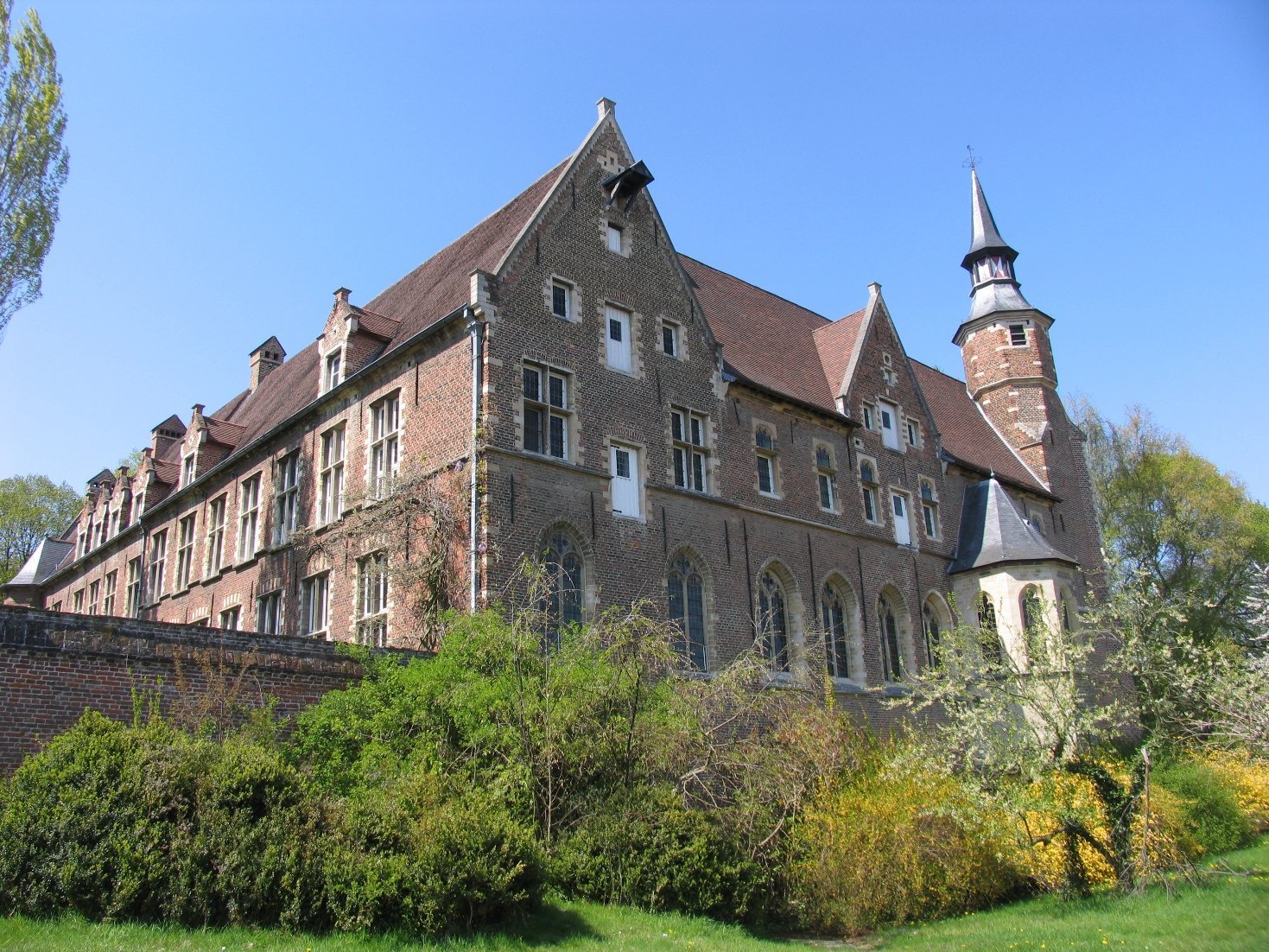
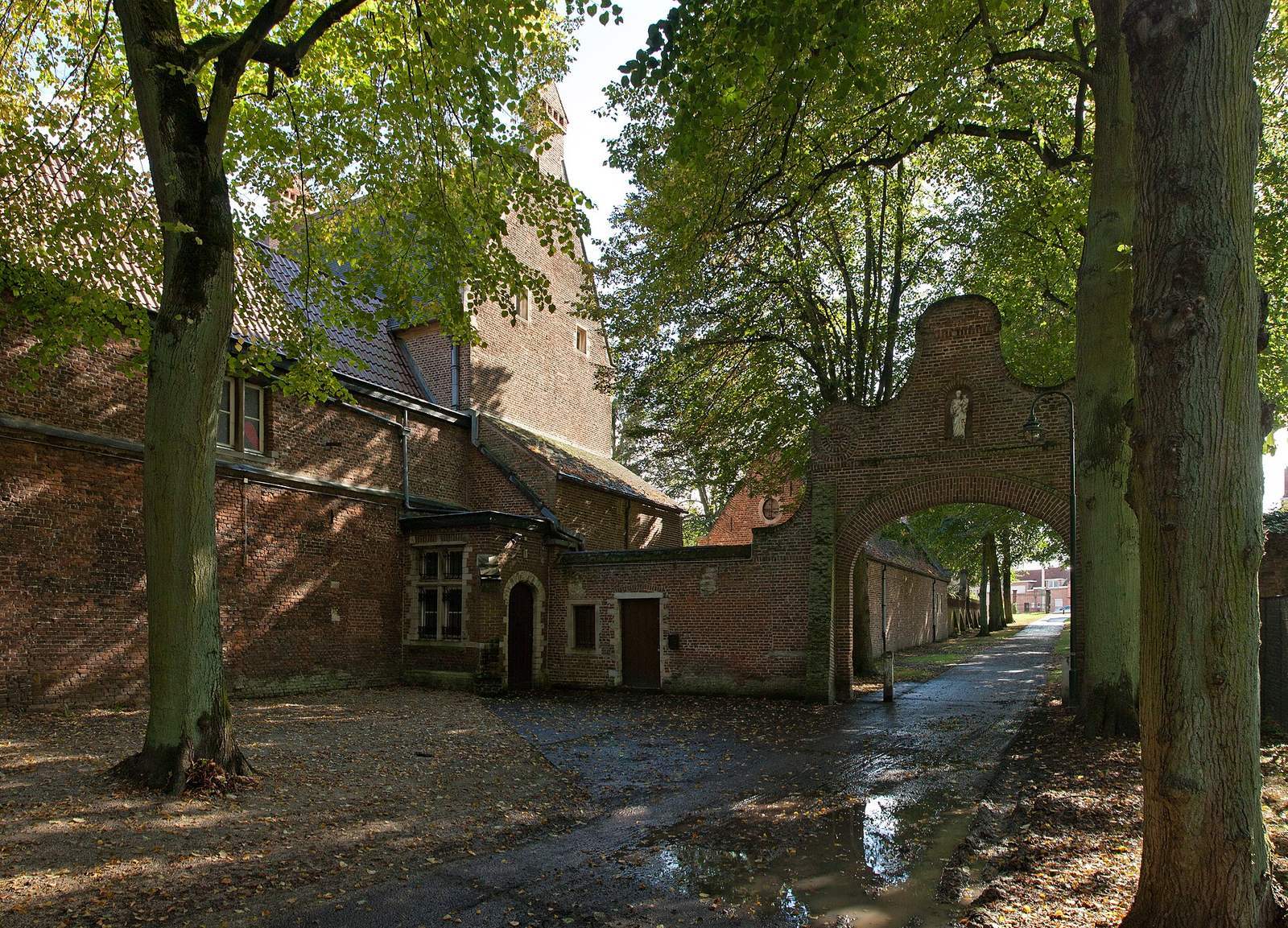
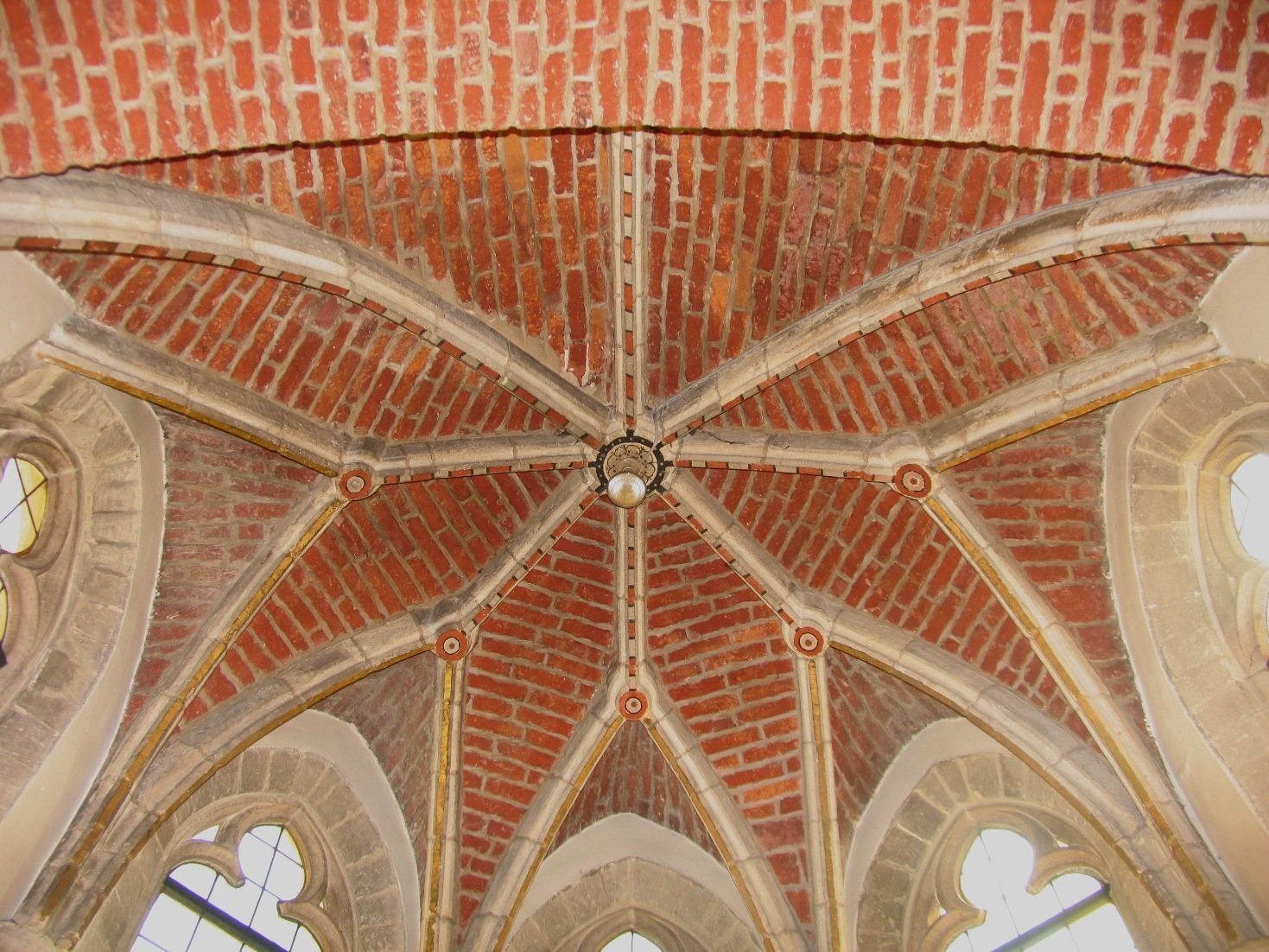
Professor and canon Thiéry of KU Leuven bought the ruined site and oversaw its restoration from 1912 to 1917. The work aimed to preserve the buildings’ Gothic character as far as possible. Some bas-reliefs were moved to Leuven’s Sint-Geertrui complex for museum display, and the restored building was sold as a residence to the Capuchins, a branch of the Franciscan order. They moved in in 1921. The monastery’s outbuildings required further restoration in the 1970s.
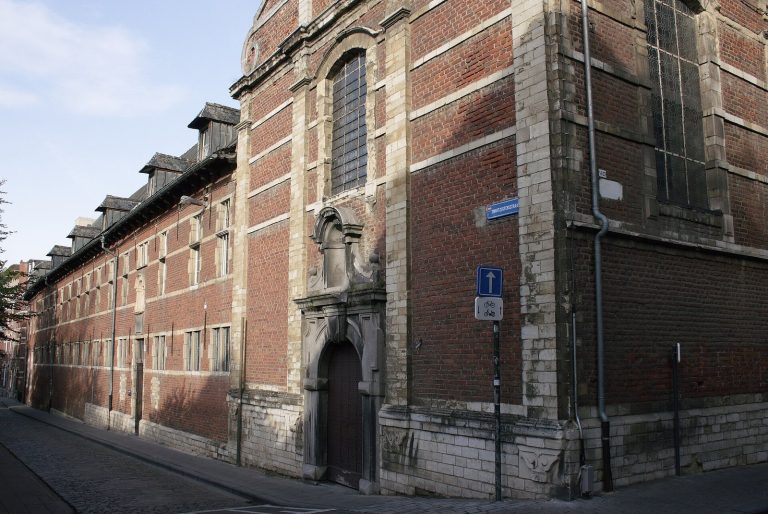
KU Leuven has owned the site since 2005 and began major renovation work in 2006. The renewed complex became a campus for children with specific care needs called Child Convent, or KartHuis. It houses the Centre for Developmental Disorders, the Youth Health Care department, and the Centre for Mental Health Care. The surviving complex is protected as a historic monument in the Flemish Region.
Remains
Urban setting and boundaries
The charterhouse stood inside Leuven’s city walls, with Bankstraat to the north, Heilige-Geeststraat to the east, and Tervuursevest along its western and southern sides. Of twenty Carthusian monasteries in the Low Countries, it was the only one built within a city’s walls.
The two monastic enclosures
The first group of monastic buildings and its church took shape in the late fifteenth and early sixteenth centuries. A larger monastery was begun during the sixteenth century, with an inner garden five times the size of the first group’s courtyard. Cells opened onto the larger complex’s main courtyard, and each cell also had a screened private garden on its outer side.
Church and communal buildings
Built between 1501 and 1530, the church lay between the first and later monastic groups, alongside the priory, library, and refectory, the community’s shared dining room. Its stained-glass windows came from the workshop of Henri van Diependale, and it contained a Nativity painting by Hendrick de Clerck. In 1785, Austrian soldier de Croly broke some windows, saying that the hay stored in the church smelled too strongly and needed ventilation. The remaining stained glass was taken to Brussels for public sale in the late 1780s.
Service buildings and garden feature
The complex also included a large farm, stables, and a house for domestic staff. A monumental water pump stood at the centre of the larger monastery’s garden from the eighteenth century. It was later moved to Tiensestraat, where it became known as the Carthusian Pump.
Emblems and devotional features
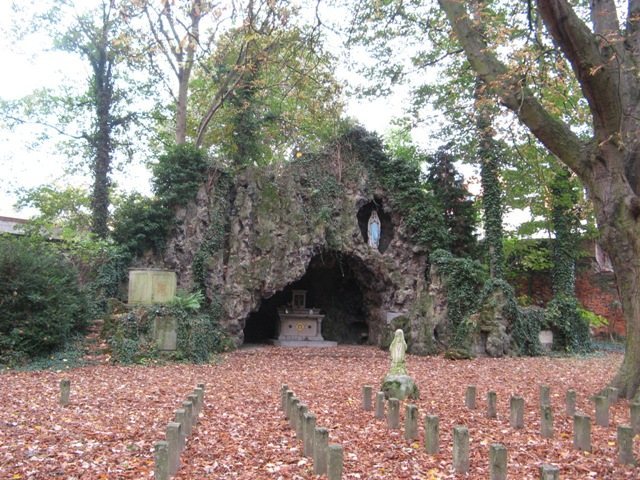
The monastery’s seal showed a jar of herbs, an attribute linked to Saint Mary Magdalene in Western Christian tradition. That association drew on the identification of Mary Magdalene with the unnamed woman who anointed Jesus in Luke’s Gospel. During the 1920s and 1930s, the Capuchins added Stations of the Cross, devotional representations of events in Jesus’s Passion, and a Marian grotto, a cave-like shrine dedicated to Mary.