Lemland Church: A Medieval Parish Church in Åland, Finland
Site at a Glance
- Popularity
- Low
- Country
- Finland
- Primary era
- Medieval
- Eras represented
- Medieval, Early Modern, Modern
- Civilizations
- Grand Duchy of Finland, Russian, Swedish
- Site type
- Religious
- Remains
- Church
On this page18 sections
History
Medieval foundation and parish
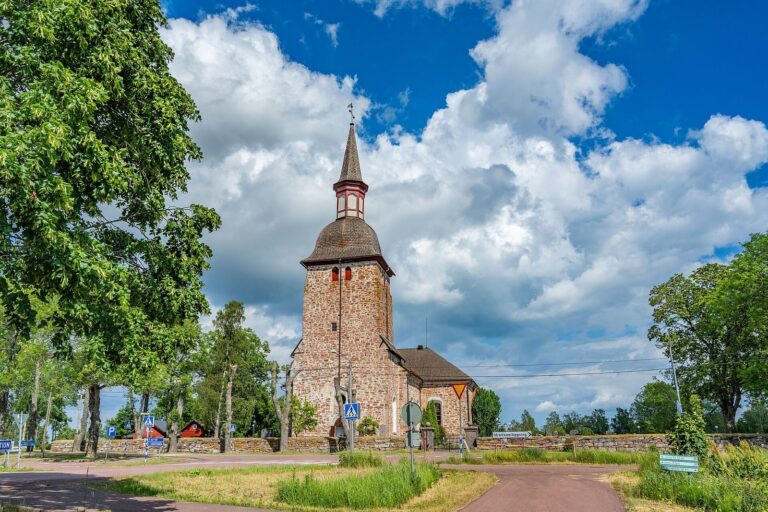
Lemland Church is a medieval stone church in Lemland, on the Åland Islands of Finland. Consecrated in the 13th century, it was probably first dedicated to Saint Nicholas, a Christian saint traditionally associated with the protection of sailors. By the 15th century, the church was associated with Saint Birgitta of Sweden, a 14th-century religious figure who founded the Bridgettine order.
Excavations in the 1950s revealed evidence of an earlier wooden church beneath the present building and showed that the stone church predated the then-common attribution to the 15th century. Coins from the excavations suggest that the wooden predecessor may have been built in the early 13th century. Its relationship to the late-14th-century Lemböte Sailors’ Chapel on the same island remains unclear. The stone church took shape through successive building phases.
Lemland Church is the principal church of the Lemland-Lumparland parish. Lumparland’s church also belongs to the parish, and its chapel was historically subordinate to Lemland. The church is affiliated with the Evangelical Lutheran Church of Finland and the Diocese of Borgå.
Early modern changes
After the Reformation, the church received new furnishings, and its interior walls were whitewashed around 1660. The choir, the area around the altar, was the last major part completed, in 1679. It also served as a burial vault and was first used as a burial chapel for Admiral John Bergenstjerna and his wife, Kristina Persdotter, of Haddnäs estate. In 1775, it was converted into the church’s main altar area.
Nineteenth-century alterations
The tower roof was renewed in 1817. Work in the 1840s altered the windows and choir entrance: southern windows were enlarged, a northern window was added, and the priest’s doorway into the choir was bricked up.
Renovation and continued use
Renovations took place in 1957 and 2005–2006. During the later work, the organ was moved to a raised platform in the northwestern part of the nave. The church remains the principal place of worship for the Lemland-Lumparland parish.
Remains
Setting and church architecture
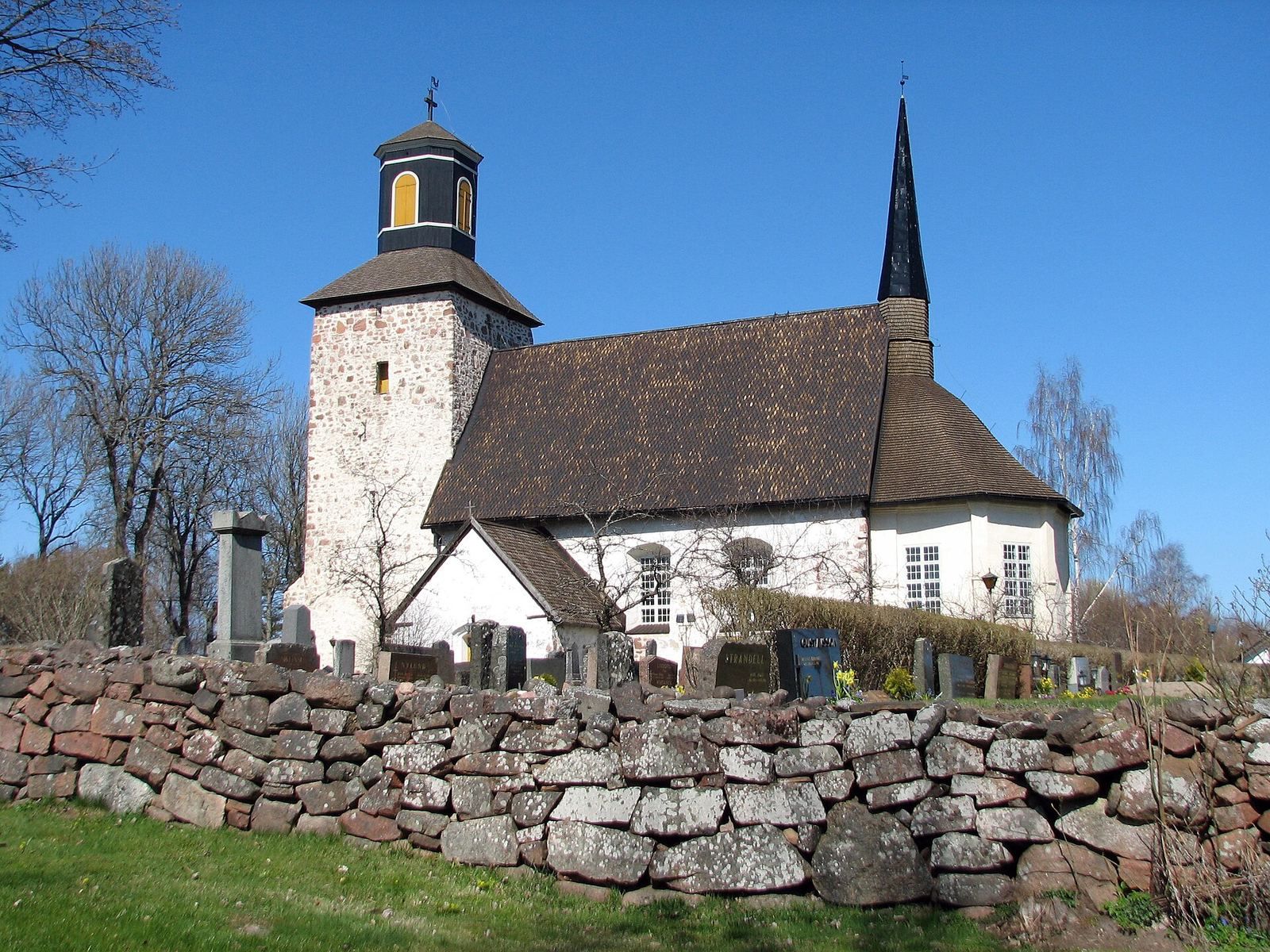
The church is built of locally quarried red rapakivi granite, a variety of granite. It stands beside an Iron Age burial ground near Norrby, close to a small harbour connected to Lumparn, Åland’s central lake. The nave, the main space of the church, measures 18.6 by 11.4 metres internally, and its walls are about one metre thick. It is the oldest part of the stone building, dating to the late 13th century; tree-ring analysis places some ceiling timbers in the same period.
A tower stands at the western end, added around 1317, while the sacristy, a room for clergy and church objects, dates to the first half of the 14th century. The southern porch, attributed to the early 14th century and dated to 1318, serves as the main entrance and is among the region’s earliest. A smaller doorway lies beneath the tower. At the eastern end, the present choir has a many-sided plan and a roof turret with a weather vane dated 1679.
Churchyard and archaeological remains
Church stable
A historic stable stands south of the enclosed churchyard. It sheltered the horses of people attending services.
Wooden predecessor and excavated finds
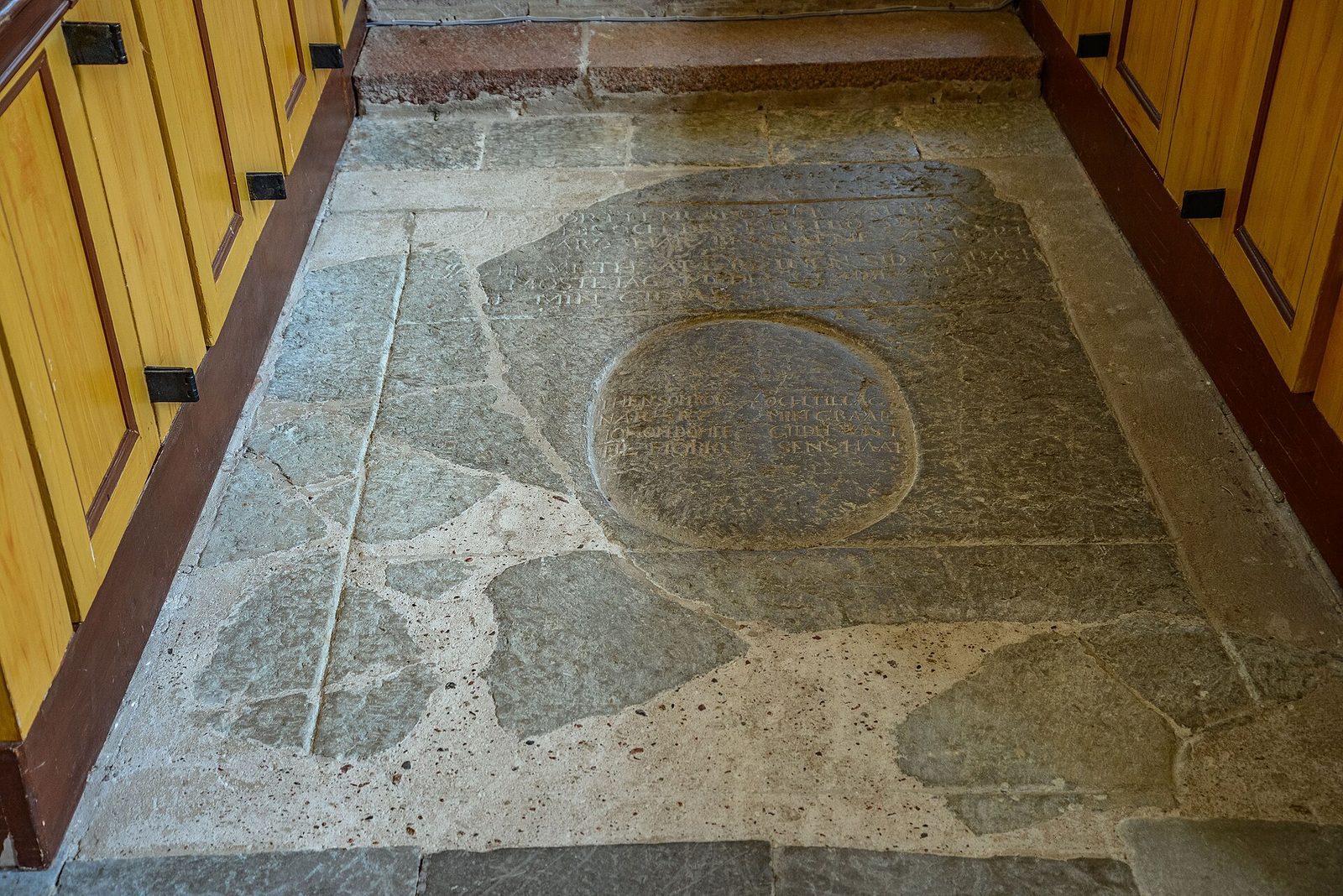
The foundation of the earlier wooden church extends partly beneath the present building. Finds from the porch include a grave slab from the first half of the 12th century, fragments of glass from the original altar window, and pieces of two baptismal fonts.
Wall paintings and consecration marks
Painted scenes
The oldest wall paintings date from the 1290s, with some assigned to around 1300. Much of the decoration was lost when large windows were opened in the north and south walls and the choir was rebuilt. The largest surviving painted areas are on the north wall. In the eastern part of the nave, which originally served as the choir, the paintings formed three horizontal bands divided by ornamental friezes. The upper band begins with the Last Supper on the north wall and continues on the original east wall with scenes of Jesus being scourged, the Crucifixion, and his encounter with Mary Magdalene after his death.
The middle band begins with scenes from Saint Nicholas’s life and miracles. Much of its continuation on the original east wall was destroyed when an opening into the present choir was made in the 18th century. South of the original choir window, the Nicholas scenes were probably followed by a sequence on the martyrdom of Saint Catherine of Alexandria, a Christian saint venerated as a martyr; part of it survives on the south wall. Faint traces of the lowest band remain.
Apostles and consecration crosses
In the western nave, figures of apostles, Jesus’ early followers, were painted in red on white plaster beside consecration crosses, marks associated with the ritual dedication of a church or its walls. Andrew can be identified by his X-shaped cross, and he and John are shown larger than life. Five consecration crosses remain visible and date to around 1280.
Altarpieces and crucifixes
A mid-15th-century altar retable, an ornamental structure behind or above an altar, is displayed on the north wall. Its crowning piece, dated 1662, is now in the tower hall. A separate altar painting by the 19th-century court painter Robert Wilhelm Ekman dates to the 1870s.
A large triumph crucifix, a cross placed at the entrance to the choir, comes from the Cologne region and dates to the mid-14th century. It stands at the second vault arch in front of the choir arch. Another mid-14th-century altar crucifix, possibly made on Gotland, is kept in the baptismal niche.
Sculptures and church furnishings
Carved figures
A wooden sculpture of the enthroned Madonna and Child, dating to about 1320, is set on the northeast wall and is regarded as among Finland’s finest wooden sculptures. Other carved figures include Saint Nicholas in the west window, the apostle James, and a 15th-century Saint Birgitta, possibly made on Gotland, in an old window niche in the south wall.
Ships, pulpit, and baptismal font
The votive ship at the front of the church dates to the 17th century; a second, at the rear, dates to 1844. Votive ships are model vessels offered as religious dedications. The pulpit is from the 19th century, and its hourglass dates to the mid-19th century. A baptismal font in medieval style was made in 1958.
Organs
The church’s first organ, built by Frans Anderson in 1866, was transferred to Sottunga Church in 1957, later sold to that parish, and remains in use there. A Veikko Virtanen organ was installed in 1960 and eventually replaced by a digital Johannus organ, now at Lumparland Church. The present organ was completed in 2009 by the German builder H. O. Paschen in a French Romantic-symphonic style, with tonal design and tuning involving H. Gripentrog and K. Mäkinen.