Leeds Minster: The Historic Parish Church of Leeds
Site at a Glance
- Rating
- 4.7
- Popularity
- High
- Country
- United Kingdom
- Primary era
- Modern
- Eras represented
- Medieval, Modern
- Civilizations
- Anglo-Saxon, British
- Site type
- Religious
- Remains
- Church
On this page18 sections
History
Leeds Minster is a Church of England church dedicated to St Peter, one of Jesus’s apostles, in Leeds, United Kingdom. Its present building was erected in 1839–1841 in a Gothic Revival interpretation of late-fourteenth-century English Gothic. A church is recorded at the site by the seventh century, and the nineteenth-century replacement was England’s largest new church built since St Paul’s Cathedral, consecrated in 1707.
Early church and medieval parish
A church at Leeds, with land and a priest, appears in the Domesday Book of 1086. The building was enlarged and rebuilt over the centuries, including after a fire in the fourteenth century. The parish’s early religious administration was connected to the Benedictine Priory of the Holy Trinity in York, a religious house of the Benedictine order. When the priory was founded in 1089, the Norman landholder Ralph Paynel gave it the right to appoint Leeds’s priest and collect tithes, payments used to support the church.
Following the English Reformation, the right to appoint the priest passed between different owners. In 1588, parishioners purchased that right and entrusted it to the people of Leeds.
A large parish and its division
Leeds parish covered about 21,000 acres and included the outlying townships of Allerton, Armley, Beeston, Bramley, Farnley, Gipton, Headingley, Holbeck, Hunslet and Wortley. Adel and Whitkirk were separate parishes. Chapels of ease, built to shorten parishioners’ journeys to church, were established in several townships. Bramley’s chapel, founded by monks from Kirkstall Abbey, may have come first; Farnley’s followed around 1240, then Beeston’s in 1597 and Headingley’s in 1616. Chapels at Armley and Wortley were established in 1649.
St John’s Church on New Briggate, founded in 1634, and Holy Trinity Church on Boar Lane, founded in 1727, served the parish alongside the parish church. A proposal to divide the parish in 1650 was not carried out. St Mark’s Church in Woodhouse received its own parish district in 1826, followed by St Stephen’s Church in Kirkstall in 1829.
Further subdivisions followed legislation in the 1840s. The Spiritual Care of Populous Parishes Act 1843 was followed by new parishes at St Andrew’s in 1845, St Philip’s in 1847, Holy Trinity, Meanwood, in 1849, All Saints and St John’s, Little Holbeck, in 1850, St Matthew’s, Little London, in 1851, and St Jude’s, Hunslet, in 1853. Four more followed in 1854: St John’s, Wortley; St Michael’s, Buslingthorpe; St Matthias’s, Burley; and St Barnabas, Little Holbeck. Walter Hook’s Leeds Vicarage Act 1844 led to new parishes at St John’s Church, Briggate, in 1845, St Saviour’s in 1846, St Mary’s, Hunslet, in 1847, and St Michael’s, Farnley, in 1851. Many Commissioners’ Churches, part of nineteenth-century church-building efforts organized through the Church Building Commission, were also built in the parish.
Rebuilding in the nineteenth century
By the early nineteenth century, the existing church had deteriorated, while Leeds’s congregation grew during industrialisation. A rebuilding plan approved in November 1837 proposed moving the tower from the crossing, where the church’s main arms meet, widening the chancel to match the nave, and raising the north aisle roof. Once work began, the old structure proved unsafe, and a complete replacement was chosen.
Walter Farquhar Hook, vicar of Leeds from 1837 until his appointment as Dean of Chichester in 1859, directed the project and helped reinvigorate Anglican church life across Leeds. Designed by Robert Dennis Chantrell, the new church was built from 1839 to 1841 with voluntary contributions from townspeople and cost more than £29,000. It was consecrated on 2 September 1841.
Minster title and later status
The church’s eastern end was altered between 1870 and 1880. On 2 September 2012, the 171st anniversary of its consecration, the former Leeds Parish Church received the title Leeds Minster. “Minster” is an honorific used for certain historically important churches; it does not mean that the building is a cathedral. The church is a Grade I listed building, England’s highest listed-building category, and is associated with the Greater Churches Group and the Major Churches Network. Since the Diocese of Leeds was formed in 2014 from the dioceses of Ripon and Leeds, Bradford, and Wakefield, St Peter’s has been considered as a possible pro-cathedral, a church designated to serve provisionally as a diocesan cathedral, subject to a decision by the diocesan bishop.
Remains
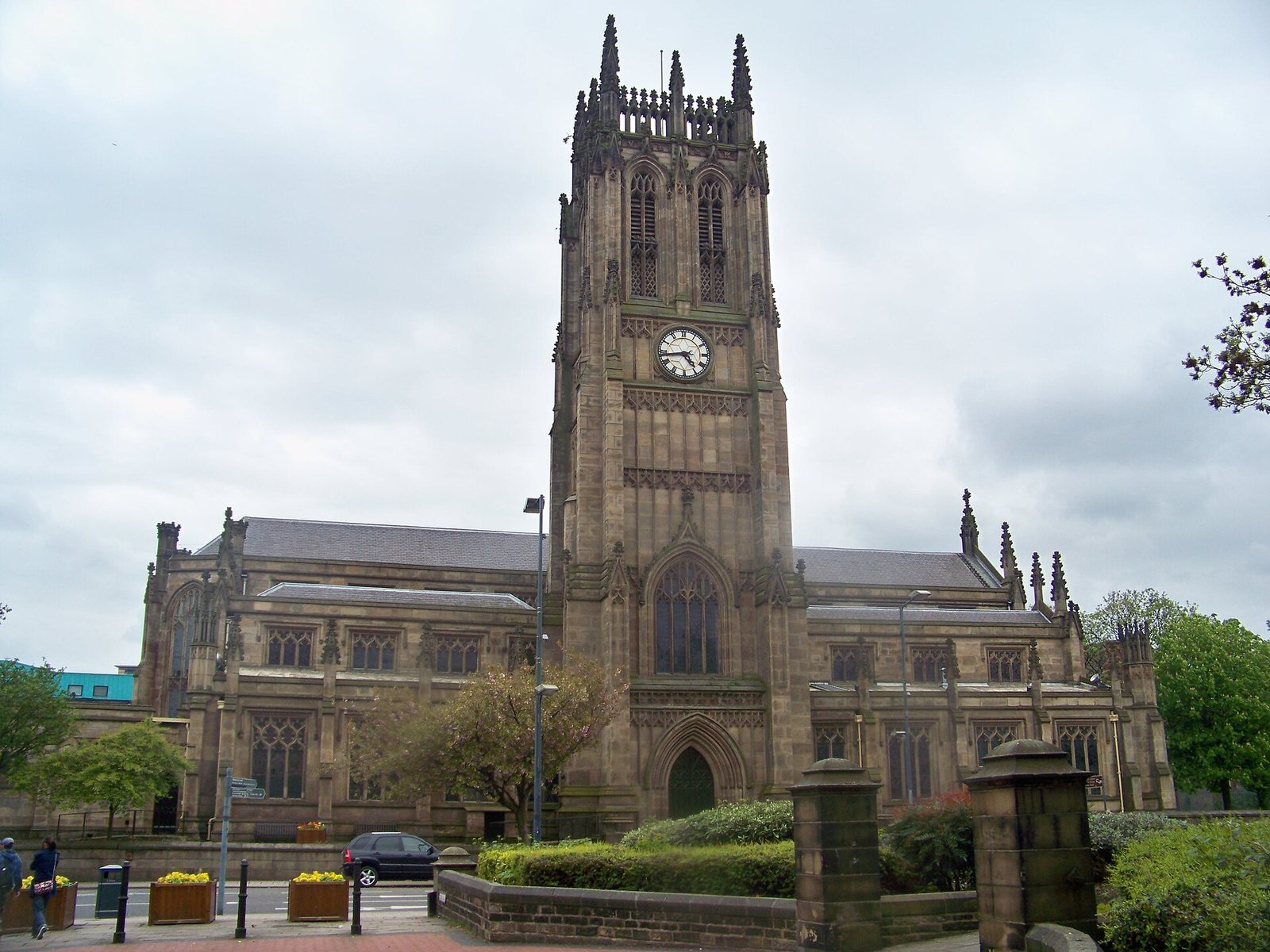
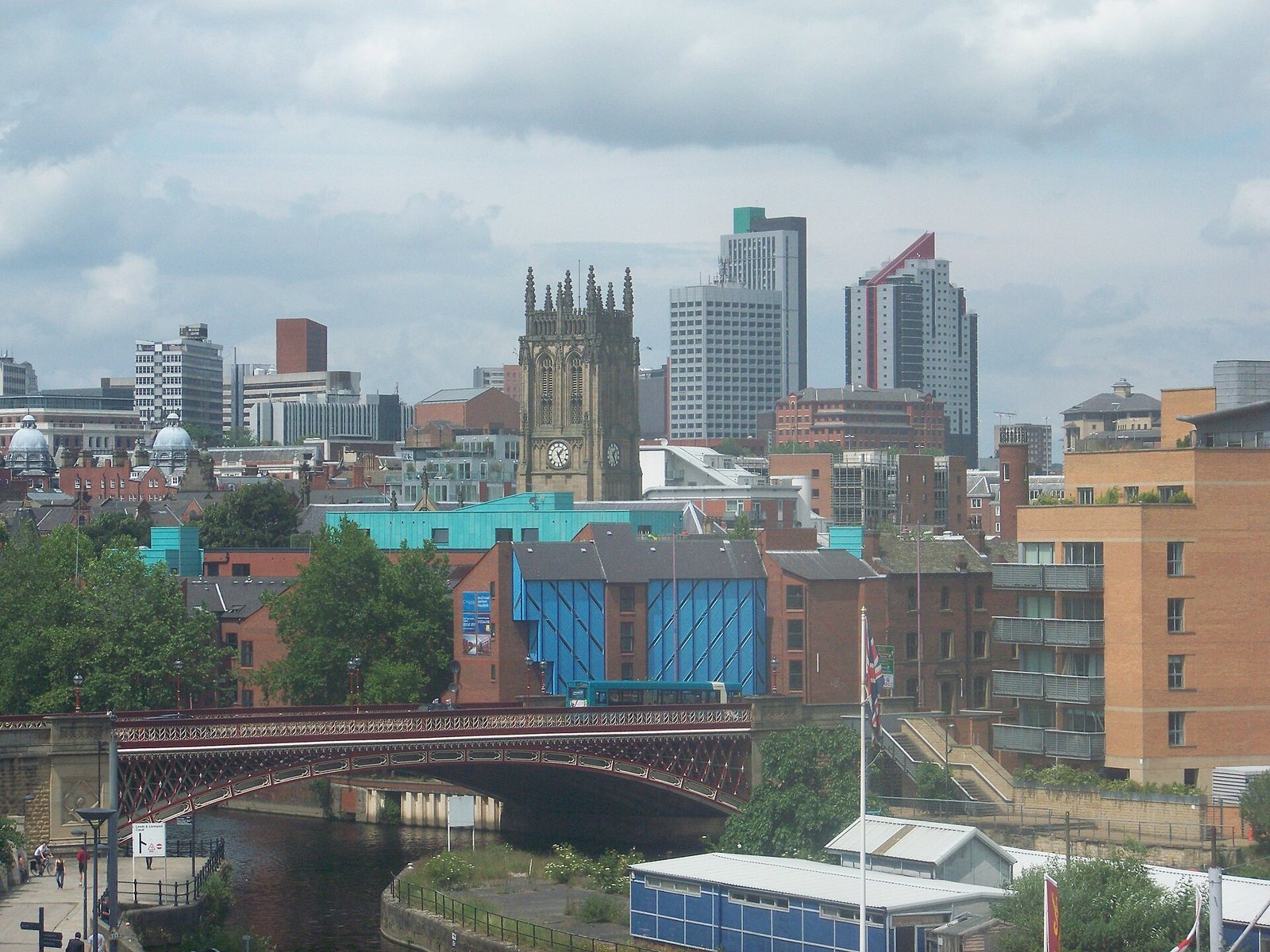
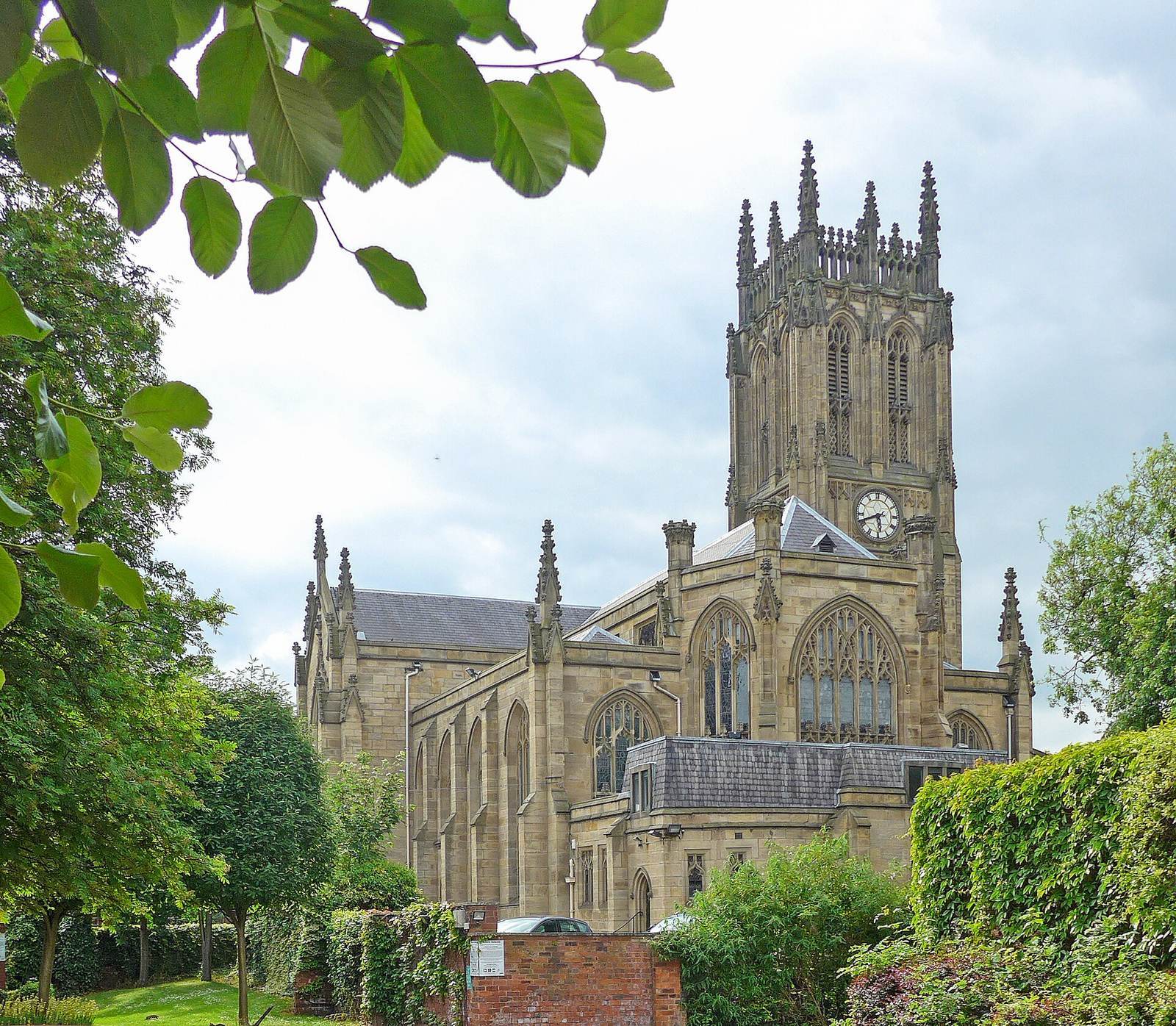
The Minster stands near the River Aire at the eastern edge of Leeds city centre. Its precinct has Kirkgate to the north and The Calls to the south; High Court Ings connects its western side with High Court. The cross-shaped church is built of ashlar, finely dressed stone blocks laid in regular courses, and has slate roofs. It measures 55 metres long and 26 metres wide, and its tower reaches 42 metres.
Plan and interior
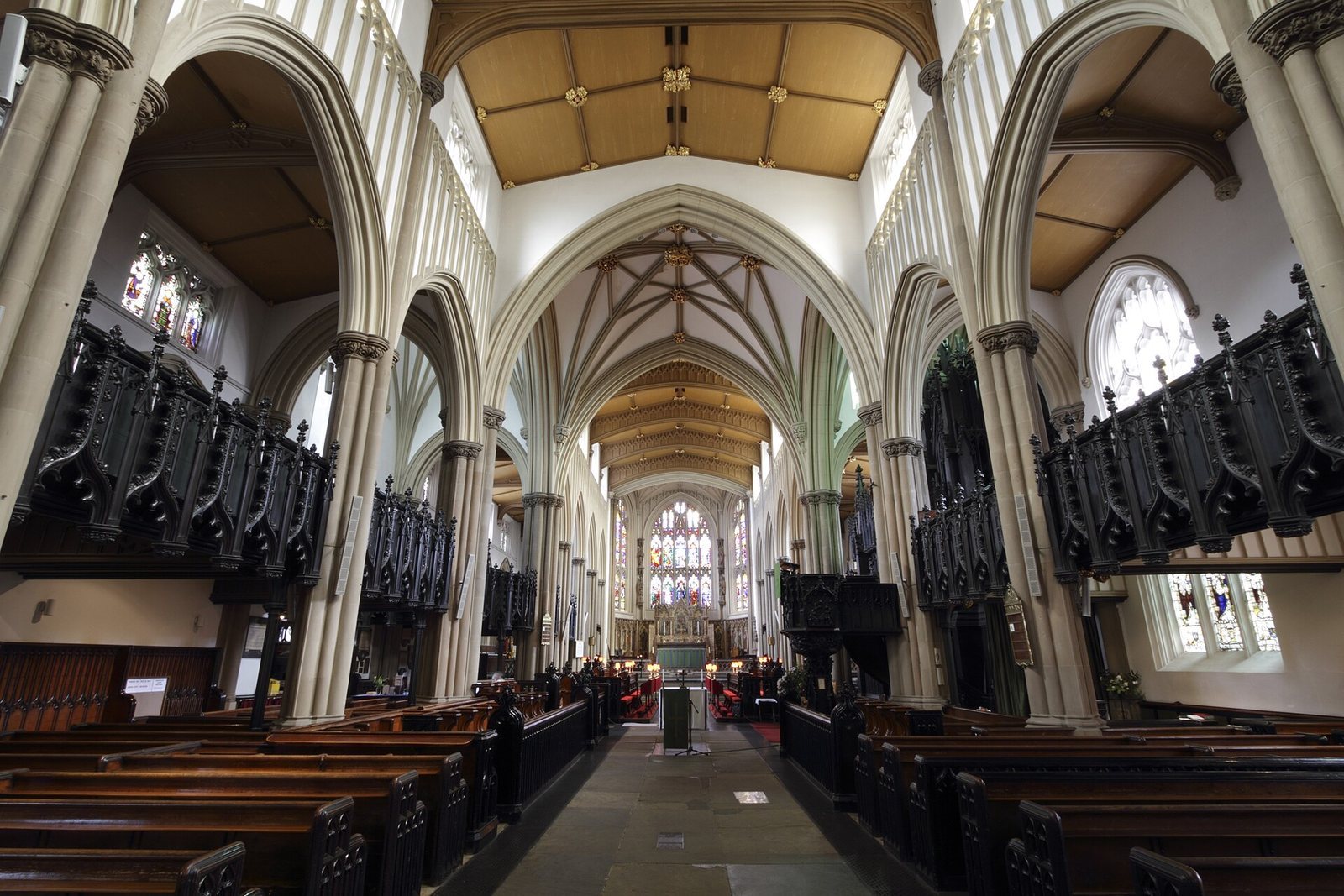
The nave and chancel each have four structural bays, or divisions marked by supports, and both are flanked by tall aisles. Each has three aisles and wooden galleries set above the openings between the main supports. At the east end, a polygonal apse, the church’s end section, has a single aisle. A short cross-arm extends from the main body of the church. The ceilings are wooden except above the crossing, which is vaulted. The building has capacity for more than 1,600 people.
Tower and entrances
The tower stands at the centre of the north aisle, on the northern arm of the cross-shaped plan, and the main entrance lies beneath it. Its four unequal levels have panelled sides and projecting supports at the corners. Above them are small turrets with hooked ornament, openwork battlements and pointed pinnacles. The tower clock was made by Potts of Leeds.
Windows and sanctuary
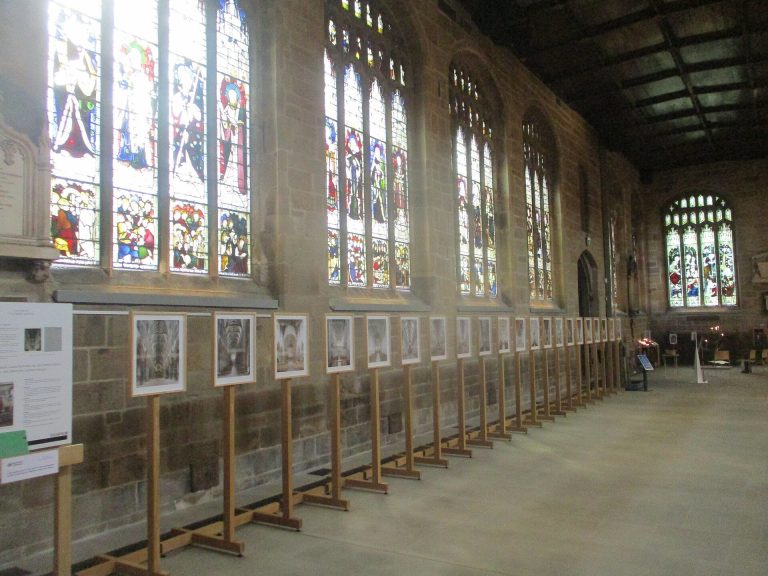
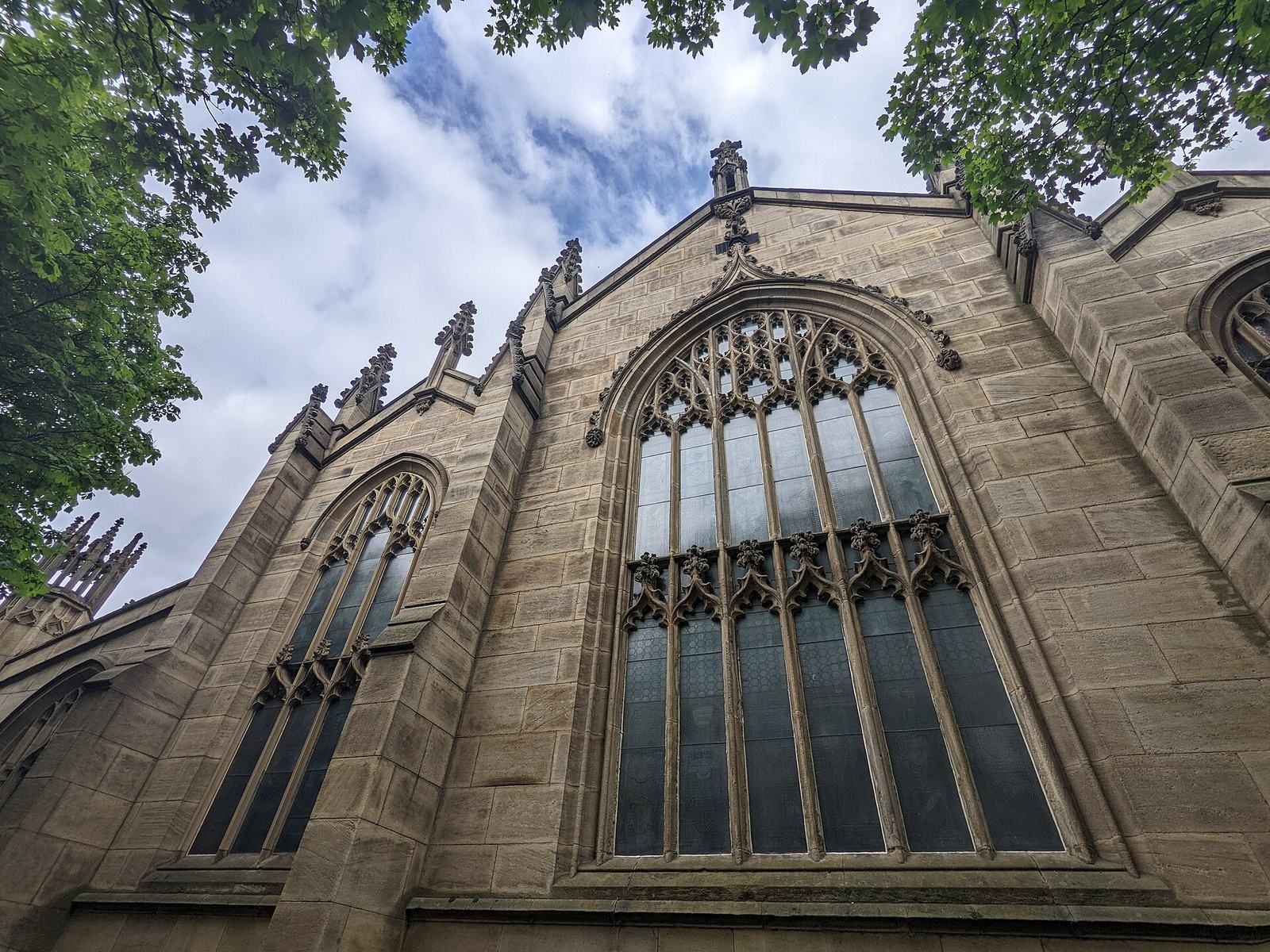
The windows have Perpendicular tracery, the ornamental stone framework characteristic of that phase of English Gothic architecture. The five-light east window dates to 1846 and contains glass collected on the continent. Flemish stained glass fills the apse windows, which Chantrell designed to fit the glass. In the sanctuary, mosaics made by Salviati of Venice decorate a marble arcade. Behind the altar is a reredos, an ornamental panel, made of coloured marble and alabaster by George Edmund Street.
Early carved stone
During the 1838 demolition of the medieval church, fragments of elaborately carved tenth-century stone crosses were found within its masonry. Their Anglo-Scandinavian character reflects cultural traditions shaped by contact between Anglo-Saxon and Scandinavian peoples in early medieval England. The Leeds Cross, an Anglian cross, is positioned south of the marble floor known as the altar flat.
Bells and organ
Bells
A set of 13 bells was cast by Mears in 1842 and recast by John Taylor of Loughborough in 1932. The tenor bell weighs 40 long hundredweight, one quarter and 27 pounds, equivalent to about 2,057 kilograms.
Organ
The organ includes pipes by Edmund Schulze, as well as parts dating from 1841 or earlier, and is essentially an instrument by Harrison and Harrison. It has 83 stops, which select groups of pipes, across four hand-played keyboards and a foot-operated pedal. Electrical controls and pneumatic mechanisms operate the pipes. A high-pressure stop called the Jubilee Trumpet was added in 2002.
Memorials and burial ground
Church memorials
The church contains a memorial to Christopher Beckett and architectural sculpture, most of it made by Robert Mawer. Further memorials commemorate the Kitchingman, Fenton, Lodge, Milner, Cookson and Ibbetson families.
Angel Screen
Sally Scott’s Angel Screen, a work of contemporary glass engraving, was installed at the north-tower porch entrance in 1997. The family of Lord Marshall of Leeds gave it to the church.
Leeds Rifles War Memorial
Designed by Sir Edwin Lutyens, the Leeds Rifles War Memorial stands in the churchyard facing Kirkgate. It was unveiled on 13 November 1921.
Former burial ground
The parish burial ground lay across Kirkgate from the church and closed to burials in the 1830s. The site later became Penny Pocket Park.