Funbo Church: A Romanesque Parish Church in Sweden
Site at a Glance
- Country
- Sweden
- Primary era
- Medieval
- Eras represented
- Medieval, Early Modern, Modern
- Civilizations
- Swedish
- Site type
- Religious
- Remains
- Church
On this page18 sections
History
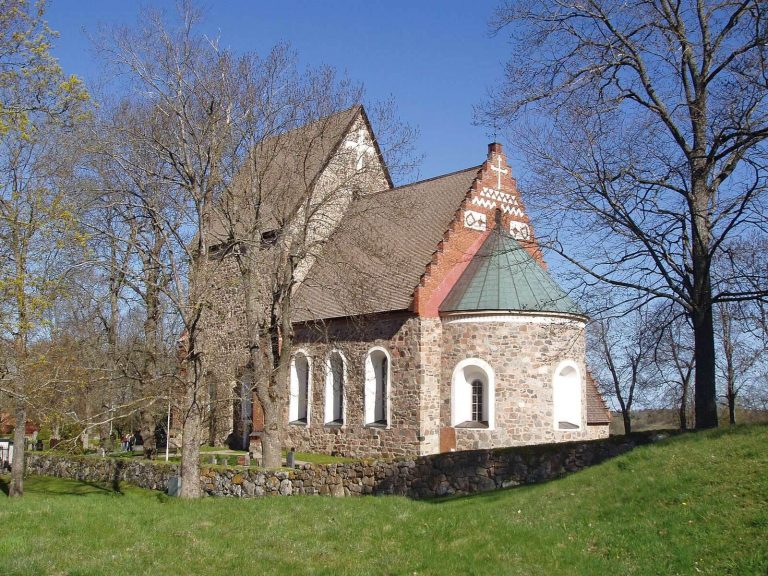
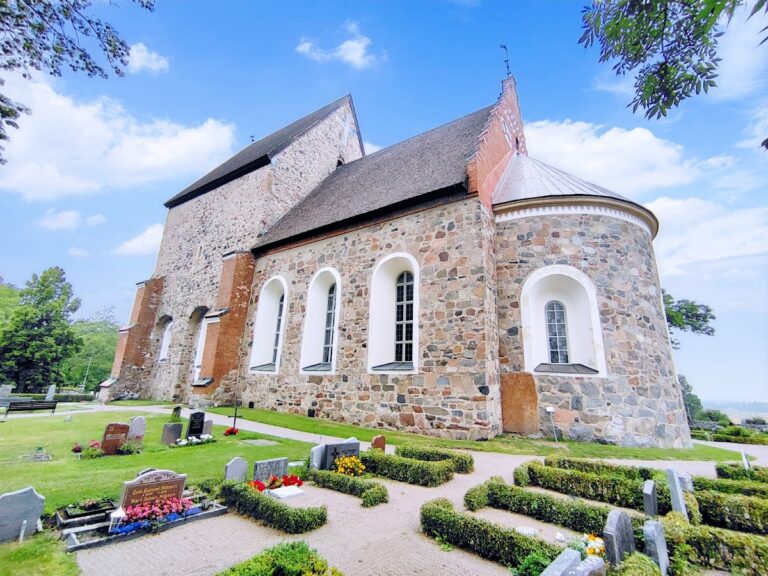
Funbo Church is a stone parish church in Funbo, east of Uppsala, Sweden, built around 1200 in the Romanesque style. Romanesque churches commonly use rounded arches and substantial masonry. Construction may have begun in the late 12th century, while the church’s original consecration took place in either the 12th or 13th century. It began as a Roman Catholic church and now serves as an active parish church of the Evangelical Lutheran Church of Sweden, within Danmark-Funbo parish in the Archdiocese of Uppsala.
Foundation and medieval rebuilding
The church was probably enlarged around the turn of the 14th century. It was rebuilt in the Gothic style, associated with pointed arches and ribbed vaults, and its main altar was consecrated again on 5 December 1301. An indulgence letter, which granted a remission of temporal punishment for sin, issued by Archbishop Nils Allesson, Uppsala’s senior bishop, gives that date.
Further building and interior work took place during the 15th century. The church’s ceiling was altered and painted during this period, as described in the account of its surviving features below.
Later changes and parish life
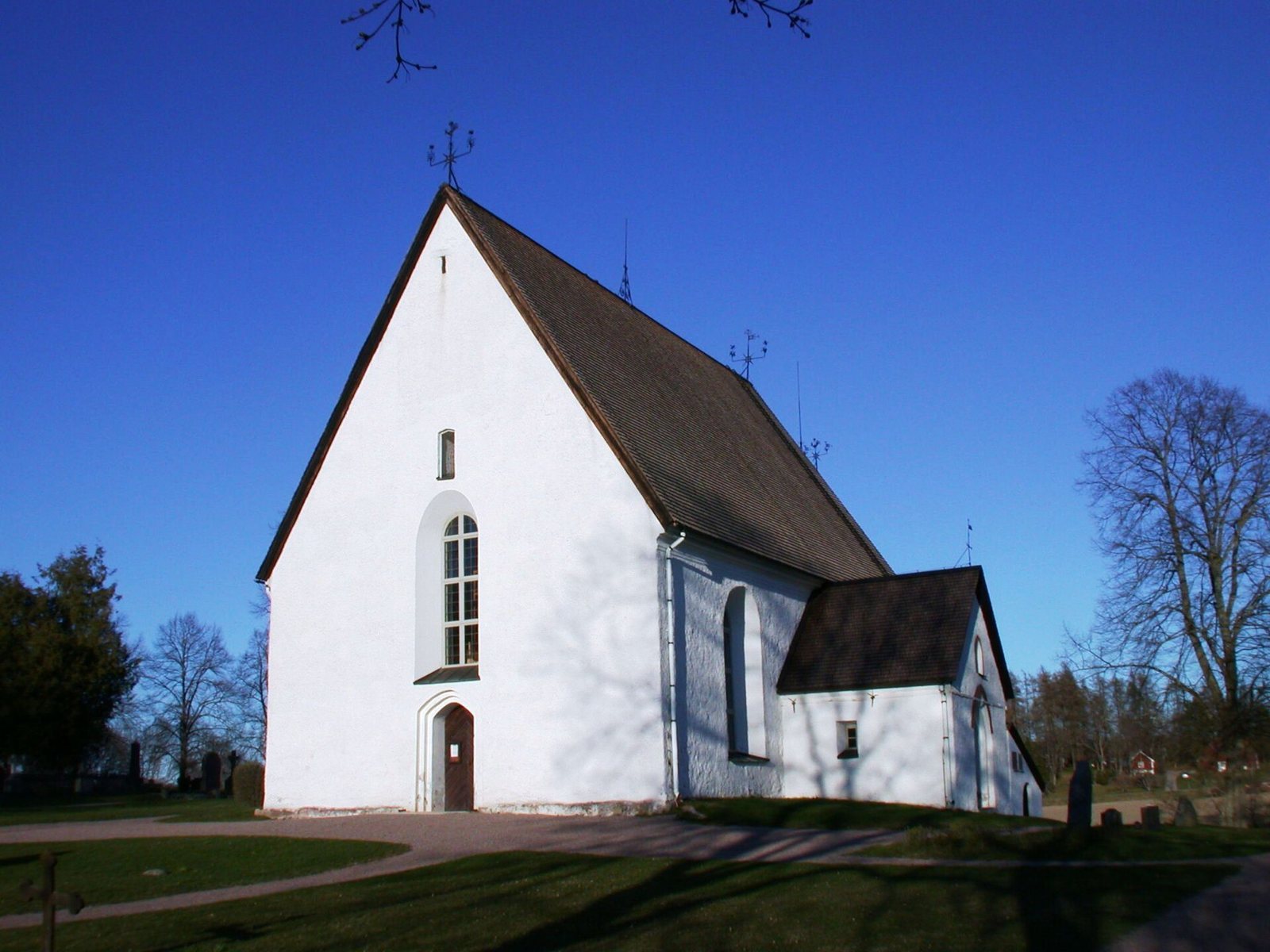
A porch served as the main entrance until a doorway was made in the west gable in 1745. In 1762, whitewash covered the church’s paintings, and two years later the arch between the nave and choir was raised.
From 1833 to 1841, parish priest Johan Dillner promoted church music and singing. He purchased musical instruments for the church and established one of Sweden’s earliest church choirs.
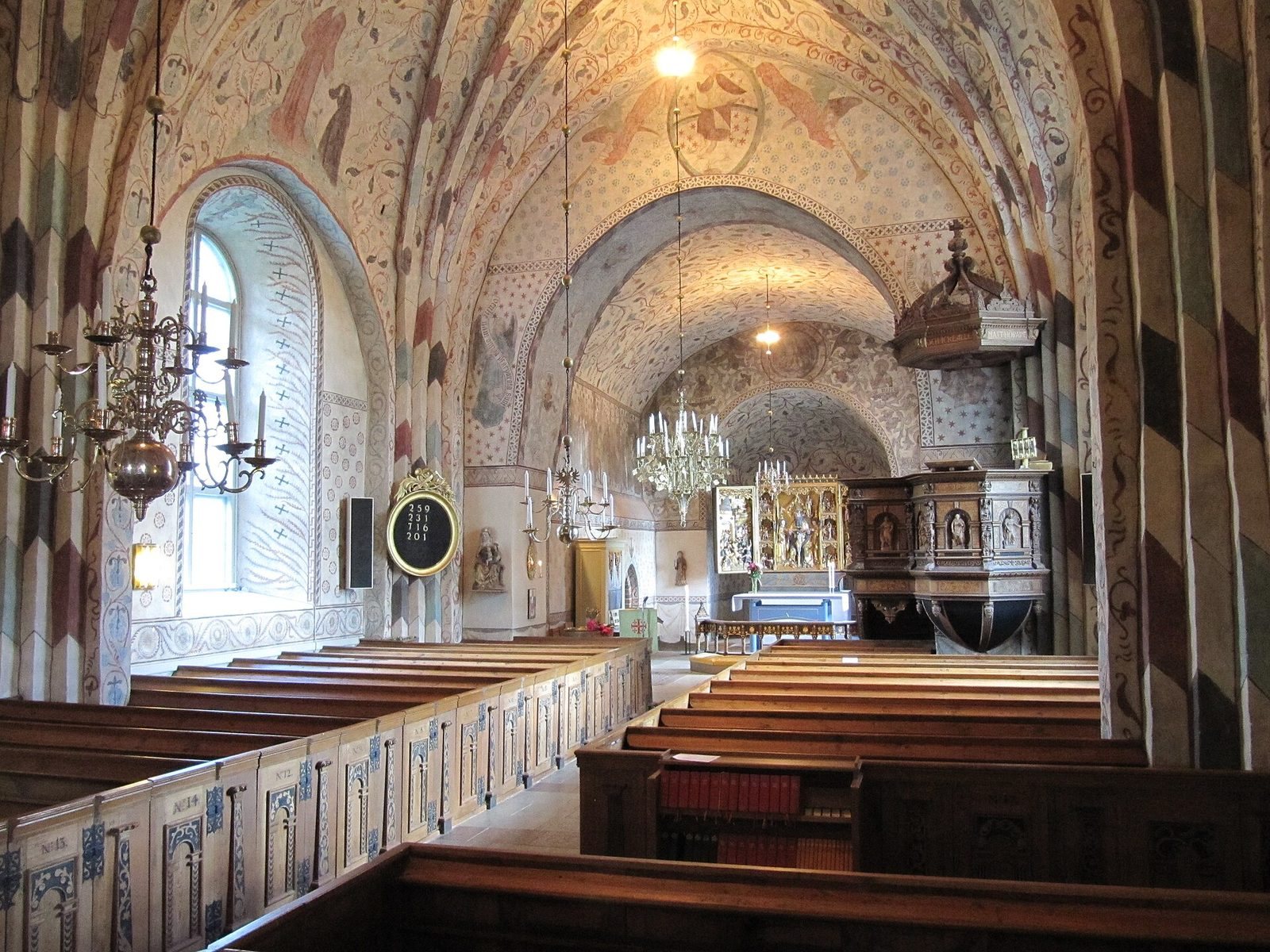
The paintings were uncovered in 1896 and extensively restored, with substantial repainting. The pulpit was restored that year by the church cantor. A further restoration in 2004 cleaned the vaults and walls, conserved paintings and chandeliers, renewed floors in the choir, apse and pew areas, installed a table altar, and added plumbing to the sacristy.
Remains
The church stands in a valley west of the Funbo River. Its plan brings together a rectangular nave, the main body of the church, a narrower choir around the altar, and an apse, a recess at the end of the building. Stone construction and Romanesque forms shape the original structure, with later additions and interior changes visible across the church and its grounds.
Building and grounds
Main church
The nave was probably lengthened during rebuilding around 1300. A sacristy, a room for preparing and storing items used in services, was added on its north side in the early 15th century. A porch was built on the south side during the same period. The west-gable entrance, added in 1745, provides another way into the church alongside the porch.
Bell tower and interior
A freestanding bell tower dates from 1675. The arch connecting the nave and choir was raised in 1764. The choir has a stone floor, while the apse and the areas beneath the pews have wooden floors renewed during the 2004 restoration.
Vaults and paintings
Brick vaults replaced an earlier wooden barrel vault, a continuous arched ceiling, in the 1440s. Paintings were made as part of this work and are thought to be by the same artist or workshop that decorated Rasbo Church around that time. They belong to the Mälardal School, a tradition of church painting associated with the Lake Mälaren region. The paintings cover the church’s ceiling vaults.
Furnishings
Sculptures and baptismal font
The church’s sculptures include a 13th-century image of Mary, altered in the 15th century, and a figure of St Lawrence dressed as a deacon. Other medieval works include a 15th-century group of St Anne with the Virgin and Child, a barefoot apostle, and figures of St Eric and St Olaf that once belonged to an altarpiece. St Lawrence was an early Christian deacon and martyr, St Anne is traditionally regarded as Mary’s mother, and St Eric and St Olaf are associated with Sweden and Norway respectively. The baptismal font, the basin used for baptism, dates from the 13th century.
Altarpiece
An oak altarpiece made in northern Germany around 1500 contains 134 figures. Its central image, the Throne of Mercy, shows God the Father supporting the crucified Christ. Other panels depict episodes from Christ’s Passion, while the doors show St Catherine, St Margaret, St Dorothy and St Barbara.
Chandeliers and pulpit
A late-15th-century chandelier bears an image of the Virgin Mary on its central stem. Another chandelier, made of yellow metal, was brought back as war booty by Colonel Mauritz Duwall of Hallkved after the Thirty Years’ War, the European conflict fought from 1618 to 1648. The church’s pulpit was commissioned by Colonel Jakob Forbes.
Musical instruments and organs
The church has two kettledrums, trumpets and a psalmodikon, a simple instrument used to accompany singing. Its organs trace a succession of instruments: Niclas Söderström of Husby built a seven-stop organ in 1781, followed by a six-stop instrument from Åkerman & Lund of Stockholm in 1870. Furtwängler & Hammer of Hannover built a 15-stop organ in 1925, with two manuals, or hand keyboards, and a pedal, the foot-operated keyboard. The present organ was built in 1961 by Gebrüder Jehmlich of Dresden. It has a mechanical action, slider chests that direct wind to pipes, and a 54/30 compass, giving the note ranges for its manuals and pedal.
Churchyard inscriptions
Runestone U 987 stands in the churchyard. A runic grave slab, a burial stone inscribed with runes, is fixed to the west wall of the porch and is identified as U 989.
Other parish buildings
Klockarbol and barn
Klockarbol was built in 1828 as the parish clerk’s residence and is now used for children’s activities. Its former barn is a separate building that now houses a local heritage museum.
School
The church school, built in 1876, remains in use for grades 1–3.
Parish hall and center
The parish hall dates from 1776 and served as a poorhouse until 1916. A parish center was added in 1994.