Kungsholmen Church: A Baroque Lutheran Church in Stockholm
Site at a Glance
- Country
- Sweden
- Primary era
- Early Modern
- Eras represented
- Early Modern, Modern
- Civilizations
- Swedish
- Site type
- Religious
- Remains
- Church
On this page18 sections
History
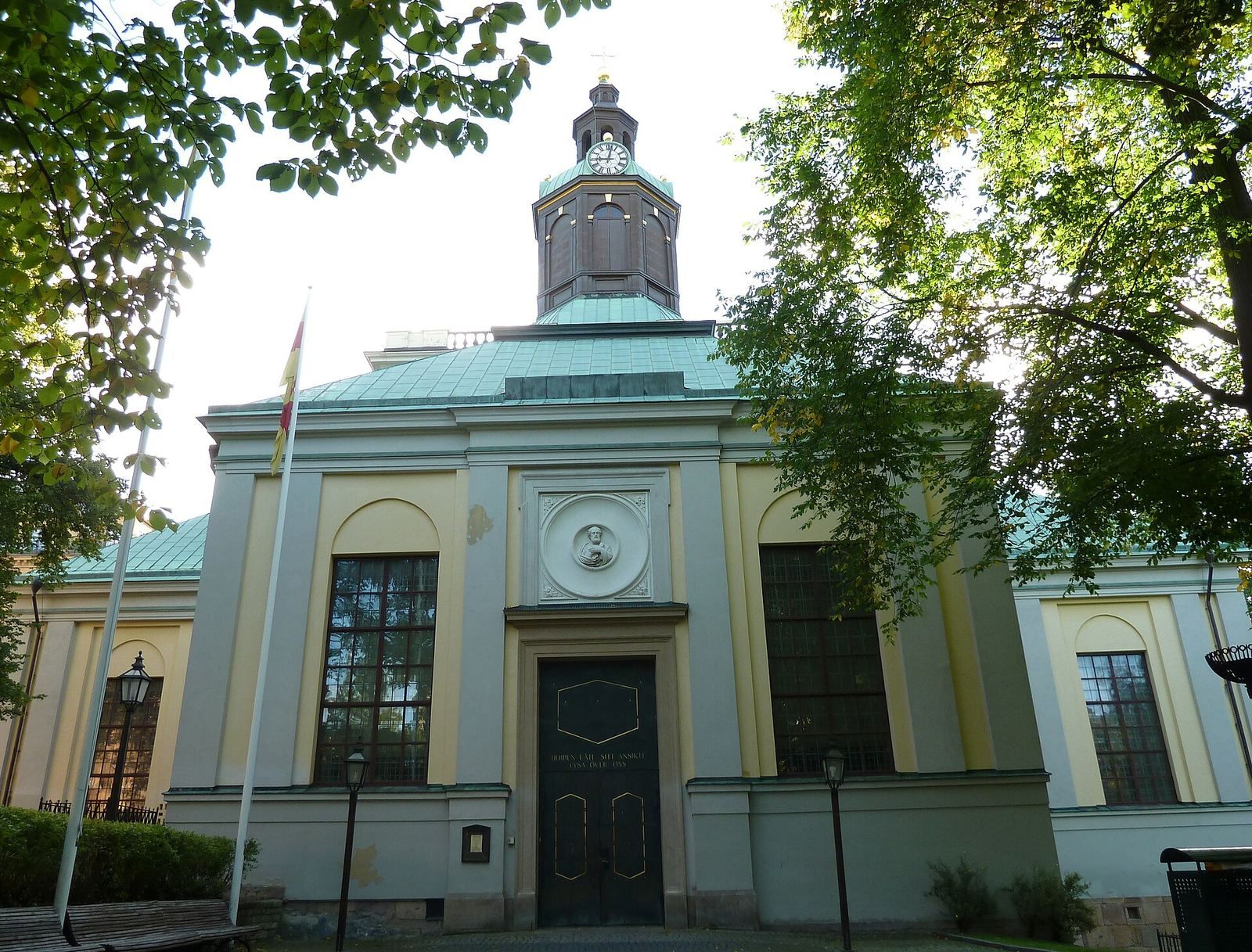
Kungsholmen Church, officially Ulrika Eleonora Church, is a Baroque Lutheran church in Stockholm, Sweden, begun in 1672 for the newly established Kungsholm parish. It belongs to the Church of Sweden and serves Västermalm Parish in the Diocese of Stockholm.
Foundation and consecration
The district had previously formed part of St Clare Parish. Permission to build a separate church was granted on 21 March 1671, the year Kungsholm parish was established. Until a permanent building could be used, worship took place in a small wooden structure that also provided living, workshop, and storage space.
Mathias Spieler began work in 1672. After King Charles XI, who ruled Sweden from 1660 to 1697, provided substantial financial support, the foundation was laid on 10 May 1673 under master mason Mårten Hack. Funding problems and disputes halted construction in 1676, and work did not resume until 1685. The temporary wooden church burned down in 1679.
Archbishop Olof Svebilius consecrated the church on 12 December 1688. Charles XI attended with Queen Ulrika Eleonora, his mother Queen Dowager Hedvig Eleonora, and the royal councillors. The building was still incomplete: its interior was unfinished, and work on the vaulting remained to be done.
Completion and church furnishings
Financial difficulties delayed completion of the vaulted ceiling until 1757. The earlier pulpit had a longer history: it was transferred from Stockholm Cathedral in 1702, after standing there since 1605, and was lost during alterations in 1819.
A small organ of unknown origin was acquired for the 1688 consecration. In 1696 the parish obtained an older instrument made in 1653 by Franz Boll for Riddarholm Church, but could not afford to install it. At organist Jacob Bergner’s initiative, both instruments were sold. The seven-stop small organ went to Husby-Långhundra Parish for 1,700 copper dalers; the other instrument’s pipes and timber brought 650 copper dalers.
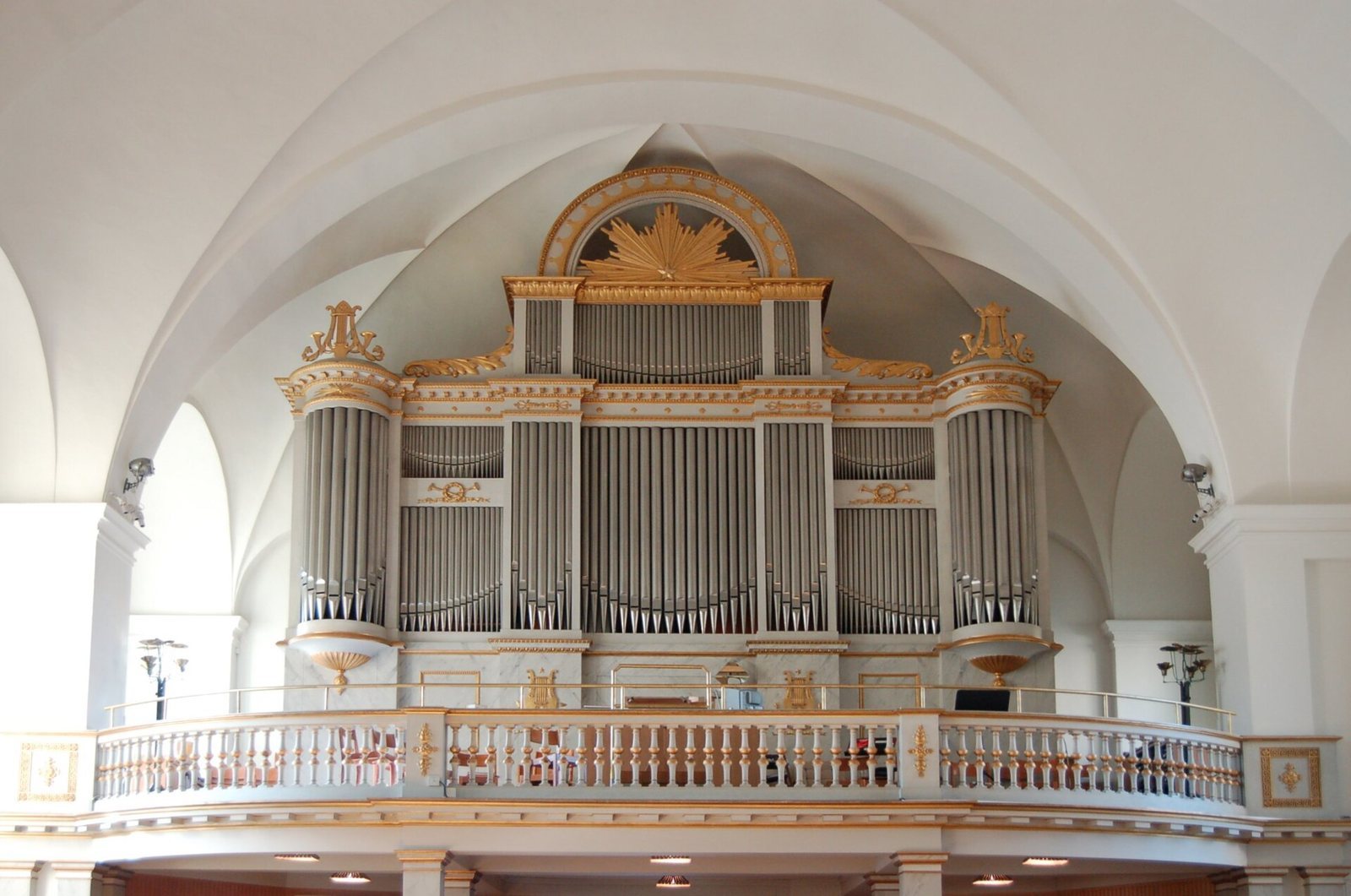
Jonas Gren and Petter Stråhle built a 10-stop organ in 1753. Pehr Zacharias Strand replaced it with a 32-stop instrument in 1831, and the earlier organ was sold to Hammars Church in Närke. In 1898, Åkerman & Lund built a 34-stop organ, the first in Stockholm to use pneumatic controls transmitted through tubes. Nils Hammarberg rebuilt and enlarged it in 1956, and that year also made a mechanical-action choir organ to designs by Professor Erik Lundberg.
Nineteenth-century changes
The present pulpit was made in 1820 to designs by Carl Christoffer Gjörwell and paid for by Sergeant Johan Carlgren. Its Empire style, an early nineteenth-century design approach influenced by classical forms, was the church’s first contribution in that style. Carlgren’s portrait is kept in the sacristy.
Gjörwell also prepared designs for the altar. Its painting of Christ’s Resurrection, by Fredric Westin, was installed on Easter Day 1823. Later changes included the erection of the church tower in 1810 and the construction of burial chapels, described below.
Restoration and later use
The church’s 23 original Carolean windows disappeared during restoration work in 1882. Carolean refers to a Swedish artistic and architectural period associated with Charles XI and Charles XII. The windows were rediscovered and reconstructed during major work in 1954–56, which aimed to restore the church’s Carolean character. Further major restorations followed in 1995–97 and 2017–18.
A memorial grove in the eastern part of the cemetery was dedicated on 7 October 1979.
Remains
The church’s surviving fabric has a Baroque design and a cruciform plan, with a single nave and a crosswise arm. Its interior, tower, entrance, and cemetery preserve features added across several centuries.
Church fabric and exterior
Plan and vaulted interior
The church’s cross-shaped layout is formed by one nave and a crosswise arm. The completed vaulted ceiling covers the interior, while the burial chapels occupy the southeastern corner of the crosswise arm.
Tower and entrance
Erected in 1810 to designs by Per Wilhelm Palmroth, the tower has a brick lower section decorated with pilasters, shallow projections resembling columns. An octagonal, copper-covered dome supports a lantern, a raised structure above the dome, where the large, middle, and priest’s bells hang. When the tower was finished, the older bell tower in the cemetery’s northwest corner, in place since the 1670s, was demolished. A stone staircase at the southern entrance was built between 1792 and 1794 to designs by Jean Eric Rehn.
Carolean windows
The church has 23 reconstructed Carolean windows, 20 of which cast golden-yellow light into the interior. Each design places a biblical passage, the donor’s name, and the year 1688 beneath a crown.
Burial chapels and cemetery
Lenman and Westin chapels
The Lenman burial chapel stands in the southeastern corner of the crosswise arm. Built in the late 1730s for Stockholm merchant Hans Lenman (1683–1739), it is associated with a gravestone and commemorates Lenman and his wife, Märta Kohl (1691–1734). The Westin chapel was added beside it in 1835 for tanner Johan Westin the Younger, son of politician Johan Westin the Elder. Jacob Westin the Elder and Jacob Westin the Younger were also buried there.
Cemetery graves and memorials
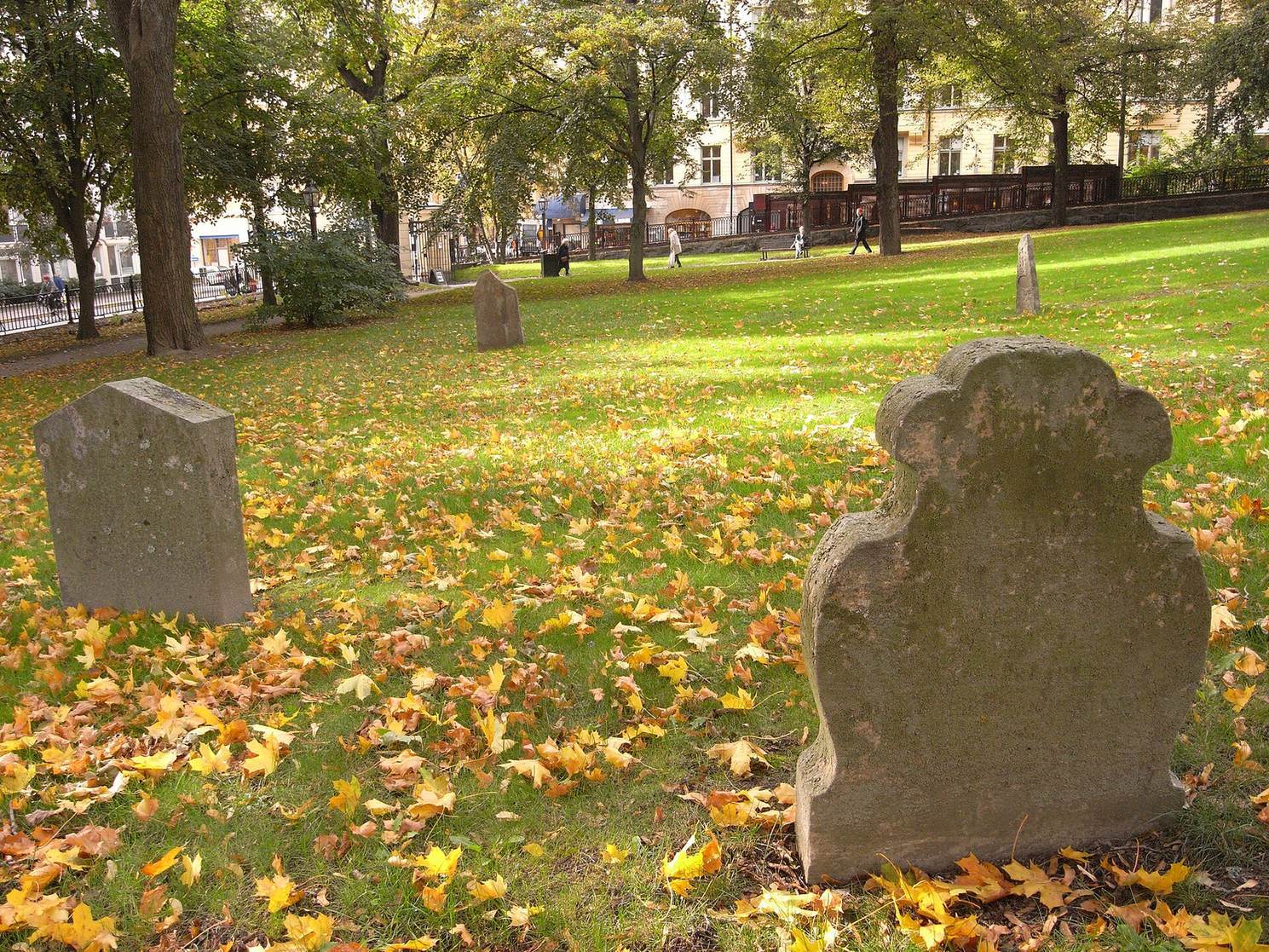
The cemetery contains the grave of poet Erik Sjöberg, who wrote under the name Vitalis, and those of parish priest T. Z. Fuchs (1772–1848) and his successor, field provost C. O. Gravallius (1785–1861). A field provost was a senior military chaplain. A grave monument commemorates tanner Johan Westin (1784–1834), and a memorial grove occupies the eastern part of the cemetery.
Interior furnishings and commemorations
Altar and pulpit
The altar’s central painting, Fredric Westin’s Resurrection of Christ, is regarded as a masterpiece. One of the angel heads at its top is said to portray Franz Michael Franzén’s daughter; Franzén reportedly exclaimed that the painting was a revelation when he first saw it. A tin crucifix by Ture Jerkman is also associated with the altar.
The 1820 pulpit, designed by Gjörwell, was funded by Sergeant Johan Carlgren. A Bible associated with Gustav II Adolf rests on it. Printed in 1618, the Bible has a gold-tooled leather cover with brass fittings and clasps. Master bookbinder Bengt Höök gave it to the church for its consecration.
Baptismal chapel and vessels
The baptismal chapel is in the northern arm of the church. Local master sculptor Caspar Schröder carved it, and Elsa Guthermuth presented it to the church in 1707. Its screen carries figures of the four authors traditionally associated with the Gospels, each with a symbol: Matthew with an angel, Mark with a lion, Luke with an ox, and John with an eagle. The font’s lid shows Christ surrounded by children.
A silver baptismal basin, decorated by hammering the metal from its reverse, was given by Emerentia von Düben in 1713. The church also has a silver baptismal bowl bearing a coat of arms and the initials M. P. S. M.
Organs
The main organ stands on the gallery in the western arm of the church. It is described as having 44 stops, which select the sounds available, across three manuals, or hand keyboards, and a pedal played with the feet. Its 1956 rebuilding had expanded it to 47 stops. The 1898 instrument had three manuals and a pedal, with Roosevelt-type windchests, the boxes that distribute air to organ pipes. In 1956, the windchests for the first and third manuals and the pedal were retained; the second manual received a round-bellows chest. The rebuilt organ used electro-pneumatic controls, combining air pressure with electrical assistance.
The separate choir organ has mechanical action, which links keys to valves, and slider chests that use sliding boards to control the pipes that sound.
Portrait, epitaph, and heraldic memorials
A portrait of Gustav II Adolf, painted by Jacob Elbfas and presented to the church in 1684, is regarded as one of the finest portraits of the king. An epitaph for Zacharias Halling (1659–1709), a memorial inscription, was made by court sculptor Caspar Schröder. Above one of the doors, a sun symbol surrounds JHWH, the four-letter divine name known as the Tetragrammaton.
Memorials in the sanctuary commemorate guild elders Johan Westin the Younger and Carl Sjöstedt. Guild elders were senior members or officers of craft guilds. Heraldic funeral memorials represent the Adlercrantz, Fleming, Gripenhjelm, Lichton, Reutercrantz, Stjernander, von Knorring, and Rehnskiöld families. Named individuals include Johan Adlercrantz (1651–1693), Baron Lars Fleming, who died in 1693, Claes Gripenhjelm, Robert Lichton (1631–1692), royal gamekeeper Hans Reutercrantz (1640–1695), Isaack Esbiörn Reutercrantz, and Baron Jöran Johan von Knorring (1657–1726). The inscribed arms of Count Gert Rehnskiöld of Gribenow and Balingsta (1679–1682) were also placed in the church.