Korela Fortress: A Medieval Frontier Fortress in Russia


Site at a Glance
- Rating
- 4.6
- Popularity
- Medium
- Country
- Russia
- Primary era
- Early Modern
- External website
- Open
- Eras represented
- Medieval, Early Modern
- Civilizations
- Novgorod Republic, Russian, Swedish
- Site type
- Military
- Remains
- Fort
On this page15 sections
History
Korela Fortress is a medieval and early modern fortress in Priozersk, Russia, first built by Karelians and developed by Novgorodians at the turn of the thirteenth and fourteenth centuries. It occupies islands in the Vuoksi River system and was established to protect the Novgorod Republic’s northwestern frontier against Sweden. The site is also known as Käkisalmi, its Finnish name, and Kexholm, its Swedish name.
Early fortification and Novgorodian rule
The island had been used before the medieval fortress was founded. Bronze buckles found there date from the sixth or seventh centuries, while radiocarbon-dated barley grains indicate human activity in the twelfth century. The earliest known fortification was a wooden structure built by the Karelians.
Korela stood beside a waterway linking Lake Saimaa, Lake Ladoga, and Vyborg Bay. Along with Vyborg and Tiurinlinna, it helped control movement through this route and protect it from threats approaching from different directions. A Novgorod chronicle mentions Korela in 1143, and a Swedish chronicle records the settlement of Käkisalmi in 1294.
Novgorodian authorities established the medieval fortress on an island at the end of the thirteenth or the beginning of the fourteenth century. Swedish forces led by Sigge Lake captured it in 1294 during the Third Baltic Crusade, a late-thirteenth-century campaign by Christian powers in the eastern Baltic. Novgorodian forces recovered the fortress in 1295 and returned in 1310, when they destroyed Käkisalmi and built a new fortress.
A small Karelian force briefly seized the fortress in 1314 and requested Swedish assistance against Novgorod. Novgorod soon retook it and punished the rebels. The Treaty of Nöteborg in 1323 confirmed Korela as a Novgorodian possession. Although Sweden attempted to capture it in 1322 and 1348, Korela remained under the Novgorod Republic for nearly three centuries.
During the 1330s, Novgorod transferred Korela and other regional fortresses to the Lithuanian duke Narimantas. A Karelian revolt against his rule took place in 1337. A major fire almost completely destroyed the fortress in 1360, and Novgorod rebuilt it in stone in 1364. In 1383, Korela passed to Patrikas, Narimantas’s son. Complaints from local townsmen about his administration led to an exchange in 1384, when Patrikas surrendered Korela in return for Ladoga and Rusa.
Sweden briefly regained the fortress in 1411, but much of the fifteenth and sixteenth centuries was comparatively peaceful. Korela’s position nevertheless continued to make it a contested stronghold on the frontier between Swedish and Russian spheres.
Swedish conquest and the Livonian War
The Livonian War, a sixteenth-century conflict over control of the eastern Baltic, brought renewed fighting to Korela. In 1573, the Finnish warlord Herman Fleming attacked the fortress and burned three monasteries around it. Sweden captured the deteriorated stronghold in 1580 and rebuilt it.
In early November 1580, a Swedish-Finnish army commanded by Pontus De la Gardie attacked Käkisalmi from several directions. Artillery positioned near Tenkalahti bombarded the fortress and town with heated shot, causing fires. The Treaty of Teusina in 1595 required Sweden to return Korela to Russia, and the transfer took place in 1597.
The siege of 1610 to 1611
Swedish control returned during the conflict that began in 1610 and was confirmed by the Treaty of Stolbovo in 1617, when the fortress became part of the Swedish County of Kexholm. The change followed a prolonged siege during the Time of Troubles, a period of political crisis and dynastic conflict in Russia that began in the early seventeenth century.
In February 1609, Tsar Vasily Shuisky promised Korela and its district to the Swedish commander Jacob De la Gardie in exchange for Swedish troops and mercenaries to help suppress the crisis. Local inhabitants rejected the agreement. After Shuisky was overthrown in 1610, De la Gardie tried to take the fortress by force.
From September 1610 to March 1611, about 2,000 local militia and 500 streltsy, Russian infantry units maintained by the Moscow government, defended Korela. The defense was led by Ivan Mikhailovich Pushkin Menshoy, with A. Bezobrazov, V. Abramov, and Bishop Silvester also involved. The garrison surrendered after its forces were exhausted, and about 100 survivors withdrew into Russian territory.
Russian forces made another unsuccessful attempt to take Korela in 1656 under the voivode Peter Pushkin. During the Russo-Swedish War of 1656 to 1658, the Swedish defender Olavi Pentinpoika held the fortress for three months with 171 men against 2,500 Russian attackers. He was later ennobled as Granatenburg.
Russian rule and the end of the frontier role
Peter the Great captured Korela from Sweden in September 1710 during the Great Northern War. Peter, the Russian tsar and later emperor, sought to protect Saint Petersburg from the west, giving the fortress continuing strategic value. By the end of the Russo-Swedish War of 1808 to 1809, however, Korela had lost its frontier role.
Catherine II ordered General Alexander Suvorov in 1791 to strengthen the defenses of Old Finland east of the Kymijoki. Korela became part of Suvorov’s southeastern Finnish fortification system. From the eighteenth into the nineteenth century, the fortress also served as a political prison. The family of Emelyan Pugachev and some participants in the Decembrist uprising were held there. The Decembrists were Russian officers and political reformers who led an unsuccessful uprising against imperial rule in December 1825.
After the Finnish War, Käkisalmi was incorporated in 1812 into the Province of Vyborg within the Grand Duchy of Finland. Finland became independent in December 1917, and Käkisalmi became part of the independent Finnish state. The 1940 Treaty of Moscow, concluded after the Winter War, transferred Käkisalmi and the surrounding territory to the Soviet Union. Finland temporarily regained the town during the Continuation War of 1941 to 1944, but Soviet forces retook it in 1944. The town was renamed Priozersk in 1948.
Excavation, restoration, and museum use
Archaeological excavations at the old fortress began in the summer of 1948. Restoration work started in August 1960, and the surviving fortress became the Korela Fortress historical and local-history museum on 17 June 1962. The fortress is a federally significant cultural-heritage property of the Russian Federation. Its surviving ensemble is partially ruined, while preserved rooms are occupied by the museum.
Remains
Islands, fortresses, and settlement
Korela originally occupied two islands at the mouth of the Vuoksi. The smaller island held the original citadel, known as the Old Fortress, while the settlement later expanded onto the larger Spassky Island. A bridge joined the Old and New Fortresses, and another crossed the Fedorovka channel between Spassky Island and the northern bank.
The course of the Vuoksi changed in 1857. The water level then fell, and the channels separating the islands dried up. The New Fortress consequently stood on the northern riverbank, while the Old Fortress occupied the western part of the larger Kukushkin Island.
The fourteenth-century settlement covered about 6,000 square metres and contained approximately 100 log houses. Around 300 people lived there, practicing agriculture and fishing as Christians. The surviving Old Fortress stands on the site of the medieval citadel. Seventeenth- and eighteenth-century plans and engravings show the fortress with a single tower.
Defensive works
Round Gate Tower
The surviving Round Gate Tower, also called the Lars Torstensson Tower or Pugachev Tower, is a low circular structure about 8 metres high. It has two levels, later-filled gun recesses, and lower walls about 4 metres thick. The tower belongs to the Swedish period and dates to the second half of the sixteenth century. Excavations in the 1970s showed that it was not the stone tower traditionally identified with the fourteenth-century construction attributed to Posadnik Yakov.
The thickness of the tower walls reflects a fortification system designed around firearms. Comparable circular towers were built in the Swedish kingdom by Saxon craftsmen from the early 1540s.
Bastions and curtain walls
The defenses included the circular gate tower, the Clock Bastion, also called the Klok Bastion, and the Banya Bastion, known as the Bastu or Bath Bastion. A bastion is a projecting fortification that allows defenders to fire along the faces of adjoining walls. These works were connected by low curtain walls, the sections of wall linking defensive projections.
Arsenals and powder storage
Arsenals
The fortress yard contains the Old Arsenal, also known as the artillery house, and the New Arsenal. The New Arsenal dates to 1776, while the Old Arsenal forms part of the defensive group beside the powder cellar.
Powder Cellar and Cavalier Bastion
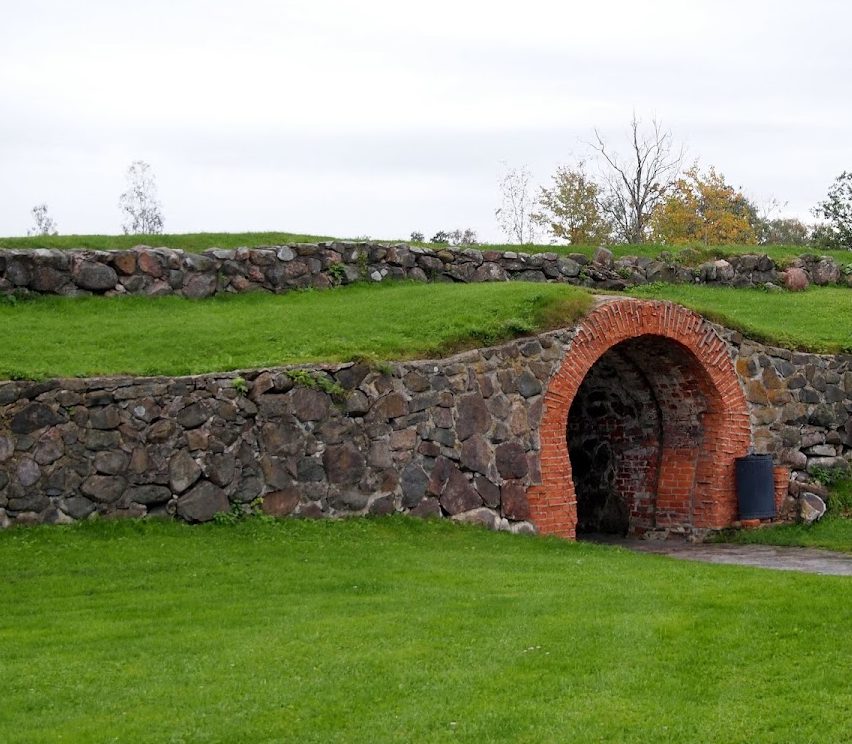
The powder cellar dates to 1592 and is partly sunk into the ground. It adjoins the Old Arsenal on its northeastern side. An arched entrance leads from the fortress yard down stone steps through a wall up to 5 metres thick. A bastion was built above the cellar on a substantial earthen fill. It was called the Trubnoy Bastion in the seventeenth century and the Cavalier Bastion in the eighteenth. A cavalier is a raised defensive work constructed above another fortification.
Gates and commemorative fittings
Alongside the main gate, the fortress had Clock Gates beneath the Clock Bastion. Water Gates, also called Mill Gates, stood in the southeastern curtain, where a moat also ran. The Water Gates and the southeastern curtain date approximately to 1590.
The old fortress gates preserved in the museum are covered with flattened sheets made from approximately 70 cuirasses. Tradition attributes the order for this fitting to Peter the Great after his capture of the fortress in 1710. The armor came from the captured arsenal and was attached to the ceremonial gates as a memorial.