Konevsky Monastery: A Russian Orthodox Monastery on Konevets Island


Site at a Glance
- Rating
- 4.7
- Popularity
- Low
- Country
- Russia
- Primary era
- Modern
- External website
- Open
- Eras represented
- Early Modern, Modern
- Civilizations
- Russian
- Site type
- Religious
- Remains
- Monastery
On this page19 sections
History
Konevsky Monastery is a Russian Orthodox men’s monastery in Russia, located on Konevets Island in the western part of Lake Ladoga. Founded around 1393 by Arseny Konevsky, a monk from the Novgorod Republic, it belongs to the Vyborg Diocese and is dedicated to the Nativity of the Theotokos, the Christian title for Mary, the mother of Jesus. The monastery became known for missionary activity among the pagan Karelians and is often regarded as the “twin” of Valaam Monastery.
Foundation and early development
Before the monastery was founded, Finnish tribes regarded Konevets as a sacred island and venerated the Steed-Stone, a huge granite boulder associated with the island’s name. Monastic tradition holds that Arseny’s prayers and the appearance of the icon of the Mother of God purified the place of its pagan associations. Two storms that forced Arseny back to the island were likewise understood as a divine sign that he should remain there.
Flooding led to a change in the monastery’s location. Around 1421, Arseny established a skete, a smaller monastic settlement dependent on a larger monastery, and a chapel on Holy Mountain. Another stone skete was built at Vladychnaya Bay, where monks received and accompanied the Archbishop of Novgorod. The first Church of the Nativity of the Theotokos was built in the early fifteenth century. Arseny was buried there after his death, and the cathedral founded around 1421 became the monastery’s principal church and shrine.
The monastery had become a substantial landowner by the end of the fifteenth century. In 1499–1500 it owned 58 villages and approximately 400 peasants. In 1551, sons of boyars presented a sewn cover for Arseny’s tomb. The cover is now held by the Museum of the Orthodox Church in Kuopio, Finland.
War, occupation, and restoration
A fire in 1553 destroyed the large heated church, the enclosure, monks’ cells, granaries, icons, and charters granted by Grand Princes Ivan III and Vasily III. During the Livonian War, a Swedish force led by Klas Eriksson Fleming devastated Karelia in 1572–1573 but could not reach the monastery after the ice broke. The Swedes captured the monastery in either 1577 or 1581, after which Ivan IV ordered the monks to move to Derevyanitsky Monastery.
Restoration began in 1593 after the Treaty of Teusina and the establishment of the Karelian Diocese. In 1597, at the request of Boris Godunov, Tsar Fyodor Ivanovich issued a charter ordering the rebuilding of the churches, refectory, enclosure, and cells at royal expense. The charter also exempted the monastery from tribute and labor obligations. Archbishop Varlaam of Sarsk and Podonsk lived there in exile during the period of Boris Godunov’s rule.
Following the Swedish occupation of the Karelian region in 1610 and the Russo-Swedish War of 1614–1617, the monks again left for Novgorod and were accommodated at Derevyanitsky Monastery. In 1672–1673, Tsar Alexei Mikhailovich sought the return of Arseny’s relics to Russia.
Imperial reconstruction
Between 1700 and 1716, under Swedish rule, the monastery and its churches were dismantled for stone and brick. These materials were used to construct the fortress and church at Kexholm, now Priozersk. After Russia recovered the western part of Lake Ladoga during the Great Northern War, Peter the Great authorized the monastery’s restoration in 1718 and viewed it as a border stronghold. On 6 May 1718, the monastery was returned and attached to Derevyanitsky Monastery.
Hieromonk Tikhon, a monk ordained as a priest, had built a wooden Church of Saint Nicholas by 1719. A whirlwind and subsequent fire destroyed it, the other new buildings, and the island’s pine forest. Revival began again in the middle of the 1760s. Empress Elizabeth Petrovna’s decree of 18 January 1760 made the monastery independent. In 1764 it was transferred from the Novgorod Diocese to the Saint Petersburg Diocese and removed from the regular state establishment.
The monastery was designated a third-class monastery in 1825 and received an annual state subsidy. After the Finnish War, it became administratively part of the Grand Duchy of Finland in 1812. This was an autonomous territory of the Russian Empire from 1809 to 1917. Although the monastery lacked regular income, it donated its annual allowance and some silver objects to the army in 1812.
Nineteenth-century prominence
The nineteenth century was the monastery’s period of greatest prominence. Its reputation spread to Saint Petersburg, and it received visits from Emperor Alexander II and his family, Alexandre Dumas, Fyodor Tyutchev, Nikolai Leskov, and later John of Kronstadt. Leskov described the monastery in an essay published in 1873.
The monastery also served, from the sixteenth through the twentieth century, as a place of confinement or exile for laypeople who had been forcibly tonsured and for clergy who had fallen out of favor with tsarist authorities. For a period, Finnish authorities used it to hold Orthodox hierarchs regarded as undesirable.
Revolution, war, and renewed monastic life
After the Russian Revolution of 1917, the monastery became part of independent Finland and came under the autonomous Finnish Orthodox Church within the jurisdiction of the Ecumenical Patriarchate of Constantinople, the senior-ranking patriarchate in the Eastern Orthodox communion. The Finnish military fortified the island, and soldiers occupied the monastery’s inns.
The monastery was damaged during the Winter War and Continuation War. The monks evacuated to Finland on 13 March 1940, taking the Konevsky icon and some of Arseny’s relics. They left the iconostasis, the screen of icons separating the sanctuary from the main worship space, most church bells, and the library. The monks returned briefly during the war but withdrew again with the Finnish army in August 1944. In 1956, the Konevsky monks joined monks from Valaam Monastery at New Valamo Monastery in Finland. During the Soviet period, a military unit occupied the monastery buildings.
The monastery was recognized as an architectural monument by the Council of Ministers of the Russian Soviet Federative Republic on 30 August 1960. In 1990 it was designated for return to the Russian Orthodox Church, and services resumed. The island and buildings were returned to the Saint Petersburg Diocese in 1991. In November of that year, Arseny Konevsky’s relics were apparently found after having been hidden from the Swedes in 1573.
The Nativity of the Theotokos Cathedral in Priozersk became a dependent church property, or metochion, of the monastery in 1995. The Saint Petersburg metochion began to be revived in 1996, and Patriarch Alexy II made his first visit to the monastery in 1998. Restoration and monastic revival continued in the twenty-first century. The Kazan Skete resumed activity, the chapel on Holy Mountain was reconstructed in 2002, the lower Sretensky Church was consecrated in 2019, and restoration of the Church of Saint Arseny, including its iconostasis and frescoes, was completed in February 2020 and followed by consecration in May.
An annual procession traditionally proceeds from the monastery to the church of the Konevsky icon on 10 July. Konevsky Monastery is a federally significant cultural-heritage site of the Russian Federation.
Remains
Island setting and dependent settlements
Konevets Island is approximately 5 km long and 2 km wide, lying about 5 km from the mainland across the Konevets Strait. Its generally flat terrain includes scattered boulders, poor soil, and two low elevations, winding Snake Mountain and Holy Mountain. The monastery’s physical setting also includes the Steed-Stone and several dependent sketes distributed across the island.
Steed-Stone chapel
The Steed-Stone is a granite boulder weighing more than 750 tons and shaped like a horse’s skull. Also known as Hevoskivi, it gave Konevets its name. A small chapel stands on its summit. The earliest chapel on the stone to survive into the twentieth century was built in 1740. It contained a large wooden cross made from thick beams, with its base extending beneath the chapel floor. Only the date “1740” remained from the original inscription.
Holy Mountain and Konevsky Skete
Holy Mountain lies east of the main monastery. Arseny established a skete and chapel there during the early development of the monastery, and the Kazan Skete was founded on the mountain in 1790–1798 under Abbot Adrian. Its principal building was a stone church dedicated to the Kazan Icon of the Mother of God. By the beginning of the twentieth century, the original foundation site was occupied by Konevsky Skete, which had a church dedicated to the Konevsky icon of the Mother of God.
Vladychnaya Bay skete
A stone skete was built at Vladychnaya Bay during the monastery’s early period. A later skete, constructed there in 1874–1876, included a church dedicated to the Konevsky icon and a residential building. The settlement stood 2.5 km from the monastery. A wooden chapel dedicated to Saints Boris and Gleb was built on the island’s southern shore in 2008. The monastery also had a fishermen’s chapel on Voshchany Island, later incorporated into Valaam Monastery’s Tikhvin Skete.
Churches and monastic enclosure
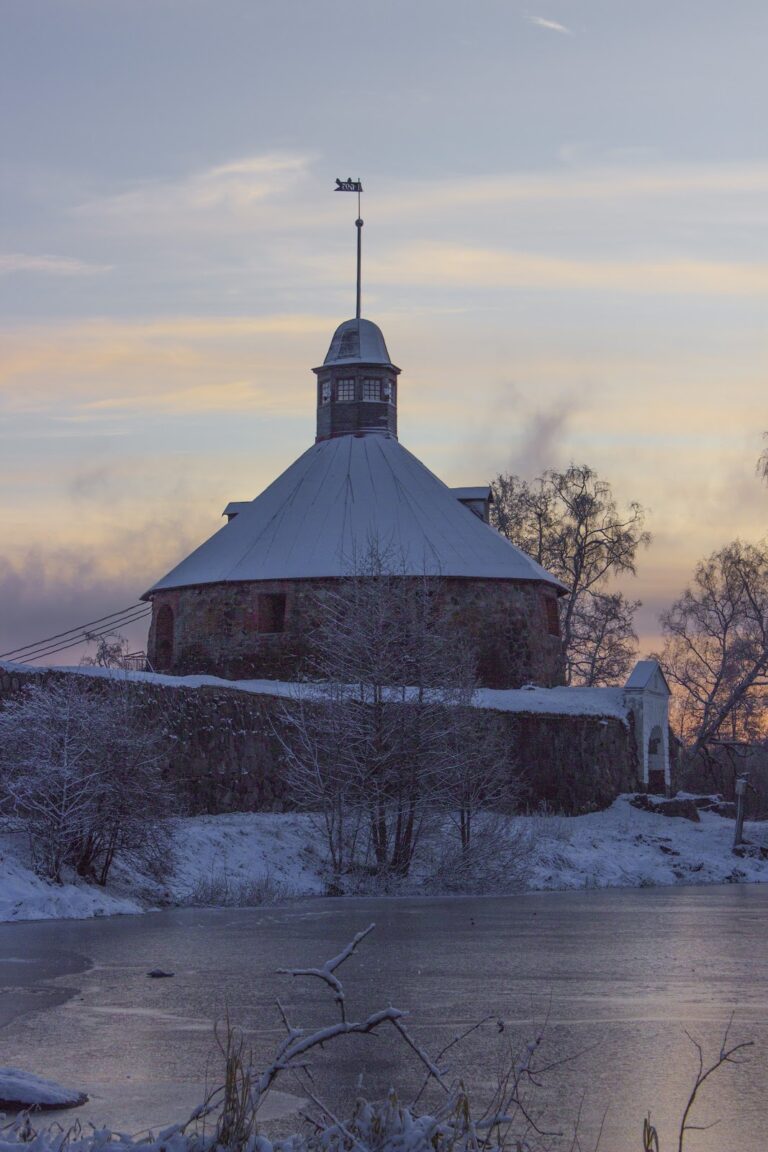
The surviving complex is enclosed and organized around two internal courtyards. The southern courtyard served the abbot, while the northern service courtyard contained the refectory. The buildings combine stone churches, towers, service structures, and later additions from the monastery’s imperial rebuilding.
Nativity of the Theotokos Cathedral
A one-storey, single-domed stone cathedral began to be built in 1766. The principal Nativity of the Theotokos Cathedral was then constructed in 1800–1809 to a design by the monk Sylvester. It is a large two-storey building with eight columns, five octagonal drums, and five blue domes. Vladimir Borovikovsky painted its icons. The lower winter church was completed and consecrated in 1802 after a second storey had been added.
Work around the cathedral continued in 1808, when the monastery added a refectory, bakery, kitchen, abbot’s cells, and brotherhood cells. The southern building later received a second storey. In the cathedral, a wrought tomb for Arseny was installed in 1843 above the place where his relics were buried. It stood on cast legs made from melted elements of the earlier tomb and donated silver, and carried an image of Arseny in the schema, the highest degree of monastic tonsure in Eastern Orthodox tradition, together with reliefs of episodes from his life and miracles.
Church of Saint Nicholas
The cemetery Church of Saint Nicholas was renewed and consecrated in 1762. A new wooden church was built in the south-eastern part of the monastery in 1813, while the surviving stone Church of Saint Nicholas, serving as a hospital and cemetery church, replaced it in 1813–1815. Its two porches contained burials of benefactors and monks.
Church of Saint Arseny and Sretensky Church
The north-eastern tower was converted into the Church of Saint Arseny. Funded chiefly by Pavel Pshenytsin and G. E. Olenyov, it was consecrated on 21 August 1849. The church contains a carved iconostasis made by Greek craftsmen and fresco decoration. Its restoration was completed in 2020.
The Sretensky Church contained a southern chapel dedicated to the Konevsky icon, consecrated on 1 February 1830. Its three-tier redwood iconostasis was crowned by an image of the Coronation of the Mother of God. A chapel designed and built by the academic architect Ivan Slupsky in 1862–1866 was consecrated on 15 December 1866. It had a carved two-tier iconostasis and painted decoration.
Towers, gate, and pier chapel
A bell tower over the western gate was built in the early nineteenth century and is approximately 35 metres high. The north-western tower stored grain, while the south-western tower contained a storeroom and a kvass brewery with a cellar. The eastern gate tower housed the monastery library and later served as a museum and pharmacy. A pier chapel dedicated to Saint Nicholas was erected in 1815.
Collections, economy, and devotional objects
Library and service facilities
The monastery’s agricultural and service facilities included a library, granaries, bakery, kitchen, garden, fruit orchard, storage rooms, kvass brewery, and pharmacy. Approximately 27 desyatinas, a historical Russian land measure of about 1.09 hectares, were used for rye, oats, and barley. About 3 desyatinas were devoted to a garden, mainly producing cabbage and potatoes, while a small orchard contained apple and pear trees and berry bushes.
Fishing was the monastery’s principal economic activity. The island’s shallow waters produced pike, perch, grayling, limited salmon, whitefish, ripus, and Ladoga char. Larger fish were preserved and smaller fish eaten fresh. The monastery also purchased fish and grain because its own production could not fully feed the pilgrims and community.
The library recorded in 1863 contained 80 manuscript books, 46 printed books of Scripture, 150 works by the Church Fathers, 336 theological books, 106 historical books, 296 liturgical books, and 157 books on household management, medicine, and philosophy. Its holdings included a manuscript Gospel copied by Zacharias in 1523–1524, a Life and Deeds of Arseny Konevsky written by Abbot Varlaam, works on ecclesiastical hierarchy, monastic life, and prayer, and writings associated with Basil the Great, John of Sinai, Isaac the Syrian, Symeon the New Theologian, John Maximovich, Dionysius the Areopagite, Paisius Velichkovsky, and Demetrius of Rostov.
The collection also included the Konevsky monastic rule approved by Metropolitan Michael and printed works dating from 1636 to 1764. Among them were a 1654 General Menaion from Derevyanitsky Monastery, a 1656 work titled The Tablet, writings by Lazar Baranovich and Symeon of Polotsk, a 1678 Patericon of the Caves, a 1680 rhymed Psalter, a 1753 Scepter of Rule, a 1678 Hexaemeron, a 1764 Margaris, and homilies copied by Princess Catherine Antonovna, daughter of Regent Anna Leopoldovna.
Konevsky icon and shrine objects
The Konevsky icon of the Mother of God, brought by Arseny from Mount Athos, an important Orthodox monastic center in northern Greece, depicts Christ held by his mother and playing with a dove or dove nestling. It was the monastery’s principal shrine and was traditionally associated with spiritual purity. After the Swedish occupation, it was kept at Derevyanitsky Monastery, returned to Konevets by 1799, evacuated to Finland in 1940, and brought from New Valamo to Konevets on 23 July 2006.
In 1799, a procession carrying the icon went to Holy Mountain, where the icon was believed to have appeared to the elder Joachim, and then continued to the Steed-Stone. The icon was later fitted with a silver covering set with diamonds and other precious stones. In 1843 and 1849, Fedor Verkhovtsev, assisted by Abbot Amphilochius, made a new silver shrine over Arseny’s burial place, together with two chalices and two diskoi, liturgical plates used in preparing bread for the Eucharist, and their accessories for the Church of Arseny Konevsky.
Several objects associated with the monastery are now held elsewhere. These include the 1551 tomb cover in Kuopio, Arseny’s relics and personal objects, a silver-bound image of Arseny holding the Konevsky icon at New Valamo, and a gilded silver processional cross donated by Grand Duke Konstantin Nikolayevich. Arseny’s birch-burl ladle and pectoral cross are in the Museum of the Orthodox Church in Kuopio. The fourteenth-century Konevsky Psalter was transferred during the twentieth-century evacuation and is reported to be in the Russian National Library, although its location is not independently confirmed in the historical record summarized here.
The 1940 evacuation left the monastery’s iconostasis, most church bells, and library in place, except for the bells of the Kazan Skete. Wartime damage and subsequent occupation by a Soviet military unit affected the buildings before restoration and reconstruction followed the monastery’s return.