Konrádov Castle: A Medieval Rock Castle in Czechia
Site at a Glance
- Rating
- 4.6
- Popularity
- Very Low
- Country
- Czechia
- Primary era
- Medieval
- Eras represented
- Medieval
- Civilizations
- Holy Roman Empire, Kingdom of Bohemia
- Site type
- Military
- Remains
- Castle
On this page7 sections
History
Konrádov Castle is a ruined rock castle in Czechia, built during the High Middle Ages, the central medieval period spanning roughly the eleventh through thirteenth centuries in Europe. Also known as the Petrified Castle, it occupied a rocky spur near the boundary between the Central Bohemian and Liberec regions.
No written records of Konrádov Castle have survived. Its history can therefore be traced only through several fragments of High Medieval pottery found at the site. These sherds confirm activity at the castle during the period, while burnt daub, a clay-based building material used as infill or plaster, indicates that the settlement probably came to an end in a fire.
The castle’s position near Houska Castle has led to the possibility that it served as the residence of a royal vassal associated with Bezděz Castle. A royal vassal was a dependent noble who held land or rights in service to the king. The same figure may also have founded Konrádov, although the surviving evidence does not identify the castle’s builder.
The ruins lie about one kilometre east of Konrádov, beside an old cart road that follows a sandstone ridge. The castle rock is in the cadastral territory of Olešno, an officially defined area used for land registration, within the town of Mšeno in Mělník District. Konrádov itself belongs to Blatce in Česká Lípa District.
Remains
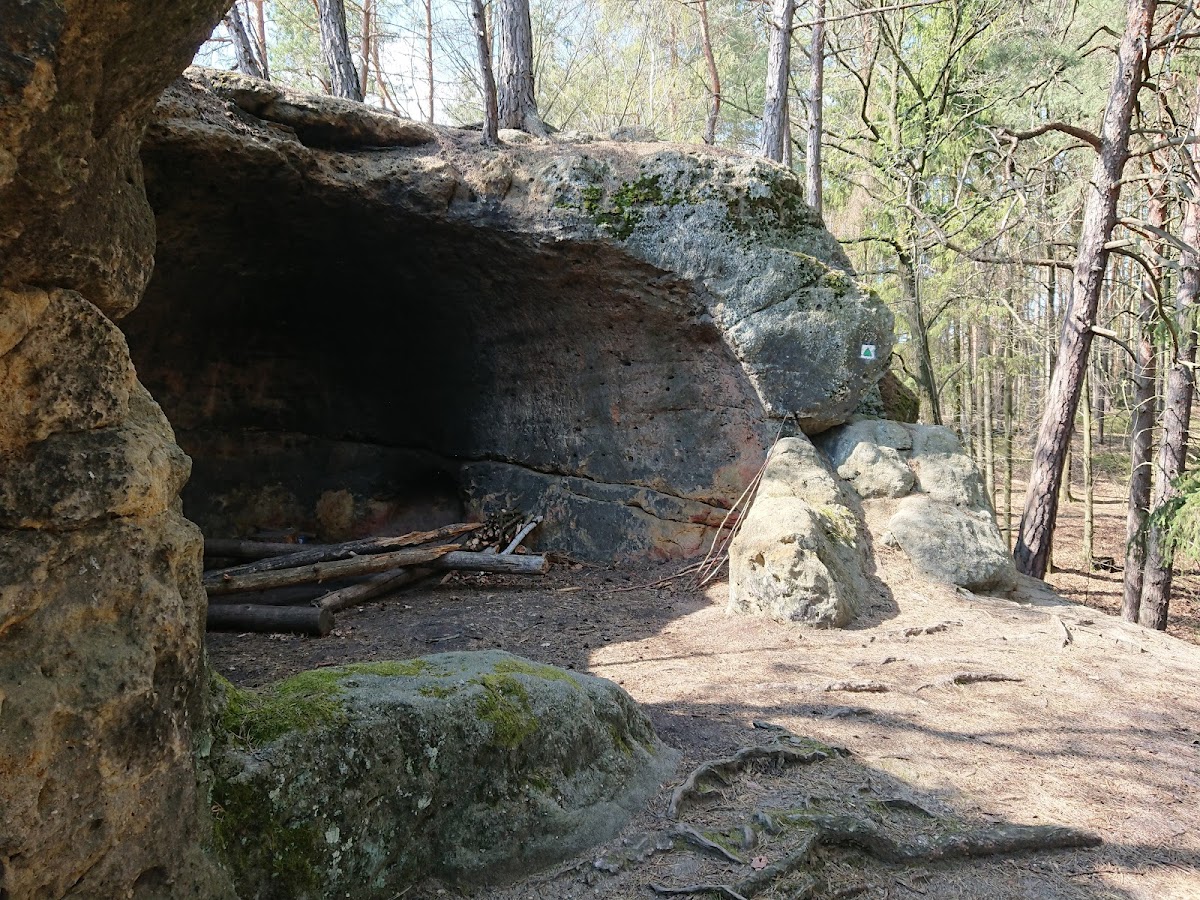
Konrádov Castle was arranged across two sandstone blocks on a rocky spur. A wooden bridge joined the blocks, and traces of its supporting points survive at the site. The position used the natural rock formation as part of the castle’s defenses, while a ditch and a fortified passage helped protect and control the approach.
Sandstone blocks and connecting bridge
First sandstone block
The first block contains a chamber cut into the sandstone. Its rock vault has partly collapsed, leaving the interior in a damaged state. A square shaft in the front wall may represent the remains of an entrance, linking the chamber with the approach across the rocky site.
Second sandstone block
The second block preserves traces where a defensive wall-walk was anchored. A wall-walk is a passage or platform along a fortification that allowed defenders to move, observe, and remain protected. Together with the bridge supports, these traces show how the two rock masses were connected and defended.
Approach and defenses
Neck ditch
A neck ditch protected the front of the castle. This type of ditch is cut across the narrow land connection between a fortified height and the surrounding terrain. At Konrádov, it was created by adapting a natural cleft in the sandstone, combining the existing rock landscape with a defensive modification.
Nearby sites