Burg Winzingen: A Medieval Hilltop Castle Ruin in Germany

Site at a Glance
- Rating
- 4.1
- Popularity
- Very Low
- Country
- Germany
- Primary era
- Medieval
- Eras represented
- Medieval
- Civilizations
- Electoral Palatinate, Holy Roman Empire
- Site type
- Military
- Remains
- Castle
On this page9 sections
History
Burg Winzingen is a medieval hilltop castle ruin in Germany, above Haardt, now a district of Neustadt an der Weinstraße. Built around 900–1000, it belongs to the Romanesque period and was associated with ministerials, members of the medieval service nobility who served rulers and powerful lords in administrative and military roles. The castle’s name comes from Winzingen village, recorded as early as 774.
Medieval Lords and Administration
By 1146, the knight Berthold of Winzingen lived at the castle. After his death, it apparently passed in 1155 to Conrad of Staufen, the half-brother of Frederick I, Holy Roman Emperor, who ruled from 1155 to 1190. In 1248, Count Emich IV of Leiningen became the castle’s custodian under Count Palatine Otto II. A castle custodian was responsible for its defence and administration.
In 1324, Emperor Louis IV, Holy Roman Emperor from 1328 to 1347, granted Burg Winzingen to his chancellor, Hermann of Lichtenberg. The castle was already in very poor condition by that time. After the Palatinate territories were divided among different branches, Count Palatine Rudolf II enfeoffed Count Emich V of Leiningen with the castle in 1350. Enfeoffment meant granting property or rights in return for service or allegiance.
Destruction and Restoration
Elector Frederick II was born at Burg Winzingen in 1482. In 1525, during the German Peasants’ War, a widespread series of rural uprisings in the German-speaking lands, peasants from Gleisweiler plundered and severely damaged the castle. Count Palatine Johann Casimir inherited the dilapidated property in 1576 and restored it to good condition. A painting from 1610 records the castle in this state.
French forces occupied Burg Winzingen during the War of the Palatine Succession, the conflict of 1688–1697 over French claims and succession in the Palatinate and nearby territories. Hessian troops shelled the castle in 1696, destroying most of the complex. Parts were restored after 1700 as a summer residence, but the site began to decay again from 1728.
Private Ownership and Later Development
Burg Winzingen has been privately owned since 1804. The Neustadt merchant Schuster invested heavily in turning the grounds into a park-like garden and adapted the remains of the principal residential building for use as a grape-pressing hall.
In 1843, the castle was shortlisted for reconstruction as a residence for Crown Prince Maximilian, the heir to a monarchy. The nearby Kästenburg, now Hambach Castle, was chosen instead and later acquired the popular name “Maxburg” after the crown prince. August Ritter von Clemm, a commercial councillor and one of the co-founders of the German chemical company BASF, acquired Burg Winzingen in 1875 and had Haardter Schloss built northeast of the castle.
Winzingen became a district of Neustadt in 1892. The later villa and the landscaped grounds form part of the property’s modern setting, while the medieval ruin preserves evidence of the earlier castle.
Remains
Burg Winzingen stands at approximately 236 metres above sea level on the southeastern spur of Schlossberg in the Haardt, at the eastern edge of the Palatinate Forest overlooking the Rhine plain. West of Schlossberg, the Sulzwiesengraben has cut the Meisental valley into the terrain. On the Schlossberg side, this landscape forms part of the Haardtrand-Schloßberg nature reserve.
Medieval Castle Structures
Chapel
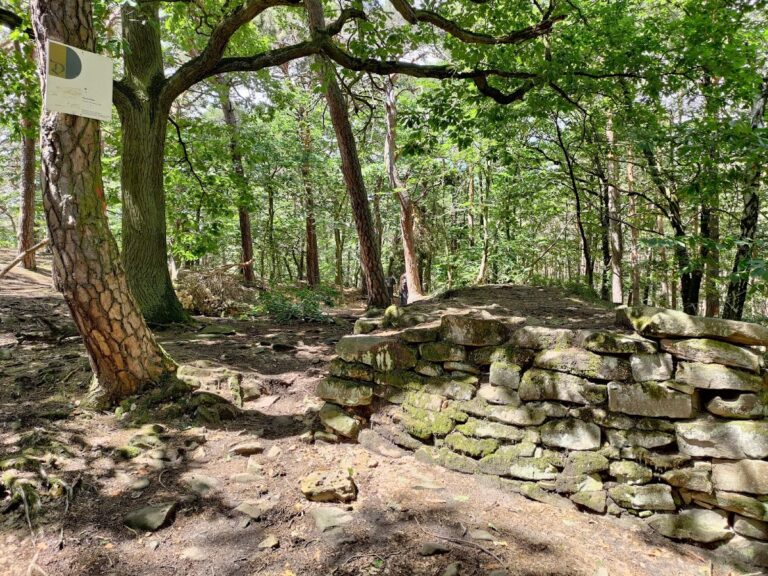
The ruin of St. Nicholas Chapel is among the oldest surviving parts of Burg Winzingen. Its remains, together with sections of the ring wall, date to the eleventh century. The chapel belongs to the castle’s Romanesque phase, an architectural style known for massive masonry, rounded arches, and heavy forms.
Walls, Towers, and Residential Remains
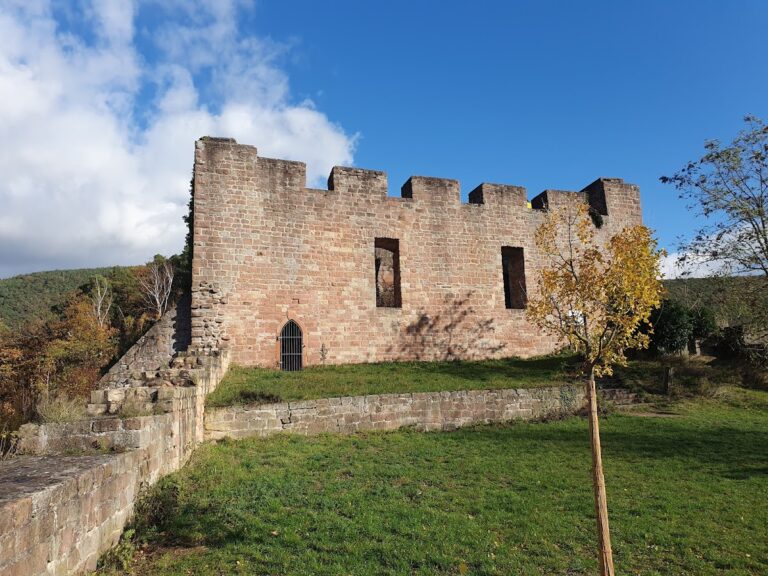
The surviving castle fabric includes the ring wall, remains of towers, a barrel-vaulted cellar, and parts of the residential palace. A barrel vault is a continuous curved vault covering a space. The residential remains were later adapted as a grape-pressing hall, linking the surviving medieval fabric with the property’s private agricultural reuse.
Later Buildings
Haardter Schloss has stood northeast of Burg Winzingen since the second half of the nineteenth century. Built after August Ritter von Clemm acquired the property in 1875, the villa occupies a later phase of the site’s development beside the medieval castle remains.
Nearby sites