Kláštorisko: A Carthusian Monastery and Fortified Settlement in Slovakia
Site at a Glance
- Popularity
- Medium
- Country
- Slovakia
- Primary era
- Medieval
- Eras represented
- Medieval
- Civilizations
- Hungarian
- Site type
- Religious
- Remains
- Monastery
On this page18 sections
History
Early settlement and fortified refuge
Kláštorisko is a fortified plateau and monastery site near Letanovce in Slovakia, where a Carthusian monastery founded in 1299 became the order’s first center in Hungary. The Carthusians were a Catholic monastic order founded in 1084, whose emphasis on solitude, silence, and ascetic discipline shaped life in their communities.
People occupied the plateau in the Late Bronze Age, around the 11th century BC, and again in the Early Iron Age, around 600 BC. The later settlement had defenses and probably served as a refuge. Fortifications associated with early Slavic settlement also protected nearby routes. During the 12th and 13th centuries, a fortified settlement was built over an older hillfort. By the mid-13th century, the Spiš Saxons had strengthened the site, which sheltered people during the Mongol invasion of Hungary in 1241. Those who took refuge there survived. The invaders withdrew around 1242 after receiving news of the Great Khan’s death.
The plateau became known as the Rock of Refuge, or Lapis Refugii, and Watch Mountain, or Mons Speculationis. A local legend connects the monastery’s foundation with Kokoš, a prominent member of the Brezovický family. The story says that he killed a provost of the Knights of the Cross at Chmeľov and was required, as penance, to found six monasteries. He established only two: one at Kláštorisko and another near Lechnica.
Carthusian foundation and flourishing
A charter dated 12 December 1299 established a monastery for the Carthusian order, dedicated to the Virgin Mary, St John the Baptist, and St Margaret. The Spiš Saxons granted the land. Martin, a priest from Žakovce, proposed the foundation, which was approved by the Union of 24 Spiš Towns, a medieval association of towns. The territory lay between the Hornád and Biela rivers, with walls marking its western boundary.
Construction began around 1300 or in the early 14th century. Andrew, a monk from the Carthusian monastery at Žiče, supervised the work with an assistant in 1305–1307. The first monks arrived in 1307 under Konrad, the community’s prior, or monastic superior. Around the turn of the 14th and 15th centuries, the monastery prospered with support from noble patrons and became a center of religious and philosophical life in Spiš. Its monks copied and produced books, decorating them with illuminated images and elaborate bindings. After 1396, Ladislav of Vlková, head of the Cistercian monastery at Spišský Štiavnik, commissioned a smaller cloister. An anonymous monastic chronicle from the early 16th century records this work.
Attacks and decline
In 1433, Hussite forces, followers of a religious reform movement associated with Jan Hus, plundered and burned the monastery. The monks moved to a house they built in Levoča, then returned and rebuilt at Kláštorisko during the 15th century. In 1454, the Bratríci, armed groups active in the region, raided the site. They had established themselves across the Hornád at a small fort on Green Mountain. During subsequent repairs, the monks replaced the floor and exchanged fireplaces for more efficient tiled stoves.
Political changes following the Battle of Mohács, a major defeat of the Hungarian kingdom by the Ottoman Empire, contributed to the monastery’s decline. After 1517, Prior P. Eucherius de Frankonia commissioned a hospice in the southern part of the complex, where laypeople could enter. In 1530, the monastery’s properties were pledged to the town of Kežmarok. In 1543, the robber-knight Matej Bašo of Muráň plundered the monastery and adapted its buildings for military use. Church authorities ordered the complex abandoned and demolished to prevent its use as a robber stronghold. The monks transferred to the Carthusian monastery at Lechnica, also called the Red Monastery, and Kláštorisko was not rebuilt.
Modern history
Archaeological investigation, rescue work, and restoration began in the 1980s under archaeologist Michal Slivka and have continued since. The ruins are protected as a Slovak National Cultural Monument. A mountain shelter opened in late 1929 after construction began in 1926. During the Slovak National Uprising, it housed a partisan unit. German forces shelled it on 14 October 1944, setting it on fire; it was rebuilt after the war.
A religious pilgrimage is held at Kláštorisko each year in late August.
Remains
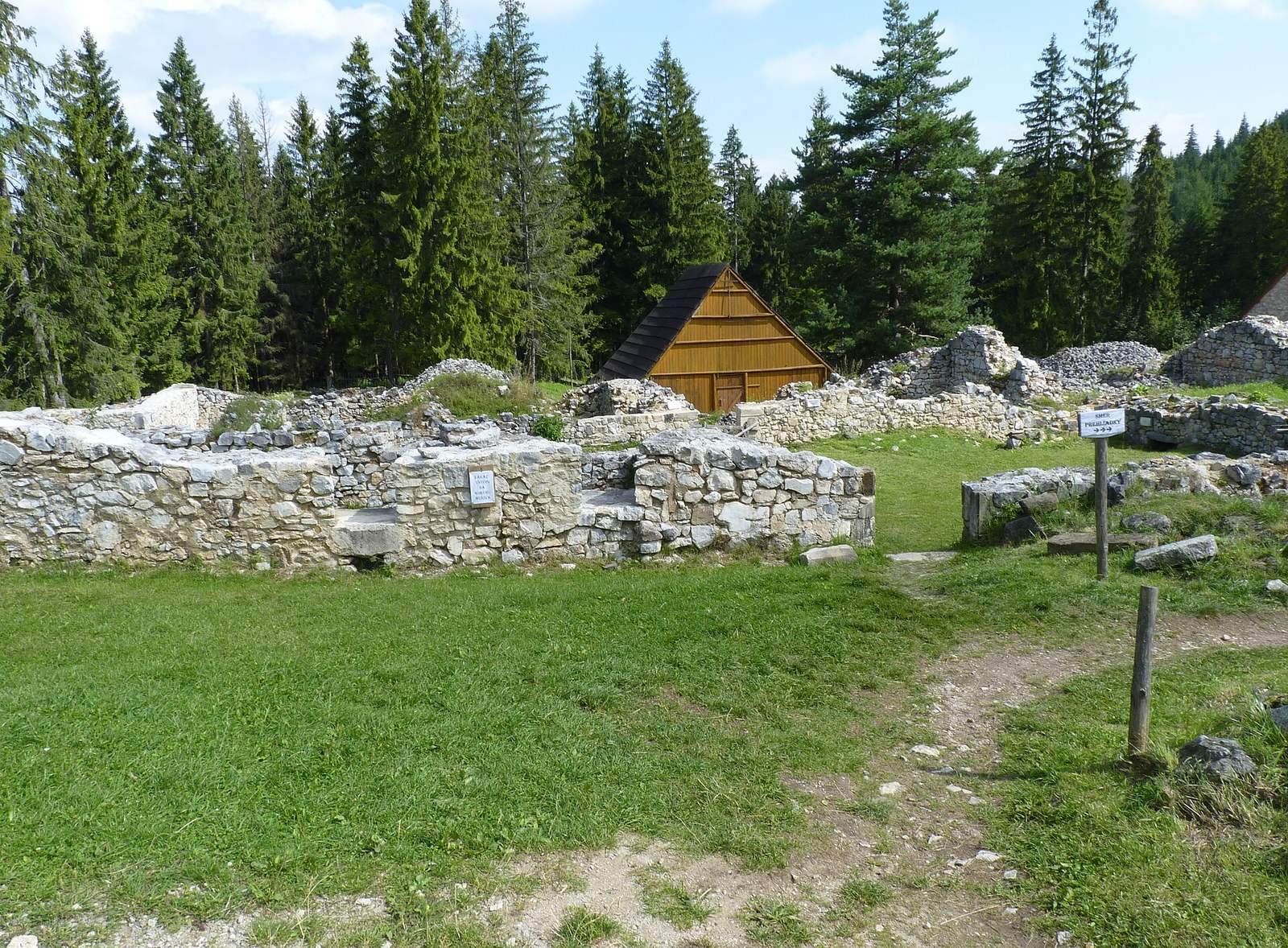
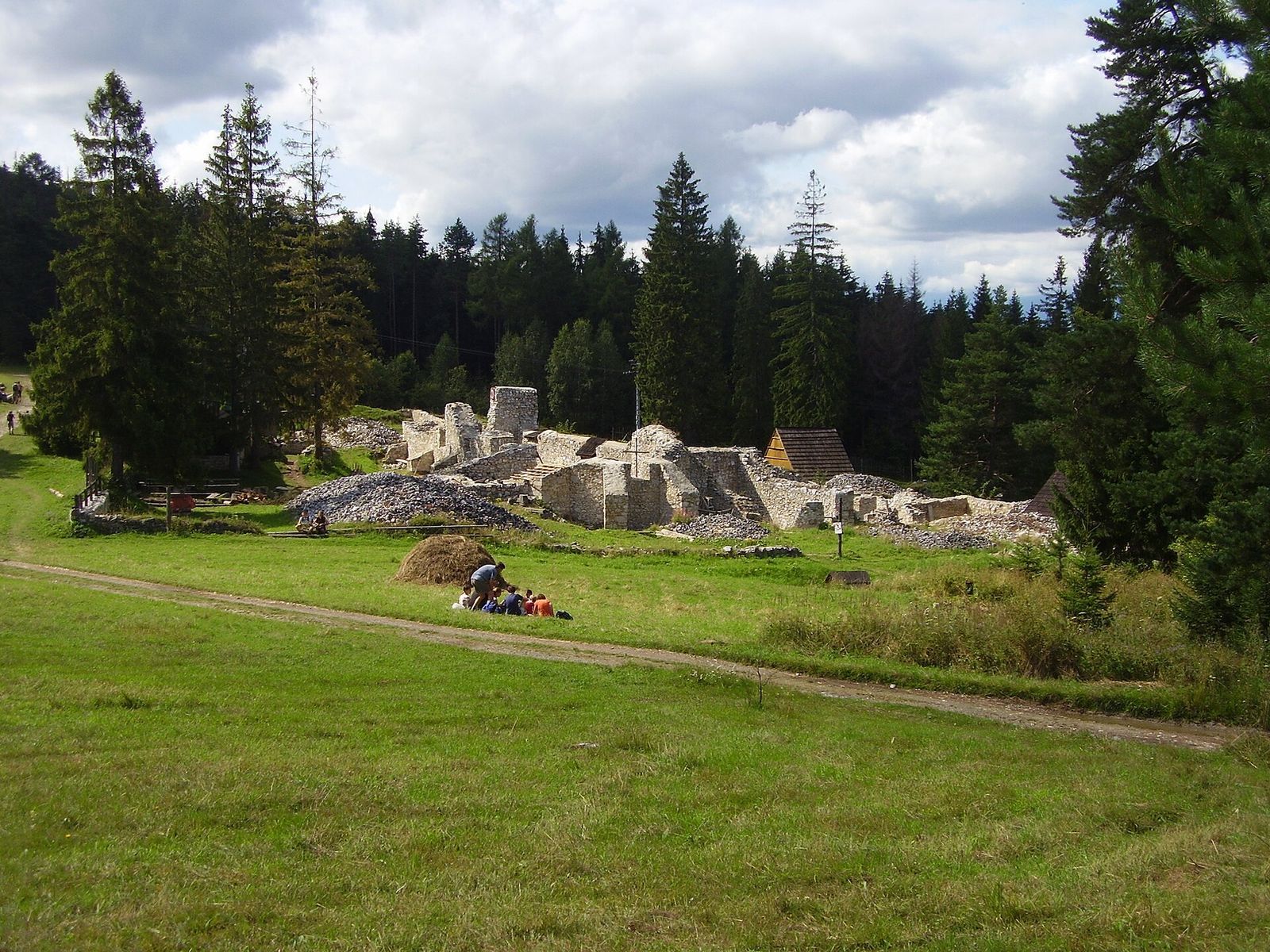
Kláštorisko occupies a plateau at about 760 metres above sea level in the center of the Slovak Paradise, with views over the Spiš Basin and surrounding countryside. The remains preserve the main elements of a Carthusian plan: the area used by laypeople lies south of the church, while the monastic enclosure occupies the ground to its north. Fortifications and monastery buildings represent distinct phases of use.
Fortifications
Earlier ramparts
The fortified settlement of the 12th and 13th centuries had two ramparts, concentrated on the more accessible western side. Traces mark the position of a separate wooden watchtower to the northeast. Two earthenware pots from the 12th or 13th century were also found at the site.
Spiš Saxon defenses
Later defenses attributed to the Spiš Saxons extended for as much as one kilometre. Their walls were 150–170 centimetres thick, and the enclosed area covered about 90 hectares.
Monastic complex
Cloisters and communal rooms
The large cloister surrounded the main courtyard, with monks’ cells arranged along its perimeter and divided by low partitions. In the southeast, a smaller cloister connected with the communal rooms: the kitchen, dining room, meeting room, and church.
Church
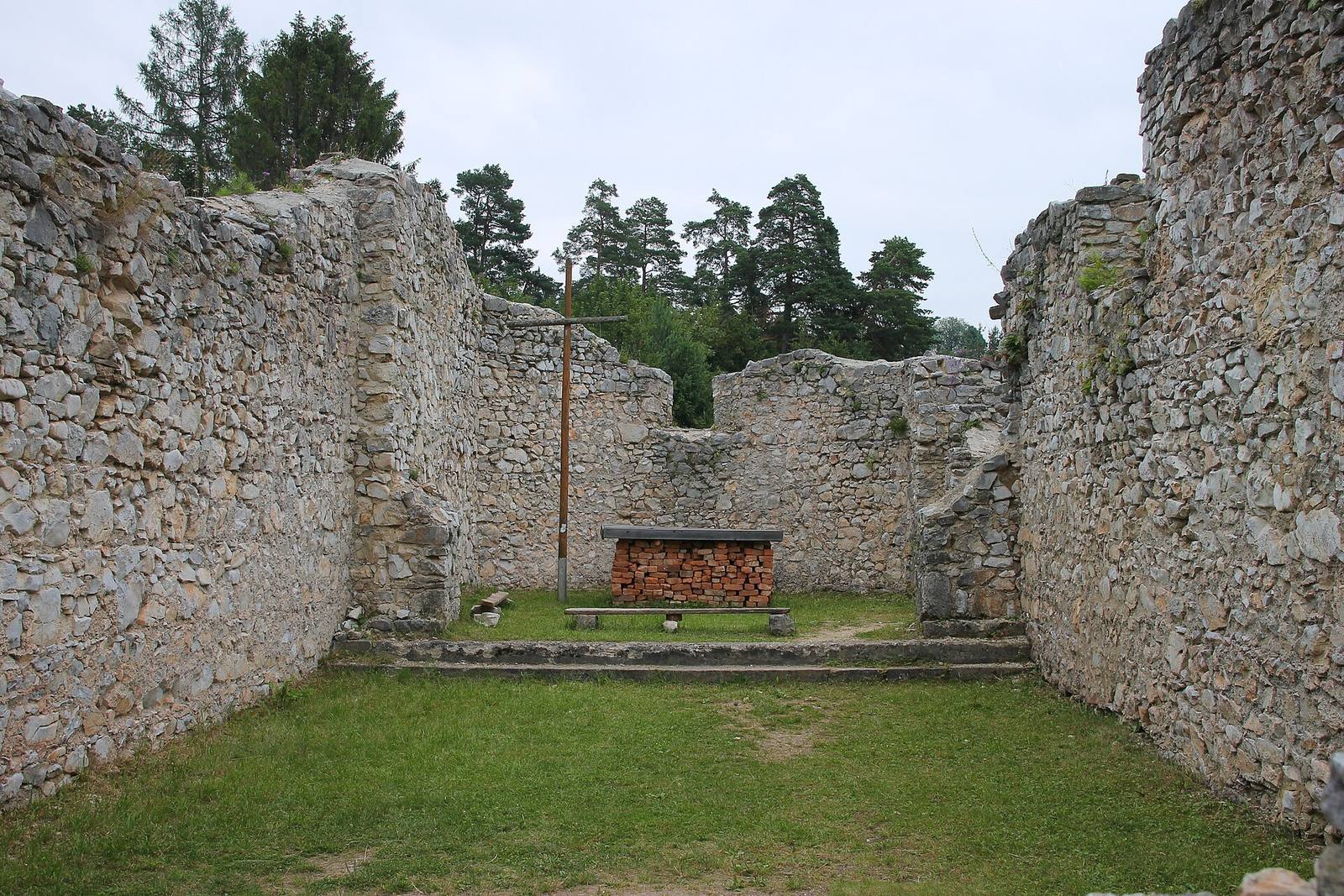
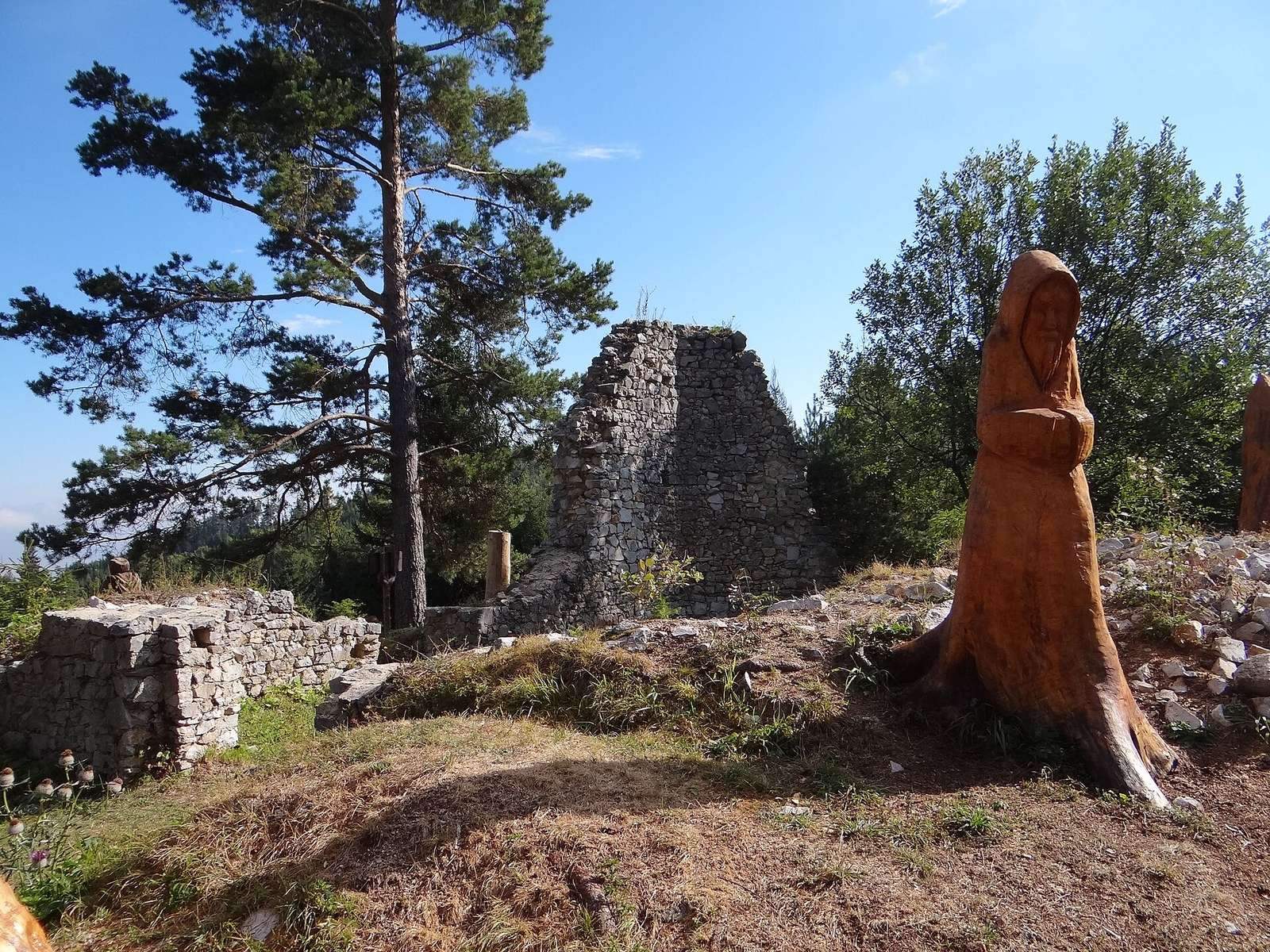
The church was a simple hall with a single nave and a polygonal sanctuary end. It served the Carthusian community, while laypeople attended services from the rear. The surviving outer wall belonged to the church of St John the Baptist and St Margaret.
North chapel
A chapel north of the church may be the oldest part of the complex and may date to the late 13th century. It stands off the church’s northward axis and had a single nave ending in an apse, the sanctuary end, formed by five sides of an eight-sided shape. Its ceiling had two sections of ribbed vaulting. Two polygonal, pyramid-shaped corbels, or projecting stone supports, remain in place; one has traces of simple tracery, a pattern of shaped stonework. Excavated fragments of the vault ribs have hollowed sides. The chapel may later have served as the community’s meeting room, while a room south of the church sanctuary may have been a sacristy, a room for church furnishings and preparation. Its identification as a church built by the Spiš Saxons remains uncertain.
Other monastic remains
A monk’s cell, a sundial, and the ruins of a former chapel in the clearing are also among the surviving features.
Landscape and associated features
Spring and stream
St Bruno’s Spring is at Kláštorisko. The Kláštorská ravine and stream begin in the meadow and flow toward the Hornád.
Meadow and memorial
A symbolic cemetery occupies the meadow. Beside a chapel ruin, a small memorial commemorates the 2015 helicopter accident in the Hornád canyon, in which two pilots and two mountain rescuers died.
Bridge over the Hornád
The 15th-century Carthusian Bridge was a stone crossing over the Hornád and the only stone bridge over that river in the Slovak Paradise. German forces blew it up during the Second World War as they tried to capture Kláštorisko, where partisans were based. A modern bridge replaced it after the war, and a replica of the earlier stone bridge was built in 1995.