Karlshof Monastery: A Royal Augustinian Canonry in Prague
Site at a Glance
- Popularity
- Medium
- Country
- Czechia
- Primary era
- Medieval
- Eras represented
- Medieval, Early Modern
- Civilizations
- Habsburg, Habsburg Austria, Holy Roman Empire, Kingdom of Bohemia
- Site type
- Religious
- Remains
- Monastery
On this page9 sections
History
Royal foundation and medieval growth
Karlshof Monastery, a former royal house of Augustinian canons in Prague, Czechia, was founded in the New Town by Charles IV in 1350. Charles, king of Bohemia and, from 1355, Holy Roman Emperor, had established the New Town in 1348 as part of an effort to strengthen Prague’s standing as an imperial capital. Building began in 1351, and the Gothic church and monastery were consecrated in 1377 under Abbot Prokop. Karlshof was Bohemia’s second Augustinian canonry, after Roudnice. Augustinian canons were clergy who lived in a religious community according to the Rule of St Augustine; a canonry was their institutional house.
Charles issued the foundation charter on 18 September 1350, and Pope Clement VI confirmed it on 22 February 1352. The confirmation gave the abbots permission to use specified episcopal ceremonial insignia and deliver solemn blessings. It also brought a church below Bezděz and its revenues into the canonry. In 1355, Anna of Schweidnitz, Charles’s third wife, granted Karlshof the patronage of a church at Lissa; Pope Urban V incorporated that church in 1368. Charles appointed the abbot and his successors as almoners of the Bohemian Crown in 1365, making them responsible for distributing royal alms. They could celebrate Masses for deceased members of the royal family when the archbishop was away, and held an honorary position in St Vitus Cathedral. Charles had considered keeping the imperial regalia at Karlshof, but they were first placed in St Vitus’s sacristy and, after 1357, at Karlstein Castle.
The church was first dedicated to Charlemagne, the Frankish ruler crowned emperor in 800 and remembered as a restorer of imperial authority. He was canonized in 1165. The dedication later included the Assumption of the Virgin Mary, the Christian belief that Mary was taken into heaven. By 1498, the Assumption was named first, followed by Charlemagne. Community life had begun before the church’s consecration, initially with eight canons. In 1379, the canons gained permission to live in individual cells rather than a shared dormitory.
Under Abbot Johann I Prokop, the community strengthened its religious and intellectual life. Its scriptorium, a place where manuscripts were copied and decorated, produced illuminated books, and a library catalogue from his tenure listed 28 codices. Prokop and the prior of Roudnice were also appointed to visit every Augustinian canonry in Bohemia. In 1400, the community had ten canons, including the abbot, and three novices; by 1409 it had grown to 19 canons. Karlshof also established prayer confraternities, associations whose members undertook shared prayers or devotional observances, with houses at Wittingau in 1376, Landskron in 1387, Sternberg in 1388, Sadská in 1389, the Sand Abbey at Breslau in 1405, and the Corpus Christi monastery at Kazimierz near Kraków in 1412.
War, exile, and recovery
In 1420, during the Hussite Wars, conflicts connected with the religious reform movement inspired by Jan Hus, the monastery was plundered and set on fire. The church and its furnishings were damaged. The canons had fled beforehand, taking refuge at Ingelheim, the Sand Abbey at Breslau, the monastery at Sagan, and the Celestines at Oybin. Abbot Matthias died in exile in 1434. That year, eight canons chose Martin von Borzislau as his successor, and Prague’s administrators confirmed the appointment on 2 November.
After the Prague Compacts, agreements that helped bring a phase of the Hussite conflicts to a close, the canons returned in 1437. Prague had granted the deserted monastery to a private owner in 1434. On 4 May 1437, Emperor Sigismund and a papal legate visited the site and resolved that it should be repaired. Abbot John II oversaw the rebuilding.
The Prague uprising of 1483, a revolt by Utraquists, a Hussite group that emphasized communion with both bread and wine, forced the canons to flee again, this time to Saxony. Abbot Wenceslas was at Pirna in 1489. The community returned in 1496 after establishing a prayer confraternity with the Celestines at Oybin. Under Abbot Matthew, the canonry recovered its religious and intellectual life. The church was reconsecrated in 1498, and King Vladislaus II and his wife Anna gave it two stained-glass windows.
Reformation and early modern rebuilding
In 1514, Karlshof gained the right to choose its own lay advocate, a representative in temporal affairs. Although its estates remained confiscated, King Louis II confirmed earlier privileges in 1522, transferred to the canonry Charles IV’s charter for the royal almoner’s office, granted it annual income from Guhrein, and assigned revenues from the royal domains of Poděbrady and Kolín. By the middle of the sixteenth century, the Reformation had left only three young canons at Karlshof. Prague’s cathedral chapter asked the abbot of Wittingau to send additional canons. One of them, Melchior von Schönberg, briefly became abbot. After the provostry at Ingelheim was dissolved in 1576, Karlshof’s abbots continued to use the title “Perpetual Visitor of Ingelheim.”
In 1572, Abbot Mikuláš Venc appealed to the ruler for help, reporting that the buildings had deteriorated. Repairs followed in 1575. Lightning damaged the complex in 1603; the church was repaired and reroofed, but the convent buildings were not. During the 1611 upheaval, troops from the Bishopric of Passau intervened in Bohemia, and the monastery was plundered and partly demolished. Three canons were killed: Abbot Kaspar Cepel, Prior Melchior Hofmann, and Andreas Kobr.
The return of the canonry’s estates in 1629 helped its recovery. At the close of the Thirty Years’ War, the European conflict of 1618–1648, the complex served as a military arsenal. Under Abbot Isidor de Croce, repairs were completed, followed by major rebuilding and enlargement in 1653–1658, probably to a design by Carlo Lurago. Under Abbot Wenzel Luňák, Karlshof joined the Lateran Congregation, a federation of Augustinian canon houses, with papal approval. The community established a confraternity of St Liborius in 1675–1676 and one devoted to the Most Sacred Heart of the Virgin Mary in 1727. After 1750, a burial confraternity gave particular attention to widows and orphans.
On 28 July 1716, the abbot contracted František Maxmilián Kaňka to build a new prelature, the abbot’s residence and administrative building. It was completed and occupied in 1719. During the Seven Years’ War of 1756–1763, more than 800 cannonballs damaged the church vault, and the roof was set alight several times. A fire struck the convent on 22 April 1755; repairs to the damaged roofs followed in 1756.
Suppression and later use
Joseph II’s reforms, which reshaped church administration in the Habsburg lands and suppressed many religious houses, brought Karlshof’s monastic life to an end on 1 May 1784. The canonry was dissolved, its property inventoried and transferred to the religious fund, and the last abbot, Augustin Johann Paukert, and the canons were granted annual pensions. The buildings became a municipal hospital for the incurably ill, and the church was deconsecrated. Some furnishings were sold or moved to other churches.
The church was repaired and reconsecrated in 1789. The convent buildings were altered in 1789–1791, rebuilt and modernized in 1808, and changed again in 1865–1866 after the hospital passed into municipal administration. Part of the complex served as storage for the Museum of the City of Prague from 1948 until 1960, when the Border Guard Museum moved in. It became the Museum of the Corps of National Security in 1973 and, after 1990, the Police Museum of the Czech Republic, which remains housed in the complex.
Remains
Setting and monastic plan
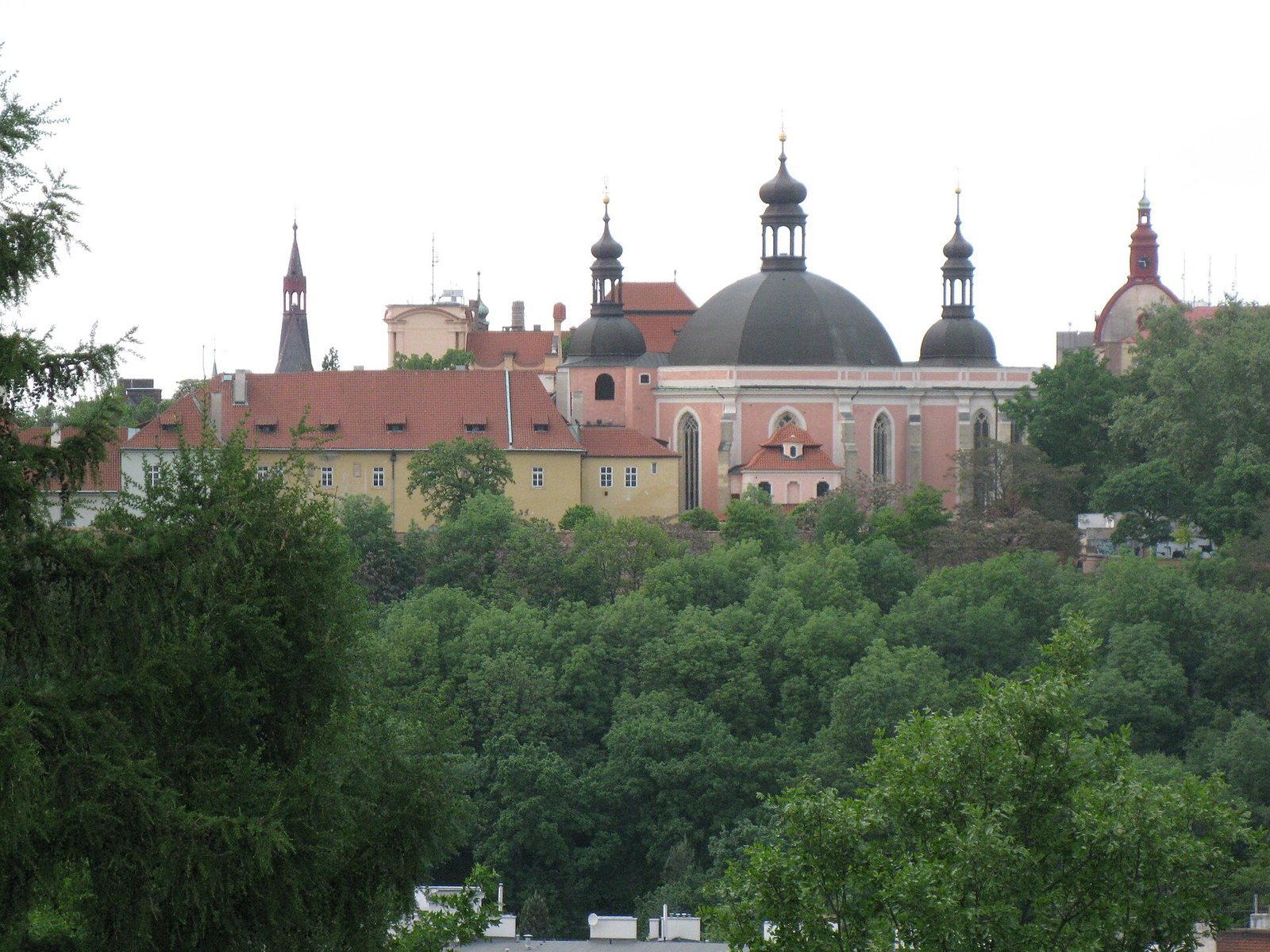
The former monastery occupies a raised rocky ridge beside Prague’s fortifications, above the former village of Nusle and opposite Vyšehrad. The complex began in the Gothic period and was substantially reshaped in the Baroque era. Three medieval wings enclose a square garden court. The convent buildings were two storeys high, while the covered walkway around the court, or cloister, had one storey. The medieval arrangement probably drew on the model of Aachen. Two wings extend west into the former monastic garden and appear to have served practical, economic functions.
Church
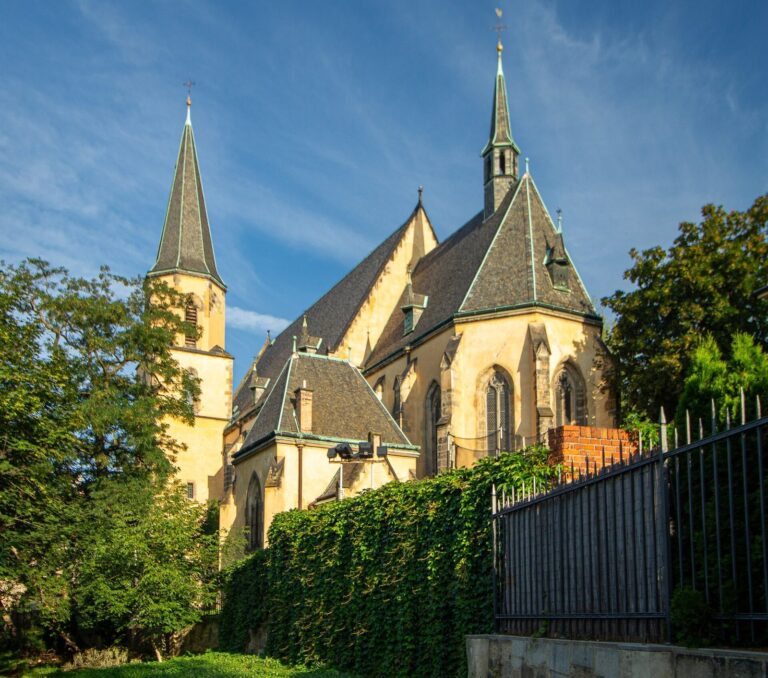
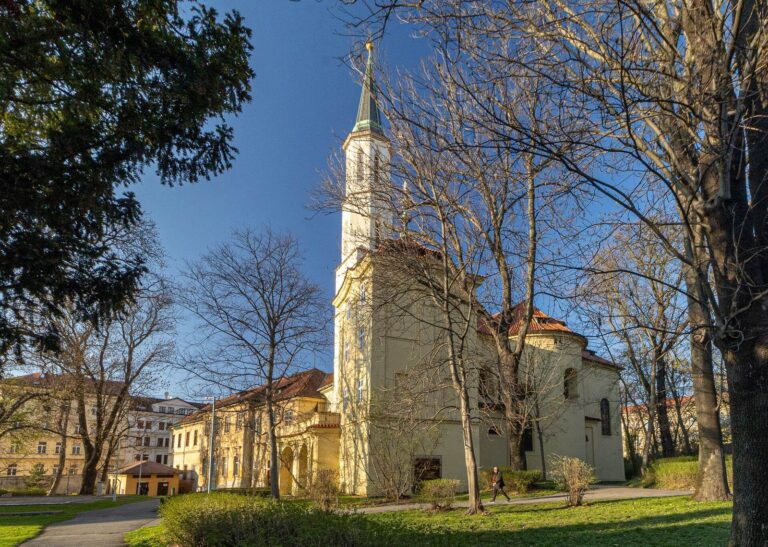
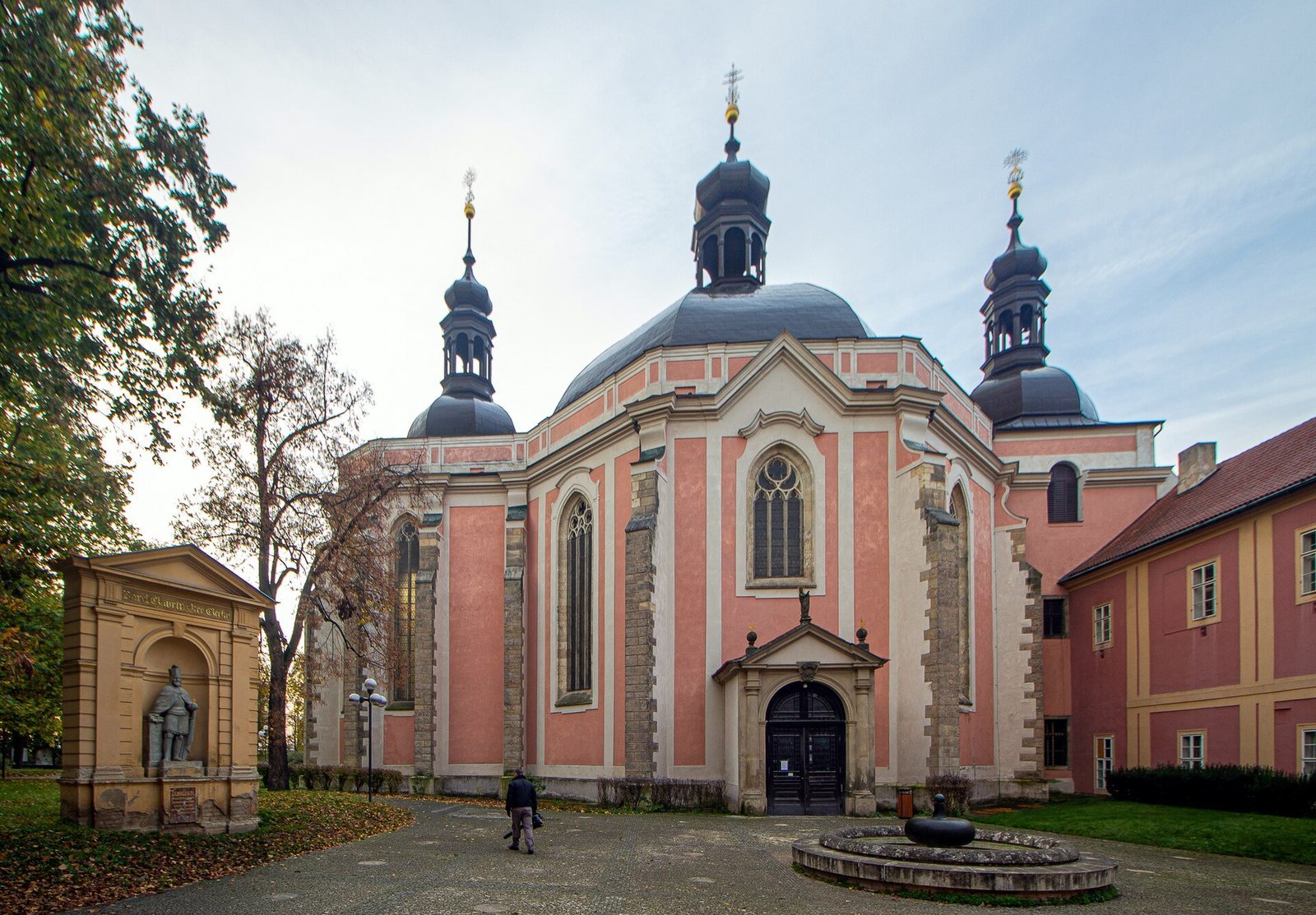
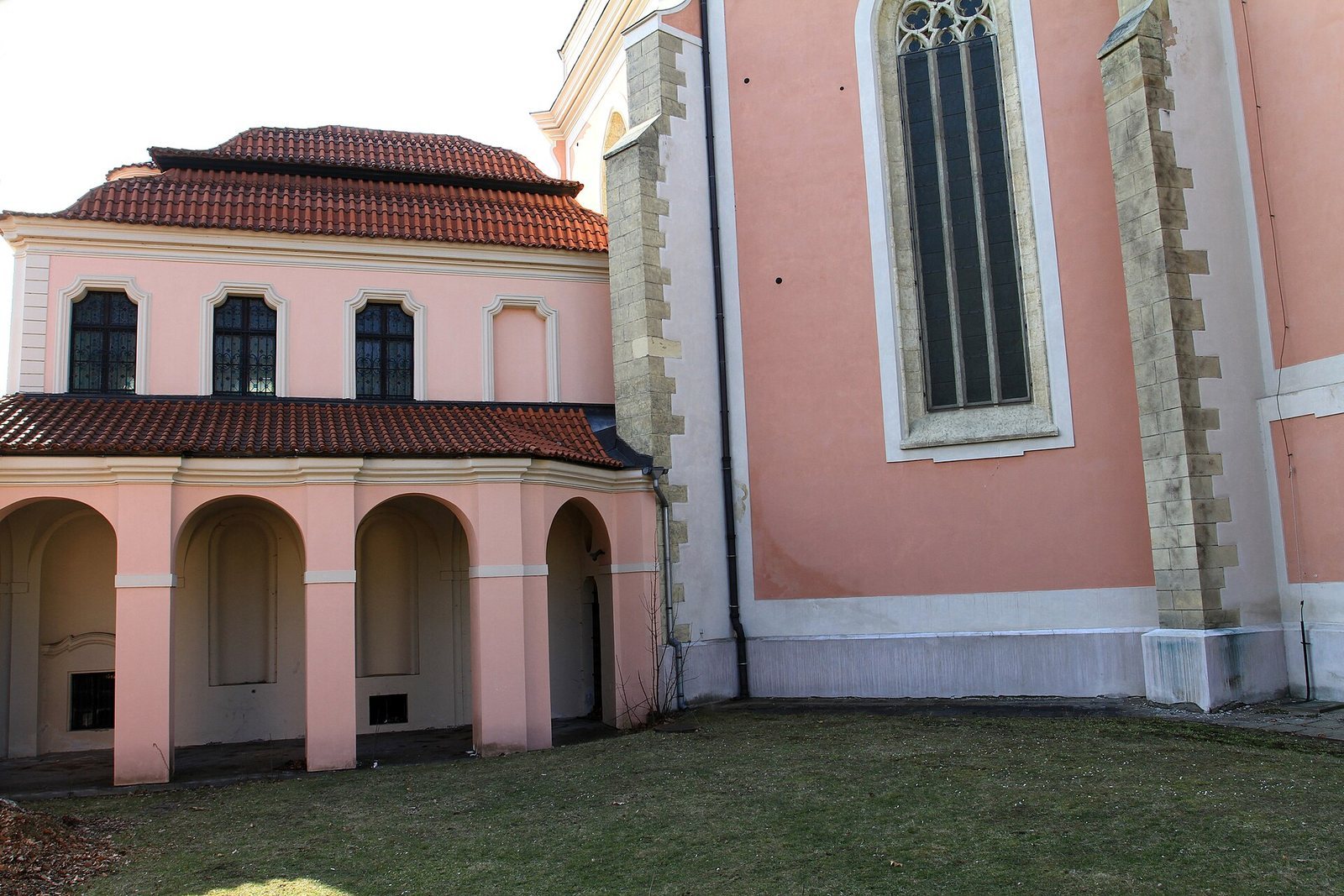
The monastery church has an octagonal Gothic nave, the main body of the church, an eastern polygonal sanctuary, and a tower at the west end. Its unusual eight-sided plan refers to Aachen’s coronation church. Three prominent Baroque domed roofs with lanterns crown the church, and a Baroque Holy Stairs building, a devotional structure centered on a prayer staircase, adjoins the south side of the nave. The vault renewed in 1575 survives. The church received two stained-glass windows at its 1498 reconsecration.
Convent wings and forecourt
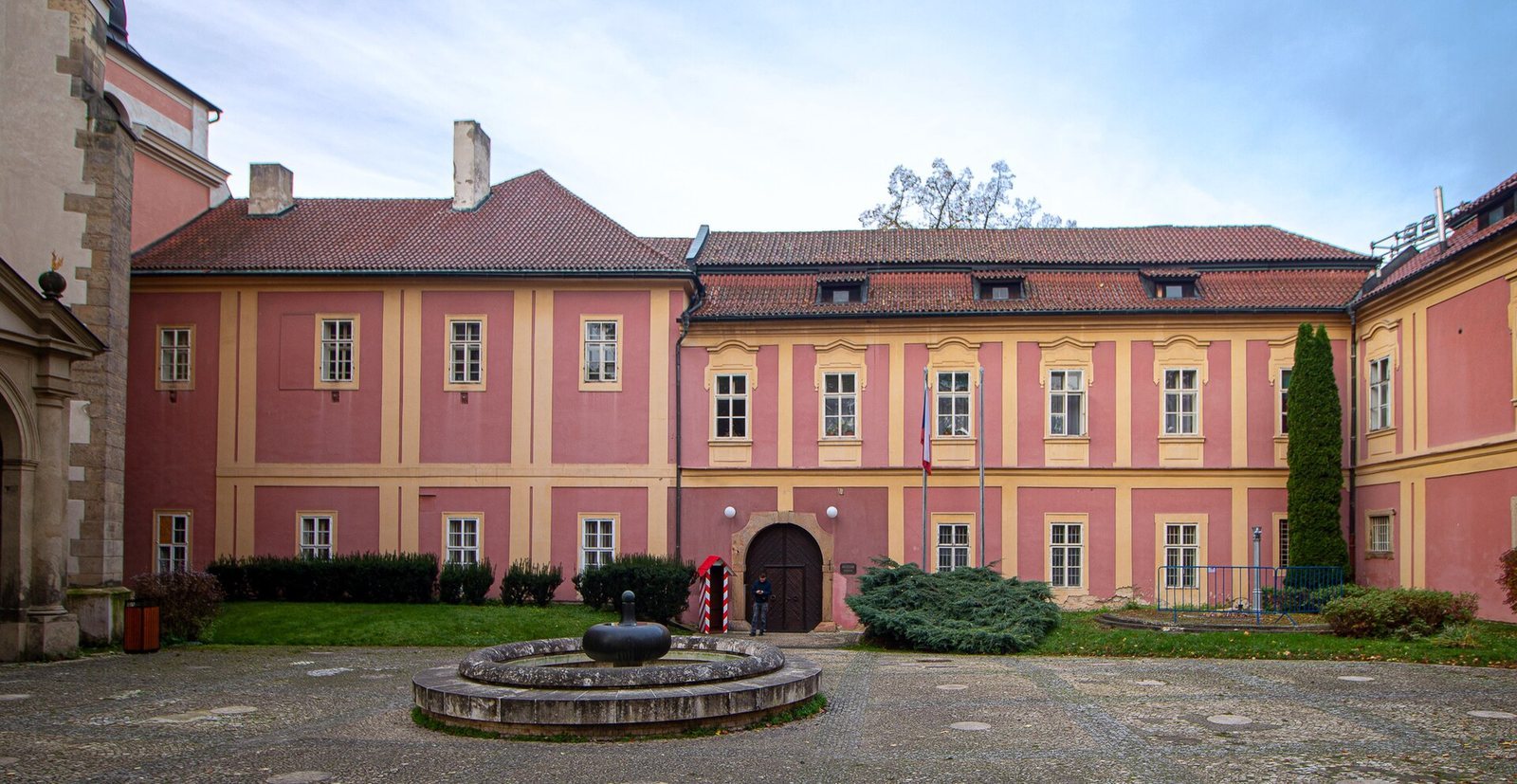
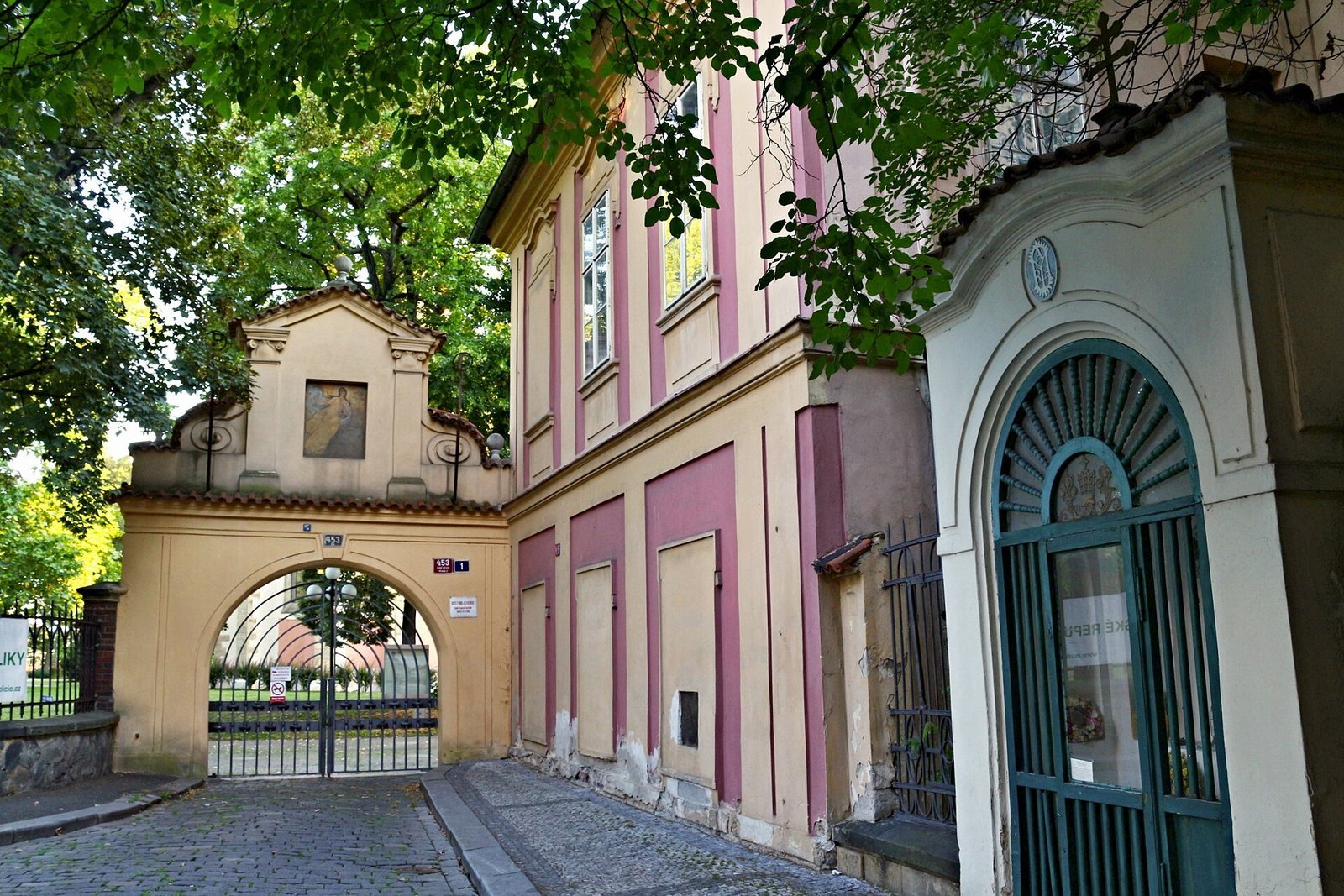
Traces of the medieval buildings are especially clear in the southern wing. They include numerous small windows on the first floor and a large pointed window from the Chapel of St Charlemagne, a rectangular space that extended through two floors. The surviving façades are plain and date from the early Baroque rebuilding. A park-like forecourt is framed by the new prelature to the north, the old prelature to the west, and the church to the south. Farther west, the convent buildings align precisely with the church; only a small part of their eastern façade projects into the open space. Their separation from the public forecourt expressed the enclosure and seclusion of monastic life.