Kizil Caves: An Ancient Buddhist Cave Complex on the Silk Road
Site at a Glance
- Rating
- 4.5
- Popularity
- Very Low
- Country
- China
- Primary era
- Medieval
- Eras represented
- Classical, Medieval
- Civilizations
- Unclassified
- Site type
- Religious
- Remains
- Monastery
On this page11 sections
History
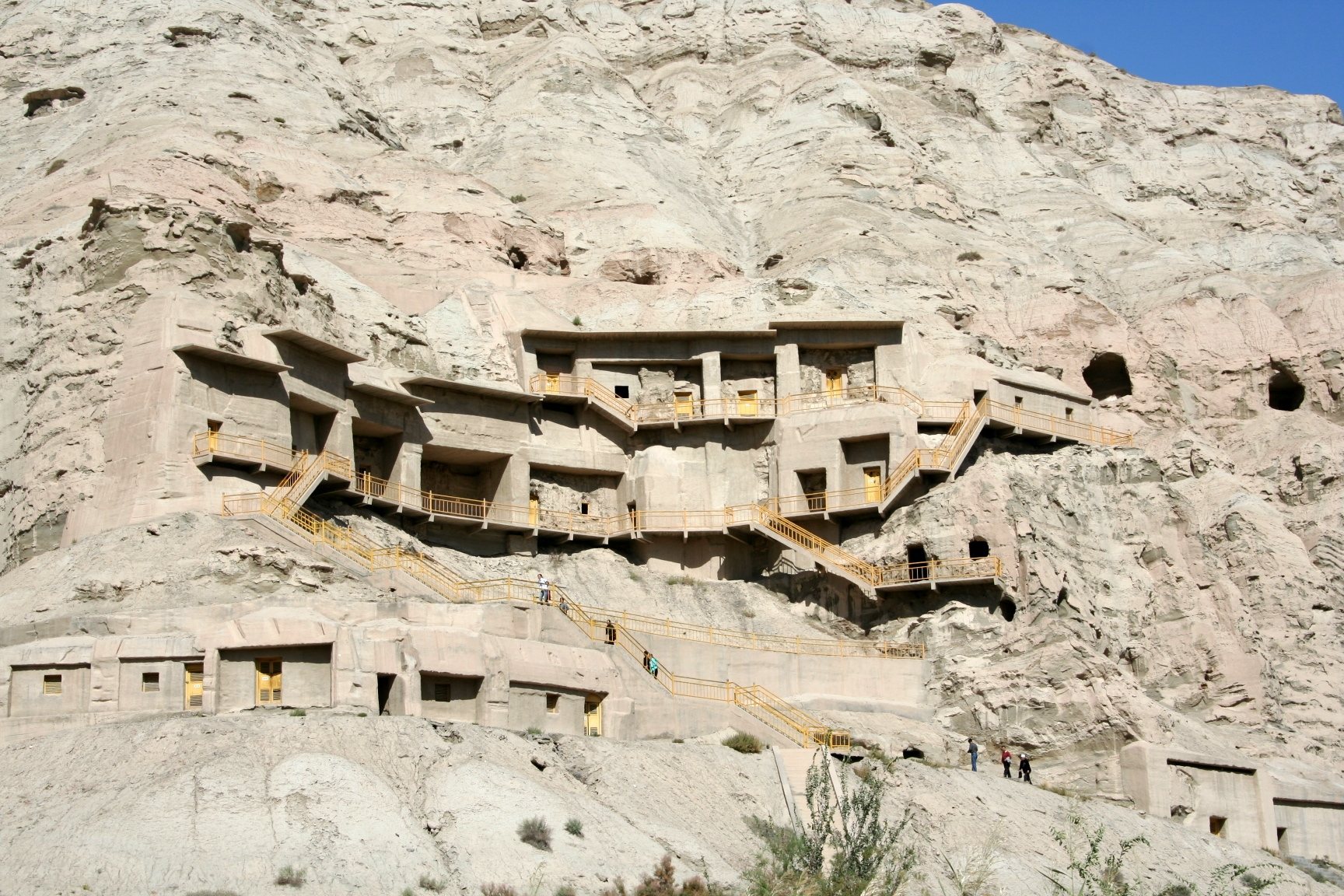
The Kizil Caves are a Buddhist rock-cut cave complex on the northern bank of the Muzat River in Baicheng County, Xinjiang, China. Built within the cultural world of the ancient Tocharian kingdom of Kucha, the complex developed from about the 3rd to the 8th century CE and became the largest ancient Buddhist cave site associated with Kucha, as well as the largest such complex in Xinjiang. Its paintings and religious institutions played an important part in the movement of Buddhism and artistic ideas across Central Asia and along the northern Silk Road.
Kucha and the first caves
Kucha was an oasis kingdom in the northern Tarim Basin, about 65 kilometres east of the caves. Its position connected Central Asia with India, Iran, and China, helping it prosper as a commercial and cultural centre. Buddhist missionaries and translators travelled through the region, and the Kuchean monk Kumarajiva, active around 344 to 413 CE, helped transmit Indian Buddhist scriptures into Chinese cultural spheres.
The earliest Kizil caves are generally dated to around 300 CE, partly on the basis of radiocarbon analysis. During the period of construction, Kucha followed the Sarvastivada school of Buddhism, which held that phenomena exist across the past, present, and future. An earlier and smaller Dharmagupta presence has also been identified. The simpler square caves may have been connected with that tradition, while the central-pillar caves that became common from about the mid-6th century are more closely associated with the Sarvastivadins.
Kizil is regarded as the earliest major Buddhist cave complex in China and as an early model for Buddhist cave construction farther east. Its art probably influenced the Mogao Caves at Dunhuang and later Chinese cave painting, particularly during the Northern Liang period. The complex also preserves evidence of the multilingual world of Kucha. A Tocharian B love poem, manuscript B-496, is dated to about 600 CE, while Sanskrit and Tocharian manuscripts, including theatrical texts, indicate the range of literary activity connected with the caves. The library has been described as containing some of the oldest known copies of Indian drama.
Royal patronage and changing political control
Inscriptions provide some of the clearest evidence for the later history of the complex. A royal inscription in Cave 69 states that a temple was constructed for the benefit of Suvarnapushpa by his son. Suvarnapushpa ruled approximately from 600 to 625, and his son Suvarnadeva ruled approximately from 625 to 648. Inscriptions in Cave 205 name the Kuchean ruler Anantavarma, the future king Tottika, and the princess Svayamprabha. Related inscriptions connect these figures with Suvarnapushpa and Suvarnadeva and place the cave toward the end of the 6th century.
Kucha was conquered by Tang forces in 648 CE. The Tang dynasty ruled China from 618 to 907, and its intervention brought stronger Chinese political and artistic influence to the region. It also marked the end of the earlier Indo-Iranian artistic predominance at Kizil. Only Caves 43 and 229 are identified as containing Tang-period art. Tibetan forces controlled much of the Tarim Basin from 670 to 692, the Uyghur Khaganate took control of the northern Tarim Basin in 753, and the region was under Muslim dominance by about 900. Researchers generally believe that the caves were abandoned around the beginning of the 8th century, after Tang influence reached the region.
A 13th-century Tibetan document preserves a tradition that a Tokharian king called Mendre commissioned paintings with the advice of the monk Anandavarman. Mendre has possibly been identified with the legendary Mandhatr or with the Indo-Greek king Menander. The document also names artists associated with India, Syria or the Byzantine world, and other regions, but the historical meaning of this account remains uncertain.
Artistic development and modern investigation
The murals are generally divided into three principal artistic periods spanning approximately 300 to 650 CE, followed by a later Uyghur-Chinese phase. The first Indo-Iranian style uses delicate brown, orange, and green painting and reflects Gandharan, Indian, and Iranian influences. Its earliest phase, dated broadly to about 300 to 400, is marked by fine lines, subtle tonal changes, and carefully modelled bodies. A bolder style emerged around 400 to 500, using stronger colours, thicker lines, and simpler forms.
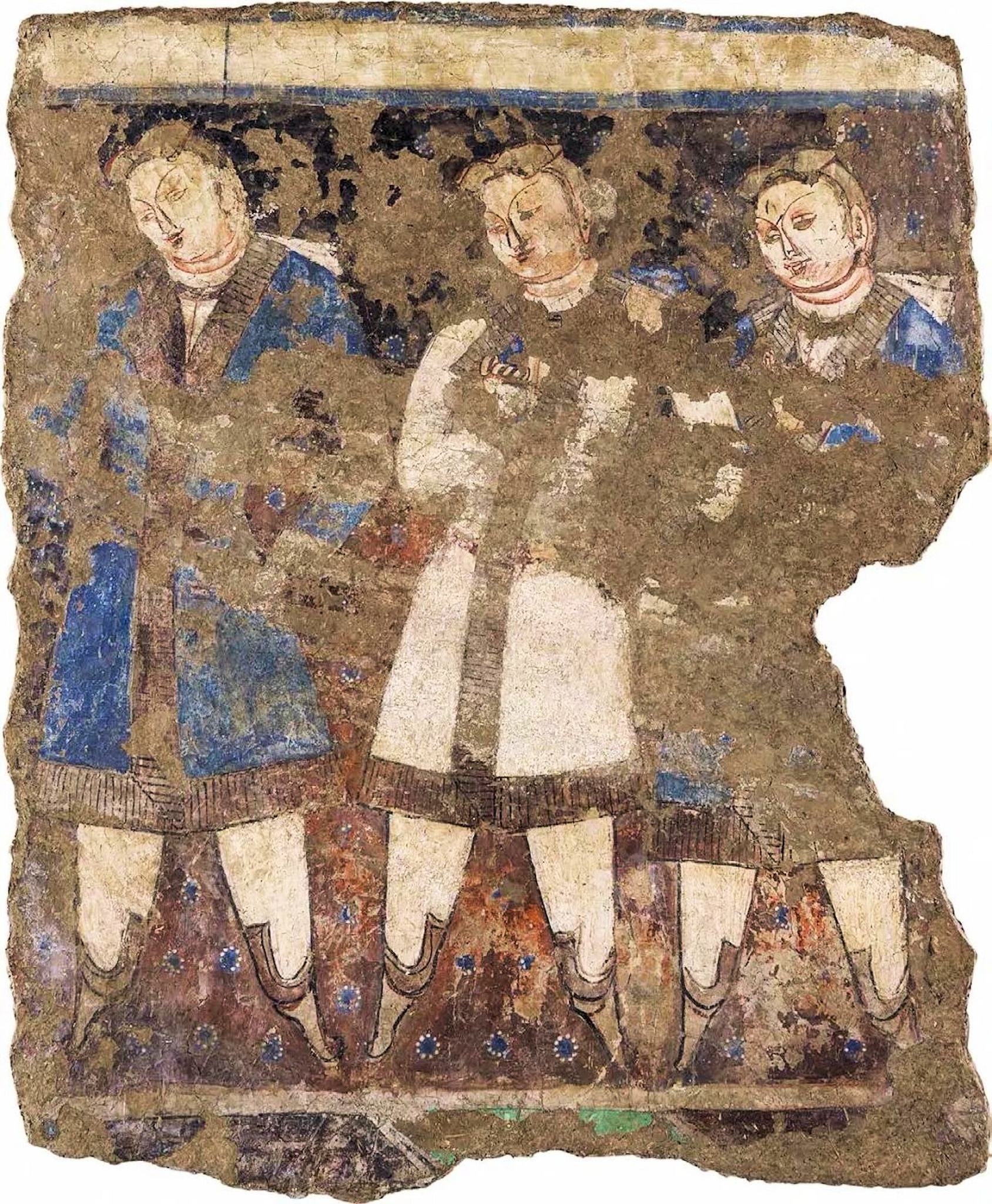
The second Indo-Iranian style developed through several transitional phases. Its Central Asian character appears in Sogdian textiles, caftans, long swords, pearl medallions, and Iranian or Central Asian mythological figures. The Hephthalites, a powerful Central Asian polity that controlled parts of Bactria and the Tarim Basin during the 5th and 6th centuries, exerted important political and artistic influence during this period. The later phase, from about the mid-6th to the early 7th century, followed Turkic expansion after the revolt against the Rouran Khaganate in 552. Its paintings use vivid colours, abundant lapis lazuli blue, elaborate ornament, and figures wearing armour and pear-shaped segmented helmets.
The early tradition is associated with the western artistic school of the Tarim Basin. It reflects influences from Gandhara, Kashmir, Bactria, Iran, and particularly the Hephthalites, while the first two major phases show little or no East Asian influence. A later Uyghur-Chinese style, visible in only two Kizil caves, reflects the stronger Chinese influence that followed Tang intervention.
The caves were first explored by the Otani expedition between 1902 and 1904. Led by Tesshin Watanabe and Kenyu Hori and financed by Count Otani, the Japanese expedition left after about four months because of a local earthquake. Albert Grünwedel led the Third German Turfan Expedition at Kizil from December 1905 to July 6, 1907. Albert von Le Coq participated under Grünwedel but left in June 1906 because of serious illness.
The German expedition photographed and copied murals before removing many paintings, sending almost 120 crates of mural panels to Berlin. One mural of warriors in the Cave of the Painters disintegrated during removal, leaving only a few fragments in the cave. Grünwedel published his findings in 1912. Paul Pelliot and the photographer Charles Nouette visited for several days beginning on September 1, 1907, and Nouette produced extensive photographic records. Von Le Coq returned with the Fourth German Expedition in 1913 and 1914 and removed additional paintings, generally making fewer records than Grünwedel.
Many removed fragments are now held in the Museum of Asian Art in Dahlem, Berlin, while others entered museums in Russia, Japan, Korea, and the United States. Some Berlin material was lost during the Second World War, and other fragments were taken to the Soviet Union and are now in the Hermitage Museum. The caves have also suffered religious vandalism, looting, weathering, dismantlement, and later damage. Destruction by the Red Guards and changes made for tourism since 2005 caused further alteration and irreversible loss of archaeological information.
The chronology of the complex remains disputed. Grünwedel’s influential 1912 scheme divided the art into two broad styles, while later epigraphic and radiocarbon studies challenged his dates. Radiocarbon campaigns took place in 1979, from 1979 to 1981, from 1989 to 1993, and through Japanese investigations in 1995, 1997, 1998, and 2011. Results are often inconclusive or contradictory because the relevant period is short compared with the margins of dating. Researchers therefore commonly combine radiocarbon evidence with stylistic and architectural analysis. In 2014, the Kizil Caves were inscribed as part of the UNESCO World Heritage property Silk Roads: the Routes Network of Chang’an-Tianshan Corridor.
Remains
The Kizil complex contains 236 cave temples cut into a cliff extending approximately 2 kilometres from east to west. The caves form western and eastern groups, and their later numbering follows their geographic position from west to east. About 135 remain relatively intact, while many others preserve fragmentary architectural and painted evidence. Approximately two-thirds are monastic cells, or kutis, used as living quarters and storage spaces. These generally lack mural paintings, while the ritual caves preserve the principal architectural and artistic programme.
Cave types and painted programme
The principal cave types include square or rectangular rooms, central-pillar caves, caves designed for colossal images, and monastic cells. In a central-pillar cave, the apparent pillar is uncut rock left at the rear of the chamber. A circular passage was cut around it for ritual circumambulation, the practice of walking around a sacred object. The usual arrangement consists of a large vaulted front chamber, a smaller rear chamber, and two tunnel-like side corridors connecting them.
The central pillar normally contains a niche for a Buddha image and symbolically reproduces a stupa, a Buddhist reliquary monument. The main Buddha sculptures that once occupied the front niches have not survived. In the principal chamber, scenes of the Buddha’s sermons commonly appear on the walls, while Jataka stories, which narrate the Buddha’s previous lives, occupy rhomboid ceiling compartments. Avadanas, exemplary Buddhist legends about the moral consequences of actions, also form part of the painted programme. The central niche may contain an Indrasala Cave composition, while scenes of the Buddha’s Parinirvana, his final passing from the cycle of rebirth, appear in the rear chamber or corridor. Maitreya, the future Buddha, is shown in Tusita Heaven above the exit.
Many main chambers have vaulted ceilings divided into diamond-shaped compartments. Buddhist scenes fill these compartments in superimposed sequences, creating a visual narrative across the ceiling. About 5,000 square metres of wall painting are thought to remain. The murals depict Jataka stories, avadanas, episodes from the Buddha’s life, sermons, Parinirvana scenes, donors, monks, musicians, deities, warriors, and Central Asian merchants. Their pigments and imagery reveal the successive artistic connections of the Tarim Basin, from Gandharan, Indian, and Iranian traditions to Central Asian, Sogdian, Turkic, and later Chinese influences.
Colossal-image and late central-pillar caves
Cave 77, the Cave of the Statues
Cave 77, known as the Cave of the Statues, is a cave designed for a colossal image near the Peacock Cave. Its main chamber had no niche but contained a podium approximately 3.8 by 1.4 metres, probably intended for a colossal standing Buddha. The chamber was about 6 metres high, and its roof has collapsed. A rear room preserves a rare gabled ceiling. The cave belongs to the small group at Kizil planned for very large Buddha images.
Cave 123, the Cave with the Ring-Bearing Doves
Cave 123 is an exceptional late central-pillar cave. Its circumambulatory corridor surrounds a near-cubic main chamber measuring approximately 3.42 by 3.42 metres. A richly decorated dome rises above the niche, and rows of flying geese holding rings or wreaths give the cave its name.
Two monumental Buddhas occupy the sides of the main chamber. Their full-body mandorlas, almond-shaped halos surrounding the entire body, contain numerous seated or standing Buddhas representing the Great Miracle of Shravasti. The side corridors contain related Buddha images, devatas, Vajrapanis, and rows of birds carrying rings. Vajrapani is a powerful Buddhist protector commonly shown beside the Buddha.
Caves 184, 186, and 187
Caves 184, 186, and 187 represent the final narrative phase of the Kizil paintings. In these caves, monumental and cosmological Buddha images dominate the compositions, while secondary figures and narrative scenes occupy a reduced role.
Later Uyghur-Chinese paintings
Caves 43 and 229 contain art associated with the later Uyghur-Chinese or Tang-influenced style of the 8th and 9th centuries. Their paintings reflect the stronger Chinese influence that followed Tang intervention in Kucha and provide the clearest surviving examples of the complex’s later artistic phase.