Kaaba: Islam’s Central Sanctuary in Mecca
Site at a Glance
- Rating
- 4.9
- Popularity
- Very High
- Country
- Saudi Arabia
- Primary era
- Early Modern
- External website
- Open
- Eras represented
- Medieval, Early Modern, Modern
- Civilizations
- Ottoman, Saudi, Umayyad
- Site type
- Religious
- Remains
- Sanctuary
On this page18 sections
History
The Kaaba is an Islamic sanctuary at the center of the Masjid al-Haram in Al Haram, Makkah, Saudi Arabia. Muslims regard it as their holiest site, the qibla, or direction of prayer, and the destination of Hajj and Umrah, the major and non-seasonal pilgrimages to Mecca. Its earliest construction has no firm date, while its present form mainly reflects an Ottoman rebuilding completed in 1630.
Origins and the pre-Islamic sanctuary
Islamic tradition describes the Kaaba as the first house of worship established for humanity. Traditions variously attribute its earliest construction to angels before Adam, to Adam or his descendants, and its rebuilding after the Flood to Ibrahim and his son Ismail. The Quranic account specifically associates Ibrahim and Ismail with raising the foundations and purifying the sanctuary for worshippers.
Muslim tradition holds that the earlier structure was destroyed or lost in the Flood and that Ibrahim and Ismail rebuilt it at a site revealed to Ibrahim. The Black Stone was brought to Ibrahim and placed in the building’s eastern corner. The sanctuary became associated with pilgrimage, sacrifice, and a protected area where warfare and bloodshed were forbidden.
Before Islam, the Kaaba served as a pilgrimage sanctuary for Arabian tribes and also had social functions. It contained idols, sculptures, and paintings, including traditions describing an image of Hubal and other religious images. Accounts also associate its interior with money, decorations, and a pair of ram’s horns. Mecca was treated as a protected zone in which tribal conflict was suspended.
Tradition attributes the first door to the South Arabian king Tubba, while other traditions associate earlier roofing with Qusay ibn Kilab. Qusay is also said to have roofed the building with dom wood and palm branches. These traditions do not provide a firm date for the earliest construction.
The Quraysh rebuilding
Shortly before Muhammad’s prophethood, the Quraysh rebuilt the Kaaba after a fire weakened the building and a subsequent flood damaged it. Their funds were insufficient to include a section of foundations associated with the earlier Abrahamic structure, so this area remained outside the rebuilt walls and became the Hijr Ismail, also called the Hatim.
The Quraysh raised the building, added a roof and rain spout, lifted the entrance above ground level, and closed the opposite door. Muhammad, then about thirty-five years old, took part in the rebuilding. When the clans disputed who should replace the Black Stone, he settled the dispute by having their leaders lift it on a cloth before placing it in position himself. One tradition connects the work with timber from a wrecked Byzantine vessel and an Egyptian or Coptic carpenter.
Islamic transformation and Umayyad sieges
After the conquest of Mecca in 630 CE, Muhammad removed the idols and images associated with pre-Islamic worship. The Kaaba thereafter became a sanctuary dedicated exclusively to Islamic monotheism. According to Islamic tradition, the direction of prayer changed from Jerusalem toward the Kaaba in 624 CE.
In 683 CE, during the first Umayyad siege of Mecca, catapults and fire damaged and burned the Kaaba and parts of the mosque. Abdullah ibn al-Zubayr demolished the damaged structure and rebuilt it according to the foundations traditionally attributed to Ibrahim. He incorporated the Hatim, created two ground-level doors, and expanded the surrounding mosque.
During the second siege of Mecca in 692 CE, the Umayyad army commanded by al-Hajjaj ibn Yusuf again bombarded the sanctuary. After Abdullah ibn al-Zubayr was killed, Abd al-Malik ibn Marwan ordered al-Hajjaj to remove Ibn al-Zubayr’s additions, close the western door, and return the building to the Quraysh configuration. The work restored a single raised entrance and placed the Hatim outside the main structure.
The Black Stone and later rebuilding
In 930 CE, the Qarmatians attacked Mecca, killed pilgrims, and seized the Black Stone. They carried it to al-Ahsa in eastern Arabia, where it remained for about twenty-two years before returning to the Kaaba in 952 CE, corresponding to 339 AH.
Heavy rain and flooding in 1626 caused the Kaaba’s walls to collapse and damaged the Masjid al-Haram. Under the Ottoman sultan Murad IV, Egyptian engineers rebuilt the structure in 1630 using granite from Mecca. The work began and ended in that year, while later Ottoman interventions consisted of repairs and replacements rather than another complete reconstruction.
During the Ottoman period, the sanctuary and its associated features received repeated repairs. Sultan Murad IV replaced the door in 1045 AH, and Ottoman rulers renewed marble surfaces and other elements of the Masjid al-Haram. In the Saudi period, a new gold door was commissioned during the reign of King Khalid ibn Abd al-Aziz. Under King Fahd ibn Abd al-Aziz, major restoration replaced old wooden columns with teak, removed and rebuilt the roof, repaired eroded stones, and reinforced the floor with marble.
Custodianship and continuing ritual use
Custodianship includes opening and closing the building, cleaning it, washing its interior, maintaining its covering, and caring for its key. This responsibility passed through several groups in Islamic and pre-Islamic tradition and is now held by the Banu Shaybah, descendants of the Quraysh lineage associated with the office.
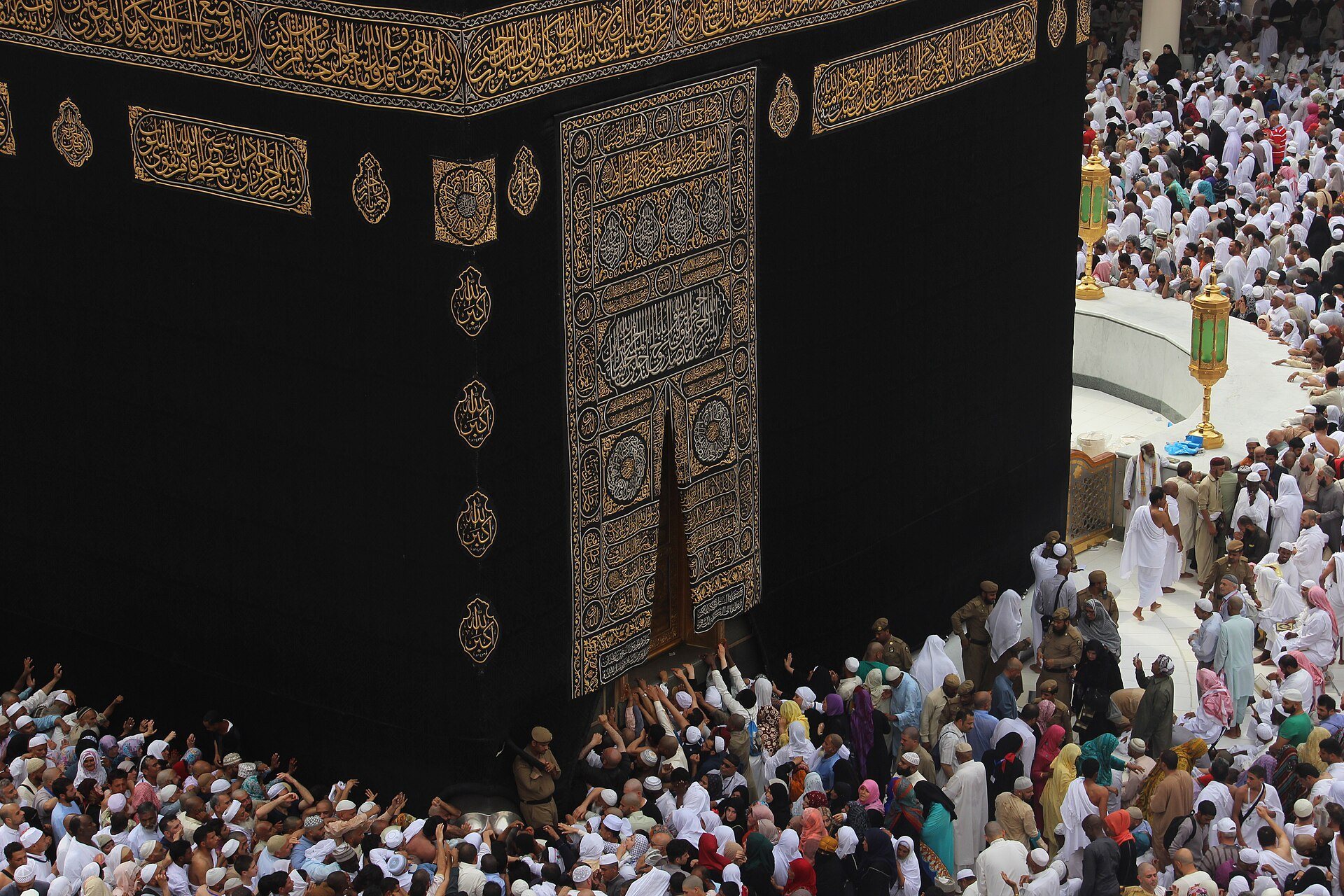
The Kaaba has historically been dressed with a kiswah, the ceremonial textile covering placed over the building. Traditions attribute the first complete covering to Tubba, king of Himyar. The Quraysh later organized regular funding for it, and Muslim rulers supplied it after the Islamic conquest. For long periods it was sent from Egypt, while Saudi Arabia assumed responsibility for its production in the twentieth century and established a dedicated workshop in Mecca.
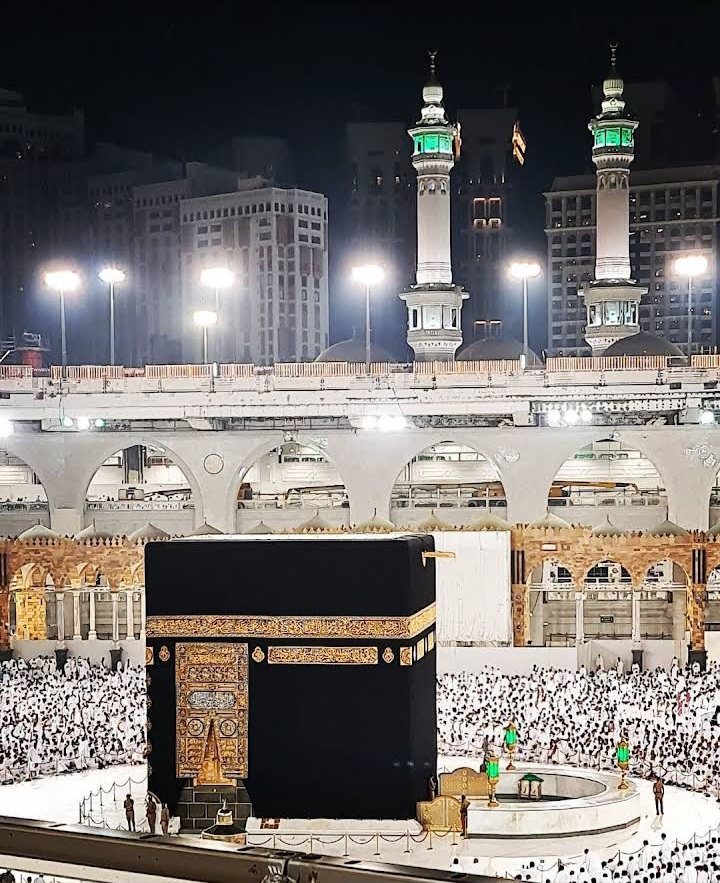
The Kaaba remains an active religious sanctuary. Tawaf, the ritual circumambulation of the building seven times counterclockwise, is an essential rite of both Hajj and Umrah. The building is periodically opened for an established interior-cleaning ceremony using Zamzam water and perfumes, and the kiswah is replaced annually during the Hajj season.
Remains
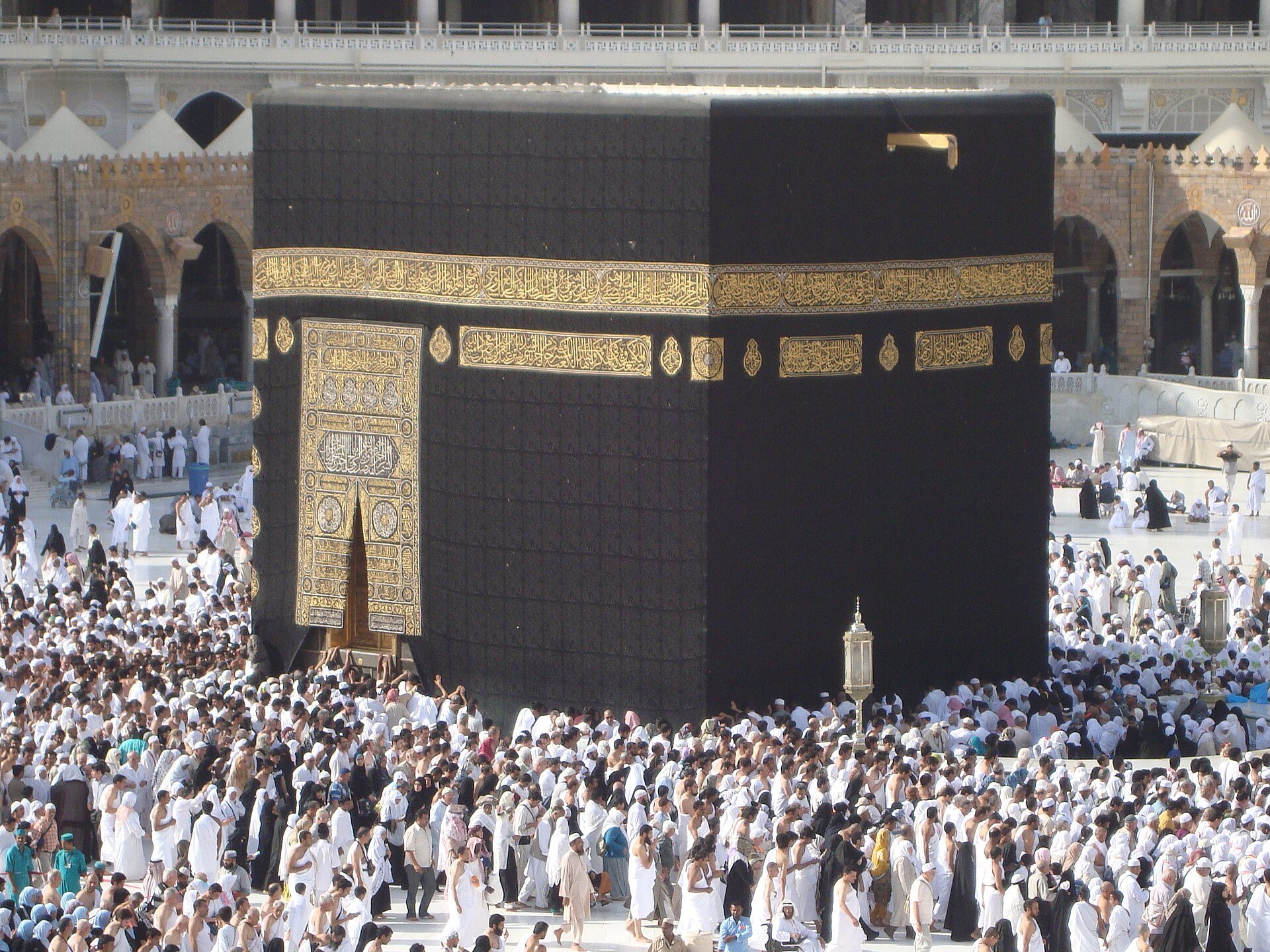
The Kaaba is a freestanding, cuboid stone building positioned approximately at the center of the Masjid al-Haram. It is about 13 meters high, with sides measuring roughly 11 by 13 meters and a floor area of approximately 119 square meters. Granite or other stone forms the principal material, while marble and limestone appear on interior surfaces and associated features. The present building derives from the Ottoman rebuilding of 1630, with later repairs and replacements.
Exterior walls and sacred markers
The corners and Black Stone
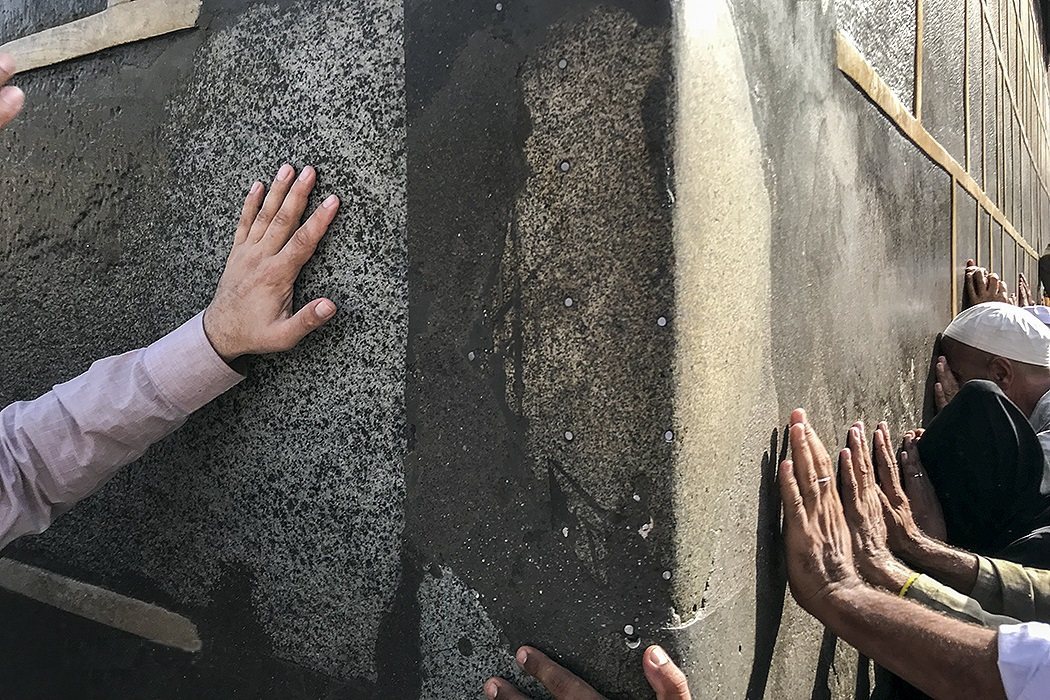
The four corners are traditionally known as the Black or Eastern Corner, the Iraqi Corner, the Levantine or Shami Corner, and the Yemeni Corner. They correspond approximately to the four cardinal directions. The Black Stone is an oval, dark stone with a reddish tinge, about 30 centimeters in diameter and approximately 1.5 meters above the ground. Set in a silver frame in the eastern corner, it marks the beginning and end of tawaf. Islamic tradition describes it as having originally been white before becoming darkened by human sins.
The entrance and lower wall
The single principal entrance is set in the northeastern wall, about 2.2 meters above the surrounding pavement. One set of measurements gives the door a height of about 3.18 meters, a width of 1.71 meters, and a depth of roughly half a meter. The modern door is made with approximately 280 to 300 kilograms of high-purity gold and bears Quranic inscriptions. Earlier doors included Ottoman-period silver-plated examples.
A staircase beside the entrance leads to the roof through the Door of Repentance. The sloping marble Shadherwan surrounds the lower exterior except beneath the entrance and along the Hijr. It projects from the foundation, reinforces the walls, protects them from floodwater, and carries rings used to attach the kiswah.
Hijr Ismail and Al-Multazam
The Hijr Ismail, or Hatim, is a low semicircular wall north of the Kaaba. About 1.3 meters high and made of white marble, it encloses ground traditionally regarded as part of the earlier structure. Because this area lies outside the present walls, tawaf is performed around the enclosure as part of the circuit around the Kaaba.
Al-Multazam is the approximately two-meter-long section of wall between the Black Stone and the entrance. In Islamic practice, pilgrims may touch this part of the wall and offer prayers.
Interior, roof, and covering
Interior structure
Three wooden columns support the roof inside the Kaaba. A small table or altar-like furnishing stands between one column and the other two, while lamp-like objects hang from the ceiling. The interior floor is raised above the surrounding tawaf area and is surfaced with marble and limestone.
The interior walls are faced with white marble or tiled marble to approximately halfway up their height, with darker trim near the floor. Inscribed marble tablets include six near the entrance and additional tablets on other walls. Gold-embroidered Quranic text runs along the upper interior walls.
Roof and rain spout
The roof and ceiling form a double-layered structure made of teak wood and capped with stainless steel. The internal staircase provides access to the roof for maintenance and replacement of the kiswah. The Mizab, or rain spout, projects from the northern wall toward the Hijr Ismail. It drains rainwater and water used to wash the roof. The present gold-clad spout was installed during the Ottoman period and later received partial repairs.
Kiswah and entrance curtain
The kiswah is a black silk covering embroidered with Quranic verses and Islamic declarations in gold and silver thread. A broad embroidered band called the hizam encircles the building, while the specially decorated curtain over the entrance is known as the sitara or burqu. Together, these textiles cover and distinguish the exterior of the sanctuary.
Associated features and surrounding pavement
Maqam Ibrahim
The Maqam Ibrahim, or Station of Ibrahim, is an ancient stone associated with Ibrahim’s standing place during construction of the Kaaba. It is traditionally said to preserve the impressions of his feet. The stone is enclosed in a glass and metal casing on a marble base near the Kaaba.
Orientation and circumambulation
The Iraqi Corner lies beside the eastern side of the Hijr, while the Shami Corner stands beside its western side. The Yemeni Corner is opposite the Black Stone corner, which lies near the entrance and approximately opposite the Zamzam Well. A marble strip in the surrounding pavement marks the beginning and end of each circumambulation. The Kaaba’s long axis has been observed to align approximately with the rising of Canopus, while its shorter east-west axis has been associated approximately with the summer-solstice sunrise and winter-solstice sunset.