İkinci Bayezid Camii: The Central Mosque of Edirne’s Ottoman Külliye


Site at a Glance
- Rating
- 4.9
- Popularity
- Medium
- Country
- Turkey
- Primary era
- Medieval
- Eras represented
- Medieval
- Civilizations
- Ottoman
- Site type
- Religious
- Remains
- Mosque
On this page11 sections
History
İkinci Bayezid Camii is a historic Ottoman mosque in Edirne, Türkiye, built during the reign of Sultan Bayezid II between 1484 and 1488. It formed the religious centre of the Sultan Bayezid II Külliye, an Ottoman charitable and religious complex organized around a mosque with educational, medical, lodging, and food-distribution facilities. The mosque belongs to the Sunni Islamic tradition and was intended to serve a wider religious, social, and cultural institution.
Foundation and Ottoman development
Bayezid II laid the mosque’s foundations in 1484. Construction was completed, and the building opened for worship in 1488. The architect is identified as either Mimar Hayrettin or Yakup Şah bin Sultan Şah, so its authorship remains uncertain. The mosque is regarded as a transitional work between early Ottoman architecture and the later classical Ottoman style. Its spacious interior and centralized dome arrangement contributed to the subsequent development of Ottoman mosque architecture.
The mosque stood at the centre of a complex that included a darüşşifa, an Ottoman medical institution, as well as a school for religious and medical studies, a charitable kitchen, a tekke associated with Sufi religious practice, and an inn. The hospital treated patients through music and water. It was later converted into a health museum, while other parts of the surrounding complex have also been adapted for museum use.
Inscriptions and present status
Zenbilli Ali Efendi composed the mosque’s foundation inscription, and the calligrapher Sheikh Hamdullah executed it. Sheikh Hamdullah is also associated with the inscriptions above the mihrab-shaped niches on either side of the entrance. The mosque remains open for worship, and the site has been included on UNESCO’s World Heritage tentative list since 2016.
Remains
Central mosque and courtyard
Domed prayer hall
The mosque occupies the central position within the külliye and has a square plan. Its interior is described as free of columns and arches, with a single central dome measuring 22 metres in diameter. The dome rests directly on four massive walls, producing a broad, open prayer space. At the far left of the qibla wall, the wall oriented toward Mecca, stands the sultan’s mahfil, an elevated gallery reserved for the ruler. It is supported by 17 marble columns and is regarded as the first sultan’s gallery built in Ottoman mosque architecture.
Courtyard gallery
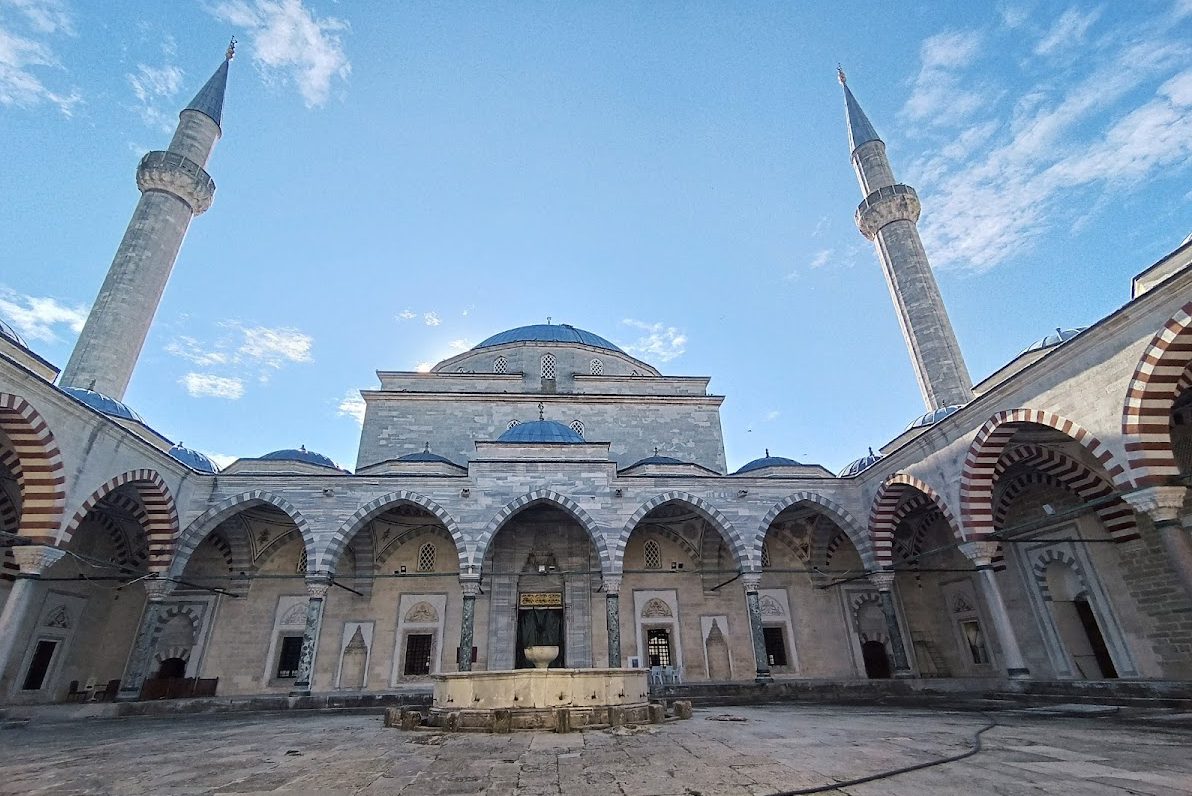
The courtyard is enclosed by a revak, or arcaded gallery, made up of 22 domes. At its centre is an open-topped shadirvan, a fountain used for ablution. The courtyard and its covered gallery form the principal approach and transitional space around the square prayer hall.
Entrance and surviving workmanship
Foundation inscription
The main entrance carries a foundation inscription arranged in two lines and six cartouches. Its date is encoded through the abjad system, which assigns numerical values to letters so that words or phrases can express a date. The phrase “Good and Beautiful” corresponds to 893 in the Islamic calendar, approximately 1487 to 1488.
Calligraphy and doors
Five-line inscriptions appear above mihrab-shaped niches on the walls to the right and left of the entrance. The exterior entrance also bears the Quranic verse beginning, “When the call to prayer is proclaimed on Friday, hasten to the remembrance of God,” together with exterior decorative designs. The mosque’s interlocking wooden doors are examples of the kundekari technique, a traditional form of interlocking woodworking. Floods of the Tundzha River damaged the doors after they remained underwater for extended periods, and they were transferred to the Edirne Museum for preservation.
Associated külliye buildings
The former hospital, school, charitable kitchen, tekke, and inn survive as constituent buildings and facilities of the Sultan Bayezid II Külliye. Together with the central mosque, these structures represent the complex’s combined religious, medical, educational, charitable, and lodging functions.