Kilteel Castle: A Medieval Tower House on Ireland’s Pale Frontier


Site at a Glance
- Rating
- 4.3
- Popularity
- Very Low
- Country
- Ireland
- Primary era
- Medieval
- External website
- Open
- Eras represented
- Medieval
- Civilizations
- Crusader, English, Knights Hospitaller
- Site type
- Military
- Remains
- Castle
On this page13 sections
History
Kilteel Castle is a late medieval fortified tower house in Ireland, near Naas in County Kildare, built around 1400 on a contested frontier of the Pale. The Pale was the area under English administration and settlement in medieval Ireland, where fortified boundaries separated English-controlled territory from lands held by independent Irish clans. The castle replaced or strengthened earlier defensive installations and remained exposed to attacks for centuries.
Early medieval Kilteel
The land around Kilteel was occupied from prehistoric times. A nearby mound in Kilteel Wood was traditionally associated with the inauguration of local kings and clan chiefs. Alexander Taylor described the mound and the remains of an ancient fortification in 1783, and John Taylor returned to the subject in 1816.
During the early medieval period, the district belonged to the Mac Brennan clan, a sept, or kin-based branch, of Fothairt Airthir. Rathmore served as the residence of the clan chief, while the principal church of Fothairt Airthir stood on land connected with the Uí Máel Ruba sept. The name Kilteel comes from an Irish expression meaning “Church of Hele.”
In the seventh century, Bishop Kele Krist of the Cenél nEógain lineage established a church at Kilteel. An early form of the place-name appears in a papal letter of 1179. Another church, known as Kildronan or Cell Epscoip Drónáin, also stood in the surrounding area.
Anglo-Norman and Hospitaller control
Maurice FitzGerald granted the land to the Crowal family in 1257. In 1317, All Saints Priory, a Christian religious house governed by a prior, sought to recover the property, which was then held by Thomas de Crowal.
During the twelfth and thirteenth centuries, the area was associated with the Knights Hospitaller, a medieval military-religious order that held land and operated fortified establishments. The order reportedly built a castle at Kilteel in 1212, although it remains uncertain whether Gerard FitzMaurice or his son Maurice FitzGerald granted the land to them. Foundations belonging to that earlier stronghold survive separately from the present castle.
Frontier warfare and the present castle
Kilteel formed part of the Pale’s frontier and was repeatedly threatened by the O’Byrnes and O’Tooles, Gaelic clans outside direct English control. In the fourteenth century, Edward III issued letters requiring the defense of Kilteel, Rathmore, and Ballymore against O’Byrne and his allies. Acts passed in 1488 and in 1494–1495 placed the Pale boundary through Kilteel and Rathmore and required defensive earthworks along parts of the frontier.
The present castle was built around 1400 during this period of territorial tension. Its position brought further attacks. Rory O’More sacked and burned it in 1573 and repeated the assault in 1574. Fiach MacHugh O’Byrne attacked Kilteel during the Second Desmond Rebellion in 1580, an uprising against English rule in Ireland. The castle was then defended by 50 cavalrymen and 100 infantrymen. Fiach’s son attacked it again in 1595.
Reformation and later ownership
The Reformation, the sixteenth-century religious transformation that led to the dissolution of monasteries and the transfer of ecclesiastical lands, altered ownership around Kilteel. The lands passed to the Allen family of Norfolk. John Allen became Lord Chancellor of Ireland in 1536, while a lease dated 12 July 1539 identified Thomas Allen and his wife Mary as holders of Kilteel and defenders against attacks by the O’Tooles.
John and Thomas Allen received royal pardons in 1549. Robert Allen held the castle from 1554 to 1556 and was described as an Irish Catholic. Thomas Allen appeared among the judges, commissioners, and peace officers in 1561, and Robert Allen was recorded at Kilteel in 1626. The nearby church was destroyed in 1630, later restored, and subsequently destroyed again. Control of it changed between Catholic and Protestant authorities.
In 1669, the castle was held by the Earl of Tyrconnell. During the Jacobite and Williamite wars, conflicts arising from the struggle between James II and William III and their supporters, the castle and estate were confiscated. A company purchased the castle in 1703, William Fownes acquired it in 1706, and John Kennedy bought the castle and estate in 1838. Estate lands were later sold to tenants under late nineteenth-century land legislation. Kilteel Castle and the associated archaeological remains are now listed among Ireland’s protected archaeological monuments.
Remains
Kilteel Castle occupies a complex of medieval and early medieval remains that includes a five-storey stone tower house, an attached gatehouse, earlier castle foundations, church ruins, a cemetery, and traces of the Pale boundary. The surviving structures combine rubble-stone construction with evidence of successive defensive, religious, and territorial uses.
Castle and defensive remains
Tower house
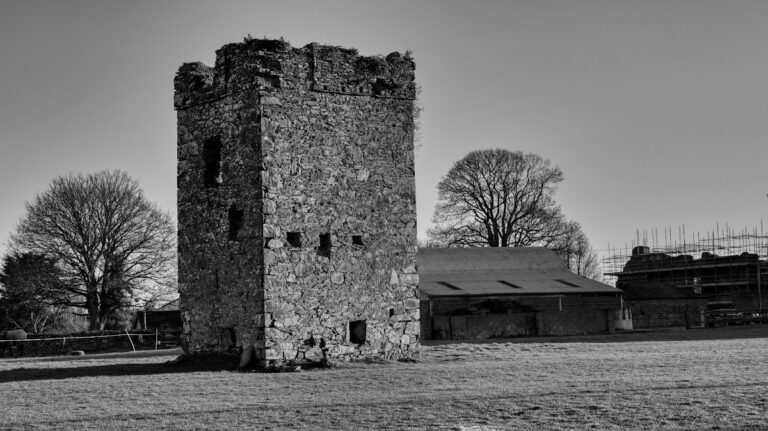
The present castle is a rectangular tower house, a fortified residential tower of the late medieval period. It has five storeys, with four upper floors rising above a ground floor covered by a vaulted ceiling. The ceiling over the third floor is also vaulted, and underground chambers or cellars form part of the building. Constructed from rubble stone, the tower is described as being in good condition.
An illustration published in the Dublin Penny Journal in 1833 shows the castle with steep gables. These may represent alterations made in the late seventeenth or early eighteenth century. A similar form appears in an undated drawing held in the Edwin Rae collection at Trinity College Dublin.
Gatehouse and earlier castle
A gatehouse is attached to the southwest side of the tower house. The castle complex originally had an enclosing structure, adding a wider defensive setting to the residential tower.
Separate foundation remains belong to the Hospitaller-period castle reportedly built in 1212. These earlier remains reflect the presence of a fortified establishment before the construction of the present tower house. A cannonball possibly dating from the seventeenth century was found near the castle in 1901.
Church and cemetery
Romanesque church
Near the castle are the ruins of a Romanesque stone church. Romanesque architecture is a medieval style associated with rounded arches and substantial masonry. The church was built around 800 and was connected with carved sculptures, some of which were later moved to other churches. Its setting beside an old cemetery preserves the association between the religious building and burial ground.
Stone cross
A large stone cross survives near the church and is associated with Diarmait Mac Murchada, the medieval king of Leinster. His mother belonged to the Mac Brennan clan, linking the monument’s traditional association with the early medieval community connected with Kilteel.
Early settlement and Pale boundary
Archaeological investigations in the area identified two churches, a monastery, and a circular fortification with a D-shaped plan. Together with the church, cemetery, cross, and earlier castle foundations, these remains indicate a landscape occupied by religious and defensive sites over many centuries.
A section of the former Pale boundary can be identified southeast of the medieval church. Aerial imagery shows traces of a possible earthen bastion, a projecting defensive earthwork, while excavations indicate that the boundary continued eastward and divided the townlands of Kilteel Upper and Cupidstown.