Kiafa Castle: A Souliot Fortress in Greece
Site at a Glance
- Popularity
- Medium
- Country
- Greece
- Primary era
- Modern
- Eras represented
- Early Modern, Modern
- Civilizations
- Ottoman
- Site type
- Military
- Remains
- Fort
On this page8 sections
History
Kiafa Castle is a hilltop fortress in Greece and one of the fortified settlements of the Souliot Confederacy, an alliance of communities with a degree of self-government under Ottoman rule. Its defenses made it a stronghold of Souliot resistance into the Greek War of Independence, which began in 1821.
The Souliot Confederacy and Ottoman campaigns
The Souliots were a Christian, bilingual people who identified as Greek. They had been allies of Skanderbeg, the fifteenth-century Albanian leader who resisted Ottoman expansion. After his death, they moved from the Gjirokastër region to southern Epirus around 1550, seeking to escape Ottoman violence. Souli, also known as Kakosouli, Kiafa, Avariko, and Samonida formed the confederacy’s original four-settlement core, whose fortifications helped secure the community. Over time, Kiafa became a widely recognized emblem of courage and resistance in Greece.
Ottoman campaigns against Souli in 1721, 1731, 1754, 1759, 1762, 1772, and 1775 targeted Kiafa but did not take it. Three further campaigns under Ali Pasha followed in 1788, 1789, and 1800, also without capturing the stronghold. After a four-year siege, the Souliots capitulated and departed on 16 December 1803. Kiafa passed into Ali Pasha’s control without having been taken by Ottoman forces. A local tradition holds that the betrayal of Pilios Gousis may have helped bring about the capitulation.
Ali Pasha and the Souliot return
After the Souliots left, Ali Pasha of Ioannina, a powerful Ottoman provincial ruler, built a fortress at Kiafa. Its construction appears to have served his ambition to control the former Souliot stronghold more than a military need. Kiafa was not on the edge of his territory, and the four-settlement core had been assigned to Turco-Albanian settlers, who controlled the region’s 60 villages.
During Ali Pasha’s revolt against the Ottoman sultan, Mahmud II summoned the Souliots, then exiled in the Ionian Islands, to return and join the sultan’s forces. After 17 years away, they returned to Ioannina, then became paid allies of their former persecutor. On 8 December 1820, they entered Kiafa’s fortress without fighting and were received by its commandant. With the fortress as their base and 1,500 Turco-Albanian supporters of Ali Pasha joining them, the Souliots recovered their ancestral lands within five months and drove Sultan Mahmud II’s troops, commanded by Ismail Pashobey, from the Souli region.
Departure and later control
After the unsuccessful outcome of the Battle of Peta in 1822, the Souliots were forced to leave their ancestral lands again. Kiafa’s next major change came when the Greek army took control of the region during the First Balkan War of 1912–1913, fought between the Ottoman Empire and Balkan states.
Remains
Setting and plan
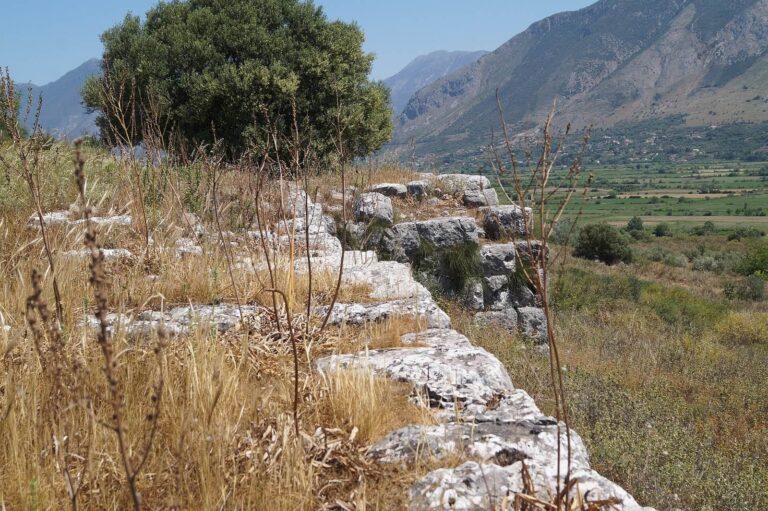
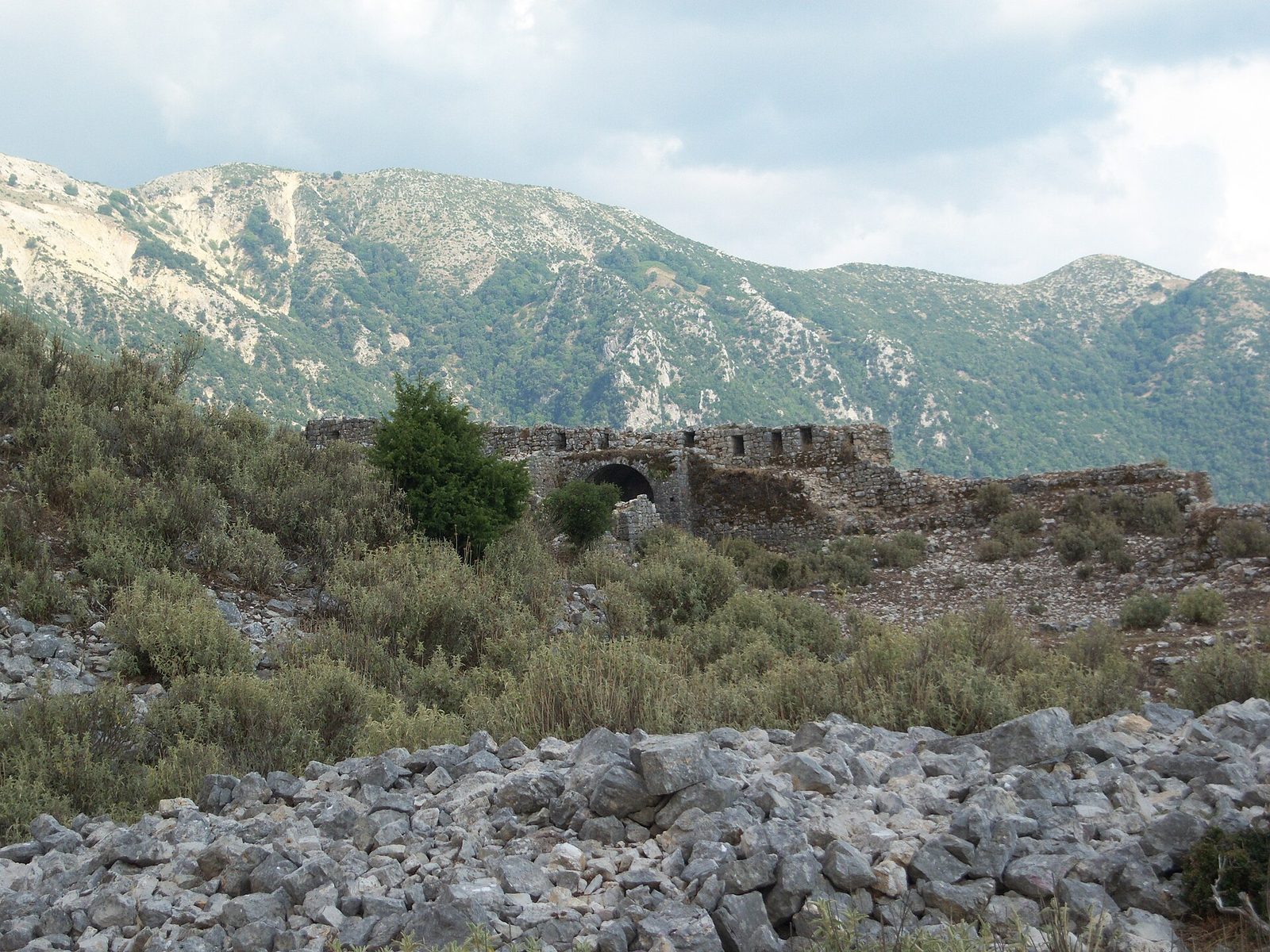
The fortress occupied the full summit of a steep hill at about 700 metres above sea level, opposite Kougi and between Avariko and Samonida. The site extends to a cliff edge. Its surroundings are rugged, rocky, treeless, and short of water, among the mountains of Mourgka, Tourlia, and Zambrouchos. The nearby Acheron River meets its tributary, the Tsangariotiko. The fortress had a rectangular plan oriented north to south.
Defensive works
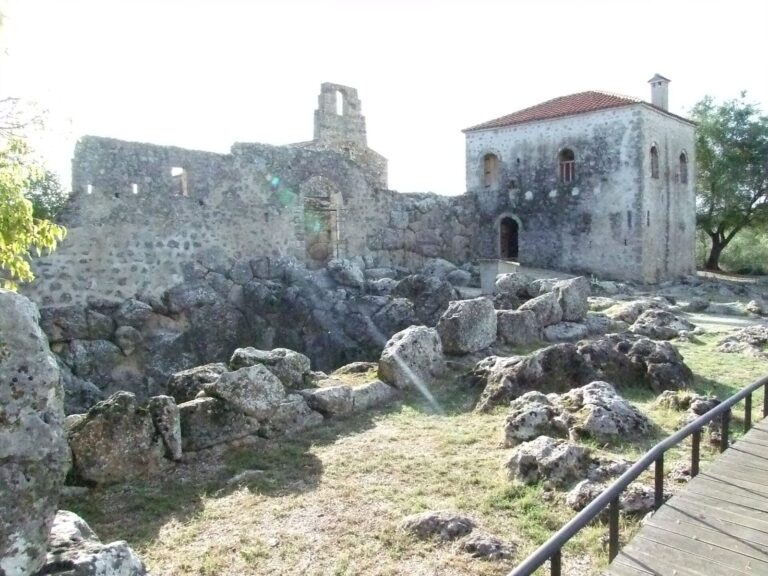
Two arched entrances gave access through the defenses. Polygonal bastions, projecting defensive structures, stood at the ends, while battlements, parapets with openings along their tops, ran around the perimeter. The walls also had cannon embrasures, openings through which artillery could fire, and buttresses, projecting supports built against a wall. Other openings were used to pour hot liquids.
Garrison buildings and facilities
Inside the fortress were accommodation and other facilities for the garrison, storehouses, powder magazines, and cisterns. A substantial guesthouse for Ali Pasha also stood within the complex; part of it remains visible from a distance.