Karlstor: Munich’s Medieval City Gate
Site at a Glance
- Country
- Germany
- Primary era
- Modern
- Eras represented
- Medieval, Early Modern, Modern
- Civilizations
- Duchy of Bavaria, Electorate of Bavaria, German, Holy Roman Empire, Kingdom of Bavaria
- Site type
- Military
- Remains
- Gate
On this page13 sections
History
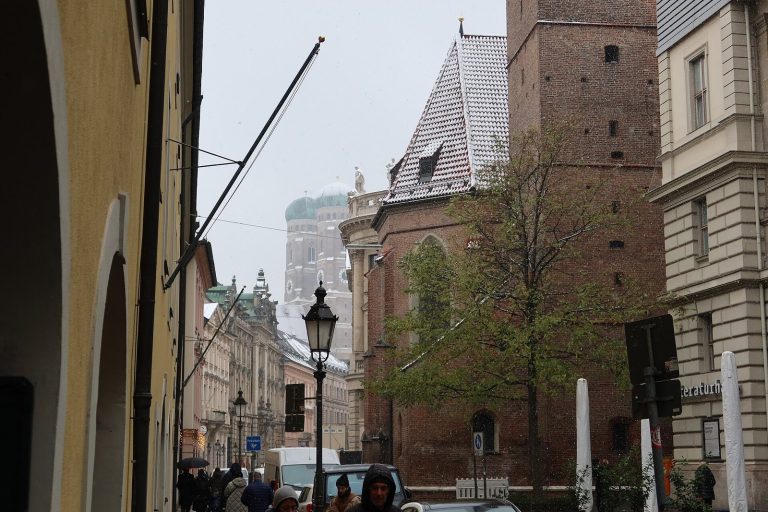
Karlstor is a medieval city gate at the western end of Neuhauser Straße in Munich, Germany. Built around 1300 as part of the city’s second fortification, it helped defend Munich as the settled area expanded.
Construction and medieval use
The second defensive circuit was built between 1285 and 1347. Karlstor was first recorded in 1302 as Neuhauser Tor, a name referring to the village reached by travelling west from the city. The gate served as a defended entrance and checkpoint, and it was strengthened and enlarged over time.
From 1448, horse races took place each year during the Jakobidult, a traditional Munich fair. The course ran from Neuhauser Tor to Feldmoching.
Changing defenses and the name Karlstor
Munich began removing its inner town wall in the 16th century, while retaining five older gate towers. During the Thirty Years’ War (1618–1648), a series of conflicts that devastated much of Central Europe, the Prince-Elector ordered new defenses designed to withstand artillery. Older walls and gates in the second defensive ring remained, while outer works were incorporated into the new system, removed, or replaced by bastions.
In 1791, Count Rumford, then commander of the Bavarian army, and architect Franz Thurn altered the flanking towers under Elector Charles Theodore. The gate took the name Karlstor in the same year, in honor of the elector. At the turn of the 19th century, an electoral order began the dismantling of Munich’s fortifications. Karlstor is one of three principal medieval city gates that survive.
Rebuilding and modern change
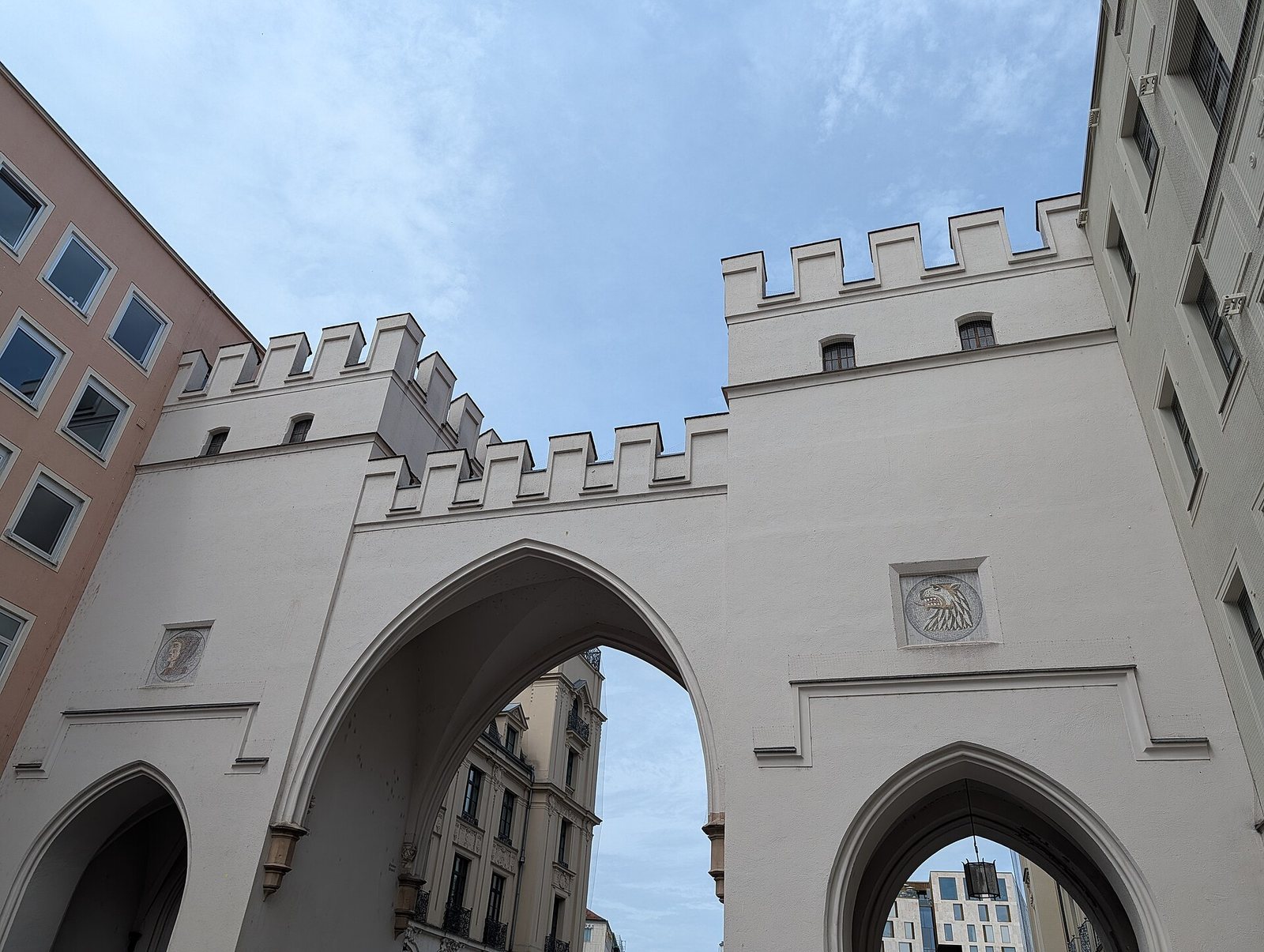
In 1857, gunpowder kept in an annex beside the main tower exploded, damaging both structures. They were later demolished, and around 1860 the main tower and the remains of the inner barbican were also removed. The flanking towers were redesigned and linked by a new bridge, and architect Arnold Zenetti remodeled the gate in the Neo-Gothic style in 1861 and 1862. Buildings designed by Gabriel von Seidl and constructed beside the gate from 1899 to 1902 incorporated and further altered the towers.
As traffic increased from the late 18th century into the early 20th, the passages were widened and raised for coaches and horse-drawn and electric trams. Some side walls were also broken through. Karlstor suffered severe damage during the Second World War and was rebuilt in a simplified form. An underground shopping-centre project at Stachus uncovered a brick escape tunnel in 1970.
Remains
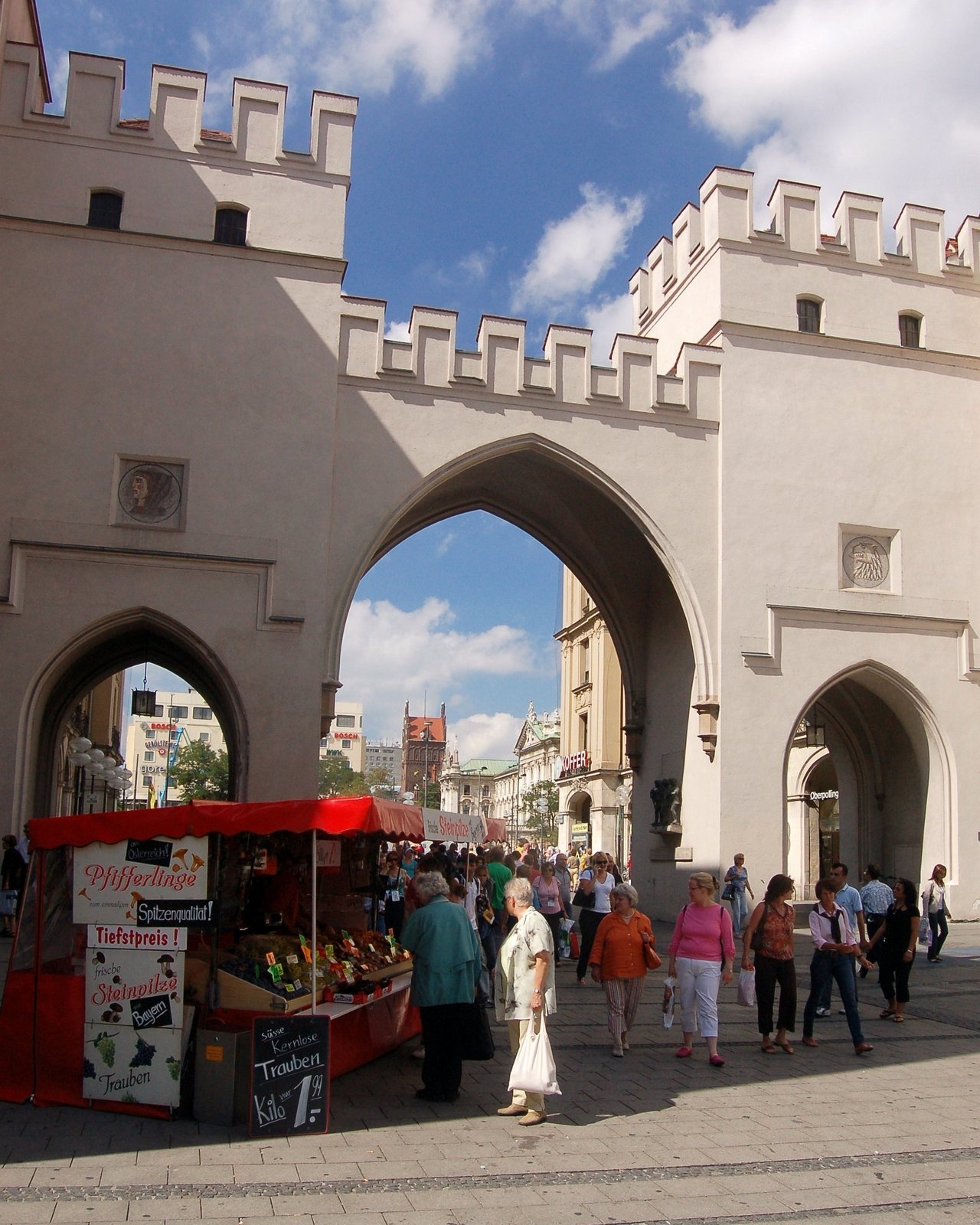
Karlstor now forms a passage between two flanking towers at the western end of Neuhauser Straße. The gate separates Munich’s old town from Ludwigsvorstadt, a 19th-century expansion, and stands beside Karlsplatz, also known as Stachus. Neuhauser Straße was part of the Salt Road and the old town’s east–west thoroughfare. The towers retain the gate’s only original medieval fabric, although both have been extensively altered.
Gate, defensive approach, and tunnel
Surviving gate fabric
The outward-facing towers and connecting arch have a later appearance than the medieval entrance, which was narrower and lower. The original main-gate arrangement had two lower towers facing the bridge, joined by a front wall with the passage at its centre. A taller tower stood on the town side, and walls linked the three towers around a small inner courtyard.
Medieval approach
The approach crossed a side channel of the moat on a wooden runway and led to a semicircular barbican, an outer defensive work protecting an entrance. A narrow opening near one corner gave access to its enclosed courtyard. From the rear exit, the route turned sharply right and crossed the broad moat on an open stone bridge.
Escape tunnel
A short section of the brick-built tunnel uncovered in 1970 is displayed on the first underground level of the Stachus shopping centre, at its fountain plaza. It was thought that soldiers, and possibly civilians, could use it to escape or reach positions behind enemy lines.
Figural and heraldic features
Memorial and musician children
A memorial to Herbert Jensen, who proposed establishing a pedestrian zone, is set on the north side of the main arch. Three musician-child figures by sculptor Konrad Knoll are also associated with Karlstor. Knoll made them in 1866 for the Fischbrunnen; they were not reused when Josef Henselmann redesigned that fountain in 1954.
Figures beneath the central vault
Four small stone figures rest on the corbels, or projecting stone supports, beneath the central vault. At the northeast is musician and folk singer Josef Sulzbeck (1767–1845), shown as Baron Sulzbeck and linked with a refrain from a Ländler, a southern German and Austrian folk dance, roughly meaning ‘Hooray, grab him by the leg.’ The southeast figure is musician and humorist Georg Pranger (1745–1820), known as Prangerl, depicted as a court jester with a panpipe. He was the last Bavarian court jester under King Maximilian I Joseph.
At the southwest, Joseph Huber (1763–1829), a small-statured shopkeeper and courier, appears as the Finessensepperl. He carried love letters and was associated with the saying ‘Nothing certain is known.’ Horse-dealer and racing-stable owner Franz Xaver Krenkl (1780–1860) occupies the northwest position. He is linked with the phrase ‘If you can, you can.’
Heraldic emblems
On the east, or inner, face of the towers, an older depiction of the Munich Child appears on the left and a lion’s head on the right. The Munich Child is the city’s heraldic emblem. On the west, or outer, face, the third coat of arms of the Kingdom of Bavaria is left of centre, while a more recent depiction of the Munich Child is right of centre.