Kandahar Bilingual Rock Inscription: Ashoka’s Greek and Aramaic Edict
Site at a Glance
- Popularity
- High
- Country
- Afghanistan
- Primary era
- Classical
- Eras represented
- Classical
- Civilizations
- Mauryan
- Site type
- Civic
- Remains
- Monument
On this page8 sections
History
The Kandahar Bilingual Rock Inscription is an edict carved by Mauryan emperor Ashoka at Chehel Zina near Kandahar, Afghanistan, around 260 BCE. The Mauryan Empire was an ancient South Asian empire. The inscription is considered Ashoka’s earliest known edict, and its text says that ten years of his reign had passed. It predates his other inscriptions, including the Minor Rock Edicts, the Barabar cave inscriptions in India, and the longer Major Rock Edicts.
Ashoka’s proclamation
The edict presents Ashoka’s call for piety after the violent beginning of his reign. In the Greek text, he says he has stopped killing living beings, and that royal hunters and fishermen have given up their pursuits. It also describes people who had lacked restraint as making efforts to control themselves. Both versions urge respect for parents and elders. The Aramaic text likewise describes reduced animal slaughter and limits on fishing, and speaks of moral restraint and the spread of peace and joy.
Languages and political setting
The Greek and Aramaic texts are not direct translations of one another, but distinct renderings of a Prakrit original, a Middle Indo-Aryan vernacular. One interpretation is that both were translated separately from Magadhi, a Middle Indo-Aryan language. The Aramaic version also contains Iranian elements that are difficult to interpret. Greek renders dharma, a moral and religious principle, as Eusebeia, meaning piety; Aramaic uses qaššīṭā, meaning upright or true. The Aramaic addresses Ashoka as ‘our lord, King Priyadasin,’ while the Greek uses the more neutral ‘King Ashoka.’ This difference has been interpreted as a stronger assertion of his authority for Aramaic-speaking readers.
Greek communities lived in the northwest of the Mauryan Empire after Alexander the Great’s conquests and settlement efforts around 323 BCE. Aramaic had served as an administrative language under the Achaemenid Empire, the Persian power that preceded Alexander in the area, and continued to matter after that empire fell. One interpretation is that the Greek addressed local Greek residents and the Aramaic the Kambojas, an ancient people associated with Iranian-speaking populations. Greek communities were also established in the Greco-Bactrian kingdom, a Hellenistic state in Central Asia, including at Ai-Khanoum in northern Afghanistan during the rule of Diodotus I.
The edict’s presence at Kandahar is generally taken to indicate that Ashoka controlled the area. Its transfer to the Mauryan sphere may have followed a peace agreement in 305 BCE, when Seleucus I Nicator, a Hellenistic ruler, is thought to have ceded territory to Chandragupta Maurya, founder of the Mauryan Empire.
Excavation near Kandahar uncovered the inscription in 1958, beneath roughly a metre of rubble.
Remains
Inscription and setting
Carved panel
The inscription is cut into rock and measures 55 cm high by 49.5 cm wide. Its Greek text is positioned above the Aramaic, preserving the two versions together on the same panel. The inscription remains on the mountainside where it was found.
Chehel Zina outcrop
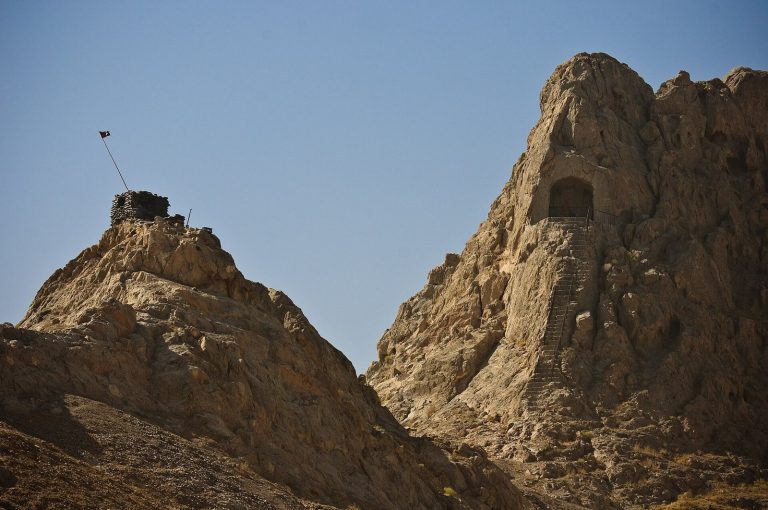
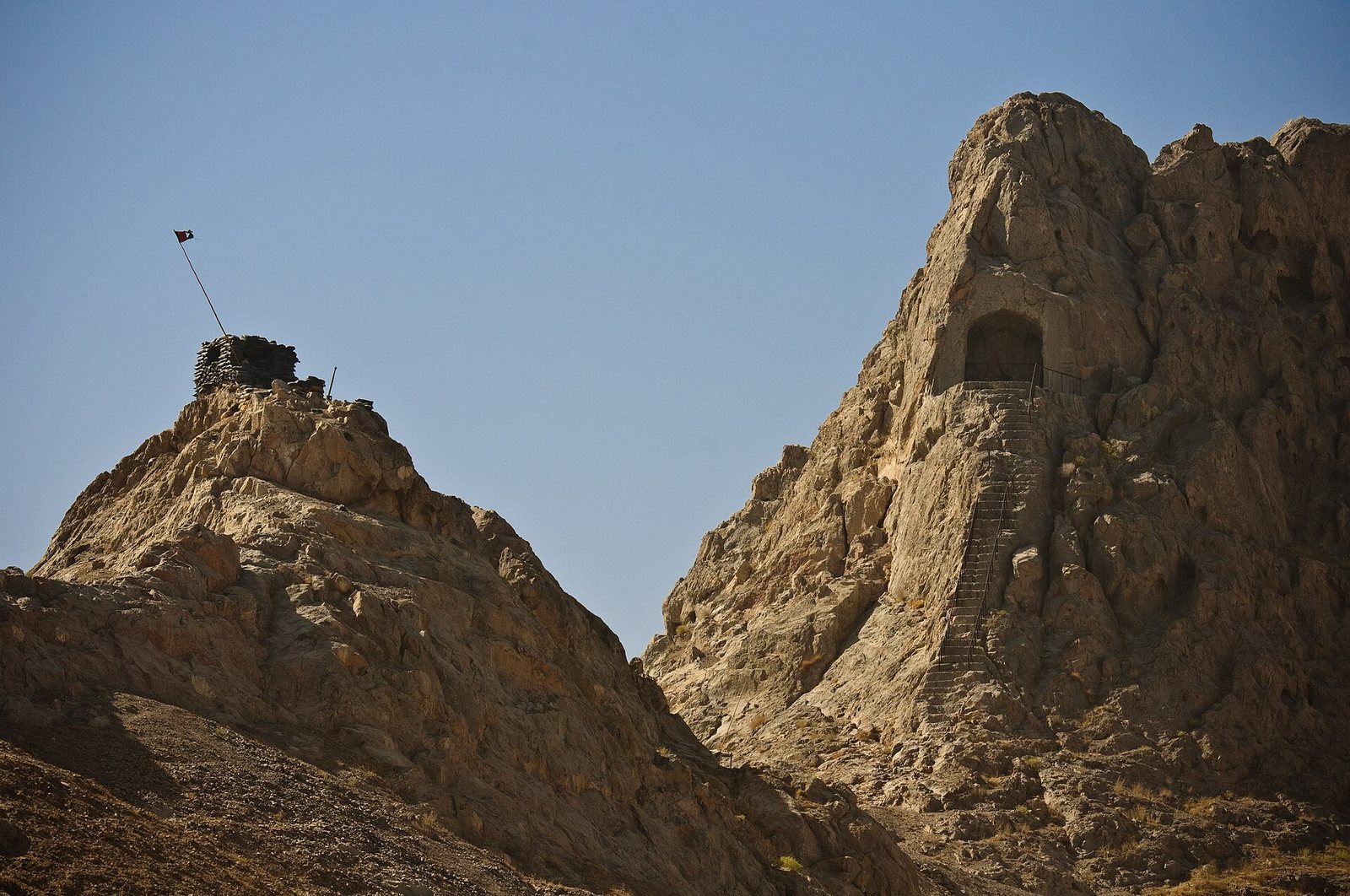
Chehel Zina, a Persian name meaning ‘forty steps,’ is a mountainous outcrop forming the western side of the natural stronghold associated with ancient Alexandria Arachosia, a Greek city, and Kandahar’s Old City. The inscription is positioned at the eastern foot of a small saddle, a low depression between two rugged hills, below the summit bearing carvings associated with Babur, founder of the Mughal Empire.
Museum cast
A cast of the inscription is held at the National Museum of Afghanistan in Kabul.