Kamieniec Castle: A Medieval Border Fortress in Poland


Site at a Glance
- Rating
- 4.4
- Popularity
- Medium
- Country
- Poland
- Primary era
- Medieval
- External website
- Open
- Eras represented
- Medieval, Early Modern
- Civilizations
- Kingdom of Poland, Polish–Lithuanian Commonwealth
- Site type
- Military
- Remains
- Castle
On this page12 sections
History
Kamieniec Castle is a medieval fortress ruin on the boundary of Korczyna and Odrzykoń in Poland. It probably began during the building programme of King Casimir III the Great in the fourteenth century and formed part of the defensive route from Poland to Hungary through the Dukla Pass. The Gothic stronghold occupies a rocky site in the Dynów Mountains and was first mentioned in 1348, when a burgrave of Camyenecz appeared in the location charter of Osobnica near Jasło.
The Kamieniecki family
In 1396, the Polish knight Klemens of Moskorzew, of the Pilawa coat of arms, received Kamieniec for his service in the defence of Vilnius. He built the Upper Castle and the eastern outer section, later known as the Middle Castle. Klemens hosted King Władysław II Jagiełło at Kamieniec in 1399. Jagiełło was king of Poland and grand duke of Lithuania during the Jagiellonian period.
Klemens founded a chapel in 1397, and it was consecrated in 1402. That year, at his request, Bishop Maciej Janina of Przemyśl increased the endowment of the castle chaplain. John of Dukla celebrated Mass in the chapel while serving as guardian of a religious house in Krosno. From 1407, Klemens’s family used the name Kamieniecki, emphasizing the castle’s place as its ancestral seat. His son Marcin inherited the family estates, including the castle at Korczyna, in 1408.
Henryk Andreas Kamieniecki inherited the castle in 1448 and enlarged it towards the east. He was castellan of Sanok until 1487, a position involving administration of the castle district and representation of the monarch. Hungarian forces belonging to King Matthias Corvinus attacked or besieged Kamieniec in 1475.
The castle later passed to Henryk’s son Mikołaj Kamieniecki, who became the first lifelong Grand Hetman of the Polish Crown. A hetman was a senior military commander in the Polish-Lithuanian political system. Mikołaj also served as starosta of Kraków and Sanok, making him a prominent military and political figure under King Sigismund I the Old.
Division between the upper and lower castles
On 12 March 1528, Crown Field Hetman Marcin Kamieniecki received the exiled Hungarian king John Zápolya at Kamieniec. Zápolya sent letters from the castle inviting Polish magnates to a meeting at Tarnów. He sought support in his contest for the Hungarian throne and attempted to secure the votes of the magnates and of Sultan Suleiman I.
From 1528, the Upper Castle was pledged to the Boner family for 2,000 florins. Under an agreement concluded at Wawel in 1530, Klemens Kamieniecki, then castellan of Sanok, sold the lower eastern section, known as the Lower Korczyna Castle, to Severin Boner, banker to Queen Bona Sforza. Boner founded a chapel there, consecrated by Bishop Stanisław Tarło, and rebuilt the Lower Castle in 1543. The Boners retained this section until 1593.
Severin Boner hosted Fausto Sozzini at the castle. Sozzini was associated with Socinianism, a non-Trinitarian Christian movement linked to the Polish Brethren. Boner’s daughter Zofia married Jan Firlej, Grand Marshal of the Crown and royal secretary, and brought the Lower Korczyna Castle to the Firlej family as her dowry. In 1575, the section was pledged to Andrzej Bolassa.
Ownership of the Upper Castle passed from the Siemieński family in 1579 to the Stadnicki family in 1599. Jan Skotnicki acquired it in 1601. The division created separate ownership of the castle’s sections and led to a dispute between Piotr Firlej and Jan Skotnicki over access to the well and the cutting of trees. The quarrel lasted about thirty years and ended with the marriage of Mikołaj Firlej and Zofia Skotnicka in 1638.
Jan Skotnicki repaired the Upper Castle walls and chapel and carried out other works there. A later dispute over rainwater flowing from a rebuilt roof and damage to the gutters became the subject of Aleksander Fredro’s comedy The Revenge, written by the nineteenth-century Polish playwright.
War, decline, and changing ownership
After forces commanded by George II Rákóczi entered Poland on 16 March 1657, Jan Firlej organized Kamieniec’s defence and mobilized neighbouring nobles. The defenders could not hold the castle, which was severely damaged. The inhabitants escaped through underground passages. In 1658, Zofia Skotnicka founded a prebend, an endowed ecclesiastical benefice, for the Brotherhood of the Most Holy Name of Jesus at the church in Odrzykoń in gratitude for her survival.
After the Swedish invasion, the castle was only partly rebuilt, chiefly in its interiors. The Mniszech and Bogatka families later occupied it. The chapel was rebuilt, but by the episcopal visitation of 1745 it had been abandoned and had fallen into ruin. An earlier visitation in 1721 still noted its condition.
After 1730, the residence passed to the Scipio family and then to the Branicki family, including Grand Crown Hetman Jan Klemens Branicki. Through the marriage of Magdalena Scipio to Roch Michał Jabłonowski, ownership passed to the Jabłonowski family. During the Bar Confederation, an armed movement of Polish nobles formed in 1768 against Russian influence and aspects of royal policy, confederate troops occupied the deteriorating ruins and caused further damage.
Józef Jabłonowski inherited Odrzykoń Castle and Korczyna in 1796. After a storm tore the roof from the Upper Castle, he moved to a manor at Krościenko Wyżne. With his authorization, the wall enclosing the eastern courtyard began to be dismantled between 1807 and 1809. Part of the castle had passed to the Potocki family in 1801. By the mid-nineteenth century, the property was again divided: the western part, including the Upper Castle, belonged to the Starowieyski family, while the eastern part, including the Middle Castle, belonged to the Szeptycki family.
Literary associations and conservation
On 8 July 1828, Aleksander Fredro married Zofia Skarbkowa, née Jabłonowska. Her dowry included the Korczyna estate and half of the old castle at Odrzykoń, making Fredro its heir when the fortress was already in ruins. While studying the estate papers, he found the seventeenth-century court records of Piotr Firlej and Jan Skotnicki and used their dispute as the basis for The Revenge.
After the November Uprising in 1831, Jan Machnik of Dukla, who was mentally ill, took up residence in the ruins. He became the literary prototype for the protagonist of Seweryn Goszczyński’s novel The King of the Castle. Stanisław Starowieyski, owner of the Upper Castle, held the last reception there in 1863.
Architect Napoleon Nawarski made architectural measurements, and a conservation project was prepared in 1885. Work based on that project began in 1906. A monument to Tadeusz Kościuszko was unveiled in the Upper Castle in 1894. The community of Odrzykoń funded it for the centenary of the Kościuszko Uprising. During the First World War, fighting for positions around the ruins took place in May 1915 and involved the predominantly Polish 57th Austrian Infantry Regiment.
The eastern and northern elevations of the Upper Castle were partly rebuilt in 1952, and its cellars were secured in 1970. Part of the Lower Odrzykoń Castle tower collapsed in August 1974, while the western tower collapsed in 2000. A small building beside the entrance gate was rebuilt in 2003. Kamieniec Castle is protected as a cultural heritage property in Poland, with registrations dated 20 September 1968 and 8 September 2005.
Remains
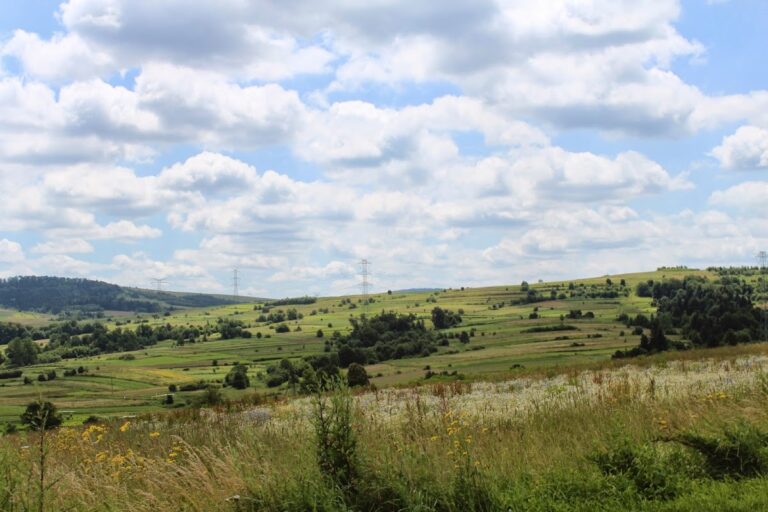
Kamieniec Castle stands on a rock at 452 metres above sea level in the Dynów Mountains. Its irregular plan follows the terrain. The complex developed as a Gothic border fortress and later received Renaissance-style additions. The Upper Castle occupies the western, higher part, while the castle’s eastern sections incorporate the Lower and Middle Castle areas and associated outer baileys, enclosed spaces outside the main fortified area that served residential, economic, or defensive purposes.
Upper and western castle
Upper Castle
The Upper Castle, also called the Higher or Odrzykoń Castle, retains a pointed portal and an eastern wall with a recess. Its eastern and northern elevations were partly rebuilt in 1952. The cellars were secured in 1970, and the western tower collapsed in 2000. The monument to Tadeusz Kościuszko, erected in 1894, stands within this part of the complex.
Lower Odrzykoń Castle
The fifteenth-century expansion added a second western outer bailey known as the Lower Odrzykoń Castle. It had its own well and entrance, forming a distinct part of the enlarged fortress. Part of its tower collapsed in 1974.
Eastern castle and service areas
Lower Castle
The Lower Castle, also called the Korczyna Castle, resulted from the eastward expansion begun in 1448. A rectangular tower was completed during this phase, and a moat was built around the entire castle. Rooms in the tower served as an armory and a prison. The eastern section is better preserved and includes the entrance to the former castle, residential buildings, and a chapel. A small museum occupies this area. Its collections include military objects from the former arsenal, belongings associated with successive owners, and a fourteenth-century coat of arms taken from a castle door.
Lower Korczyna Castle
The eastern service outer bailey, known as the Lower Korczyna Castle, had a gate and was later separated from the Upper Castle by a boundary wall created after the division of ownership. The chapel and a deep well were shared by the two sections. The well was made of dressed stone and was described as exceptionally deep. A small building beside the entrance gate was reconstructed in 2003.