Jaufenburg: A Medieval Hilltop Castle in Italy


Site at a Glance
- Rating
- 4.3
- Popularity
- Very Low
- Country
- Italy
- Primary era
- Medieval
- External website
- Open
- Eras represented
- Medieval, Early Modern
- Civilizations
- Habsburg, Holy Roman Empire
- Site type
- Military
- Remains
- Castle
On this page13 sections
History
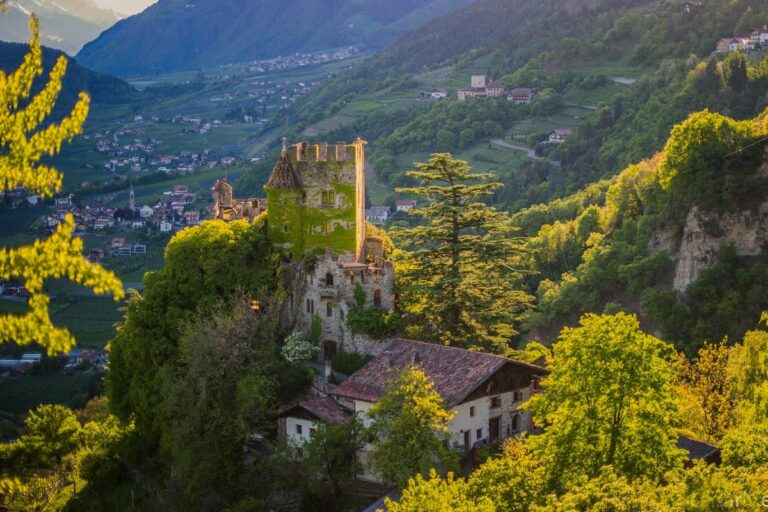
Jaufenburg, also known as Castel Giovo, is a medieval hilltop castle in Italy above St. Leonhard in Passeier, at the foot of the Jaufen Pass. A fortified castle was built there around 1200, although the oldest surviving structure dates from the late thirteenth century. The site stood at a medieval route junction leading toward the Jaufen Pass and the Timmelsjoch, and it became an administrative centre for the Passeier Valley.
The Lords of Passeier
The Lords of Passeier, ministerials who served the Counts of Tyrol in administrative, military, and judicial roles, built and controlled Jaufenburg. The Counts of Tyrol ruled the County of Tyrol, including the Passeier Valley. On behalf of these rulers, the Lords of Passeier administered the court of Passeier, an authority first mentioned in 1290. They also held the judicial lordship of the valley, although their repeated pledging of this authority led to disputes with the local population.
Several members of the family held wider positions. Degen I von Jaufenburg served as governor of Tyrol. In 1363, Margaret of Tyrol transferred Tyrol to the House of Habsburg, the European ruling dynasty that acquired control of the county. Members of the Lords of Passeier appear among the seals attached to the transfer document.
Inheritance and family rule
The Lords of Passeier died out in the male line in 1418. Through the marriage of Hildebrand’s daughter Barbara to Christoph Fuchs von Fuchsberg in 1385, Jaufenburg passed to the Fuchs von Fuchsberg family. This family developed three lines named Freudenstein, Lebenberg, and Jaufenburg. The Jaufenburg line ended in 1749 with Sebastian Franz Fuchs, after which the castle passed to the Lebenberg line. When that branch became extinct in 1828, the estate was sold in 1833 to the Haller family of St. Leonhard.
The lords of Jaufenburg continued to exercise judicial authority over Passeier. Relations with the valley population varied. Carl Fuchs the Younger was remembered for treating the inhabitants relatively well, and religious institutions in the area received numerous donations and endowments from the family. Christoph II von Fuchsberg, who became bishop of Brixen, later commissioned the frescoes in the castle tower.
Abandonment and damage
After Carl Fuchs the Younger died, his heirs inherited heavy debts. The Fuchs family had held countly status since 1634, and its extravagant lifestyle and costly celebrations deepened its financial problems and worsened relations with the valley population. These difficulties forced the family to leave the castle complex in the middle of the eighteenth century.
Hieronymus de Battaglia then administered Jaufenburg while holding the judicial lordship of Passeier. He resigned from the office in 1762, and the castle was completely abandoned. The complex was left to decay and suffered severe damage during the Napoleonic Wars in 1809, the conflicts in which Napoleon’s forces fought across much of Europe.
Josef Haller of St. Leonhard acquired Jaufenburg and the Baumannhof below it in 1833. The Pfistradalm, also called St. Anna, went to the municipality of Latsch in the Vinschgau. Jaufenburg was later used as a materials depot, while the removal of dressed stones for building work in the village accelerated its deterioration. An inventory from the eighteenth century still listed several Baroque rooms, but those interiors no longer survive.
Conservation and later history
In 1911, the Merano Heritage Protection Association called for the castle to be renovated. Conservators inspected the site in 1913 and reported that the roof needed repair to the Imperial-Royal Central Commission in Vienna. The association subsequently renewed the damaged roof, helping to preserve the frescoes on the fourth floor.
Major structural stabilization of the keep took place in 1995, and the complex was later opened to the public. The surviving frescoes received extensive renovation in 2000. At the end of the Second World War, Allied forces found numerous artworks at the castle that retreating German troops had looted from galleries in Florence, including works evacuated to Villa Bossi-Pucci at Montagnana near Montespertoli. The artworks were returned to their original institutions.
The Heilig-Kreuz Church at the foot of Jaufenburg preserves the oldest known depiction of the castle. A local legend says that Hildebrand Fuchs vowed to build a chapel after falling into danger at sea while returning from a pilgrimage to Jerusalem. He is said to have chosen the site after his horse knelt there, and the chapel was built in 1531. In 1785, during the ecclesiastical policies of Joseph II, Count Josef Fuchs von Lebenberg transferred the church’s altar stone and some furnishings to the chapel of Lebenberg Castle. In 1790, he handed the church to the parish of St. Leonhard, which could use it as its only church during floods of the Waltner Bach.
Remains
The restored keep
The principal surviving structure at Jaufenburg is a restored keep, the castle’s main fortified tower, while the remainder of the complex survives mainly as wall remains. The tower was probably built in the second third of the thirteenth century and was first mentioned in 1320 as the “turn under Jauven.” It originally had five levels, and its upper section was probably raised from the fourth floor during the sixteenth century.
The original entrance was a high entrance, an elevated doorway intended to improve security, on the second floor. The present entrance is about three metres above ground level on the floor below. Traces of former wooden steps and a masonry step leading to a niche with a segmental arch survive at this level. On the second floor, the arch of the former high entrance and the passage leading into the lost southwest palace can still be seen.
Openings on the third floor probably belong to the sixteenth century. The fifth floor has further openings from the same period, most of them associated with the castle’s defenses. Six of the original eight recoil beams and their timber recesses remain in place.
Renaissance painted chamber
The fourth floor contains the keep’s surviving Renaissance wall paintings, a decorative cycle produced during the Renaissance. They date from 1538 and are attributed to Bartlmä Dill Riemenschneider, a German painter and sculptor who was the son of Tilman Riemenschneider. The painted room measures 6.5 by 6.5 metres. Its south wall, which has no window, is almost entirely covered with painting apart from a damaged bare area. Decoration survives around a side-seat window on the east wall, while the west wall retains a painted window frame. Paintings on most of the other walls have almost completely disappeared.
The cycle combines religious subjects, biblical quotations, heraldic emblems, and painted architectural forms. Some quotations follow Luther’s translation even though the Catholic bishop Christoph Fuchs von Fuchsberg commissioned the work. Coats of arms belonging to several families, including the Fuchs von Fuchsberg arms, run along the upper edge.
Religious scenes and putti, small childlike decorative figures, dominate the paintings. Three nude putti play in the western window arch, while the eastern window contains an Annunciation. A painted balustrade runs along the lower part of the room, and two illusionistic cornices occupy the upper zone. Several painted scissors allude to the name of the artist.
The wider castle complex
Earlier images show Jaufenburg as a large and elaborate complex containing two palaces, service buildings, a chapel, and several gardens. Its associated possessions included farm buildings, a smithy, and the Pfistradalm, or St. Anna. The surviving wall remains convey the extent of a complex that was once much larger than the restored tower.
West or Southwest Palace
The West or Southwest Palace stood beside the keep and was connected to it by the passage from the former high entrance. The palace is now lost, but its former relationship with the tower remains visible through the surviving passage.
East Palace and service buildings
The East Palace formed another part of the castle complex, which also included service buildings, gardens, farm structures, and a smithy. Earlier views preserve the appearance of this broader arrangement, while the physical remains are now concentrated in walls and fragments of the former buildings.
Heilig-Kreuz Church
Heilig-Kreuz Church stands at the foot of Jaufenburg. Built by Bartlmä Hueber, it has a marble lintel incised with the date 1531. Its Gothic wall paintings mainly depict episodes from the life and Passion of Christ. One scene includes the earliest known representation of the Jaufenburg complex.
A painting made in 1816 by Benedikt Auer the Younger, showing the way to heaven and hell, was later transferred to the MuseumPasseier. Valuable figures from a South German Crucifixion group are now on loan to the Diocesan Museum in Brixen.
Museum and surviving objects
The restored keep houses part of the MuseumPasseier. Marble coats of arms belonging to the Lords of Passeier and the Fuchs von Fuchsberg are preserved inside. The museum presents the history of the castle, the judicial administration of Passeier, and the families who owned Jaufenburg.