Einsiedel Palace: A Württemberg Rococo Hunting Retreat in Germany


Site at a Glance
- Rating
- 4.5
- Popularity
- Very Low
- Country
- Germany
- Primary era
- Medieval
- External website
- Open
- Eras represented
- Medieval
- Civilizations
- Holy Roman Empire
- Site type
- Domestic
- Remains
- Elite Residence
On this page9 sections
History
Einsiedel Palace is a former Rococo hunting retreat in Germany, at the Einsiedel estate near Kirchentellinsfurt. Built between about 1767 and 1772 for Duke Charles Eugene of Württemberg, it belonged to a much older forest-edge estate shaped by hunting, religious use, and the interests of the ruling House of Württemberg.
The Württemberg estate and medieval lodge
The estate belonged to the House of Württemberg by the second half of the fifteenth century. Around 1460, Count Eberhard V, known as Eberhard im Bart and later the first Duke of Württemberg, established a stud farm at Einsiedel. The location at the edge of the Schönbuch forest was also used for hunting, and a medieval hunting lodge was built around 1480, with 1482 given as a more specific date.
Beside the lodge, Eberhard founded the St. Peter religious foundation for the Brothers of the Common Life, a late-medieval religious community devoted to shared worship, education, and devotional practice without conventional monastic vows. Eberhard was buried there in 1496. The foundation burned in 1550, while the hunting lodge and its associated hawthorn burned in 1619. Duke Johann Friedrich then arranged a partial restoration of the lodge.
The Rococo palace
From around 1750, Duke Charles Eugene ordered new buildings for the stud farm. He commissioned a Rococo palace as a pleasure residence and hunting retreat. Rococo was an eighteenth-century style known for lightness, refined ornament, and asymmetrical decoration. The new palace was constructed between about 1767 and 1772. Its exterior was completed after two years, and the interior was finished in 1772.
Charles Eugene later lost interest in the retreat. A visitor wrote in 1790 that the palace was partly furnished but uninhabited and had not been visited by the duke for a long time, despite its earlier use for hunting. In 1804, Duke Frederick I of Württemberg ordered its demolition. The medieval hunting-lodge complex and the later Rococo palace were therefore separate historical phases, with only part of the older complex preserved.
Estate administration and later use
The Einsiedel estate and stud farm were administered directly by the state until 1795, when the ducal government began leasing them. From 1802, Johann Heinrich Kling operated the agricultural estate as tenant. In December 1822, the Court Domain Chamber acquired the estate from the Upper Finance Chamber and assumed its administration the following spring. The Court Domain Chamber administered the ruling family’s private estates, while the Upper Finance Chamber was a state financial authority.
The estate remains owned by the Württemberg Court Chamber and continues to be used agriculturally. Südzucker AG leased it from 1926 to 2012, mainly for sugar-beet cultivation. Since 1964, the surviving part of the medieval hunting lodge has served as a Catholic youth guesthouse. Einsiedel remains associated with the ducal House of Württemberg, whose members held the titles of count and duke, and from 1806, king. Frederick I became the first King of Württemberg.
Remains
The surviving site combines a small remnant of the medieval hunting-lodge complex with the archaeological and landscape traces of the demolished Rococo palace. The older complex was built as a three-story lodge beside the St. Peter foundation, while the later palace used half-timbered construction and stood within a system of star-shaped avenues.
Medieval hunting-lodge complex
Hunting lodge
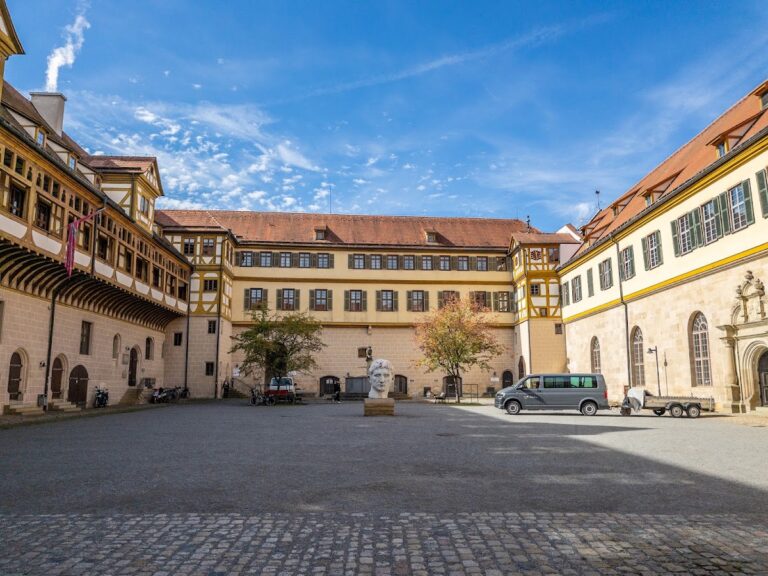
The medieval hunting lodge was a three-story building associated with the Württemberg estate’s use for hunting. A small remnant survives, including one wing, and it forms the oldest preserved part of the Einsiedel settlement. The lodge was damaged by fire in 1619 and later partly restored under Duke Johann Friedrich. Since 1964, the preserved portion has been used as a Catholic youth guesthouse.
St. Peter foundation and the hawthorn tradition
The St. Peter foundation stood beside the lodge and burned in 1550. The complex was also associated with a famous hawthorn, traditionally said to have been brought from Palestine by Eberhard im Bart and planted at Einsiedel. The tree’s story was later commemorated in Ludwig Uhland’s poem Count Eberhard’s Hawthorn. Uhland was a nineteenth-century German poet and scholar.
Rococo palace site
The palace commissioned by Charles Eugene was a comparatively economical half-timbered building rather than the more substantial construction used for the duke’s principal residence. It had one main story beneath a mansard floor, a habitable upper level set within a steeply pitched roof. The ducal apartments occupied the western side. The palace site is identified by the surviving star-shaped avenues laid out around it, preserving part of its former spatial arrangement.