Iliz Koz: The Medieval Parish Church Site at Plouguerneau, France


Site at a Glance
- Rating
- 4.2
- Popularity
- Very Low
- Country
- France
- Primary era
- Medieval
- External website
- Open
- Eras represented
- Iron Age, Medieval, Early Modern
- Civilizations
- Celtic, Duchy of Brittany
- Site type
- Religious
- Remains
- Church
On this page15 sections
History
Iliz Koz is a medieval archaeological site at Plouguerneau in France, preserving the former parish church of Tréménac’h and its associated religious precinct. The parish was founded toward the end of the first millennium in the historic Catholic Diocese of Léon, in the coastal Pays Pagan of northern Finistère. Its development belongs to the medieval history of Brittany, while the surviving enclosure preserves the church, cemetery, and clergy residence of the former community.
Origins of Tréménac’h
Tréménac’h succeeded a Gaulish necropolis, and an Iron Age stele at the site was later Christianized by the addition of a cross. The parish name appears in 1467 as Tribu Monachorum, formed from Old Breton terms meaning “village” and “monks.” Other religious establishments associated with the former parish territory included the chapel of La Martyre, Saint Michael’s Chapel, and a cell linked with Michel Le Nobletz, a seventeenth-century Breton Catholic missionary and religious teacher.
Tréménac’h was administered by an annually elected fabrique council. This parish body managed church finances and property, regulated the cutting of seaweed used as an important soil amendment, appointed coast guards, and organized compulsory labor. A fabrique deliberation book survives and is displayed in the site museum. A parish register containing baptisms, marriages, and funerals from 1610 to 1792 is held in the departmental archives.
Sand, storms, and abandonment
From the fourteenth century onward, progressive coastal sand accumulation increasingly affected habitation at Tréménac’h. The process was intensified by severe winters and storms during the cooler and more variable climatic period known as the Little Ice Age. During the final phase of occupation, the village had approximately one hundred inhabitants, while the presbytery was already partly buried by sand in 1721.
Severe weather further damaged the settlement, including the hurricane of 26 November 1703, the winter of 1709, and storms in April 1718. In 1729, the parish rector requested the church’s definitive abandonment and the transfer of worship to the chapel of La Martyre. Burials within the church enclosure were still taking place when the church was abandoned.
The commune of Tréménac’h was created in 1792 but disappeared two months later when it was incorporated into Plouguerneau. The former parish therefore remained part of Plouguerneau, while sand gradually covered its buildings and burial ground.
Rediscovery and preservation
Iliz Koz was exposed in 1969 during work on privately owned land. Initial investigations were led by Dr Gérard Philips of the Archaeological Society of Finistère. Plouguerneau acquired the land in 1977 and organized volunteer-supported operations to remove the sand, including major desanding work in 1992. Archaeological work resumed and continued during the 1990s.
Since 1990, the Iliz Koz association has managed the site and its conservation work. The site is protected within a ZPPAU, a designated protected zone for architectural and urban heritage, adopted in 1986. Finds recovered during the clearance include three keys carefully placed on one of the presbytery windows in 1992. They are preserved in the Iliz Koz museum, together with other objects connected with the former parish.
Remains
The parish enclosure and church
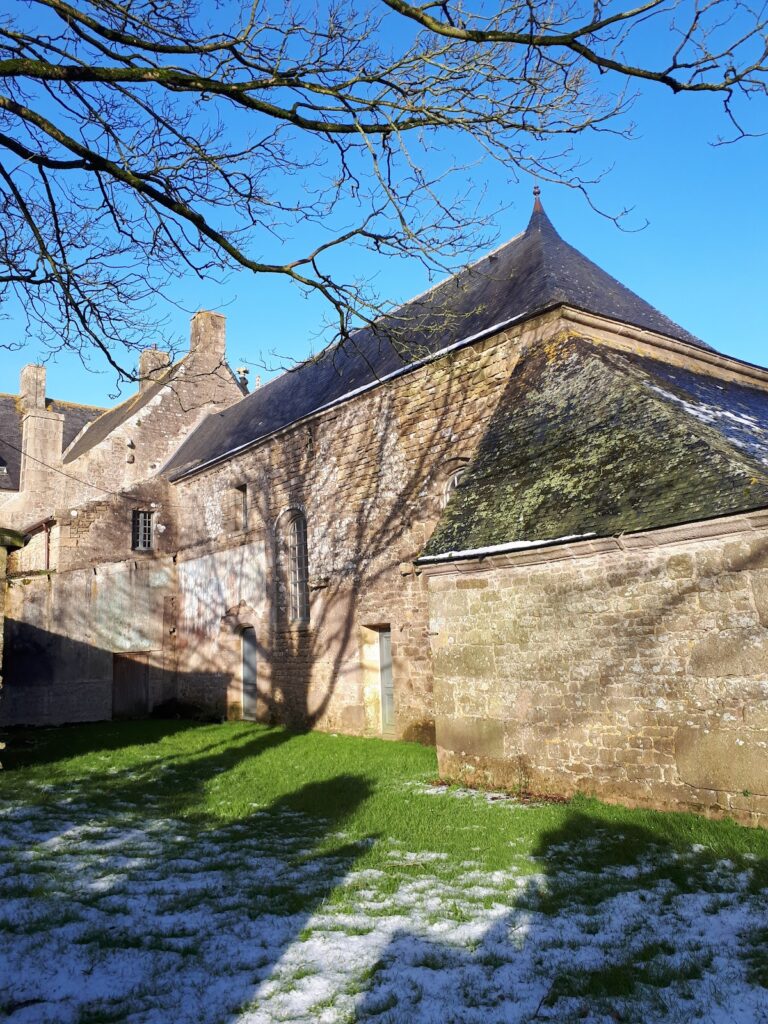
Iliz Koz retains its primary parish enclosure, a walled religious precinct containing the church, cemetery, ossuary, and presbytery. The enclosing wall is almost entirely preserved and maintains the characteristic arrangement of a regional parish complex. The church has a nave without a transept and is entered through a lateral porch on the south side. Dedicated to the Trinity, it contains baptismal fonts and numerous burials.
The church interior
The choir tombs
The choir is regarded as the oldest part of the church and contains three notable graves. The largest is a three-dimensional relief tombstone with a shield and a long sword measuring approximately 83 centimetres, including a circular pommel. Its heraldry corresponds to the Coëtivy family, and tradition identifies it as the tomb of Prigent VI de Coëtivy, who died in 1384. His wife, Tiphaine de Grenguen, owned the now-vanished Menan manor several hundred metres from the site.
Another tomb, attributed to a religious figure, has a recess for a separate decorative stone. The ornament is a roughly 15-centimetre cube of durable Breton kersanton, carved with a chalice above an oliphant, a curved ceremonial or hunting horn. Probably quarried at Logonna-Daoulas, the stone is preserved in the site museum. Its partly erased Gothic inscription can still be read in part as “G……… TREMENECH.” Smaller holes in other slabs may have held similar ornaments.
Two further tombs bear the three-cinquefoil arms of the De Parscau family, reflecting the family’s later importance in the parish. The oldest tombs lie in the choir, where local lords held burial rights and could display their arms. Their surviving heraldic designs have lost their polychromy, and some identifications remain uncertain. Faded elements may represent the allied Coëtivy and Duchâtel families.
The Parscau Chapel
The later-added Parscau Chapel stands on the right-hand side of the church. It is entered from outside but opens visually toward the choir. Inside are an altar, four armorial tomb slabs, and two enfeus, which are wall recesses or tomb enclosures for elite burials. One of the enfeus bears the family arms.
The chapel’s name derives from Breton words meaning “field” and “elder.” From the late fourteenth century onward, the Parscau family held Menan manor after the Coëtivy line. The manor stood immediately near Iliz Koz but has no visible remains. Yves Parscau and François Parscau served as rectors of Tréménac’h in 1536 and 1583 respectively. A granite seigneurial bench made from armchair-like seats was reserved for noble families. Family archives record their right to display arms in the stained-glass windows and to occupy benches in the chapel.
The ossuary and adjoining chapel
An ossuary was built against the church in the sixteenth century. Used to hold bones removed from older graves when burial space was reused, it opens onto the nave through an oculus, or circular opening. Its openwork structure has a roof supported by stone columns, a form comparable to the ossuary at the chapel of Le Grouanec.
A small chapel adjoins the ossuary. It contains altar consoles, an unarmorial holy-water font, and a niche beside the altar. These structures form part of the surviving church complex and its arrangements for worship and burial.
The presbytery
The paved approach
The partially cleared presbytery remains are reached through a carefully paved lane. A small door from the nave, approached by three steps, leads to a passage approximately ten metres long and one metre wide. The paving is slightly convex and has two channels along the sides for draining water.
The priest’s residence
The presbytery, the residence of the parish priest, contains at least two rooms set one above the other and connected by a stone staircase. Each room has a fireplace aligned with the one below. Several openings at the lower level are now blocked; they formerly led outside or into other rooms. Further excavation and removal of sand may expose additional parts of the building.
Burials and carved slabs
Approximately one hundred graves surround the church, while more than twenty lie inside the nave, choir, and Parscau Chapel. The dead were generally wrapped in a shroud and buried directly in sand beneath slabs of local granite. Coffins were uncommon on this coast because timber was scarce and reserved for domestic use and shipbuilding.
Several slabs bear chalices identifying priests’ burials. Five are grouped near the entrance to the Parscau Chapel, and one carries the vertical inscription “T. BIZIAN : P.”, with the final letter identifying the deceased as a priest. Other graves show engraved swords and gauntlets associated with knightly burials. The relatively blunt, elongated swords emphasize cutting rather than thrusting. The gauntlets follow an established image convention, with the left hand facing downward and the right hand upward.
Some graves combine swords or gauntlets with crosses or an episcopal crozier, suggesting that their occupants may have held both noble and ecclesiastical roles. One slab is engraved with a measuring ell and a pair of scissors, probably identifying a cloth merchant or textile craftsman. Another, known as the caravel tomb, depicts a fourteenth- or fifteenth-century carrack together with an anchor and its buoy rope. Its detailed maritime imagery reflects the sculptor’s technical knowledge and the prosperity associated with late-medieval maritime commerce.
Murals and excavated objects
Murals were discovered on the north wall of the nave, opposite the porch, and removed for conservation. One thirteenth-century decoration consists of hand-painted Marian roses on a white ground around a piscina, a small liturgical basin set into a church wall. The motif has parallels at Roscoff.
A fragmentary fifteenth-century mural shows a chivalric scene with an armed figure and a shield bearing alternating red and white bands. Damage to the plaster prevents a certain identification of the arms, although the Duchâtel and Coëtivy families have been proposed. Two geometric murals imitating stone masonry, in grey and garnet tones, date from the sixteenth or seventeenth century. One was painted over the other during a renovation.
The murals were removed by Gabriel Taillefer’s restoration company at the initiative of the Iliz Koz association and are preserved in the site museum. Archaeological operations also recovered coins dating from the eleventh to the eighteenth centuries, religious medals, crosses, stained-glass fragments, and other funerary objects. Together with the church, graves, presbytery, and enclosure, these remains preserve material evidence of the former parish across many centuries.