Iglesia de Nuestra Señora del Manzano: A Former Collegiate Church in Castrojeriz
Site at a Glance
- Popularity
- Medium
- Country
- Spain
- Primary era
- Medieval
- Eras represented
- Medieval, Early Modern
- Civilizations
- Crown of Castile, Spanish
- Site type
- Religious
- Remains
- Church
On this page16 sections
History
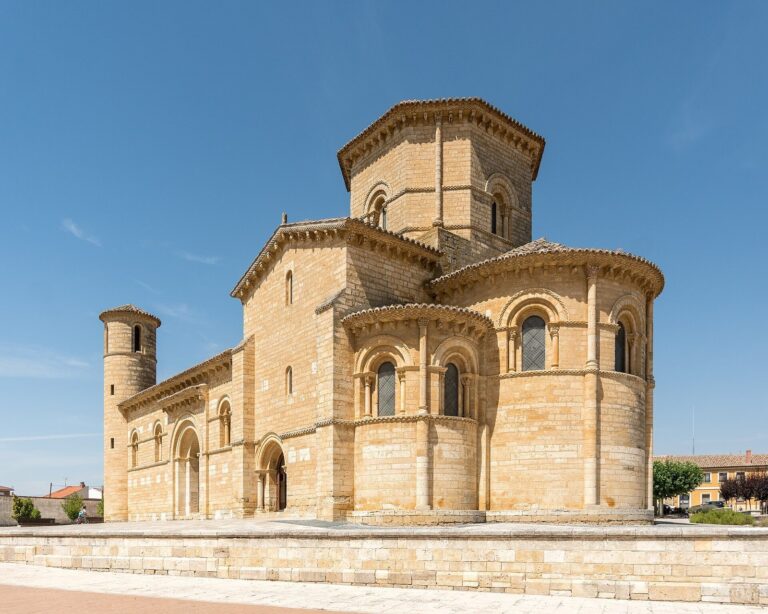
Iglesia de Nuestra Señora del Manzano is a Roman Catholic church in Castrojeriz, Spain, within the Archdiocese of Burgos and formerly a collegiate church. A collegiate institution existed here by the tenth century. The present building began in 1214 at the instigation of Berengaria of Castile, daughter of Alfonso VIII and mother of Ferdinand III. Its Gothic design, a medieval architectural style, includes Romanesque features from an earlier medieval tradition.
Collegiate foundations and changing status
The church’s beginnings are unknown, but a privilege issued in the tenth century by Count García Fernández of Castile shows that its canons already served a collegiate institution, a church governed by a chapter of clergy. The grant allowed them to build houses with towers and fortifications in Castrojeriz. It placed them on the same standing as local commoners with knightly status and imposed fines of 500 sueldos, a medieval unit of account. Insults or violence in their homes carried this penalty, as did killing or wounding a canon or another religious person, in the latter case payable to the victim’s relatives. The fines matched those applied to members of the Castilian nobility. Castrojeriz had received its own charter of privileges from García Fernández in 974.
In 1050, King García Sánchez III of Navarre linked the collegiate church to the monastery of San Millán de la Cogolla. It became the Abbey of Santa María de Castro, a monastic institution governed by an abbot. After García Sánchez lost his Castilian possessions, the church remained an abbey with exempt status for several decades. During the reign of Alfonso VII of León and Castile, the abbey was linked to Burgos Cathedral. Its abbot received a place of dignity there and the tenth seat in the cathedral choir. In 1173, under Alfonso VIII of Castile, the collegiate church was secularized and left the Rule of St Benedict, the monastic code followed by Benedictine communities. King Fernando IV confirmed the earlier privilege in 1299, while still a minor.
Medieval devotion and royal associations
Several medieval cantigas, songs or poems, were dedicated to the image of Our Lady of Manzano. Cantiga 242 tells of the Virgin saving a stoneworker who lost his balance and was left hanging by his fingernails. Cantiga 249 concerns a master working in the church, while Cantiga 252 recounts people saved from sand at Castrojeriz. In Cantiga 266, a wooden beam falls during mass without injuring anyone.
Eleanor of Castile was murdered at Castrojeriz in 1359 on the order of her nephew, King Peter I. Documents place her burial at the collegiate church, but the identification of a tomb there as hers remains uncertain. Her remains have also been associated with the Cathedral of La Seu Vella in Lleida and the monastery of Las Huelgas in Burgos.
Reforms and modern recognition
Reforms in the late fifteenth and early sixteenth centuries altered some of the church’s vaults and created the rose window above the main entrance. Extensive eighteenth-century works renewed the building, including its sanctuary, tower, and roofs. Juan de Sagarvinaga was among the architects associated with this work, which also changed the church’s arrangement and added new religious and burial spaces.
In the eighteenth century, masses were celebrated in memory of Alfonso VII, Sancho IV of Castile and his wife María de Molina, and Fernando IV and his wife Constance of Portugal. The chapter then comprised an abbot, twelve canons, three other dignitaries, and eight clergy holding positions supported by prebends.
The church was designated a Spanish Asset of Cultural Interest on 25 April 1974. In 2015, it became an associated component of the UNESCO-listed Routes of Santiago de Compostela: Camino Francés and Routes of Northern Spain.
Remains
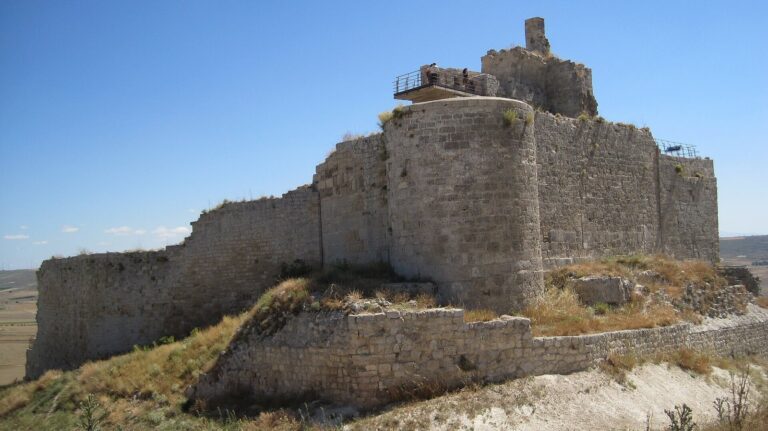
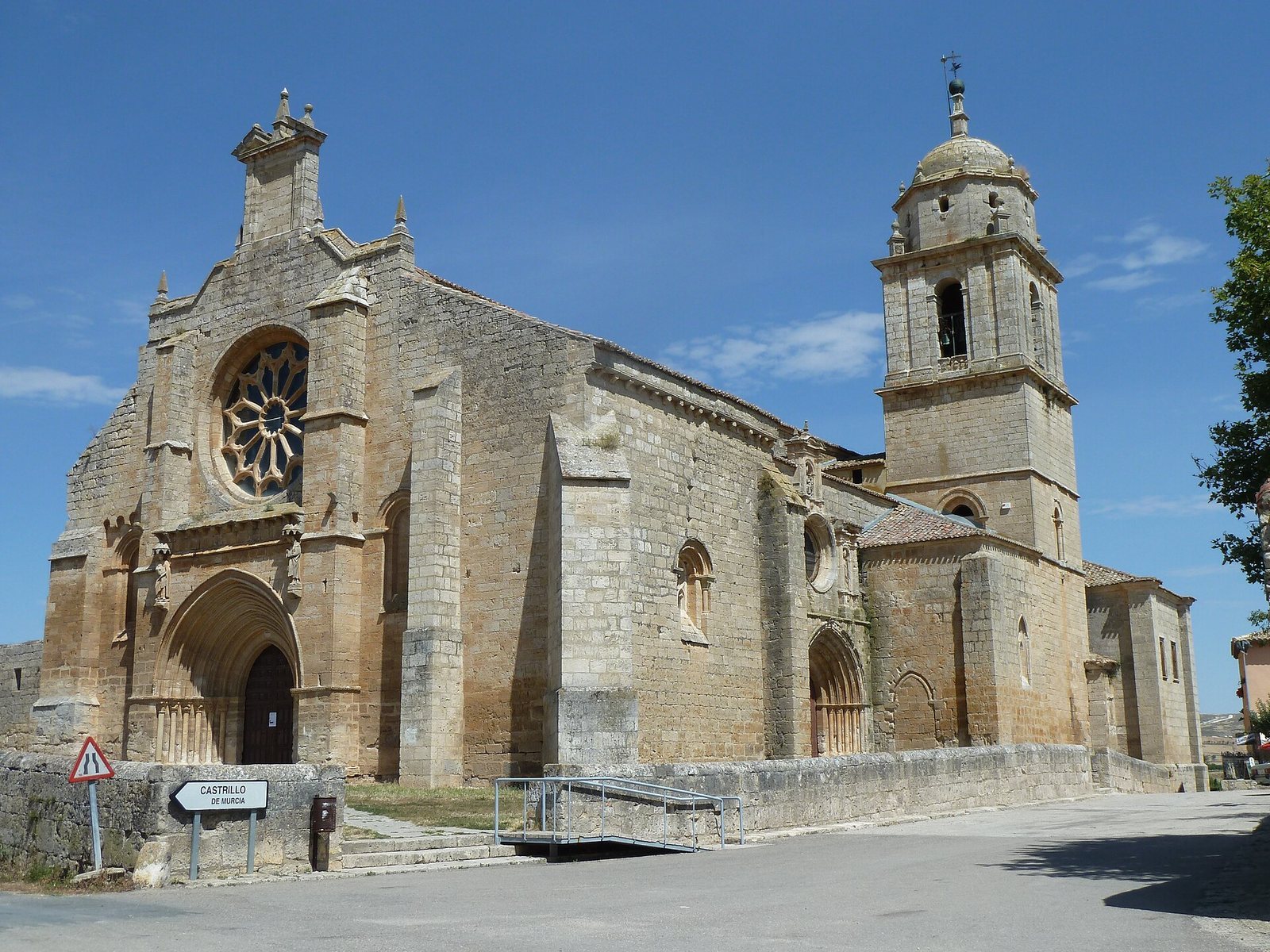
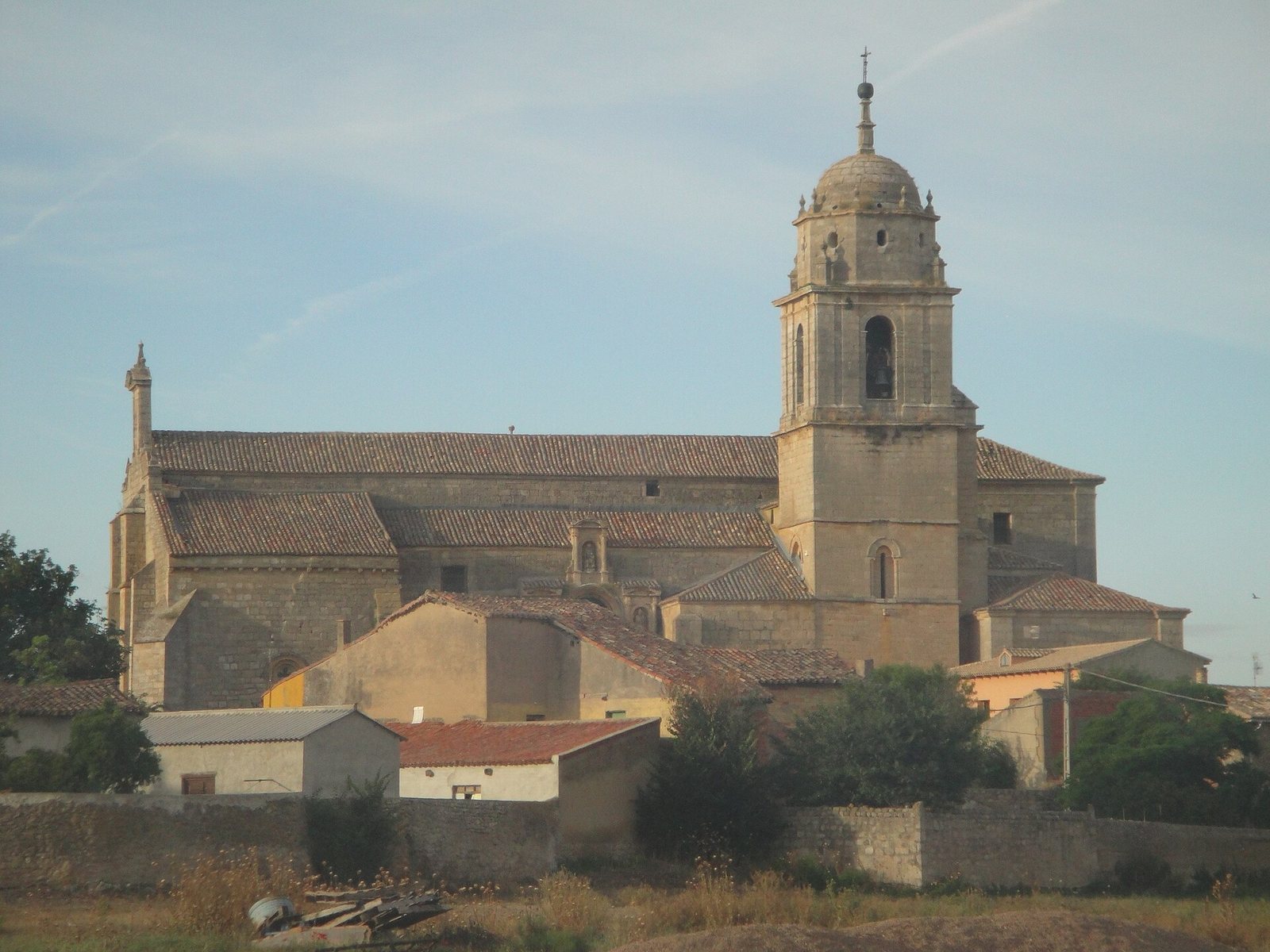
The church stands at the foot of the hill on which Castrojeriz Castle is situated. Built from regularly cut stone blocks, it has three lengthwise spaces, or naves, divided into five bays, the structural sections between supports. The central nave rises about 17 metres and is twice as wide as either side nave. Those side spaces end in flat walls and have late Romanesque arcade arches and Gothic stone vaults. The original sanctuary end was removed during eighteenth-century works and replaced by the present rectangular east end.
Entrances and windows
Main entrance
The Gothic main entrance is at the foot of the church. Its opening widens outward and is framed by moulded arch bands and rounded stone shafts, with plant designs on their bases and capitals. Thirteenth-century stone figures of the Virgin Mary and the Archangel Gabriel stand on brackets beneath canopies on either side. Above the entrance, a restored rose window, a large circular window with radiating divisions, depicts God giving a blessing surrounded by the apostles. Its border includes symbols of the four Evangelists, angel heads, and the donor’s coat of arms.
South entrance and tower
The entrance on the south façade follows Renaissance design, which drew on classical antiquity. The tower has a Romanesque base, while its upper bell stage dates to the eighteenth-century alterations and was added in 1746.
North rose window
A separate German stained-glass rose window on the north side dates to the late fifteenth century. Donated by Iñigo López de Mendoza, it shows the Eternal Father at the centre, surrounded by the twelve apostles, six angels, and symbols of the four Evangelists.
Interior and furnishings
Chapel of Our Lady of Manzano
Juan de Sagarvinaga built the eighteenth-century chapel of Our Lady of Manzano. Its polychrome stone image, finished in several colors, depicts the crowned Virgin standing in a blue tunic patterned with stars, with her mantle gathered at the waist. She holds the Christ Child on her left arm and touches his foot with her right hand. The child wears a red tunic, and a cameo marked with the letter “T” is set on the Virgin’s chest.
Francisco Díez de Mata made the chapel’s three altarpieces, decorated structures behind or above altars. The two side pieces contain images from the now-vanished Monastery of San Antón de Castrojeriz and were left ungilded. The central Baroque altarpiece, in an ornate artistic style, houses the image of Our Lady of Manzano. The Burgos painter Martínez del Barranco, a pupil of Anton Raphael Mengs, gilded it.
Altarpieces
The oldest surviving altarpieces depict the Crucified Christ and Saint James the Apostle, dating respectively to the late sixteenth and seventeenth centuries. The others are from the eighteenth century. The main altarpiece was made in 1760 with the support of the Counts of Ribadavia, holders of a hereditary Galician noble title. Its paintings show the Annunciation, the Visitation, the Nativity, the Presentation of Jesus in the Temple, and the Child Jesus among the Doctors, with Saint John the Baptist at the top. Anton Raphael Mengs painted the Annunciation. Several of his pupils are credited with the other works, including Mariano Salvador Maella and Francisco Bayeu.
Choir
The choir, the area reserved for clergy or singers, occupies the central nave and is enclosed by a Renaissance grille. Its furnishings include choir stalls made around 1776 and a lectern. A Neoclassical organ, whose design revives ancient Greek and Roman forms, dates to around 1790. Behind the choir is a painting of the Virgin of the Cherries, attributed to the Flemish painter Pieter Pourbus.
Tomb and museum
Tomb attributed to Eleanor of Castile
Near the baptistery at the foot of the church is a Gothic tomb attributed to Eleanor of Castile. Its cover bears the carved figure of a woman lying at rest, and its workmanship has been compared with tombs from the mid-fourteenth century. The tomb was moved in the eighteenth century from the Gospel-reading side of the high altar to make room for the Counts of Castro’s burial chamber beneath the church. In June 1970, the Mission Rescue Group of the Marqués de Camarasa school found it concealed behind an adobe wall.
Museum collection
The former collegiate church houses a museum of objects associated with Christian worship. Its collection includes wooden figures, some carved in the fourteenth century, as well as paintings, books, chalices, and other objects.