I Tesori della Ca’ Granda Museum: The Art Collections of Ospedale Maggiore
Site at a Glance
- Popularity
- Very Low
- Country
- Italy
- Primary era
- Medieval
- Eras represented
- Medieval
- Civilizations
- Duchy of Milan, Holy Roman Empire
- Site type
- Civic
- Remains
- Hospital
On this page20 sections
History
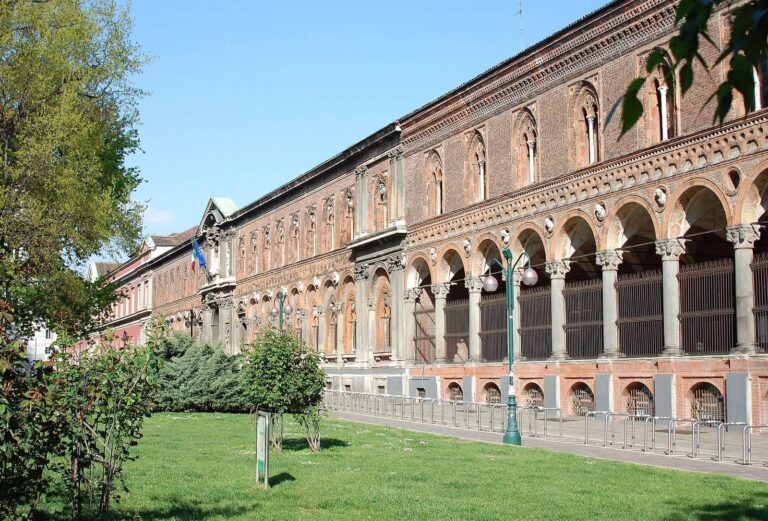
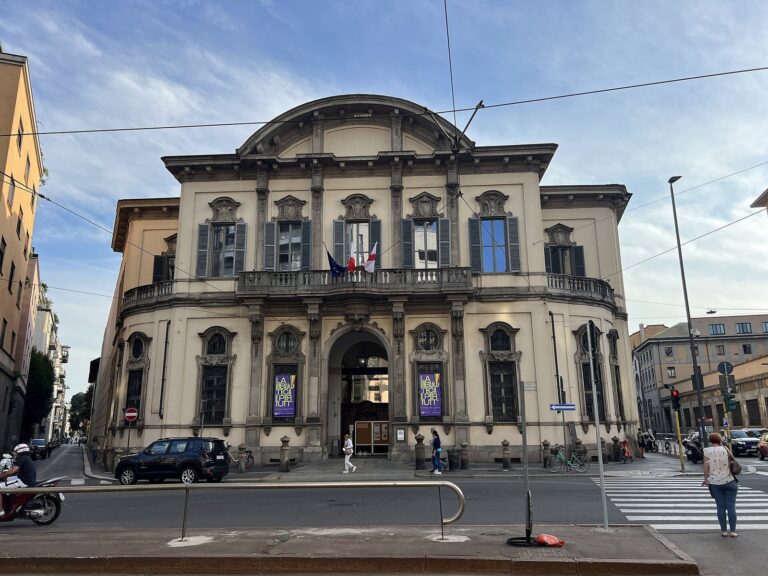
I Tesori della Ca’ Granda Museum is associated with the historic headquarters of Ospedale Maggiore, the Ca’ Granda in Milan, Italy. Duke Francesco Sforza founded the hospital in 1456, and portraits honoring its benefactors began soon afterward. The collections grew through gifts, bequests, the preservation of valuable possessions, and the incorporation of other Milanese hospitals.
Hospital portraits and donor policy
At first, the hospital reserved portrait honors for high-ranking people whose contributions were exceptional. From the seventeenth century, as portraiture became more usual among wealthy people, it extended the practice to donors of different social ranks. In 1810, the hospital set the portrait’s format according to the size of a gift or bequest: 40,000 lire qualified a donor for a half-length portrait, while 80,000 lire qualified for a full-length one. The policy encouraged some people to give in order to receive a portrait, and the resulting donations enlarged the collection. Some benefactors also left enough to commission portraits of relatives.
After the First World War, inflation reduced the value of the required sums, which were not adjusted at first. Donations and portrait commissions consequently rose; the thresholds were later increased and periodically revised. Until the twentieth century, the hospital council chose the painters, usually considering the wishes of the benefactor or the family. In 1906, a commission of prominent Lombard figures took over that responsibility. Its members included Luca Beltrami, Carlo Bozzi, Ettore Modigliani, Aldo Carpi, and Mario Sironi.
Growth of the wider collection
The hospital’s broader art collection began to expand in the sixteenth century. It grew through the preservation of valuable items, donations and bequests, and the absorption of other Milanese hospitals. An earlier consolidation, promoted by Cardinal Enrico Rampini and carried out by Francesco Sforza in the mid-fifteenth century, brought furnishings and sacred objects from the incorporated hospitals’ churches and chapels.
Cardinal Carlo Borromeo left the hospital Titian’s Adoration of the Magi. His nephew Federico later acquired the painting and gave it to the Ambrosiana Picture Gallery. A major bequest came in 1804 from Count Giacomo Sannazzari della Ripa. It included Raphael’s Marriage of the Virgin, which Giuseppe Lechi had acquired in 1802 after his role in freeing Città di Castello from papal rule. Lechi, a Napoleonic general, sold the painting to the state in 1806 to meet financial difficulties and tax debts; it was placed in the Brera Picture Gallery.
In 1899, Duchess Eugenia Litta left the hospital the church of Santa Maria delle Selve at Vedano al Lambro, nearby land by the Royal Villa of Monza, and a hall she had built for the Litta family archive. The archive held manuscripts, parchment documents, and about forty family portraits. Later gifts included around sixty paintings donated in 1938 by the widow of Camillo Rapetti, a painter who had made portraits for the hospital, and more than two hundred works from sculptor Achille Alberti’s estate in 1943. Other important works were sold or dispersed, including a Head of Christ attributed to Leonardo da Vinci and considered a study for The Last Supper, as well as paintings by Giovanni Bellini, Marco d’Oggiono, and Ambrogio Figino.
Portrait commissions and wartime protection
From 1929, the portrait commission included artists associated with Novecento, an Italian movement that sought a return to order and traditional forms. Among them were Giuseppe Amisani, Achille Funi, Esodo Pratelli, Mario Sironi, and Aldo Carpi. The commission and many benefactors’ families favored conventional portraiture over avant-garde movements such as Futurism. Painters, often Lombard, were sometimes asked to portray people who had died using only old photographs. From the second half of the twentieth century, the commission’s approach became less uniform, though figurative painting remained an important thread in the collection.
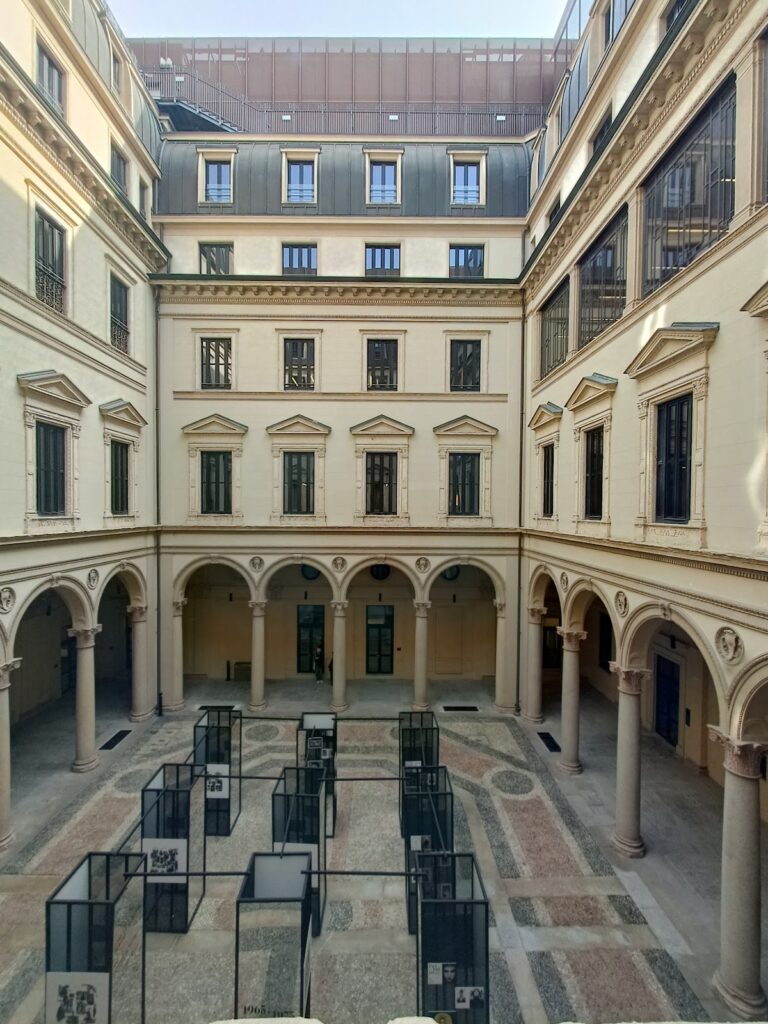
For years, portraits were displayed in the Ca’ Granda courtyard for just one day every two years during the Festa del Perdono, a religious observance known as the Feast of Forgiveness. As the collection grew and space became a problem, Pope Pius XI urged the hospital to establish a permanent and dignified display, which he hoped would encourage further giving. After the hospital moved to the areas now occupied by Policlinico and Niguarda Hospital, its administration assigned the Ca’ Granda’s Macchio cross-gallery to the portraits in 1940. The installation was taken down in 1942 as a precaution, protecting the paintings from the severe bombing of the Ca’ Granda on the night of 14–15 August 1943. The collection now numbers more than 900 portraits, but has yet to receive an adequate arrangement.
Remains
The collections associated with the Ca’ Granda comprise more than 900 benefactor portraits and over 1,900 other paintings, sculptures, and objects. The portraits form the principal group. Together, works by artists from different periods also record changing dress and fashion in Lombardy and offer a broad visual record of people in Milanese and Lombard history.
Benefactor portraits
Fifteenth-century portraits
Two large canvases commissioned in 1470 from Francesco Da Vico, a little-known painter also called Di Vico, recall the hospital’s beginnings. In one, Francesco Sforza and his wife Bianca Maria Visconti kneel before Pope Pius II, with the Ca’ Granda façade behind them. The other shows their eldest son, Galeazzo Maria Sforza, and his wife, Bona of Savoy, kneeling at an altar and offering money in the presence of Saint Ambrose. The figures in the second painting do not match those named in the commission, and there is no evidence that the couple gave money or other benefits to the hospital. The painting may originally have shown the founders, with their faces changed after their deaths to honor the new duke and duchess. Other fifteenth-century portraits are few and tend to show sitters from the chest or waist up, with restrained compositions.
Sixteenth-century portraits
A portrait of Marco Antonio Rezzonico della Torre entered the collection with his estate. Rezzonico had also served as a hospital councillor. One inscription at the bottom attributes the canvas to Titian and gives the date 1558; a second, nearly illegible inscription toward which the sitter seems to point, gives 1557. The Titian inscription is later and probably prompted the attribution. Paolo D’Ancona proposed Paris Bordon as the painter, though that attribution remains disputed. The work’s place within sixteenth-century Venetian painting is clear.
Seventeenth-century portraits
About eighty portraits from the seventeenth century are in the collection. Full-length figures became more common, and simpler earlier compositions gave way to richly dressed sitters and elaborate settings. The paintings reflect a Baroque style influenced by Spanish and Flemish art. Artists represented include Andrea Porta, Fede Galizia, Carlo Francesco Nuvolone, Salomon Adler, and Giacomo Santagostino.
Eighteenth-century portraits
Sixty-one portraits date to the eighteenth century. Their styles largely continued those of the previous century, with Flemish influence joined by English painting, especially in town and landscape backgrounds. The collection includes four portraits by Antonio Lucini and twelve by Anton Francesco Biondi, painted between 1774 and 1801. The last two portraits by date already show Neoclassical and Empire tendencies; Empire was a phase of Neoclassicism associated with Napoleonic France.
Nineteenth-century portraits
More than two hundred portraits represent the nineteenth century, including works in Neoclassical, Romantic, Impressionist, and Divisionist styles. Divisionism builds images from distinct strokes or dots of color. Pelagio Pelagi’s portrait of the priest Francesco Bossi dates to 1821–22. Francesco Hayez’s early Romantic painting is represented by three canvases from 1816–23, portraying the priest Carlo Calvi, Count Giambattista Birago, and Count Pietro Francesco Visconti Borromeo.
The collection also includes seven portraits by Giuseppe Bertini, among them one of lawyer Giuseppe Calcaterra, and seven by Sebastiano De Albertis. Other artists include Angelo Inganni, Giuseppe Molteni, and the brothers Domenico and Gerolamo Induno. Later-century works include Giovanni Segantini’s portrait of Carlo Rotta and paintings by Emilio Longoni, Emilio Gola, Leonardo Bazzaro, Gaetano Previati, Pompeo Mariani, and Mosè Bianchi. Antonio Rotta’s portrait of Francesco Ponti was painted in 1986.
Twentieth-century portraits
More than five hundred portraits belong to the twentieth century. Works from its first three decades generally retain the conventions of late-nineteenth-century portraiture. Artists represented include Filippo Carcano, Emilio Gola, Cesare Tallone, Ambrogio Alciati, Riccardo Galli, Eugenio Giuseppe Conti, Anselmo Bucci, Romano Valori, and Giovanni Borgonovo. Later works include paintings by Piero Marussig, Pompeo Borra, Mario Tozzi, Umberto Lilloni, Cristoforo De Amicis, Francesco De Rocchi, Carlo Martini, Carlo Varese, and Francesco Menzio. A notable sculpture from this later period is Dante Parini’s marble bust of Bianca Maria Sforza, daughter of Galeazzo Maria Sforza and later Holy Roman Empress through her marriage to Maximilian I.
Other paintings
Sacred paintings
Sacred subjects make up the largest group among the paintings beyond the benefactor portraits. Several works depict the Annunciation, the Christian account of the angel Gabriel telling Mary she would bear Jesus. The subject reflects the hospital’s original dedication to the Holy Annunciation and the dedication of the Ca’ Granda’s internal church. The most important example is Guercino’s Annunciation, painted in 1638–39.
Other subjects and scenes of hospital life
Other paintings include Berenice Cutting Her Hair, attributed to Bernardo Strozzi; portraits from the Litta collection dating to the eighteenth and nineteenth centuries; and Giovanni Segantini’s large canvas Le capinere. An anonymous work commonly called The Festa del Perdono in the Courtyard of the Ospedale Maggiore probably dates to the late seventeenth or early eighteenth century. It depicts an ordinary scene of hospital life rather than the religious festival, and offers evidence of contemporary clothing and customs. Francesco Gonin studied the painting for his illustrations to The Betrothed.
Other works are by Defendente Ferrari, Vincenzo Civerchio, Moretto da Brescia, Francesco Rizzo da Santagostroce, Giovan Battista Trotti, Ippolito Scarsella, Giulio Cesare Procaccini, Pierfrancesco Mazzucchelli, Johann Carl Loth, and Palma il Giovane. The attributions to Civerchio and Palma il Giovane are uncertain.
Sculpture and material collections
Sculptures at the Ca’ Granda and from the Litta collection
Terracotta sculptures by Francesco Solari are set on the Ca’ Granda’s south portal. Two depictions of the Madonna and Child came from the Litta collection. One remains on the portal of Santa Maria delle Selve at Vedano al Lambro; the other has workmanship and expressive features that recall the sculpture of Giovanni Pisano. The hospital collection also holds an unattributed bust of Cardinal Alfonso Litta.
Egyptian funerary objects
A gift in 1854 brought the mummy of the scribe Ptahmose and a Book of the Dead, an ancient Egyptian text intended to guide the dead through the afterlife. The papyrus was recovered from an underground room after it had disappeared before it could be fully studied. It is nearly intact and in excellent condition. Thought to come from Thebes and date to the fourteenth century BC, it concerns a scribe whose common name prevents secure identification. It names his parents as Osiry and Didia, described as a dancer of Amun. Its illustrations show Ptahmose and his mother praying, boats and other figures, the 42 judges of the underworld, and deities including Anubis, Thoth, Osiris, and Isis. The mummy was transferred to the Egyptian Museum at Sforza Castle.
Documents and pharmacy objects
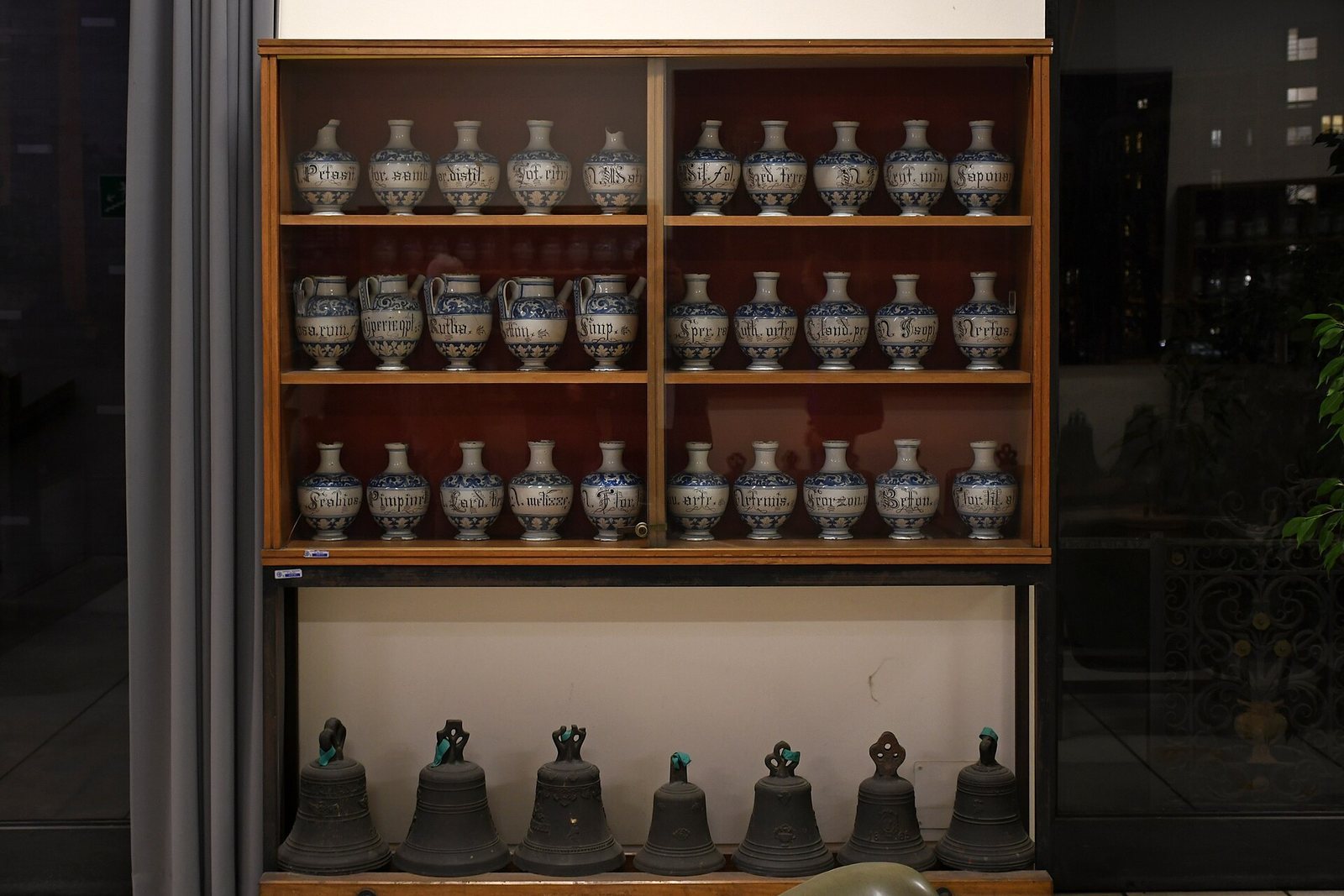
The hospital archive contains many illuminated documents from the Visconti and Sforza periods. Their decoration reflects the transition from Gothic to Renaissance taste, while their handwriting shows changes in script over time. The pharmacy collection comprises about 180 objects, including decorated jars, chased bronze mortars, and old prescriptions written on parchment. Thirteen sixteenth-century jars were dispersed among museums in Cambridge, Hamburg, and Sforza Castle. Most of the remaining objects date to the seventeenth or eighteenth century and came from workshops in Albissola or Venice.
Hospital banner
In 1927, architect and designer Gio Ponti received a commission to create a banner for the hospital. One side bears the Ca’ Granda emblem, surrounded by shields depicting events in the institution’s history and topped by the arms of the Municipality of Milan. The other shows a modern-style Annunciation. Although unfinished, the banner was presented at a ceremony in Milan Cathedral attended by Cardinal Ildefonso Schuster.