Holy Name of Mary Church in Szydłowiec Śląski: A Historic Filial Church
Site at a Glance
- Rating
- 4
- Popularity
- Very Low
- Country
- Poland
- Primary era
- Early Modern
- Eras represented
- Early Modern
- Civilizations
- Habsburg, Holy Roman Empire
- Site type
- Religious
- Remains
- Church
On this page12 sections
History
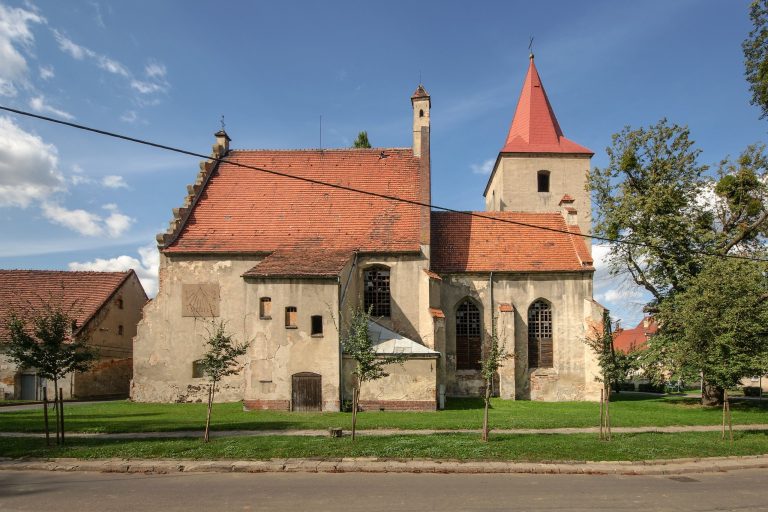
Holy Name of Mary Church in Szydłowiec Śląski, Poland, is a Roman Catholic filial church built in 1616–1617 in the regional Upper Silesian tradition of early seventeenth-century sacred architecture. It replaced an earlier wooden Catholic church and was founded as a Protestant church by Hans Puckler von Groditz, lord of Szydłowiec, and his wife, Helena von Sedlnitzky von Choltitz.
Medieval origins and the Reformation
The church was mentioned in 1335 in the tithe register of the papal nuncio Galhard de Carceribus. Schedlau, the historical German name of Szydłowiec Śląski, was described as a church village in 1379. In the sixteenth century, the Pückler family acquired Szydłowiec, introduced the Reformation, built a castle, and retained the estate, including the church, until 1945. The Reformation was the religious movement that created Protestant churches and challenged Roman Catholic authority and practice.
The present building replaced the earlier wooden church during this period of confessional change. Although its builder, the Italian master mason Antonio Rusco of Offen, came from outside the region, the church followed Upper Silesian practice rather than Italian Renaissance architecture. Its original function was Lutheran, and its furnishings were designed around the altar, baptism, and preaching as the central elements of worship.
Return to Catholic use
After the Imperial Restitution Edict of 1629, a Habsburg decree requiring Catholic ecclesiastical property to be restored, the church returned to Catholic use. The local population nevertheless remained predominantly Protestant. In 1830, just 55 of the village’s 389 inhabitants were Catholic. Protestants from Szydłowiec Śląski attended the Protestant church in Niemodlin, formerly known as Falkenberg.
The church was historically, and remains institutionally, a filial church of the parish in Niemodlin. It is dedicated to the Holy Name of Mary, whose liturgical feast is observed on 3 May. Several years of conservation culminated in a thorough renovation completed in 2018. The building entered the register of monuments of the Opole Voivodeship on 8 May 1964, under registration number 853/64.
Remains
Layout and construction
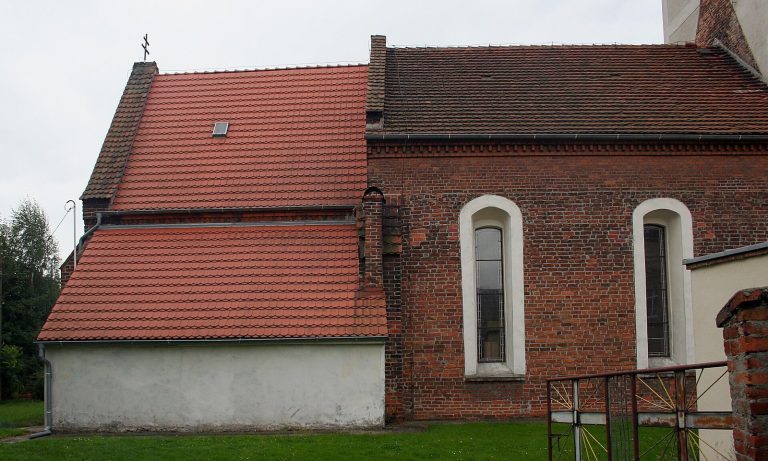
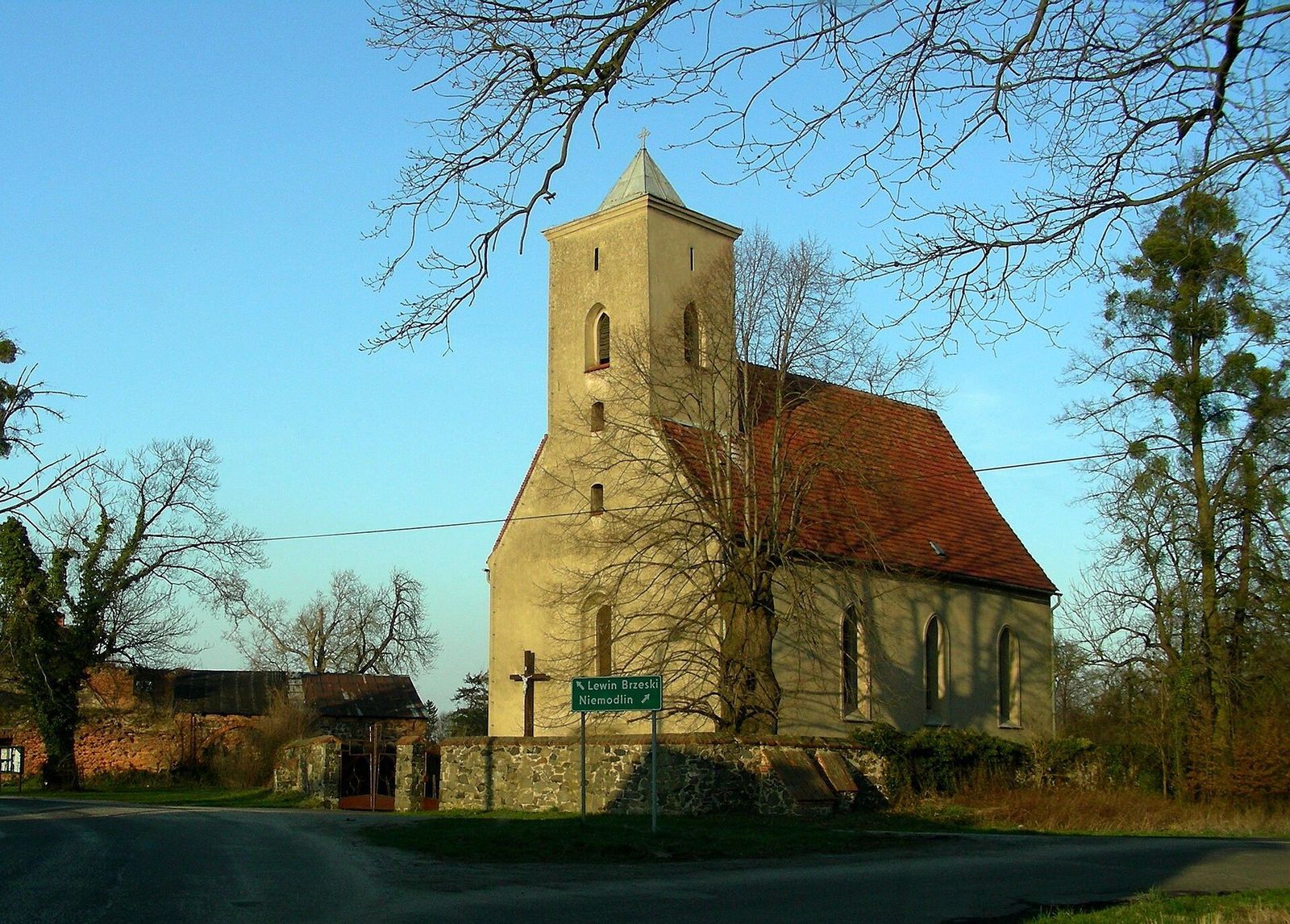
The church stands at the northeastern end of the village, diagonally beside the main road. The road runs toward the tower and continues beyond the church toward the former estate, placing the building between the village and the estate. It is a simple east-oriented hall church with a straight-ended chancel and a low tower incorporated into the front. Brick and stone form the structure, while the three-bay interior is covered by a plain barrel vault with lunettes.
Mannerist furnishings
Main altar
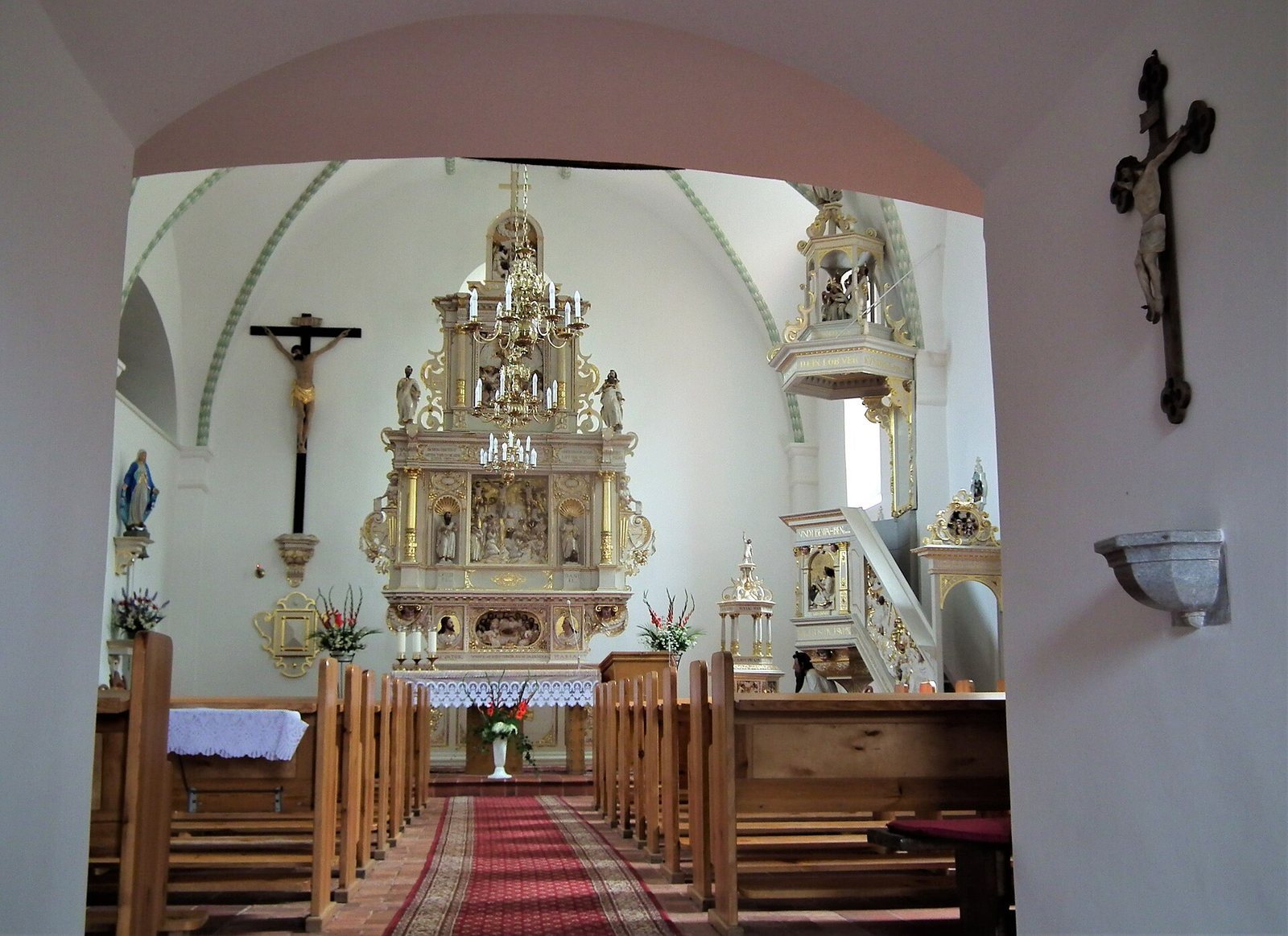
The original Mannerist interior ensemble is arranged symmetrically in the chancel. The main altar, created by the Nysa sculptor Hermann Fischer, presents four scenes in superimposed levels: the Last Supper, the Crucifixion, the Resurrection, and the Ascension of Christ. Its forms were indirectly inspired by Saxon art. A representation of the Agnus Dei was probably added in the nineteenth century.
Pulpit
Fischer also created the pulpit. Moses, holding the two tablets of the commandments, serves as its atlas figure, a sculpted human form used as a structural support or visual substitute for one. The pulpit balustrade shows the four Evangelists, Matthew, Mark, Luke, and John, while the soundboard carries a sculpture representing Pentecost.
Baptismal font
The high superstructure of the baptismal font contains a sculpture of Jesus with children. Together with the altar and pulpit, the font forms the Lutheran liturgical triad centered on altar worship, baptism, and the preaching of the Word of God. Caspar Winckler of Nysa executed the polychrome finish of the altar, pulpit, and font. Apart from the later Agnus Dei, these furnishings belong to the church’s Lutheran period.
Memorials and bell
Foundation plaque and family memorials
Above the portal, a foundation plaque displays the coats of arms of Hans Puckler and Helena von Sedlnitzky. It states that they built the Christian Apostolic Evangelical church in 1616 from their own wealth. The interior also contains epitaphs to Hans Puckler’s children, including two child memorials showing four boys and four girls, a tomb slab for a knight of the von Pückler family, and an epitaph to Helena von Pückler.
Church bell
The church bell weighs 477 kilograms and was cast in 1615 by Jakob Götz in Breslau. Its inscription asks God to protect the worshippers against Calvinism, reflecting the confessional tensions surrounding the church’s foundation. After the Second World War, the bell was transferred on loan to a Catholic parish in Roßtal, Franconia, whose congregation consisted largely of expellees.