Heylissem Abbey: A Premonstratensian Monastery and Neoclassical Château in Belgium


Site at a Glance
- Rating
- 4.5
- Popularity
- Medium
- Country
- Belgium
- Primary era
- Early Modern
- External website
- Open
- Eras represented
- Medieval, Early Modern, Modern
- Civilizations
- Belgian, Duchy of Brabant, Dutch, French, Habsburg, Holy Roman Empire
- Site type
- Domestic
- Remains
- Castle
On this page8 sections
History
Foundation and monastic growth
Heylissem Abbey is a former Premonstratensian monastery in Hélécine, Belgium, founded beside the Kleine Gete around 1129–1130. The Premonstratensians, also known as Norbertines, were a Catholic order founded in 1120 that combined communal religious life with pastoral work in surrounding parishes. The local lord Renier de Zétrud-Lumay donated the land to Floreffe Abbey and established the community with the assistance of his brother Gerland, the abbot of Floreffe. He invited the canons to provide spiritual care for his subjects.
The foundation initially operated as a double monastery, with separate communities of canons and canonesses. A double monastery contained distinct male and female religious communities within one foundation. The canonesses moved to Cologne in 1142, leaving Heylissem as a community of male canons. Pope Eugene III approved the foundation in 1145.
Donations during the twelfth and thirteenth centuries greatly enlarged the abbey’s landed estate. By the end of the thirteenth century, it covered about 800 hectares and included twelve farms and nine mills. The canons managed this agricultural wealth, including the regulation and use of the Kleine Gete, while supporting the parishes entrusted to them. About fifteen parishes in the regions of Jodoigne and Tienen remained dependent on Heylissem until the French Revolution.
Fortification and wartime disruption
During the thirteenth century, the Duke of Brabant authorized the canons to construct fortified defenses. The following two centuries were comparatively peaceful. Duke John III of Brabant, the fourteenth-century ruler of the duchy, stayed at the abbey for twelve days in 1332.
The Wars of Religion, sixteenth-century conflicts intensified by religious divisions in Europe, brought severe disruption. The repeated passage of French, Spanish, and Dutch troops caused damage, looting, disorder, and fires at the abbey, its parishes, and its farms during the sixteenth and seventeenth centuries. Heylissem was looted and burned three times. The community took refuge in Léau in 1568 and in Tienen for approximately fifteen years between 1690 and 1704.
Eighteenth-century rebuilding
The community recovered during the eighteenth century and numbered about forty regular canons. In 1749, it purchased land at Kumtich from the Benedictine Abbey of Kornelimünster. This acquisition brought additional farms into its holdings, including Stocquoy near Jodoigne, Chapeauveau at Opheylissem, Seumay near Perwez, and La Dîme at Jandrain.
In 1768, Abbot Jean-Michel Gosin commissioned Laurent-Benoît Dewez to rebuild the abbey completely. Dewez was an eighteenth-century architect known for Neoclassical designs in the Austrian Netherlands. The project lasted approximately twelve years, and the rebuilt abbey church was consecrated in 1780. Most of the buildings visible today belong to this reconstruction.
Revolution, industry, and conversion into a château
On 25 September 1796, French revolutionary authorities forcibly expelled the twenty-five canons and confiscated the abbey’s property. The estate was divided into lots and sold in 1797 or thereafter, passing through several owners. The former monastic complex then entered a succession of industrial uses. A textile mill was established in 1800, followed by a potato-spirit distillery and a sugar factory from 1821, and later a beet-sugar factory.
Industrial redevelopment removed the lateral wings, the church choir, and other conventual buildings. Some structures were also dismantled for their dressed stone. The former abbatial palace survived because it was used as a prelature and as a residence for a prefect, while part of the church also remained.
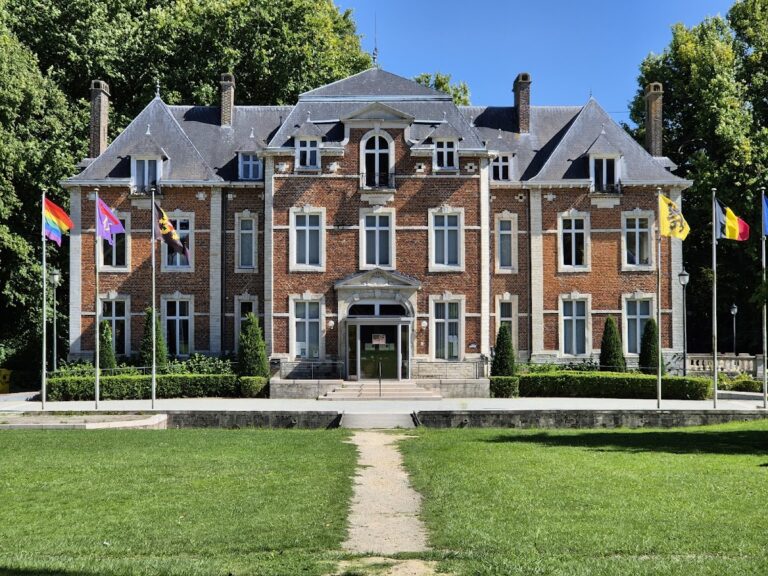
In 1870, Gustave van den Bossche’s son commissioned the Belgian architect Alphonse Balat to transform the surviving abbatial palace into a château. Balat slightly altered the facade to give it a more aristocratic appearance and lowered the church dome by about ten metres because its appearance was considered too ecclesiastical. The property later passed by inheritance to the d’Oultremont family, a Belgian aristocratic family that had lived in the palace since 1919.
The province of Brabant purchased the property in 1962. Further restoration and transformation followed, with the historical character of the site guiding the work. The château, former abbey, and surviving old wall received protected heritage status in 1955, 1977, and 1988 respectively. The former monastery is now used as a château and cultural site within the Provincial Domain of Hélécine rather than as a functioning religious community.
Remains
Palace and church complex
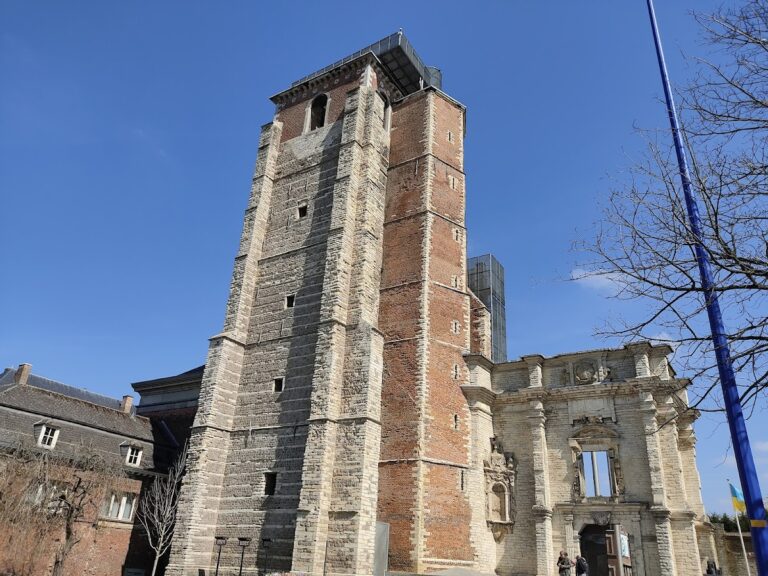
The surviving complex consists chiefly of the eighteenth-century Neoclassical reconstruction, arranged around the former abbatial palace and the remaining portion of the church. The palace is a long rectangular building with a broad facade. Its central section has an attic supported by four Corinthian pilasters, while the middle of each wing is marked by an armorial triangular pediment. Until 1876, statues of the four Evangelists stood above the facade’s attic. A notable staircase survives inside the palace, where Gobertange stone was used in the abbey’s construction.
A large central dome rises approximately 47 metres above the former church nave. The church beneath it was consecrated in 1780. Balat’s nineteenth-century alteration lowered the dome by about ten metres, and the surviving church portion became the centre of the long east–west château complex. The lateral wings of the court of honor were later converted into service buildings and stables, while a park was laid out around the palace.
Estate buildings and watermill
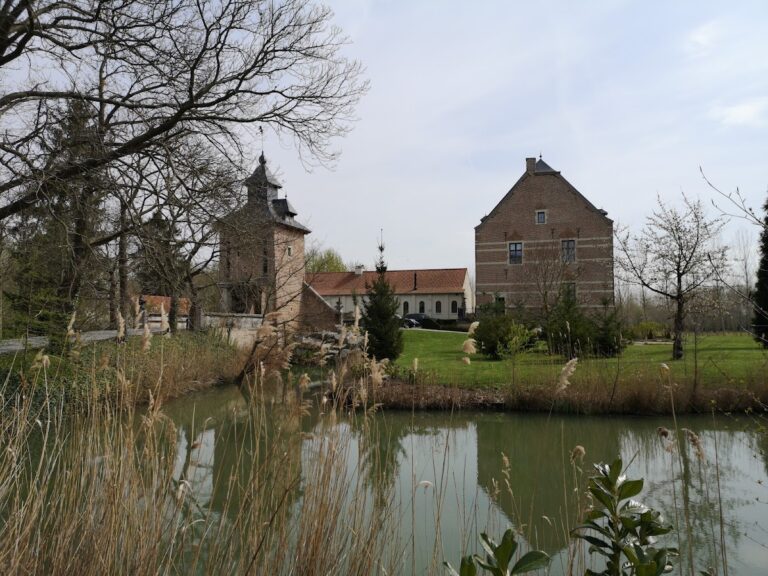
The surviving common buildings, farm, and former abbey mill preserve elements of the agricultural estate that supported the monastery. The mill was powered by the waters of the Kleine Gete. The eighteenth-century agricultural complex also included a stud farm reputed for producing a renowned breed of carriage horses. These buildings and the remaining old wall now form part of the extensive Provincial Domain of Hélécine, alongside the restored château and surviving abbey elements.