Herthaburg: A Slavic-Period Hillfort in Germany


Site at a Glance
- Rating
- 4.3
- Popularity
- Very Low
- Country
- Germany
- Primary era
- Medieval
- Eras represented
- Medieval
- Civilizations
- Unclassified
- Site type
- Military
- Remains
- Fortified Town
On this page9 sections
History
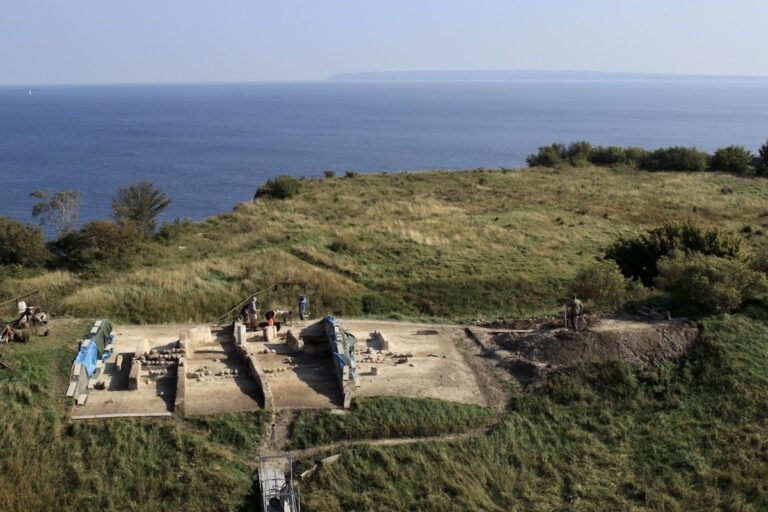
Herthaburg is a Slavic-period hillfort in Germany, built on a ridge beside Herthasee in the Stubnitz on Rügen between the eighth and twelfth centuries. Archaeological excavations show that the fort was used at least during the tenth and eleventh centuries. Pottery fragments from the site’s cultural layer, an archaeologically identifiable deposit formed by human activity, provide the basis for this dating.
Slavic settlement and earlier traditions
The fort belonged to the period of Slavic settlement on Rügen. Herthasee and its surroundings also carry older religious associations. The lake was probably a cult site for the Germanic Rugii, a people associated with the southern Baltic region, and the Wendish Ranen, a West Slavic population connected with Rügen. The nearby stone known as the Opferstein has traditionally been linked with this ritual setting, which has also been conjecturally associated with Nerthus, a Germanic fertility goddess described by the Roman author Tacitus.
Legends and Romantic-era development
Many stories connected with Herthaburg, Herthasee, and the Herthabuche took their familiar form during the Romantic period, from the late eighteenth century through the first half of the nineteenth century. One tradition presents Hertha as a Germanic goddess who lived in the castle and bathed in the lake. Attendants who witnessed the ceremony were supposedly killed, and their ghosts were said to gather along the shore.
These legends developed as tourism on Rügen began to expand. Guests of the Sagard spa, which operated from 1795 to 1806, sought diversions in the previously little-developed forests of the Stubnitz. Its proprietors, Heinrich Christoph and Moritz von Willich, arranged for paths and steps to be built along the lake shore. The inn at Königsstuhl, constructed in 1835, likewise had an interest in attracting visitors. In this setting, the Sagenstein was placed beside the path to Königsstuhl, while a trough mill was set on the Opferstein to make it resemble a bowl for collecting blood. The stone was later repeatedly covered with red paint to strengthen the appearance of the legendary scene. Theodor Fontane also mentioned the Opferstein in Effi Briest.
Remains
Fortification and lakeside setting
Herthaburg occupies a pre-existing ridge on the northeastern shore of Herthasee. The enclosure between the rampart and the lake measures approximately 120 by 60 metres, while the complete rampart system extends more than 180 metres in width. On its northeastern exterior, the rampart reaches a maximum height of 17 metres, rising about 8 metres above the interior. Its upper edge stands 136 metres above sea level.
Herthasee forms the southern natural boundary of the fort and is visible from within the enclosure. The southern side opens toward the water, and access probably took place across the lake by bridge during the fort’s period of use. The present entrance into the interior was created later. On the northeastern side, the rampart joins an earlier outer bailey, which remains clearly visible from the path to Königsstuhl. Areas of stone paving survive within the Slavic cultural layer, showing that at least parts of the enclosure had a deliberately surfaced ground.
Features associated with local legends
Opferstein
The so-called Opferstein stands near the lakeshore. Its association with ritual belongs to the later legends of the area. A trough mill was placed on the stone so that it would appear to have served as a blood-collection bowl, and red paint was repeatedly applied over several decades to make the legendary interpretation seem more authentic.
Sagenstein
The Sagenstein stands near Herthaburg beside the path to Königsstuhl. It is connected with a maiden-testing story involving alleged footprints. Its present meaning therefore belongs to the network of Romantic-era legends that grew around the fort and lake.
Herthabuche
The Herthabuche, a particularly large old beech tree associated with local legends, survives as a dead trunk. Together with the Sagenstein and Opferstein, it forms part of the later legendary landscape around Herthaburg and Herthasee.
Herthaburg lies within Jasmund National Park, near Stubbenkammer. The surviving ramparts, lakeside boundary, paved areas, and associated legendary features preserve both the physical setting of the Slavic fort and the later cultural history that developed around it.
Nearby sites