Herrenhaus Brookhusen: A Historicist Manor House in Benitz, Germany


Site at a Glance
- Rating
- 5
- Popularity
- Very Low
- Country
- Germany
- Primary era
- Modern
- External website
- Open
- Eras represented
- Modern
- Civilizations
- German
- Site type
- Domestic
- Remains
- Manor House
On this page8 sections
History
Herrenhaus Brookhusen is a manor house and protected architectural monument in Benitz, Germany, whose main building was enlarged in 1889 in the Historicist style. Historicism was a nineteenth-century approach that revived and combined forms from earlier architectural periods. The estate is documented from the thirteenth century and remained connected with Mecklenburg noble and landed families for centuries.
Medieval estate
In 1260, Otto Reventlow was knighted by Heinrich I, Lord of Mecklenburg. After Otto was elected in 1275 to the guardianship council for Heinrich’s underage sons, he received Ziesendorf, Fahrenholz, Nienhusen, and Brookhusen as a reward. Brookhusen later passed temporarily as a fief to the brothers von Ziesendorf, before Albrecht III, King of Sweden and Duke of Mecklenburg, granted it to Heinrich Reventlow in 1397.
The 1397 grant made Brookhusen an allodial estate, meaning land held as full hereditary property rather than as a conditional fief. Albrecht III awarded it to Heinrich Reventlow in recognition of his loyalty during the duke’s six-year imprisonment after his defeat at the Battle of Åsle in 1389. The Reventlow family and its descendants retained the estate until 1681.
From war damage to nineteenth-century rebuilding
The Reventlow period ended after the estate was devastated during the Swedish-Brandenburg War of 1674 to 1679, a conflict between Sweden and Brandenburg. Debt forced its sale in 1681 to district administrator Ernst von Petersdorf. Ownership then changed repeatedly, and successive proprietors rebuilt or altered the estate according to their own preferences.
Among the later owners were Dietrich III and Dietrich IV von Wolffrath, Helmuth von Petersdorf, Elisabeth Oelgard von Blücher and her heirs, Bernhard Julius Christoph Stein and his heirs, Major Joachim Franz Detlov von Bilau, and court chief huntsmen Carl Johann von Stein and Johann Georg von Stern. A court chief huntsman was a senior official responsible for hunting administration and game management at an aristocratic court. The estate subsequently belonged to Ferdinand Ernst Christian von Schack, consul Martin Koester, and Friedrich Ludwig August Never.
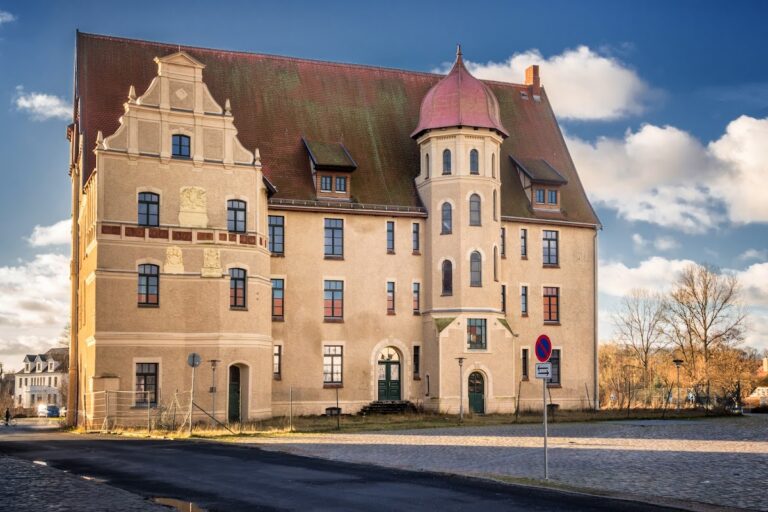
Carl Johann Franz Briesemann acquired Brookhusen in 1888 and commissioned a major renovation the following year. The work enlarged the manor house in the Historicist style, adding a larger cross wing and a tower. The expansion was partly intended to house Briesemann’s extensive painting collection. His heirs held the estate until 1918.
The Restorff family and the end of the landed estate
In 1918, retired major and Ottoman imperial lieutenant colonel Reinhold Louis Wilhelm von Restorff bought Brookhusen from the Briesemann heirs. He had gained considerable wealth in South America and intended to re-establish his old Mecklenburg noble family near Rostock. After his death in 1921, ownership passed to his divorced wife, Elisabeth Marie Karoline Juliane von Restorff, née von Plessen, and then to their son Gustav, who had been born in 1912.
Gustav was considered missing after the Red Army advanced on Budapest in 1944. Before Soviet forces reached Mecklenburg in late April 1945, his wife Elfriede, née Egge, fled the estate with their daughter Erdmuthe. Mecklenburg’s land reform began on 27 September 1945. In the autumn of that year, the 291-hectare allodial estate was divided as feudal Junker land and large landed property.
Public use and preservation
After the establishment of the German Democratic Republic in 1949, the manor house became publicly owned and was transferred to the municipality. The German Democratic Republic was the socialist state established in East Germany in 1949. The building later accommodated a medical practice, shop, school, cinema, and cultural centre. Apartments were installed on the upper floor from 1970, and employee accommodation for the Benitz agricultural production cooperative was later added on the lower floor. Such cooperatives were collective farming institutions of the German Democratic Republic.
The last tenants left after the building was officially closed in 1996 because of its rapid deterioration. The municipality had already applied for heritage protection to obtain public funding for its preservation. Since 1995, the property has been listed in the monument register of the Rostock district as “Manor House with Manor Park,” number 172.
A municipal search for a preservation-minded investor began in April 1998 in the greater Munich and Ruhr regions. More than 250 potential investors responded, but none included binding restoration and preservation commitments in a proposed use. In June 1999, the lower building-control authority ordered the manor house demolished because of the acute danger of collapse. An investor who appeared in 2000 prevented the demolition, but insolvency led to prolonged legal proceedings and the property’s return to municipal ownership.
The municipal council resumed its search in 2008. New owners acquired the manor house in 2010, after which it was restored and preserved in several stages. Its interior was converted into holiday apartments, and the building was opened to the public for the first time during Open Monument Day in 2024.
Remains
Manor house and tower
The surviving manor house combines the earlier estate building with the enlargement carried out in 1889. Its Historicist design incorporated a larger cross wing and a tower, creating additional interior space for Briesemann’s painting collection. The date “1889” remains on the wrought-iron weather vane at the top of the tower. The building’s later conversion into apartments altered its interior use, while restoration after 2010 preserved and adapted the structure for holiday accommodation.
Manor park
The property includes the manor park associated with Herrenhaus Brookhusen. The house and park are treated together in the monument register under the designation “Manor House with Manor Park.”
Nearby sites