Heraclea Sintica: The Principal City of Ancient Sintica
Site at a Glance
- Popularity
- Very High
- Country
- Bulgaria
- Primary era
- Classical
- Eras represented
- Classical
- Civilizations
- Kingdom of Macedon, Roman
- Site type
- Settlement
- Remains
- City
On this page10 sections
History
Heraclea Sintica was the principal city of ancient Sintica, in the Rupite area of southwestern Bulgaria. It stood west of the Strymon River, now also known as the Struma, and north of Bisaltia. The surrounding region was home to the Thracian Sintoi.
Early city and Macedonian rule
A Thracian settlement or tribal center, perhaps called Sintia, may have existed before the city. Heraclea Sintica probably emerged in the final quarter of the fourth century BC. Cassander may have founded it, possibly in connection with his settlement of 20,000 Autariatae, an Illyrian people, near Mount Orbel (now Belasitsa) in 310 BC. Earlier, the Macedonian kings Philip II and Alexander III had ordered fortifications in the area. The Sintoi may have been displaced rather than incorporated into the new city, whose population included Macedonian settlers.
Dardani attacks partly damaged the city in the late 290s BC. In the 280s BC it came under the Celtic kingdom centered at Tylis in Thrace, while Gallic forces also expanded into the Strymon region during the third century BC. By the mid-210s BC, the area was associated with the Odrysian kingdom, a major Thracian state, and contested by Odrysian and Macedonian rulers.
Philip V brought Heraclea firmly under Macedonian control. Its earlier name may have been Sintike or Sintia, and Philip may have renamed it Heraclea after 212 BC. Under Philip V and his successor Perseus, it was a Macedonian civic community within the Antigonid kingdom. Demetrius, a Macedonian prince and son of Philip V, was killed in the city. After Rome’s victory over Macedon, Heraclea was placed in Macedonia’s first division in 167 BC and transferred to the Odrysian kingdom in 166 BC.
Roman rule and late antiquity
Heraclea entered the Roman Empire in the first century AD and reached its greatest prosperity in the first half of the third century. It held considerable economic, political, and demographic importance. Asclepiodotus, a Roman-era general, came from the city.
In 308, the Heracleans petitioned to regain civic rights they had lost. Emperor Galerius and Maximinus II, who held the senior imperial rank of Caesar below the emperor, issued an official reply. In 350, envoys of Magnentius, a usurper claiming imperial power, met Emperor Constantius II at Heraclea.
A major earthquake around 425 destroyed much of the city’s infrastructure. Small groups settled among the ruins after 457, but permanent habitation had largely ended by about 500. As Heraclea declined as a regional center, activity shifted to nearby Parthicopolis, now Sandanski. Finds suggest that the city continued to exist into the reign of Justinian I, an Eastern Roman emperor.
Identification and excavation
Heraclea’s location was disputed for more than a century, and it was once sought south of the Rupel Gorge, in what is now Greece. Georgi Mitrev identified the ruins near Rupite as Heraclea Sintica after inscriptions found there supported the identification. The city is also mentioned by ancient writers including Livy, Diodorus, Strabo, Pliny the Elder, and Claudius Ptolemy.
Atanas Milchev carried out the first excavations in 1958. Annual, systematic work began in 2007 under archaeologist Lyudmil Vagalinski, in collaboration with the Petrich Historical Museum. The museum’s director, Sotir Ivanov, also took part.
Remains
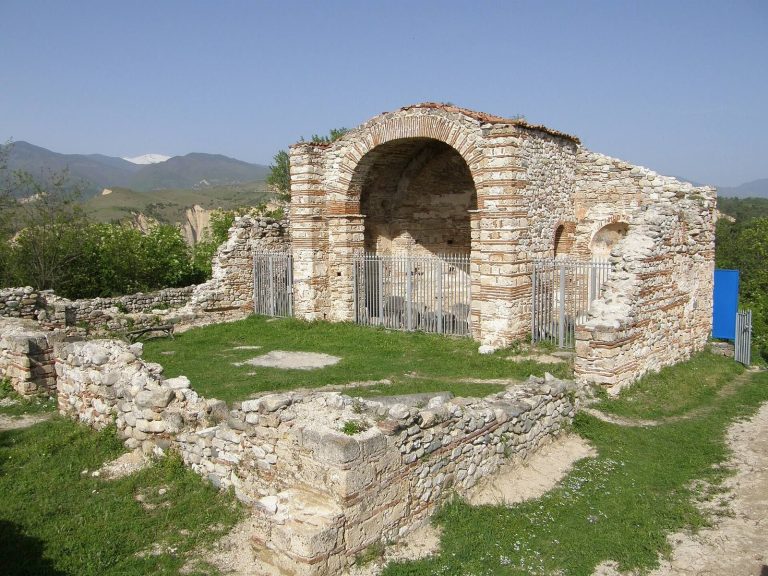
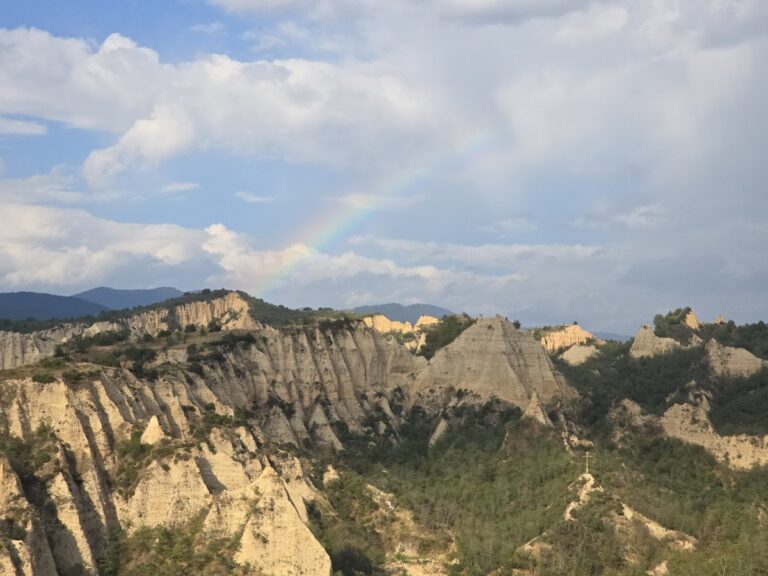
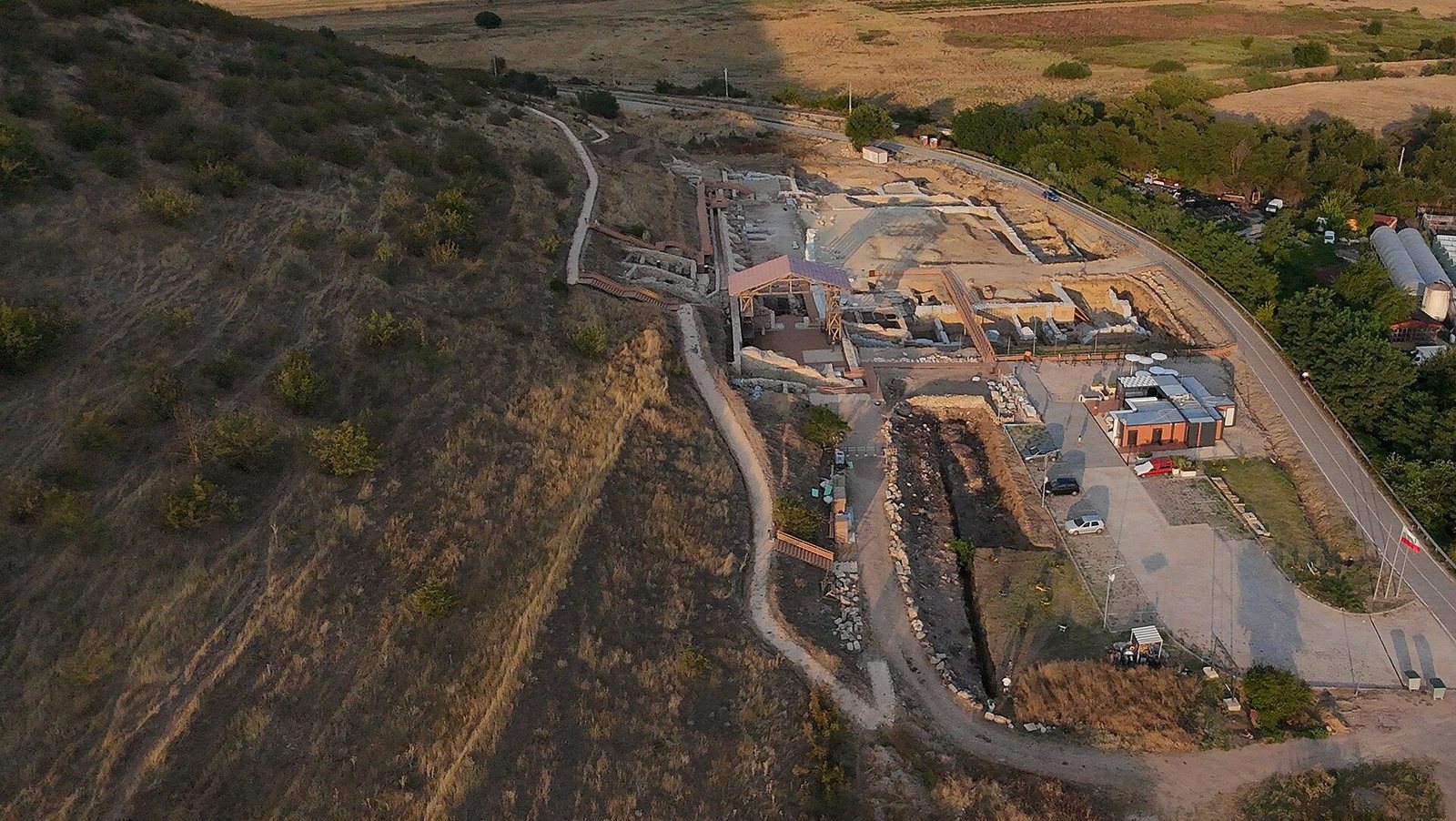
The ruined city lies on the southern slope and lower ground of Jonkov Peak, within the volcanic upland of Kozhuh and near the base of an extinct volcano. Its known physical evidence includes civic infrastructure, excavated tunnels and an arch, a workshop for ceramic masks, and finds from the city and its burial ground. The evidence for some buildings, including a theatre and an amphitheatre, remains less certain.
Public core and infrastructure
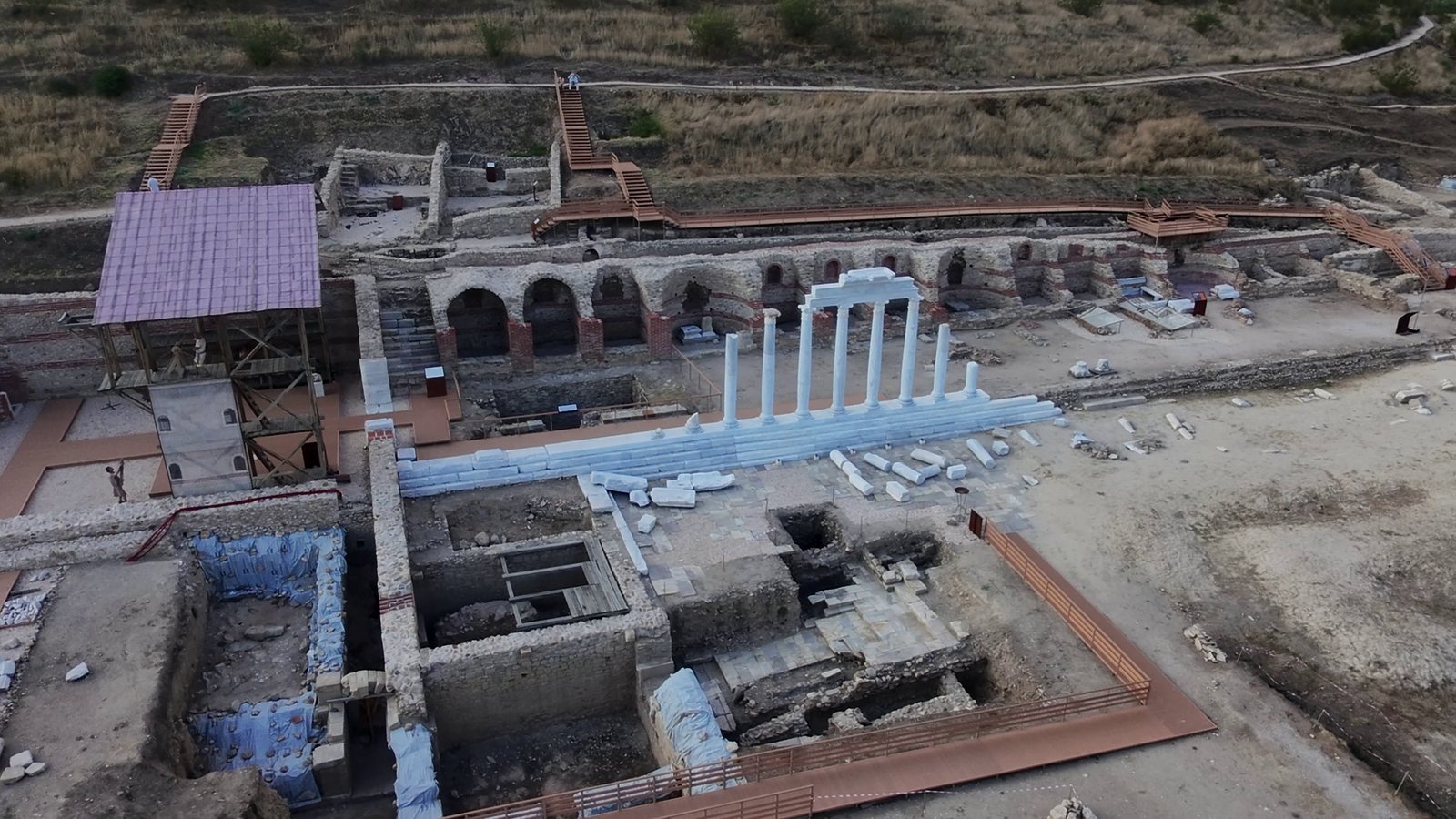
A civic basilica, a large public hall used for civic, legal, or commercial activities, formed part of the city’s infrastructure before the earthquake around 425 destroyed it. Flooding from the nearby Strumeshnitsa River inundated the forum, the city’s central public space. Excavations have also exposed tunnels and an arch.
Workshop and performance buildings
A survey of underground features identified a large workshop for making ceramic masks, associated with an ancient theatre whose location has not been identified. An amphitheatre is thought to have stood near Kozhuh; its scale has been compared with the ancient amphitheatre at Philippopolis.
Inscriptions and coins
A large Latin inscription found at the site preserves the official reply issued by Galerius and Maximinus II to the Heracleans’ petition. Another inscription, published in 2005, names Gaius Lucius Skotussaios and a man identified as a Heracleian. A bronze coin dated to about AD 101 to 138, during the reign of Trajan or Hadrian, shows a decorated Macedonian shield on its front and an upright club associated with Heracles, the Greek hero conventionally represented with a club. Macedonian-period coins found at Kozhuh have also contributed evidence about the area’s political history.
Marble statue of Hermes
In 2024, excavation of an ancient sewer uncovered most of a marble statue of Hermes, the Greek deity associated with messages and travel. The statue had been carefully placed in the sewer and covered with soil. Initial investigation suggested that citizens had deliberately buried it.
Western Necropolis grave
A Roman grave discovered in the Western Necropolis, a burial ground, in 2026 dates to the fourth century AD. It held a woman of mixed European and African ancestry. Anthropological analysis estimated that she was 35 to 40 years old and identified scoliosis and degenerative spinal illness. Precisely shaped stone blocks and heavy slabs formed the grave, construction that suggests the woman had high social status. The grave also contained a glass goblet and a lamp depicting Eros, the Greek deity associated with desire and love.