Ingá Stone: An Indigenous Rock-Art Complex in Brazil
Site at a Glance
- Rating
- 4.7
- Popularity
- Medium
- Country
- Brazil
- Primary era
- Unclassified
- External website
- Open
- Eras represented
- Unclassified
- Civilizations
- Unclassified
- Site type
- Civic
- Remains
- Rock Art
On this page13 sections
History
Ingá Stone is an archaeological monument and rock-art complex near the town of Ingá in Paraíba, northeastern Brazil. Its engravings are generally attributed to Indigenous communities that occupied the region, although their authors, date, and purposes remain uncertain. The site is also known as Itacoatiara do Ingá, a name linked to Tupi terms for stone and something scratched or painted.
Origins and uncertain chronology
The markings may have been produced by semi-nomadic groups over many generations using stone chisels. Some interpretations regard them as ancient sacred symbols, while others propose that they represent a form of writing. No identified archaeological culture can be securely connected with the monument, partly because water erosion around the rocks has left no associated archaeological artifacts.
Suggested dates range from approximately 3000 BC to 1 BC, with some interpretations placing the engravings at about 5,000 years old. Other proposals assign them to a considerably more recent period. Their chronology therefore remains disputed. The images are often understood as animals, fruits, human figures, and astronomical features, but these readings are not definitive, and the meanings of the inscriptions are undeciphered.
Protection and modern study
The land containing Ingá Stone was once privately owned before being donated to the Brazilian federal government. On 30 November 1944, the former Service for Historical and Artistic Heritage designated the site a National Monument. It has been protected by the National Institute of Historic and Artistic Heritage, known as IPHAN, since that year, and it is included on Brazil’s tentative list for World Heritage status.
Study of the monument took a mathematical direction in 1976, when the Spanish engineer Francisco Pavía Alemany began examining its engraved patterns. His initial results appeared in 1986, and a summary followed in 2005. He later interpreted groups of markings on the rock floor as stars and constellations, proposing that they were related to the capsule-shaped incisions on the vertical panel. This proposed relationship forms the basis of the site’s suggested exceptional archaeoastronomical importance. Archaeoastronomy examines how past societies observed, represented, or used astronomical phenomena. In 2006, the Egyptologist and archaeoastronomer José Lull coordinated a book presenting a study of the complex and the arguments for this interpretation.
Legends and disputed interpretations
The lack of secure information about the engravers encouraged legendary and pseudoscientific explanations from the nineteenth century onward. The priest Inácio Rolim was an early advocate of a Phoenician origin. In the early twentieth century, Fernanda Palmeira connected the markings with supposed Phoenician remains in northeastern Brazil and with Phoenician and Egyptian demotic writing.
Later fringe theories compared the engravings with Mesopotamian and Easter Island writing, associated them with Atlantis, or proposed intervention by extraterrestrial beings. Other claims involved spacecraft landings, formulas for producing quantum energy, and calculations of the distance between Earth and the Moon. These interpretations are not accepted by the majority of scholars.
Remains
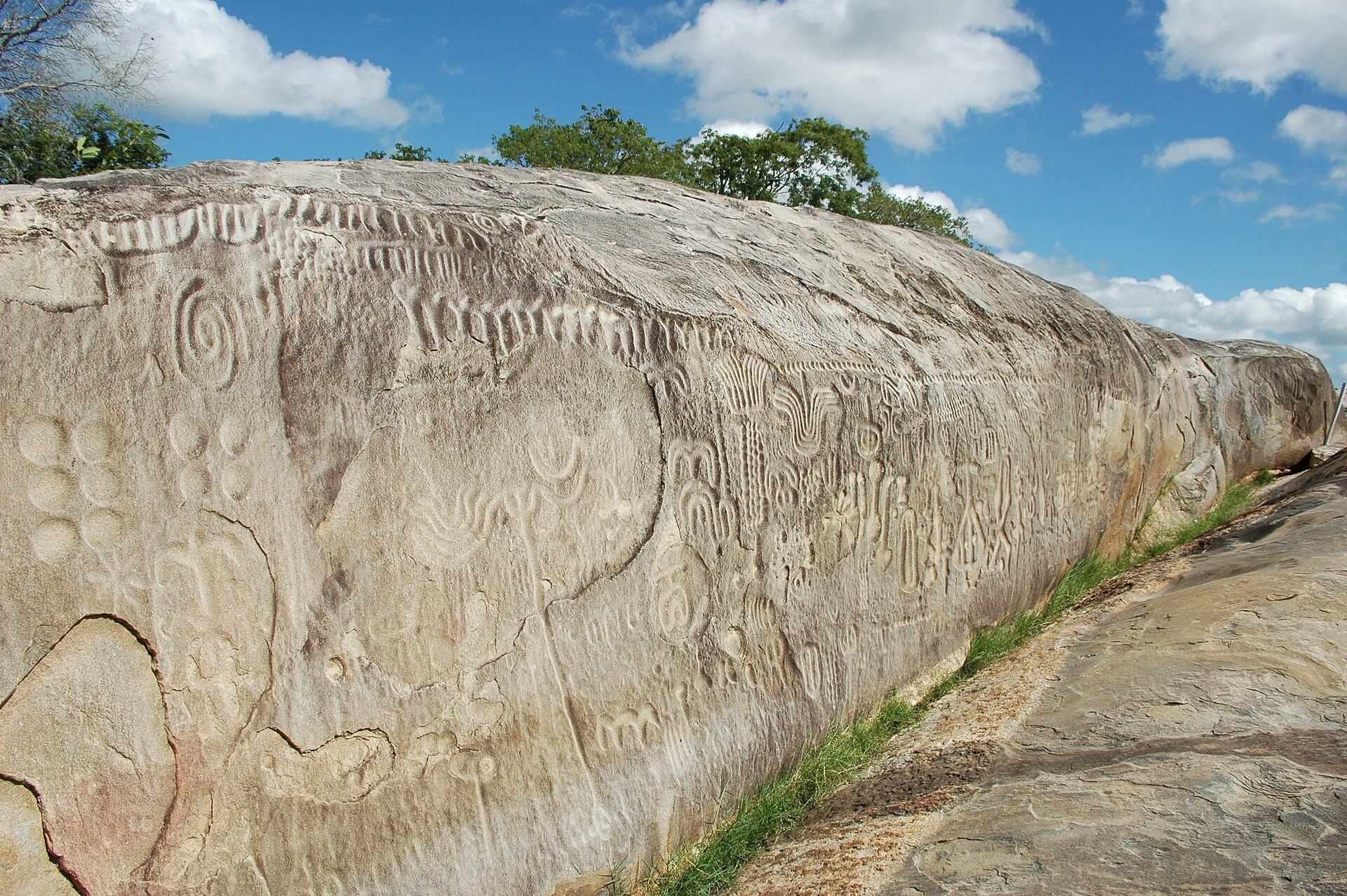
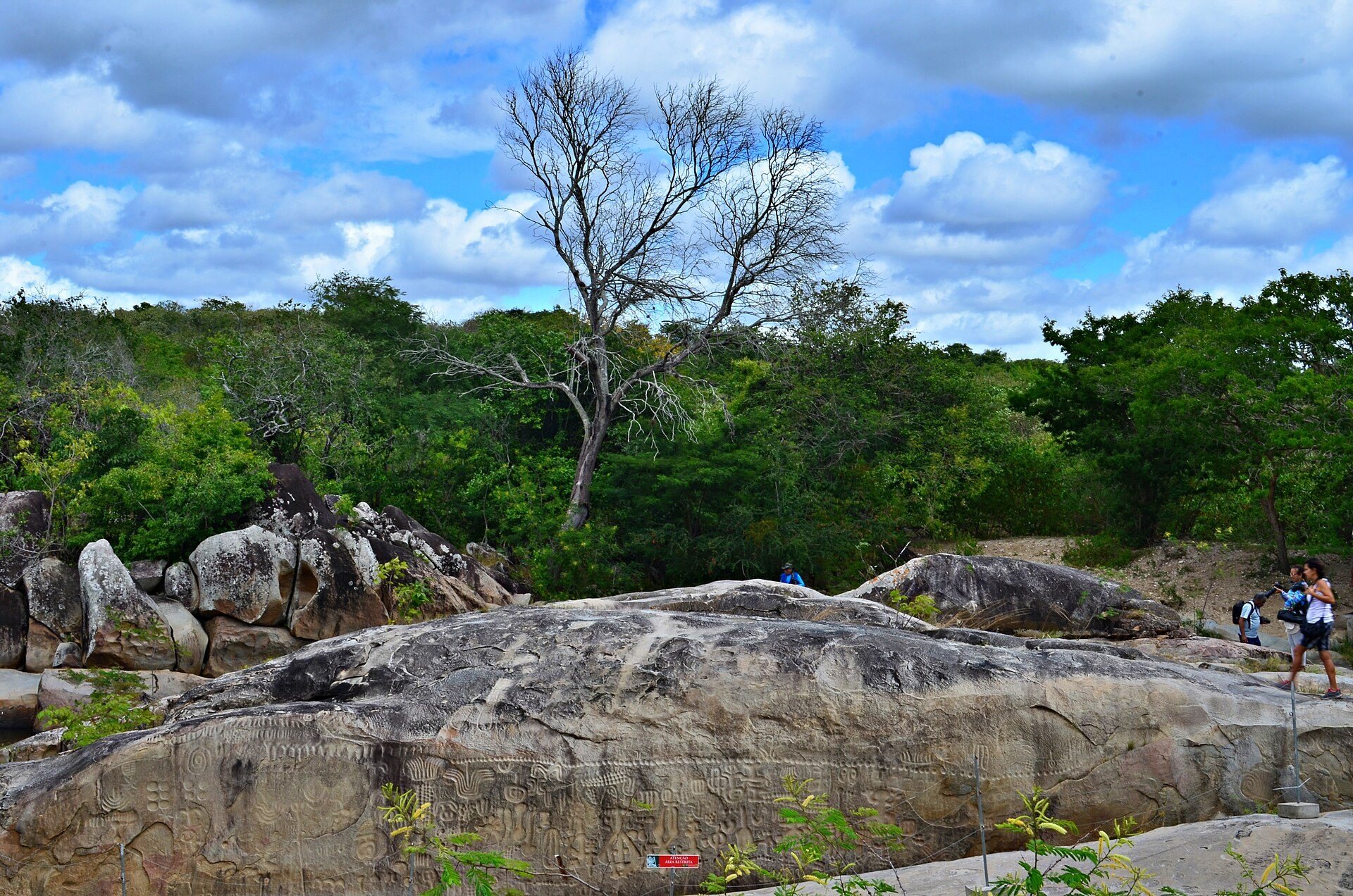
Ingá Stone is a gneiss formation covering approximately 250 square metres in a river bed. Its principal feature is a vertical rock wall about 46 metres long and 3.8 metres high, accompanied by engraved surfaces on the adjoining rock. The main inscription occupies roughly 15 metres by 2.3 metres of that wall. Most of its markings lie below a slightly undulating horizontal line formed by 112 capsule-shaped incisions.
Principal engraved panels
Vertical panel
The main vertical panel carries broad grooves that reach about 5 centimetres in width and approximately 8 millimetres in depth. Their surfaces were carefully worked and polished. The panel contains capsule- or bowl-like marks together with other symbols and figures. Francisco Pavía Alemany interpreted the arrangement as a possible solar calendar, with the vertical surface acting like a graduated scale. In this proposal, a gnomon, an upright feature that casts a shadow to indicate the Sun’s position, would project the first solar rays of each day across the engraved surface.
Lower panel
In front of the vertical wall, the rock floor bears a lower panel covering about 2.5 square metres. Rounded markings with radiating lines create forms resembling stars. These groups have been proposed as representations of Orion or the Pleiades, constellations visible from the location. Their possible relationship with the capsule-shaped marks on the vertical panel provides the main physical basis for the monument’s archaeoastronomical interpretation.
Upper panel
At the top of the rock, about 3.8 metres above the ground, an upper panel contains dispersed signs. These marks are narrower, shallower, and less carefully worked than those on the lower parts of the formation. The most conspicuous design is a large spiral-shaped circle crossed by an arrow-like incision pointing west.
Other engraved surfaces and site facilities
Marginal inscriptions
Additional inscriptions are scattered across the rock complex. They are more rudimentary than the principal panels, and many consist of scratches or scraped areas. Their relationship to the main engravings remains unresolved. Vanderley de Brito proposed that they might belong to an earlier culture, while Dennis Mota suggested that they may have functioned as preparatory sketches.
Figures and symbols
The rock surfaces include numerous figures and signs interpreted as animals, fruits, human forms, stars, constellations, and other images that cannot be identified. Their meanings remain undeciphered, so the physical presence of the symbols does not establish a single reading of the monument’s purpose.
Museum and support building
A visitor-support building and a Natural History Museum stand within the archaeological site. The museum houses fossils and lithic tools found in the region around the present-day town of Ingá.