Duntulm Castle: A MacDonald Stronghold on Skye


Site at a Glance
- Rating
- 4.5
- Popularity
- Low
- Country
- United Kingdom
- Primary era
- Early Modern
- External website
- Open
- Eras represented
- Medieval, Early Modern
- Civilizations
- Kingdom of Scotland
- Site type
- Military
- Remains
- Castle
On this page13 sections
History
Duntulm Castle is a ruined Scottish castle in the United Kingdom, probably built by the MacLeods of Dunvegan during the fourteenth and fifteenth centuries. Its surviving fabric includes fifteenth-century and seventeenth-century phases, reflecting the castle’s changing role in the contested Trotternish peninsula. The MacLeods held the office of bailiff, a local administrative and judicial position, while rivalry with the MacDonalds shaped control of the territory.
MacLeod and MacDonald control
Local tradition proposes that an Iron Age dun, a fortified enclosure or small stronghold, once occupied the promontory. It was supposedly called Dun Dhaibhidh, meaning “David’s fort,” and may later have served as a Viking stronghold. Excavation in 1961 investigated this possibility but did not establish the proposed predecessor.
Trotternish remained contested by the MacLeods and MacDonalds until the MacDonalds defeated their rivals and the Scottish king recognized their claim to the peninsula. Around 1539, Duntulm became the seat of Donald Gorm, the first chief of the MacDonalds of Sleat, a branch of the wider MacDonald clan based on Skye. Donald Gorm died that year and was succeeded by his minor son. King James V, who ruled Scotland from 1513 to 1542, visited Skye and the castle in 1540.
Repair and expansion
By the end of the sixteenth century, Duntulm had fallen into disrepair. In 1618, Sir Donald MacDonald of Sleat, also known as Donald Gorm Og and the ninth clan chief, received a binding order in a charter signed with the Privy Council, the central Scottish government body. He repaired and occupied the castle, adding a second tower.
The MacDonalds of Sleat firmly controlled Trotternish during the seventeenth century. Further improvements were made around 1650, when the castle reached its greatest importance and a rectangular house was built within the walls. The family was also involved in the conflicts that unsettled Scotland and Britain. Sir James MacDonald, the second baronet, a hereditary title below a baron, supported the Marquess of Montrose and joined the 1651 invasion of England. Sir Donald MacDonald, the fourth baronet, supported the Jacobites, who sought the restoration of the Stuart dynasty, at the Battle of Killiecrankie in 1689 and took part in the rising of 1715.
Abandonment and preservation
The MacDonalds abandoned Duntulm around 1730–1732, moving first to Monkstadt House and later to Armadale Castle in Sleat. Sir Alexander MacDonald used much of Duntulm’s stone to build Monkstadt House, a new residence about 5 miles (8 kilometres) to the south.
In the 1880s, the scholars MacGibbon and Ross described the ruins as being in good condition in The Castellated and Domestic Architecture of Scotland. The more recently built tower collapsed in 1990, sending masonry into the sea, and the ruins thereafter remained in a very poor and dangerous condition. Duntulm is managed by the Highland Council and became a scheduled monument in the United Kingdom on 9 March 1992. Because of the unsafe ruins, only the exterior can be viewed.
Legends of Duntulm
Several local traditions associate Duntulm with haunting. One story tells of Hugh MacDonald, a cousin of the third MacDonald chief, Donald Gorm Mor. After plotting to murder his relatives, Hugh was imprisoned and left to die from starvation and dehydration. He was allegedly given salted meat or fish but no water, and his death cries are said to remain audible.
Another tradition concerns Margaret, a sister of Rory Mor MacLeod of Dunvegan and the wife of Donald Gorm Mor. After losing an eye in an accident, she was sent back to Dunvegan on a one-eyed horse, accompanied by a one-eyed servant and a one-eyed dog. A variant links her grief to Hugh MacDonald’s death and says that she had loved him.
A further legend describes the spirit of Donald Gorm Mor loudly drinking at the castle with two companions. His successor and a priest are said to have compelled the nightly drinkers to become quieter. Another tale concerns a nursemaid who allegedly dropped a baby from a castle window onto the rocks. The fall is described as accidental in some versions and deliberate in others; the nursemaid was then sent to sea in a leaking or small boat, although one version says that servants rescued her. Her cries and the baby’s wailing are likewise said to linger at the castle.
Remains
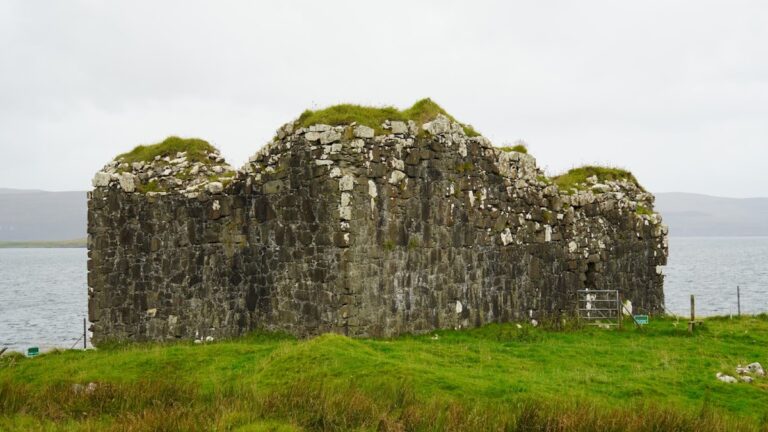
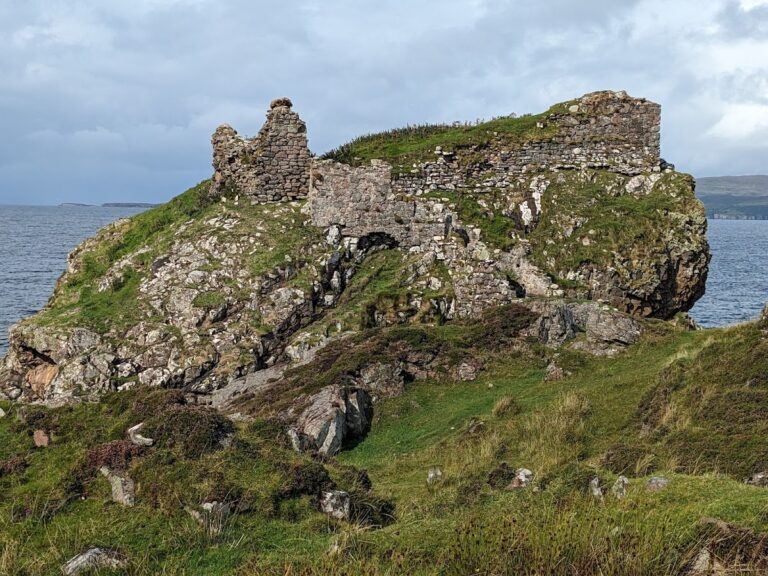
Duntulm Castle occupies a basalt promontory above the sea, overlooking Duntulm Bay, Tulm Island, and the hills of Harris. Its plan formed an irregular quadrilateral enclosing about 730 square metres. A ditch protected the southern landward side, probably crossed by a drawbridge, while steep slopes and cliffs defended the other sides. A curtain wall, an enclosing defensive wall, probably built from limestone rubble surrounded the promontory, and part of it survives on the north.
Entrances and defences
The northern wall contained a sea gate opening onto a narrow platform where people and goods could be hoisted from ships. Access to the castle was reached through a narrow cleft in the sea cliff. A small bastion, or projecting defensive platform, occupied the northeastern corner, adding to the protection of the sea-facing approach.
Fortified and domestic buildings
Southwestern donjon
The principal structure is a fifteenth-century donjon, the castle’s main fortified tower, in the southwestern corner. It measured about 25 by 9 metres and originally rose four storeys. Only its vaulted cellars survive, and the tower is now extremely ruinous.
Courtyard buildings
Seventeenth-century buildings stood around a courtyard within the donjon and the enclosing walls. A free-standing tower, probably also dating from the seventeenth century, was reached by a stair attached to the donjon’s north wall. It had two storeys and an attic before collapsing in 1990.
Northwestern building
A long building in the northwestern corner probably dates from the seventeenth century. It had two storeys, measured approximately 10 by 5 metres, and had walls about 66 centimetres thick.
Rectangular house
The later rectangular house built within the castle walls measured approximately 10 by 5 metres. Its construction belongs to the period around 1650, when the MacDonalds improved the castle and its importance reached its peak.
Memorial
A memorial on the southern side of the ruins commemorates the MacArthurs, who served as the MacDonalds’ pipers during the eighteenth century.