Gulustan Castle: A Medieval Shirvanshah Fortress in Azerbaijan

Site at a Glance
- Rating
- 4.3
- Popularity
- Very Low
- Country
- Azerbaijan
- Primary era
- Medieval
- Eras represented
- Medieval
- Civilizations
- Shirvanshah
- Site type
- Military
- Remains
- Castle
On this page6 sections
History
Gulustan Castle is a medieval fortress in Azerbaijan, approximately 3 km northwest of Shamakhi. Probably founded in the 9th century, it was radically rebuilt and strengthened from the 12th century to the beginning of the 13th century. The fortress occupied a commanding rocky ridge and became a residence and defensive stronghold of the Shirvanshahs, the ruling dynasty of Shirvan.
Early fortress and Shirvanshah residence
The earliest archaeological finds from Gulustan date to the 9th century. The orientalist and archaeologist Yevgeni Pakhomov proposed that Yazidiyya, identified in Tarikh al-Bab, a medieval history of the Caucasus, as the capital of Shirvan until 1072, stood in the area of the present ruins.
From the 11th to the 16th century, Gulustan Castle served the Shirvanshahs as both a stronghold and a residence. Its importance grew during the 12th and early 13th centuries, when it functioned as a refuge and as their second residence after Shamakhi. Shahbanu, the sister of Shirvanshah Manuchehr III, repaired the fortress in the 12th century. The poet Khaqani called it a “new Kaaba palace,” a description that the Azerbaijani archaeologist Huseyn Jiddi connected with this reconstruction.
The fortress was described in Farhad-name by Arif Ardabili, tutor to the son of Shirvanshah Kavus. Khaqani and other writers also mentioned Gulustan, preserving information about its walls and general appearance.
Safavid conquest and destruction
After Shah Ismail I of the Safavid state captured Baku in 1501, his forces besieged Gulustan Castle but failed to take it. The defenders’ resistance forced the attackers to withdraw. The Safavid state was a major Persianate empire whose expansion brought it into conflict with the Shirvanshahs, while the Qizilbash were its associated military forces.
In spring 1538, a Safavid army of 20,000 men invaded Shirvan. Following a prolonged siege, Qizilbash forces captured Gulustan Castle. The emirs of Shirvan were executed, and the last Shirvanshah, Shakhrukh, was taken to Tabriz and killed there.
In 1547, Alqas Mirza, the brother of Shah Tahmasp I, rebelled and fled after the rebellion was suppressed. His followers continued to resist at Gulustan under Mehtar Dawlat Yar. The defenders executed a shah’s envoy, after which the Safavid army besieged the fortress for three months. The castle was then destroyed on the shah’s orders. A tradition recorded by the historian Hasan-beg Rumlu says that women hostile to Dawlat Yar helped the attackers climb the walls with tent ropes.
The spread of firearms eventually reduced Gulustan Castle’s defensive importance. Its ruins are protected by the state as a monument of national architectural significance.
Remains
Ridge-top fortress
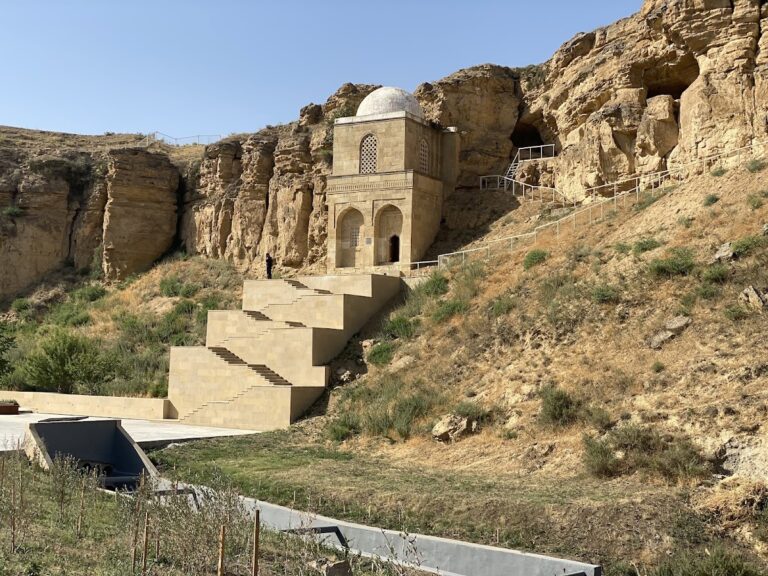
Gulustan Castle occupied the summit and part of the slopes of a rocky ridge rising approximately 190 to 200 metres above the surrounding terrain. Its defensive walls followed the mountain slopes, while the citadel, the strongest elevated part of a fortress and its final defensive position, stood at the summit. Precipices protected the northern, eastern, and western sides.
The surviving structure is a ruined complex of fragmentary round and quadrangular walls and towers rather than an intact fortress. Limestone was used in its construction. The walls and towers reflect the fortress’s adaptation to the steep ridge and its defensive purpose.
Palace and water systems
Archaeological excavations uncovered remains belonging to a palace complex, together with material-culture samples dating from the 9th to the 12th century. These remains provide physical evidence for the fortress’s early occupation and its use as a residence before its later transformations.
Clay pipes brought water into the fortress. An underground passage also led to a water source. This passage was more complex and carefully constructed than comparable passages at other Azerbaijani fortresses, forming part of the systems that supported life within the ridge-top stronghold.