Diri Baba Mausoleum: A Fifteenth-Century Mausoleum-Mosque in Azerbaijan


Site at a Glance
- Rating
- 4.2
- Popularity
- Low
- Country
- Azerbaijan
- Primary era
- Medieval
- Eras represented
- Medieval
- Civilizations
- Shirvanshah
- Site type
- Religious
- Remains
- Tomb
On this page9 sections
History
Diri Baba Mausoleum is a fifteenth-century mausoleum-mosque in Azerbaijan, dedicated to Sheikh Diri Baba, a traditionally venerated saint, or holy religious figure. Built in 1402–1403 during the rule of Shirvanshah Ibrahim I, it is regarded as a major work of the Shirvan architectural school, the regional building tradition of Shirvan, a historical region corresponding broadly to present-day Azerbaijan.
Construction under the Shirvanshahs
The building date is preserved in an inscription as 805 in the Islamic calendar, corresponding to 1402–1403. The same inscription places its construction during the reign of Ibrahim I, who belonged to the Shirvanshah dynasty, the ruling house of Shirvan. The architect’s complete name has not survived, although the inscription identifies him as the son of Ustad Haji.
Veneration and pilgrimage
Local tradition holds that Sheikh Diri Baba was buried at the site and that his body remained incorrupt. This belief gave the mausoleum a place in numerous legends and mystical traditions. Pilgrims and other visitors were drawn to it from the seventeenth century onward.
Evliya Çelebi, a seventeenth-century Ottoman traveler and writer who visited Azerbaijan in the mid-seventeenth century, described Diri Baba, also known as the Sheikh of Maraza, as a muezzin, the person who traditionally calls Muslims to prayer, at the court of Sheikh Ibrahim. Adam Olearius, a German traveler and writer of the same century, recorded traditions that Diri Baba had taught Seid Ibrahim and that his supposedly incorrupt body remained kneeling in prayer. Olearius also described the annual replacement of the saint’s grey robe, the distribution of pieces of the old robe to pilgrims, pilgrimages from distant places, and offerings in caves and chambers around the burial place.
Damage, repair, and protection
The mausoleum appears in the travel writings of Adam Olearius and Cornelis de Bruijn, as well as in a work by B. Dorn. Investigations in 1944 reported that its dome had completely collapsed. Further examination and archaeological excavation followed in 1955, after which a restoration project was prepared and the building was repaired. The mausoleum is protected by the state and was designated a nationally important historical and cultural monument by a decision of the Cabinet of Ministers of the Republic of Azerbaijan on 2 August 2001.
Remains
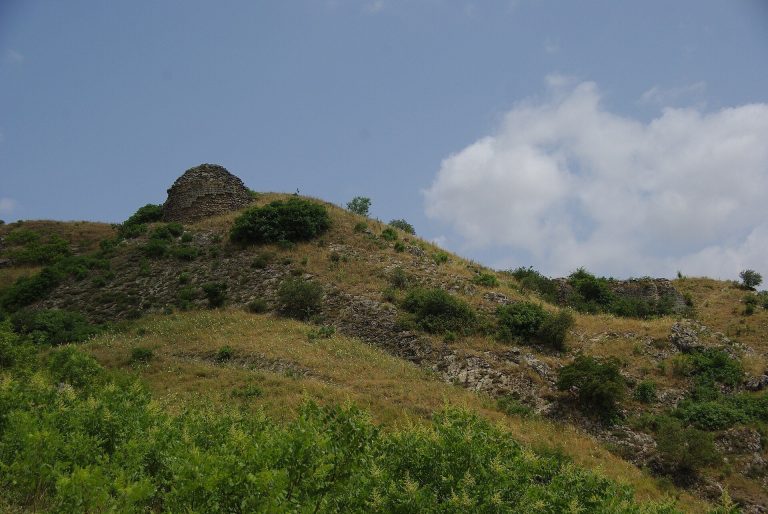
The mausoleum stands on a square platform cut into a steep cliff opposite an old cemetery on the Baku–Shamakhi road near Maraza. It is embedded directly into the rock, creating the impression of a building suspended above the ground. Its light, smooth walls contrast with the irregular dark stone of the cliff, while cliffs and green trees form part of the surrounding setting.
Exterior and architectural form
The two-storey structure adjoins the cliff and is identified with the Shirvan architectural school. A decorative band bearing inscriptions separates the two levels and appears to run around the building. Mosaic decoration and elaborate inscribed ornament enrich the walls, with the calligraphic work attributed to a craftsman identified as Dervish.
Lower hall and entrance
The first storey contains a hall covered by a pointed vault. It is entered through a small vestibule topped by an octagonal dome, where visitors traditionally removed their shoes. From this space, a narrow staircase partly carved into the rock leads upward toward the second storey.
Burial hall
The second storey is regarded as the principal part of the monument and contains the burial hall. Measuring approximately 15 square metres, the room is covered by a spherical dome with a pointed crown. Its squinches, architectural supports that carry the transition from a square room to a dome, are decorated with vegetal ornaments. One preserves a fragmentary inscription giving the building date and part of the architect’s name. A carved commemorative text on the wall mentions Ibrahim I.
Rock-cut burial area
A grotto carved into the cliff contains the traditional burial place of Sheikh Diri Baba. A narrow passage in the northern wall leads to it. Additional caves and small chambers were cut into the same rock around the burial place. Adam Olearius described four spacious chambers with places for beds and mangers, including some positioned high above the ground and reachable only by ladder.