Grote of Sint-Michaëlskerk: Zwolle’s Gothic Hall Church


Site at a Glance
- Rating
- 4.5
- Popularity
- Medium
- Country
- Netherlands
- Primary era
- Medieval
- External website
- Open
- Eras represented
- Medieval, Early Modern
- Civilizations
- Holy Roman Empire
- Site type
- Religious
- Remains
- Church
On this page16 sections
History
Grote of Sint-Michaëlskerk is a fifteenth-century Gothic church in Zwolle, Netherlands, constructed in the Lower Rhine Gothic tradition between 1406 and 1466. Dedicated to Saint Michael the Archangel, a Christian figure traditionally associated with defending against evil, it stands on the site of earlier churches and is now a nationally protected monument.
Early churches and the Gothic rebuilding
A church in Zwolle is mentioned as early as 765, and a predecessor on this site is known from before 1040. A smaller Romanesque church was built here around the twelfth century. That building was destroyed in the city fire of 1324, after which the present Gothic church was constructed during the fifteenth century.
The church was Catholic until 1580, when it was taken over for Calvinist worship and formally assigned to the Lower German Reformed Church. French forces occupied Zwolle in 1672, allowing Catholics to use the church temporarily. Calvinist control returned in 1674.
The tower collapse and later rebuilding
Lightning struck the tower in 1548, 1606, and 1669. Its condition worsened after the last of these strikes, and the tower collapsed on 17 December 1682. The fall destroyed part of the nave and the organ. Zwolle city painter Jan Grasdorp recorded the tower’s deterioration between 1669 and 1682 in a series of paintings.
Before its collapse, the tower reached approximately 115 to 120 metres and was the highest tower in the Netherlands, exceeding the 112.5-metre tower of Utrecht Cathedral. An octagonal consistory chamber, a room for the church governing council, was built on the former tower site in 1686. A replacement organ was commissioned after the collapse and installed in 1721.
Restoration and public religious history
A major restoration took place from 1882 to 1896 under designs by Pierre Cuypers, a leading Dutch architect of ecclesiastical and Gothic Revival buildings, and Lambert Hezenmans, an architect and restorer. Extensive restoration began again in 2020. Archaeological work during that campaign exposed part of the wall belonging to the Romanesque predecessor. The church has subsequently also been known as the Academiehuis.
The church hosted a reception for Willem V of Orange-Nassau, the last stadtholder of the Dutch Republic, on 30 August 1766. On 30 September 1988, Queen Beatrix and representatives of numerous religious denominations attended a joint Dutch celebration there marking the millennium of the Russian Orthodox Church.
Remains
Medieval structure and interior fabric
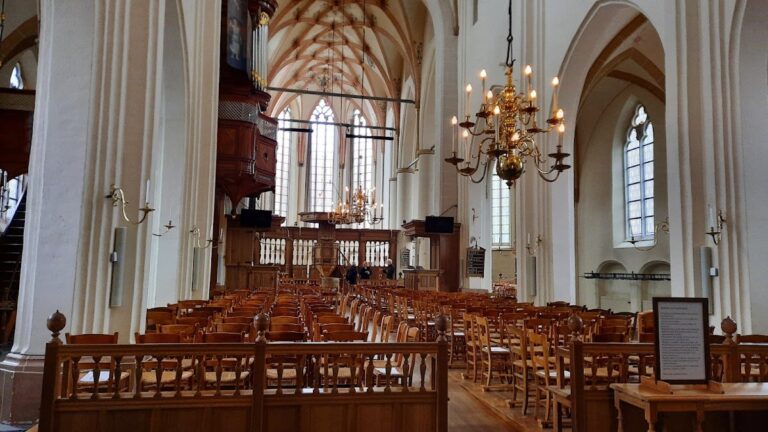
The surviving building is a three-aisled Gothic hall church on Zwolle’s Grote Markt. In a hall church, the nave and side aisles are approximately equal in height, producing a unified interior space. Its architectural character belongs to the Lower Rhine Gothic tradition, a regional form of Gothic architecture associated with the Lower Rhine area.
Romanesque relief
A Romanesque relief is built into one of the church walls. It shows Abraham together with the archangels Raphael, Michael, and Gabriel, preserving a sculptural element connected with the earlier church on the site.
Frescoes and liturgical furnishings
Fifteenth-century frescoes by Johan van den Mynnesten remain in the church. The interior also contains a sixteenth-century choir screen, which separates the choir from the main body of the church, and fragments of a sacramentarium attributed to Willem Backerweerd. A sacramentarium is a liturgical structure or cabinet associated with the storage or display of the sacraments.
Baroque pulpit
Adam Straesz made the Baroque oak pulpit between 1617 and 1622. It rises 11.5 metres and is described as the second-tallest pulpit in the Netherlands, after the pulpit in Amsterdam’s Nieuwe Kerk.
The principal organ
Construction and design
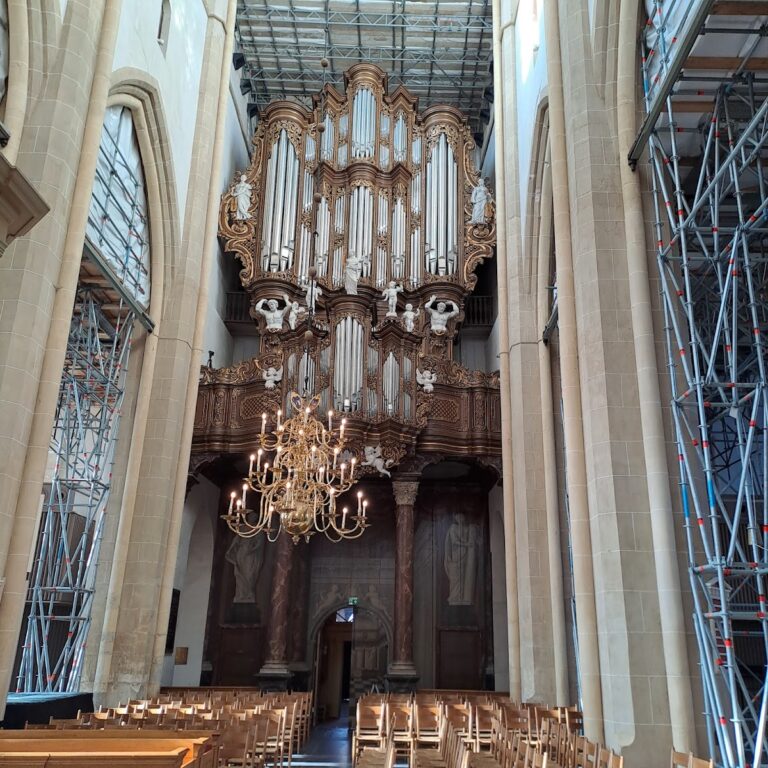
The principal organ was designed by Arp Schnitger, a major North German organ builder of the Baroque period, and built by his sons Franz Caspar and Johann Georg Schnitger between 1719 and 1721. It was completed on 30 September 1721. The builders were instructed to incorporate pipe material from the earlier organ, and an additional Brustwerk was added in 1720 to the three manual divisions originally planned. A Brustwerk is a small organ division positioned near the player and enclosed within the main case.
The instrument has four manuals, more than 4,000 pipes, and 64 registers. Amsterdam builder Jurriaan Westermann made its case, which Anthonij Aardewijn painted and gilded in 1723.
Alterations and restoration
The organ was altered several times during the nineteenth century and the first half of the twentieth century. Flentrop restored it between 1953 and 1955, with the aim of recovering its original structure and arrangement. Further restoration proceeded in phases from 2008, addressing the action and stop mechanism, wind supply, case, and pipework. A separate chest organ was made in 2009 by the Klop firm of Garderen.
Artworks and burials
Paintings and memorial objects
The church contains a painting by Hendrick ten Oever dated 1691 and a gilded wooden candle crown made by Daniël Marot in 1724. Ten Oever was a Dutch painter active in the seventeenth century, while Marot was a French-born Baroque designer and architect who worked in the Netherlands.
Tombs and grave slabs
Tombs and grave slabs commemorate the painters Gerard ter Borch and Aleida Greve and the organ builder Franz Caspar Schnitger.
Burial vaults
Six brick-built burial vaults were found in the high-choir area in 2005 during work to install central heating. They were aligned east to west, set into sand, and intact. Several seventeenth- and eighteenth-century vaults still contained lead coffins. Inscriptions on other grave slabs indicate that these vaults formed part of a wider burial history within the church.