Frauenmark Megalithic Tombs: Neolithic Burial Monuments in Germany
Site at a Glance
- Popularity
- Very Low
- Country
- Germany
- Primary era
- Stone Age
- Eras represented
- Stone Age
- Civilizations
- Unclassified
- Site type
- Burial
- Remains
- Burial Mound
On this page4 sections
History
The Frauenmark Megalithic Tombs are two Neolithic burial monuments near Frauenmark in Friedrichsruhe, Germany. Built around 3500–2800 BC by communities of the Funnel Beaker culture, a northern and central European culture named for the shape of some of its pottery, they represent two different tomb forms. Frauenmark 1 is an Urdolmen, an early, simple megalithic chamber tomb; Frauenmark 2 is a passage grave, a burial chamber reached by a passage.
In 1965, German prehistorian and archaeologist Adolf Hollnagel excavated and reconstructed both tombs. They are listed as numbers 409 and 410 in archaeologist Ernst Sprockhoff’s catalogue of megalithic tombs.
Remains
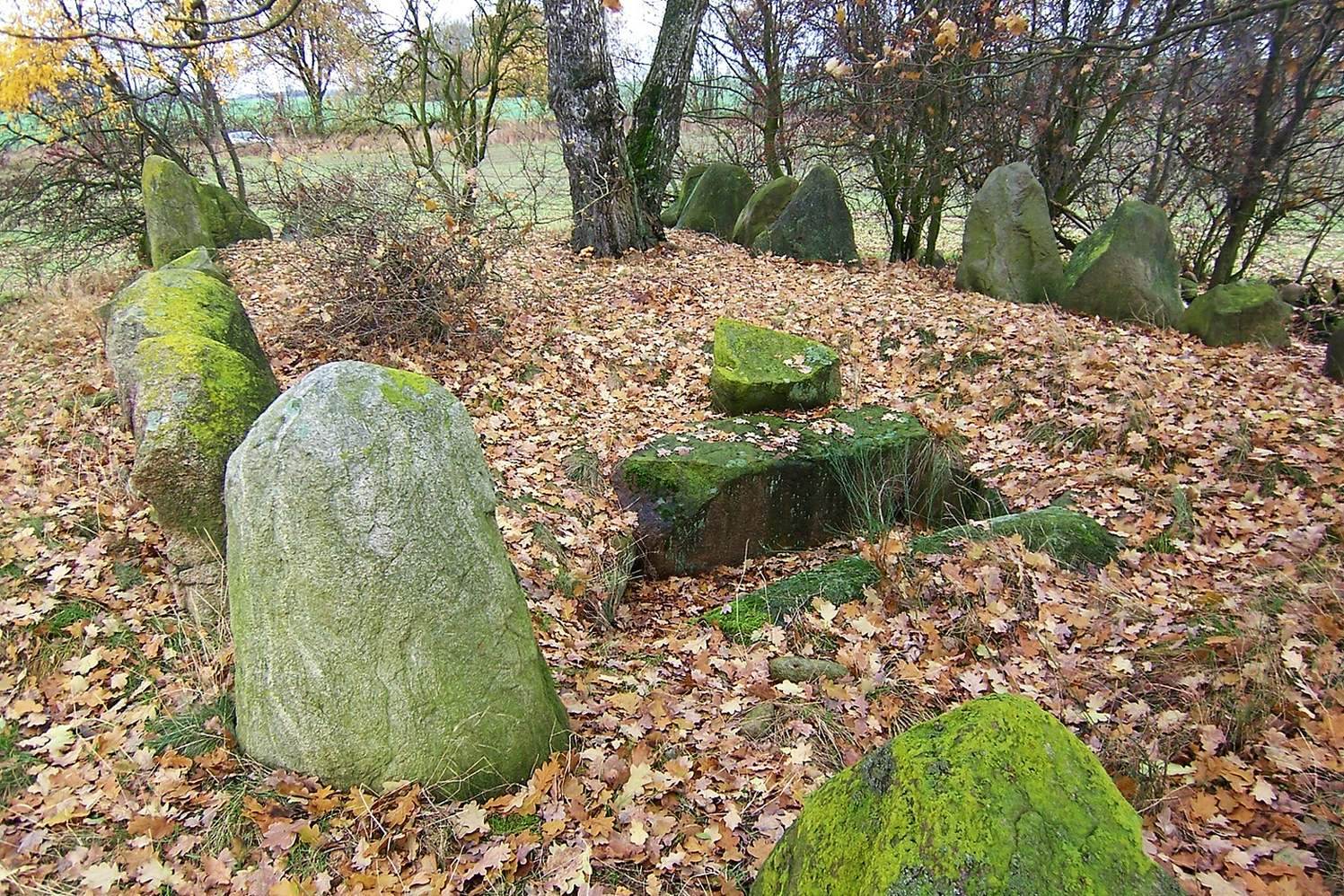
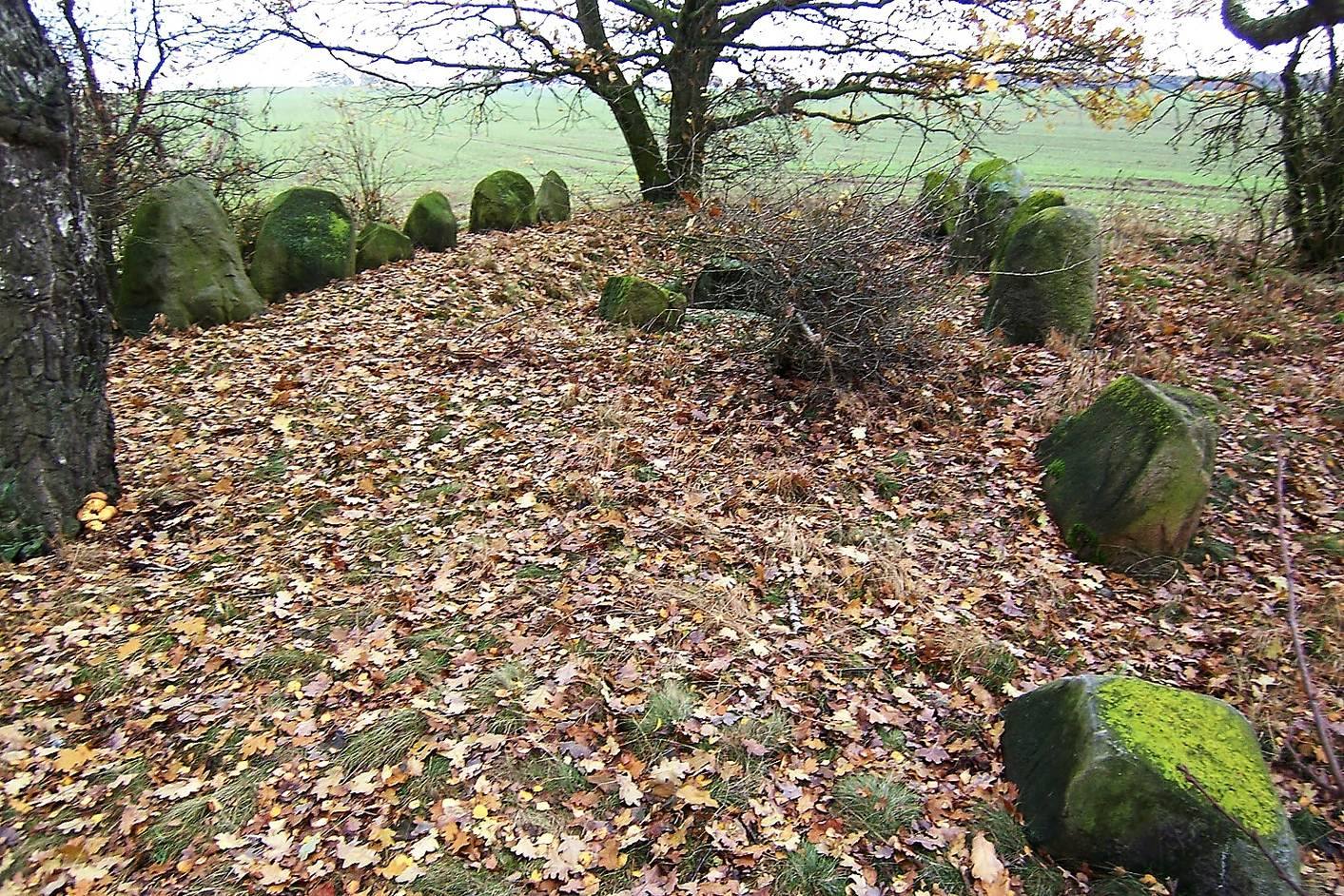
The tombs lie east of Frauenmark village, on opposite sides of the road toward Kossebade. Frauenmark 1 stands in a field north of the road, while Frauenmark 2 is in woodland to the south. The nearby Friedrichsruhe dolmen is another prehistoric monument in the area.
Frauenmark 1
Frauenmark 1 is a well-preserved, trapezoidal long barrow, an elongated burial mound, about 14.5 m long and aligned northwest–southeast. It measures about 8.5 m across at the northwest end and 6.3 m at the southeast. Twenty-one stones survive around its perimeter. Two angled guard stones stand at the northwest end, one marked with a cup-shaped hollow.
The small chamber lies across the mound and measures about 2.3 m long, 1.6 m wide, and 1.2 m high. Its supporting stones remain in place, along with a chamber-high half-stone at the entrance. The chamber is sunk to the tops of its supports, and a remnant of its single capstone lies beside it. Pebbles, heated flint, and clay screed formed the floor. Finds included a flat axe, a transverse arrowhead, and a wide-mouthed vessel.
Frauenmark 2
Frauenmark 2 is an east–west passage grave with its entrance on the south. Its trapezoidal chamber is 7.7 m long and 1.8 m high, with widths of 3.0 m and 1.8 m. All 12 supporting stones survive, and one bears nine cup marks. The western end stone is broken, while the eastern one has shifted outward. Two of the four capstones are inside the chamber and two lie beside it. A stone alongside the southern long side is probably a capstone from the entrance. Remnants of small-stone masonry remain between some supporting stones along the chamber’s long sides.
The chamber floor was made of clay screed. Finds included 26 pottery sherds, two heart-shaped arrowheads, and a hammerstone. A thin layer of rounded stones covers the earthen mound, either to reduce erosion or to give the mound the appearance of a stone-built structure.