Megalithic Tombs near Nipmerow: A Neolithic Burial Complex
Site at a Glance
- Popularity
- Low
- Country
- Germany
- Primary era
- Stone Age
- Eras represented
- Stone Age, Medieval
- Civilizations
- Unclassified
- Site type
- Burial
- Remains
- Tomb
On this page9 sections
History
Neolithic origins and later use
The Megalithic Tombs near Nipmerow are a group of five Neolithic burial monuments in Lohme, Germany, built around 3500–2800 BCE by the Funnel Beaker culture, a farming society of the Neolithic, or later Stone Age, named for its funnel-shaped pottery. One surviving tomb, Magelowberg, is a passage grave, a burial chamber reached through a narrow passage, and the only known example of this type on Rügen. The other four tombs were destroyed during the nineteenth century.
Magelowberg was used again for burials in the pre-Roman Iron Age, the Iron Age phase before the Roman period, and during the Slavic period, when Slavic communities were established in the region.
Rediscovery and excavation
Some of the tombs may be shown on detailed cadastral maps made between 1692 and 1709 during the Swedish land survey of Western Pomerania. Friedrich von Hagenow described four in 1829, and Rudolf Baier published Hagenow’s research in 1904. The four tombs had been destroyed by the time Ernst Sprockhoff surveyed Rügen’s megalithic tombs in 1931, so he did not include them; Magelowberg was still unknown to him.
Willi Lampe included Magelowberg in a monument list in 1973, but identified it as a Bronze Age burial mound because earth almost completely concealed its chamber. In 1976, gravel extraction placed the tomb at serious risk, leading to an archaeological excavation. Trees were cleared from the mound in the winter of 1982, and the main excavation followed in August 1983 under Günter Rennebach. The team first treated the site as a burial mound, using the quadrant method, which divides an excavation into sections for systematic recording. It recognized the megalithic chamber only as the work progressed.
Remains
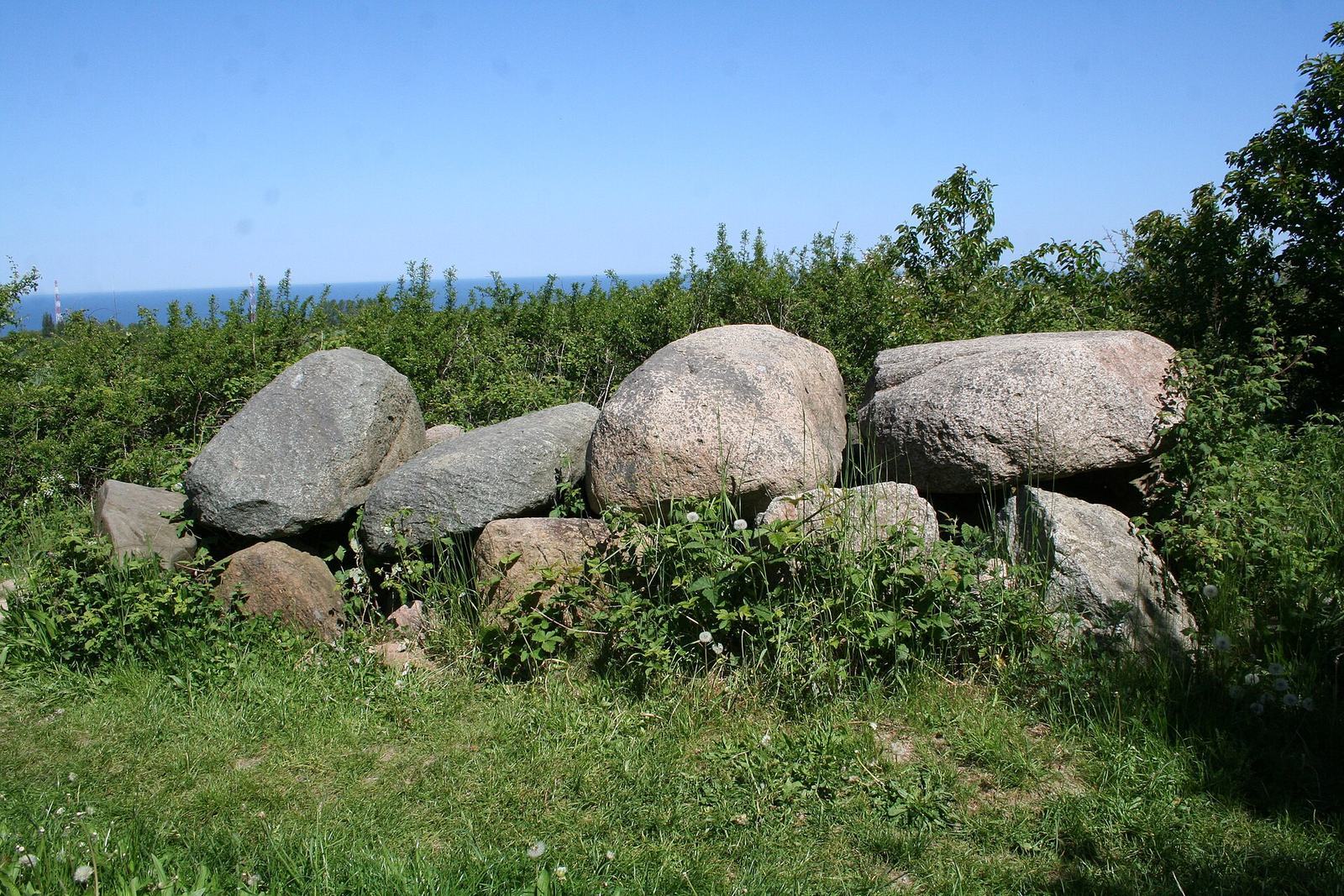
Magelowberg stands on a slight rise in the northern part of the Jasmund Peninsula, northeast of Nipmerow and east of the road to Lohme. Its construction combined an east–west rectangular long barrow, an elongated burial mound, with a later circular mound built around it. Two other megalithic tombs near Hagen-Stubnitz lie 900 m southeast, and the tomb at Ranzow is 1.4 km northeast. The destroyed tombs near Wesselin were about 2.3 km southwest; Jasmund also contains numerous burial mounds.
Magelowberg
Mounds and chamber
The first mound was a rectangular long barrow measuring 11 m long and 7 m wide, with the burial chamber set within it. A circular mound, 15 m in diameter, was later built around both, and it too had a stone perimeter. A cobble pavement lay between the long barrow’s boundary and the chamber, which was sunk into the ground. The circular mound consisted of humus-rich marl mixed with large stones and covered by a layer of humus.
Burial chamber and passage
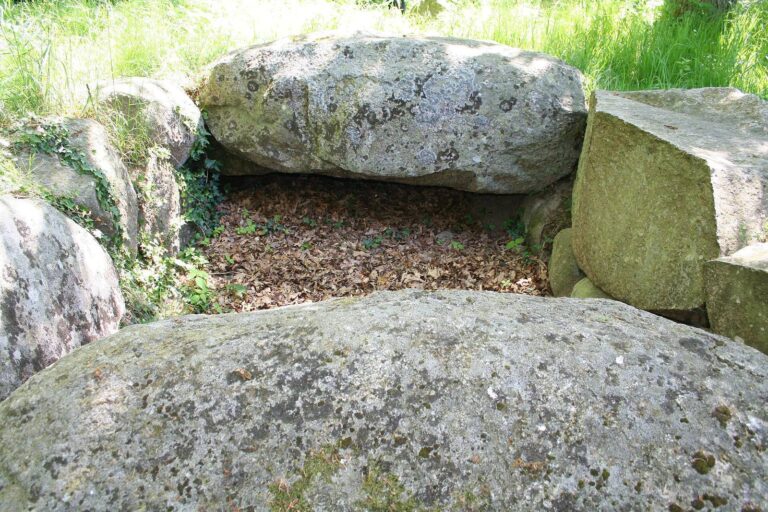
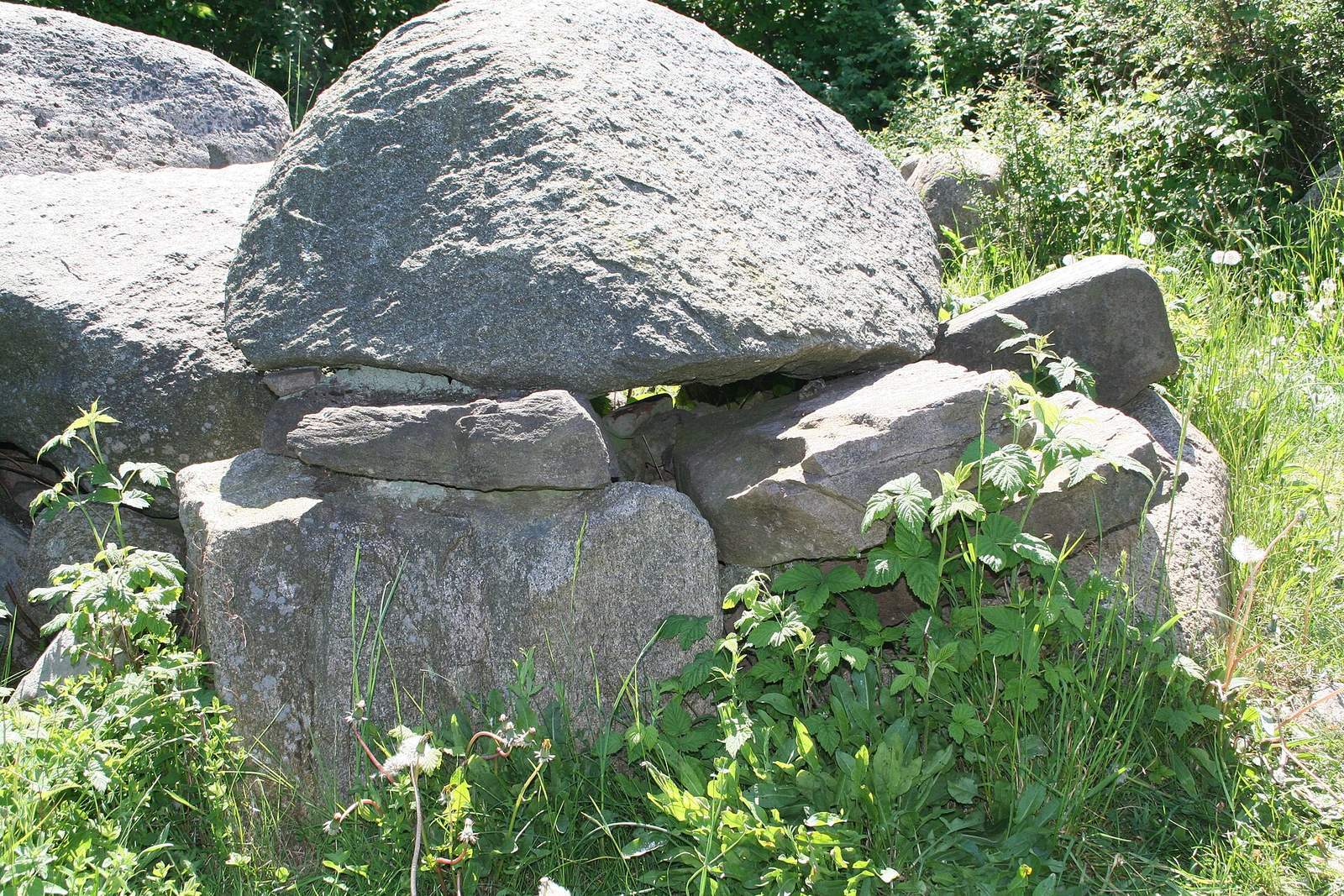
The chamber runs east to west and measures 4.0 m long, 1.6 m wide, and 1.1 m high. Four wall stones form its south side; each end has an end stone. The north side has three wall stones and a narrow slab, with two passage stones adjoining that slab and the western wall stone. Granite slabs and cobbles filled the wide gaps between wall stones and partly supported the four capstones. The passage is 0.6 m high, roofed with several granite slabs, and filled with cobbles. A slab beside the chamber had slipped inward and become wedged in place. The excavators considered the chamber less carefully built than the large dolmens they had previously examined at Burtevitz and Lancken-Granitz.
Sand-and-marl soil filled the chamber to just below its ceiling. The layer containing archaeological finds began 25 cm above the floor, which was made of tamped marl; the passage had a cobble pavement. Finds came from both the chamber and passage. Pottery included double-conical and barrel-shaped vessels, conical and small bowls, and pots. Other objects included several stone axes, one complete chisel and a fragment of another, and two items known as crow stones. Flint finds comprised a blade dagger, blades, scrapers, and transverse arrowheads, whose cutting edges were set across the shafts. Amber beads came in double-axe, disc, roller, club, and cylindrical shapes. Poorly preserved human remains, including skull fragments, indicate that at least two people were buried in the chamber.
Later burials
Near the mound’s surface in its southwest part lay a pre-Roman Iron Age secondary burial, an interment made after the monument’s original use. It included pottery rim and body fragments and cremated human remains.
A stone circle on a raised area near the mound’s center enclosed two Slavic-period burials of uncremated bodies. The rectangular grave pits were dug just below the mound surface, edged with stone settings, and aligned east to west. The bodies had been placed on their backs with their limbs extended. The skeletons were poorly preserved, with the chest, hand, and foot bones largely decayed. The skeleton in the second grave had a sharply curved spine and its head turned to the left.
The first grave held an iron knife, a fire steel used with flint to make sparks, a bronze knife-sheath fitting, a bronze ring, a bronze razor, and a pottery bowl. The second contained an iron knife and a bronze sheath fitting. Objects outside the graves included a third iron knife with a bronze sheath fitting, a broken pottery bowl, and a knobbed lid. Corrosion on all three knives preserved impressions of organic material, probably clothing, and examination identified wool fibres. Linen impressions survived on the fire steel.
The four destroyed tombs
Two of the destroyed tombs had large dolmen chambers, megalithic graves built from large stones, enclosed within cobble mounds. A third had a large dolmen chamber within a circular mound bounded by a stone ring, a circular setting of stones around a mound or burial area. The fourth contained a chamber within a trapezoidal long barrow.