Grande-Sauve Abbey: A Benedictine Monastic Centre in France


Site at a Glance
- Rating
- 4.5
- Popularity
- Medium
- Country
- France
- Primary era
- Medieval
- External website
- Open
- Eras represented
- Medieval, Early Modern
- Civilizations
- Duchy of Aquitaine, English, French
- Site type
- Religious
- Remains
- Monastery
On this page21 sections
History
Grande-Sauve Abbey is a ruined Benedictine monastery in France, founded in 1079 at Altus Villaris, or Hauteville, in the present-day town of La Sauve. Gérard de Corbie established it with the support of William VIII, Duke of Aquitaine, and dedicated it to Notre-Dame, or Saint Mary. The foundation belonged to the Romanesque period, and the abbey took its name from Silva Major, the great forest that once covered the Entre-deux-Mers region. The word “Sauve” derives from the Latin term for woodland.
Foundation and medieval growth
Gérard founded the first abbey church and became the community’s first abbot. He died in 1095 and was buried at the monastery. Pierre I d’Amboise, elected the seventh abbot in 1126, later sought Gérard’s canonization. Pope Celestine III granted it in 1197, giving the founder a recognized place in the abbey’s religious memory.
The community expanded rapidly through the support of William VIII, Pope Gregory VII, and numerous benefactors and protectors. Its connections eventually included the kings of France and England. Grande-Sauve became a wealthy and influential medieval house with 51 priories, including Burwell in England. Its possessions and authority extended into England and the Iberian Peninsula, where its dependencies included Ejea de los Caballeros, Ruesta, Los Pintanos, Tiermas, Pradilla de Ebro, Monzón, and Alcalá de la Selva. A possible military-order character for some of these Iberian dependencies has been proposed, but this remains an interpretation.
The monks followed the Rule of Saint Benedict, a monastic code centred on communal prayer, disciplined work, obedience, and regulated daily life. During the Middle Ages, the abbey’s observance stood between Cluniac traditions and Cistercian reforms. It later joined the Congregation of Exempts and became part of the Maurist movement in 1667.
Pilgrimage and political authority
Grande-Sauve stood on a route to Santiago de Compostela, the shrine of Saint James in northwestern Spain and one of medieval Christianity’s major pilgrimage destinations. The abbey served as a regional starting point and an important staging place before pilgrims crossed the difficult Landes. It offered food, care, and rest. From there, pilgrims continued toward Langoiran, crossed the Garonne at Le Tourne, and rejoined the Tours route at Belin.
By the Middle Ages, the abbey’s wealth and power rivalled those of Bordeaux. Its position also drew opposition and repeated danger. The inhabitants of the monastic town of La Sauve rebelled against the monks several times during the thirteenth century. Local lords, bandits, Basque and Navarrese raiders, and Capetian and Plantagenet forces were also attracted by the abbey’s wealth.
After Eleanor of Aquitaine married Henry II in 1152, Grande-Sauve came under the authority of the kings of England in their role as dukes of Aquitaine or Guyenne. A tradition states that Eleanor stayed repeatedly at the abbey’s priory at Burwell, although the claim remains uncertain. The monastery was later drawn into the Hundred Years’ War, the conflict fought from 1337 to 1453 between France and England over territories that included Aquitaine and Poitou. In April 1462, Louis XI confirmed the abbey’s earlier rights, privileges, franchises, and liberties, including those granted by English kings as dukes of Guyenne.
War damage and decline
Repairs and new fortifications were undertaken during the sixteenth century after wartime damage. The work took place while the abbey’s privileges were contested and while it faced economic competition from the nearby bastide of Créon, a planned fortified town. Its decline and loss of influence began during this period.
A major storm in 1665 severely damaged the roofs of the church, dormitories, and refectory. An earthquake in 1759 further weakened the church, and the bell tower collapsed near the end of the eighteenth century. These disasters added to the long-term deterioration of the complex.
Revolution, dismantling, and later uses
During the French Revolution, the abbey’s possessions were confiscated and dispersed, and the monks were expelled. The surviving buildings became a prison in 1793. The church vaults collapsed in 1809, after which the ruins were quarried for about forty years. Their stone was reused in construction at La Sauve and in the surrounding region.
Antiquarians and private individuals removed carved capitals and other architectural elements during the nineteenth-century dismantling. Many entered private collections or museums. Destruction was halted when Grande-Sauve was placed on France’s historic-monument list in 1840. Protection was confirmed in 1914, extended in 1929 to surrounding parcels containing the ruins, and completed in 2002 when previously omitted land was included.
In 1837, the archbishop acquired the conventual buildings and established a Jesuit college there. The institution later became a teachers’ training college, but a fire destroyed the school in 1910 and the site was abandoned again. Between 1914 and 1918, the remaining buildings served as a small military field hospital. The French state took over the monument in 1960 and carried out major consolidation and stabilization works. The site is managed by the Centre des monuments nationaux. In December 1998, it became part of the UNESCO World Heritage property “Routes of Santiago de Compostela in France,” reference 868-008.
Community, books, and records
The monastery housed about 100 monks in 1231 and more than 300 at its height. After twelve years of construction, Grimoald, the thirteenth abbot, completed major works and consecrated the church in 1231. This phase included the octagonal upper part of the bell tower, the entire cloister, and the vaults of two bays in the south aisle.
Grande-Sauve possessed a substantial library and archive. Its collections were moved to Cadillac during the Revolution, returned to Bordeaux in 1806, and divided between the municipal library and the departmental archives of Gironde. The municipal library received printed books and major manuscripts, including three Bibles, two Gospel books, and the principal cartularies. A cartulary is a manuscript collection of copied charters and legal records concerning an institution’s possessions and rights.
The abbey had an active scriptorium, a monastic working environment for copying and illuminating manuscripts, before the Hundred Years’ War. Twelfth- and thirteenth-century records frequently mention the office of the librarian, or armarius, alongside those of the sacristan and cantor. The monk Petrus Scriptor was remembered for copying biblical and patristic books, including two nearly complete large-format Bibles.
Many manuscripts passed through the hands of the antiquarian Amans-Alexis Monteil and were sold to the English bibliophile Sir Thomas Phillipps. After Phillipps’s death, part of the abbey’s manuscript material returned to the Gironde archives. Other documents remain in private collections in Paris, Manchester, Oslo, and at Yale University. The manuscripts have been digitized.
The Great Cartulary comprised four manuscripts kept at the abbey until the Revolution and is now preserved in the Bordeaux municipal library. Its original volume suffered the cutting of parchment margins and was later divided into two parts, with some leaves incorrectly rearranged. Another cartulary is a 4.95-metre parchment roll made from ten sewn pieces. It contains transcriptions of 35 documents concerning the abbey’s possessions in Spain.
The surviving cartularies preserve evidence of the monastery’s possessions, administration, territorial expansion, and relationships with dependent institutions. The two principal volumes cover material from 1099 to 1398 and together retain copies of nearly 1,480 documents dating from 1079 to 1356. One Bible associated with the former library was produced at Mont-Saint-Michel between 1070 and 1090. It later passed through Saint-Sauveur at Redon and another western French scriptorium before being divided into two volumes. It contains decorated initials, illuminations, and inserted documents such as papal bulls and other historical texts. A separate Bible with the prologues of Saint Jerome is notable for its early-fourteenth-century Gothic script, decorated initials, gold and silver backgrounds, and historiated scenes.
Remains
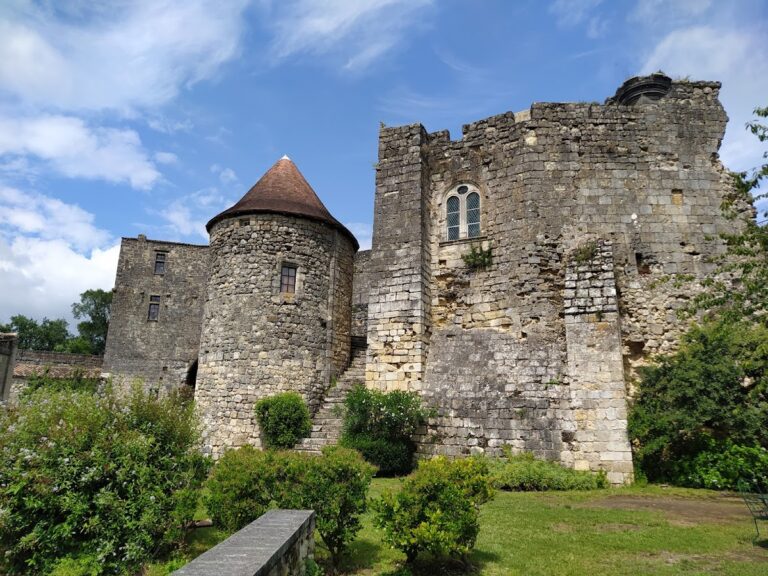
Grande-Sauve now survives mainly as the ruins of its church, chapter house, refectory, cloister plan, and fragments of associated buildings. The church is a Romanesque and Gothic structure on a Latin-cross plan, with a five-bay nave and aisles, a transept opening toward the choir, an eastern apse with adjoining apsidioles, and lateral chapels. Romanesque masonry forms the oldest surviving fabric. Most Gothic portions were destroyed, while the north transept walls, much of the chevet, and the south aisle beside the bell tower remain.
Church structure
Nave, aisles, and bell tower
The first bay of the nave contains a well and a niche. In the seventeenth century, two large masonry masses were built there to create an oval entrance structure that supported an organ gallery. The south aisle retains Gothic rib vaults in its second and third bays, dating from the thirteenth century. Its fifth bay preserves a plastered Romanesque cross vault from the twelfth century. The octagonal upper structure of the bell tower also belongs to the thirteenth-century building campaign completed under Grimoald.
Very little of the original portal survives, although seventeenth-century engravings indicate its former scale. The church masonry contains numerous masons’ marks. Those on the apse walls differ from marks in the transept, south aisle, and Romanesque bell-tower stairway, suggesting that more than one group of builders worked on the church.
Apse and sanctuary
The apse dates from the beginning of the twelfth century and is the oldest part of the church. It includes the choir and adjoining chapels, whose semicircular barrel vaults survive. Three large windows illuminate the choir, which once contained Gérard de Corbie’s tomb. The sanctuary was connected to the large north and south apsidioles by two triple arcades. Each arcade combined a passage with paired openings carried by a short, thick central column and engaged side columns. Six high-quality Romanesque capitals decorated these arrangements.
The upper apse has two levels. The axial window alone retains its original columns, decorated with chevrons and carved capitals. Its paired capitals show an angel killing two dragons and the archangel Michael killing a dragon. These images express the victory of good over evil and the hope associated with the rising sun. The archangel’s head and hands were still visible in a drawing made by Léo Drouyn in 1851 but are now lost. The object formerly held in his left hand may have been a balance for weighing souls.
Choir windows and arcades
Two complete lateral windows survive on the north wall of the choir. On the south wall, only a column and the eastern capital of the eastern window remain. Their imposts and abaci carry the dry-acanthus ornament characteristic of the abbey. The first north window has an acanthus capital and a damaged bird-bodied creature whose missing head probably belonged to a siren. The second has capitals showing two roaring male lions and a two-bodied lion with one head. Their arrangement was interpreted as a moral contrast involving hostility, pride, and forbidden male desire.
The surviving south choir capital shows three tightly grouped, bearded male busts emerging from acanthus foliage. Their forked beards and indifferent expressions formed part of an iconographic warning about bad company and moral example. Between the nave and choir, another capital depicts two bird-headed sirens approached from behind by two centaurs carrying spherical projectiles. The centaurs were interpreted as agents of justice, while the sirens represented unsuspecting victims of evil.
Romanesque sculpture
West facade and north transept
More than 80 carved capitals survive in the church, combining vegetal ornament with figural scenes. The church formerly had at least 100 capitals and about 200 modillions, projecting ornamental blocks that supported or decorated a cornice. Forty-seven modillions remain on the chevet, with additional examples on the west and east walls of the north transept.
Six surviving Romanesque sculptures on the west facade are stylistically assigned to the first half of the twelfth century, around 1150. Only one portal capital remains. Its basket has a pierced network of interlaced palmettes, while its abacus, still drawable by Léo Drouyn in 1851, is now illegible. Nearby, a frontal victorious angel presses one foot on a dragon-like creature. The angel’s face and left hand are lost, and the right hand may once have held a round consecrated host. The image represents the triumph of good over evil.
Four recessed pilasters at the junction of the north and west Romanesque buttresses contain small figurative sculptures, including a stout singing cleric, two probably canine mammals, and a badly eroded seated man holding an uncertain object. A buttress at the fifth bay carries a frieze of paired, two-bodied lions with a shared head. Their ringed manes and long, fan-shaped tails are characteristic of the abbey’s sculptural style and probably belong to the first church, around 1080.
A western capital on the north side bears three rows of pinecones suspended in a simple-twist network, with five rosettes on the abacus. An eastern capital shows a reversed man, or homo inversus, beneath a two-bodied demon. The posture and demon were understood as warnings against sexual sin.
The north-west transept window is the only one of the five transept windows to retain figurative decoration. Its capitals show a falling nude man holding a round fruit while a demon seizes his thigh, and an inverted or acrobatic man being swallowed by two animals, probably a bird and a lion. The paired scenes represent people who fall accidentally into temptation and those who persist in it deliberately.
Four nearly invisible corner modillions beneath the north-west transept’s projecting stone slab show a seated man being swallowed head-first by a beast, a simian head on a long neck, and two probably vegetal motifs. Two further modillions on the east wall depict a bearded man and a singing man. The lower portions of both were hammered away, probably during later destruction of imagery considered obscene. Two Gothic corbels with human heads survive in the north-west and north-east corners of the transept. One includes a hand holding a holy-water sprinkler, while a smaller relief near the north window may show a man holding a star or a bristled sprinkler.
Sanctuary capitals
The chevet, the eastern end of the church, contains about 30 decorated capitals, 17 of them figural. Its four apsidioles, small apses attached to the main apse or sanctuary, have largely plain wall faces that contrast with the richer sculpture of the main apse. The north triple arcade has three capitals: two-bodied lions with human heads, a monumental capital with four scenes of temptation, and a vegetal capital. The lion capital belongs to the decoration associated with Geoffroy de Laon, the fourth abbot, who held office from 1106 to 1119.
The monumental capital presents four scenes. A man fights a lion beside the Tree of Life, two griffins face a Vessel or Chalice of Life, one centaur kills another with a bow and arrow, and two basilisks confront each other above intertwined dragons. The sequence was understood as a warning against temptation rather than as a simple bestiary. The man uses a shield and sword against a lion representing human animality or evil. The griffins hold round fruits beside a twisted column supporting the Vessel of Life, an image interpreted as the Eucharistic chalice and the guardianship of paradise.
The centaur scene is badly eroded, with only part of one figure surviving. The armed archer has been interpreted as the virtuous, or “divine,” centaur traditionally associated with Chiron. An asymmetrical tree separates the imagery of paradise from the human world and symbolizes the narrow way of life and the broad way of sin. In the final scene, two basilisks raise scaly tails while serpent-like dragons intertwine between their legs. The creatures hold round fruits in their claws, continuing the sanctuary’s moral imagery of temptation.
Apse chapels
The large north apsidiole contains four historiated capitals, meaning capitals carved with narrative scenes. One presents the Fall of Adam and Eve. The serpent coils around the Tree of Knowledge, Eve offers the fruit to Adam, and Adam expresses shame. The side faces show Adam working the soil and Eve nursing Cain after childbirth. The composition derives from a Carolingian theme and is rare in Romanesque art.
Another capital depicts an inverted acrobat whose legs are consumed by two lions. A third shows two fish-tailed sirens holding vegetal stems, an image of bodily temptation. The fourth presents two naked youths kneeling and bound together by a single vine, symbolizing enslavement to instinct and passion. The scene has sometimes been identified as Ulysses tied to a ship’s mast, but the number, age, posture, and vine restraints of the figures correspond instead to the Romanesque motif Homo in compedibus corporis, the man in the bonds of the body.
The small north apsidiole contains a capital with two intertwined dragons biting their own tails. This Ouroboros, a dragon or serpent forming a circle by biting its tail, dates from the first quarter of the twelfth century and is a superior copy of a related capital in the Saint John chapel.
The large south apsidiole contains four capitals. Two are vegetal, while the two figural capitals show Daniel between two lions and episodes from the life of Samson. The chapel was dedicated to Saint Nicholas and was re-vaulted in 1662, when the Daniel capital was probably partly altered. Daniel sits calmly between two lions whose pupils may once have been inlaid with blue stone. The right-hand section appears to have been reconstructed as a close facsimile in 1662. The version of the story represented here does not include Habakkuk.
The Samson capital shows the hero killing a lion with his bare hands, carrying away the gates of Gaza, and being betrayed by Delilah. Delilah passes scissors to a servant while Samson sleeps, and the servant points to his bound wrists. The servant’s head was intact in an 1845 drawing but is now damaged.
The small south apsidiole contains two vegetal capitals revealed in 1956 when a later blocking wall was removed from its entrance arch. A plan of 1676 shows that the chapel, identified in the seventeenth century as the Chapel of Saint Benedict, was then still open.
Saint John chapel
The Saint John chapel includes a capital showing the Sacrifice of Abraham. Its scenes include the annunciation to Sarah, Abraham’s attempted sacrifice of Isaac, and the substitute ram. Only a few toes of Isaac survive, although a drawing made by Léo Drouyn in 1844 records the figure more completely.
Another capital shows two winged dragons interlaced and biting their own tails while holding round fruits. Its rustic style and archaic form suggest a date around 1080, during the period of the first abbey church. A western capital on the south wall shows four large opposed beasts, including lions with raised tails, although their heads are lost.
The Saint John transept arcade contains a capital depicting the beheading of John the Baptist. The sequence includes Herod’s feast, Salome’s dance, John’s execution, and the presentation of his head on a platter beneath angels. Herod, Herodias, Salome, a drummer, the executioner, and the angels are all included in the composition. The capital is regarded as the most famous example of the “La Sauve art.” Its anonymous sculptor is known as the “Master of La Sauve,” a name assigned to the artist through recurring features in the abbey’s Romanesque carvings. A second chapel capital is vegetal, while the western capital of the arcade toward the nave was left unfinished.
South arcade and consecration medallions
The south arcade includes one figural capital showing the three temptations of Christ by Satan. The scenes represent turning a stone into bread, worshipping Satan in exchange for worldly kingdoms, and throwing himself from the Temple. Christ’s three faces were deliberately damaged, probably during the French Revolution. The other capitals are vegetal. One central capital has 39 pinecones arranged in a network, interpreted as fruits of life in the Eucharistic setting. Another carries three superimposed rows of acanthus and a fluted stem ending in a conical flower.
Twelve consecration medallions representing the apostles were installed inside the church in connection with its consecration in 1231. The apostles are haloed and barefoot, except for Saint Bartholomew, and each holds a small church together with an attribute or instrument of martyrdom. They stand above crowned figures probably representing rulers who ordered their deaths. The medallions measure approximately 40 to 50 centimetres across. Six remain, showing Saints Peter, Andrew, James the Greater, Bartholomew, Jude, and Matthew. Traces of surrounding paint survive mainly around Saint James, and a damaged or cut-down medallion remains on the south wall of the apse.
Conventual buildings
Chapter house, cloister, and scriptorium
The chapter house survives as foundations or a delimited space marked by low columns and modern paving. The cloister lay to its west and consisted of four covered galleries surrounding a garden. Only its plan remains. The scriptorium extended south from the chapter house, with the dormitory above it, and survives in fragments. Two large built-in book cupboards remain as traces in the ruins, one in the large south apsidiole and another in the eastern cloister gallery.
The cloister’s north and west galleries probably carried scenes from the Old Testament, while the east and south galleries probably carried scenes from the New Testament. A number of dispersed elements preserve aspects of this lost sculptural programme. The lapidary collection includes two early-thirteenth-century cloister capitals showing birds attacking quadrupeds amid snakes and demonic masks, angel heads formerly placed on the cloister’s pointed arches, and a double capital representing the transition from Romanesque to Gothic art in Aquitaine after 1200.
Refectory and paving
The refectory dates from 1295. Two sections of its walls survive, including a wall pierced by tall Gothic windows of the thirteenth century. The chapter house had glazed and enameled paving tiles measuring about 12 by 12 centimetres. Their designs included lions, birds, fleurs-de-lis, and geometric patterns in black or red against yellow or green grounds.
Dispersed sculpture and associated objects
The dismantling of the abbey dispersed carved capitals, vault bosses, and modillions. Two vault bosses remain in their original positions in the second and third bays of the nave, while only nine of the former series of biblical vault bosses are known to survive. Four are displayed in the La Sauve lapidary museum, one is held by the Musée d’Aquitaine in Bordeaux, and four are embedded in the facade of Saint-Martin Church at Haux.
The Musée d’Aquitaine preserves a 0.46-metre vault boss depicting the Sacrifice of Abraham and four modillions associated with warnings against capital sins. They include a demonic beast, two acrobats, an ithyphallic burden-bearer, and a nude woman. The provenance of the last two is uncertain because their figures are shown in profile, unlike the predominantly frontal figures on the abbey’s other modillions.
The lapidary collection also contains a fourteenth-century tonsured ecclesiastical head, probably from a tomb, a kneeling statue of Saint Gérard dating from 1206 to 1221, and other elements from the cloister. The plate tomb of Eleanor of Vipont, wife of Roger de Leyburn and deceased in 1270, was found in a pond near Créon in 1895.
Several objects preserved in nearby churches are associated with the abbey. The church of Saint Peter at La Sauve contains a holy-water stoup carved from a Romanesque capital showing Daniel between two lions. This capital is earlier than the surviving Daniel capital in the south apsidiole and was originally intended for an engaged column. A statue of the Virgin and Child in Saint Martin’s Church at Sadirac formerly stood on the abbey church’s high altar. Mary sits on a throne, holds a sceptre, and carries the Christ Child; her crown is badly damaged.
The Metropolitan Museum of Art in New York holds ten abbey modillions and two cloister capitals. The Art Institute of Chicago holds six additional modillions derived from the dispersal of George Blumenthal’s collection. Other removed sculptures remain in private collections whose locations are not known.