Gardens of Vatican City: Papal Grounds and Landscape
Site at a Glance
- Popularity
- Very High
- Country
- Vatican City
- Primary era
- Early Modern
- Eras represented
- Medieval, Early Modern, Modern
- Civilizations
- Italian, Papal States
- Site type
- Domestic
- Remains
- Park
On this page18 sections
History
The Gardens of Vatican City are papal grounds on Vatican Hill, enclosed and planted by Pope Nicholas III in 1279 before their later Renaissance and Baroque transformation. They developed from a garden and retreat into a landscape containing religious, cultural, and administrative buildings.
Medieval and early Renaissance development
A pious tradition associates the grounds with Empress Helena, a Roman empress and Christian saint. It holds that she brought soil from Calvary and scattered it here, symbolically joining Christ’s blood with that of early Christians killed during the persecutions under Nero, the first-century Roman emperor.
In the Middle Ages, gardens and vineyards lay north of the Papal Apostolic Palace. In 1279, Nicholas III transferred his residence from the Lateran Palace back to the Vatican, enclosed the area, and established an orchard, lawn, and garden. These early grounds were near Sant’Egidio Hill, around the area now occupied by the Palazzetto del Belvedere and the Vatican Museums’ courtyards. In 1485, Pope Innocent VIII commissioned a summer residence at the Belvedere, designed by the Renaissance artist and architect Antonio del Pollaiolo. Later popes added buildings between it and Nicholas III’s palace.
Renaissance and Baroque transformation
Pope Julius II commissioned the architect Donato Bramante to link the Apostolic Palace with the Belvedere and redesign the gardens. Bramante planned three courtyards and replaced Nicholas III’s enclosure with a large defensive wall. The connecting galleries were completed in 1546. During the pontificate of Pope Pius IV, the Casina was built; Pope Pius V established a botanical garden beside it, while Pope Gregory XIII set up an astronomical observatory in the Tower of the Winds. Walls built under Popes Paul III and Pius IV formed the outer boundary of the state and much of the gardens.
Water features expanded after additional water was brought from Lake Bracciano, about 40 kilometres away, in 1607. Dutch craftsmen used this supply to create fountains, cascades, and other features. An aqueduct built under Pope Paul V also supplied the grounds. By 2012, the gardens contained 100 fountains. The latest was dedicated to Saint Joseph and presented to Pope Benedict XVI.
Architectural development was especially active in the sixteenth and seventeenth centuries. From the second half of the seventeenth century, parts of the grounds were increasingly used for botanical purposes. Under Pope Clement XI, rare subtropical plants were introduced. The gardens became less central as a papal retreat after the Quirinal Palace was built for that purpose and a villa at Castel Gandolfo was acquired in the seventeenth century.
Later development and conservation
From about 1850, substantial areas were arranged in the English landscape style, which uses more naturalistic park layouts than formally geometric gardens. Pope Leo XIII opened a zoo in the grounds in 1888. He also built a modest villa on the summit of Vatican Hill, where he spent time, and converted a tower into a summer residence. The tower later became a Vatican Radio studio. Under Pope Pius X, an underground passage linked Leo XIII’s villa with the Apostolic Palace.
After the Lateran Treaty of 1929, several institutional buildings were constructed in the gardens, including the Governorate Palace, Tribunal Palace, Palace of Saint Charles, railway station, Ethiopian College, and Vatican Radio headquarters. On 17 May 1927, Pope Pius XI named Saint Thérèse of Lisieux patroness of the gardens, with the title “Sacred Keeper of the Gardens.” A small chapel dedicated to her was built near the Leonine walls that year.
Following a 1921 fire that destroyed the Virgin Mary’s statue in the sanctuary of the Basilica of the Holy House, Pius XI commissioned a replacement in 1922. Enrico Quattrini designed it, and Leopoldo Celani painted it. Carved from cedars of Lebanon grown in the Vatican Gardens, it is now venerated in the Basilica of Loreto. In late 2014, the Vatican Museums and the Governorate’s technical services began conserving stone artworks to slow their deterioration. A 2017 study selected non-toxic treatments, including oregano and thyme, and lawn care had also been moving toward organic methods since 2017.
Remains
Setting and overall layout
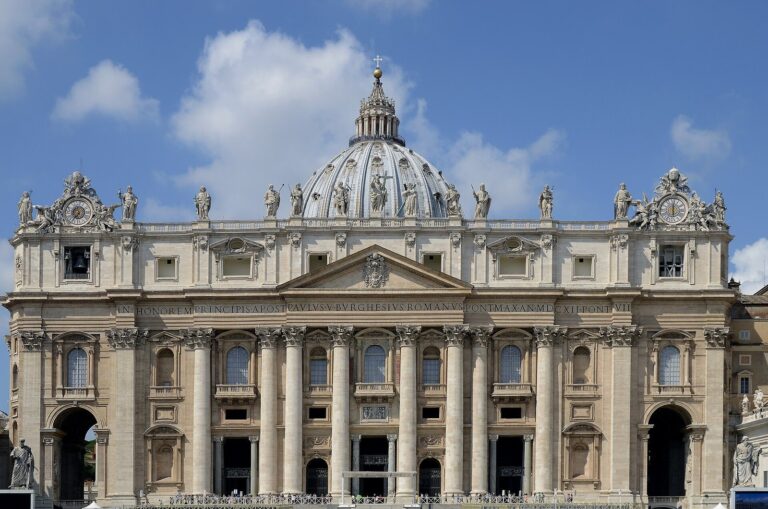
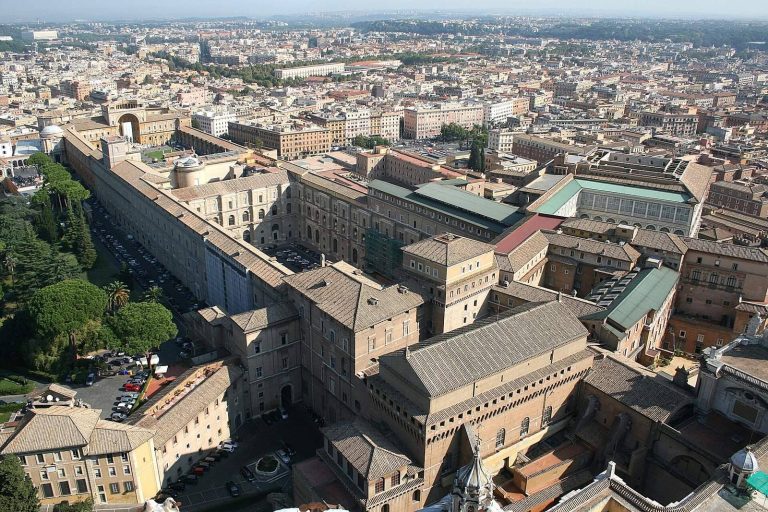
The gardens cover about 23 hectares, roughly half of Vatican City, and reach 60 metres above sea level. They occupy the western part of the territory on the slopes of Vatican Hill. Walls, including sections with projecting defensive works called bastions, enclose the northern, southern, and western sides. To the east, the grounds meet the curved end of Saint Peter’s Basilica and a long wing of the Vatican Museums.
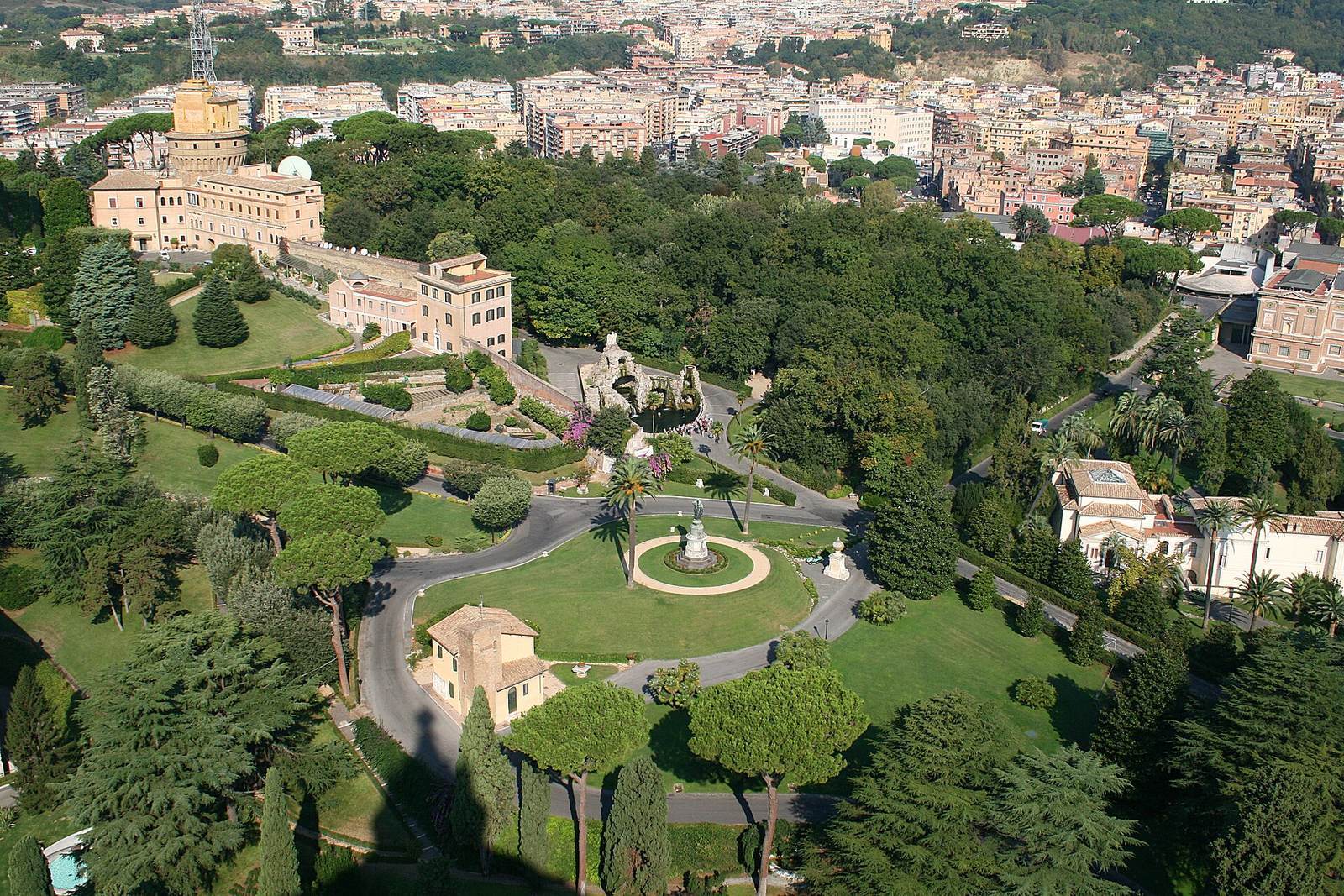
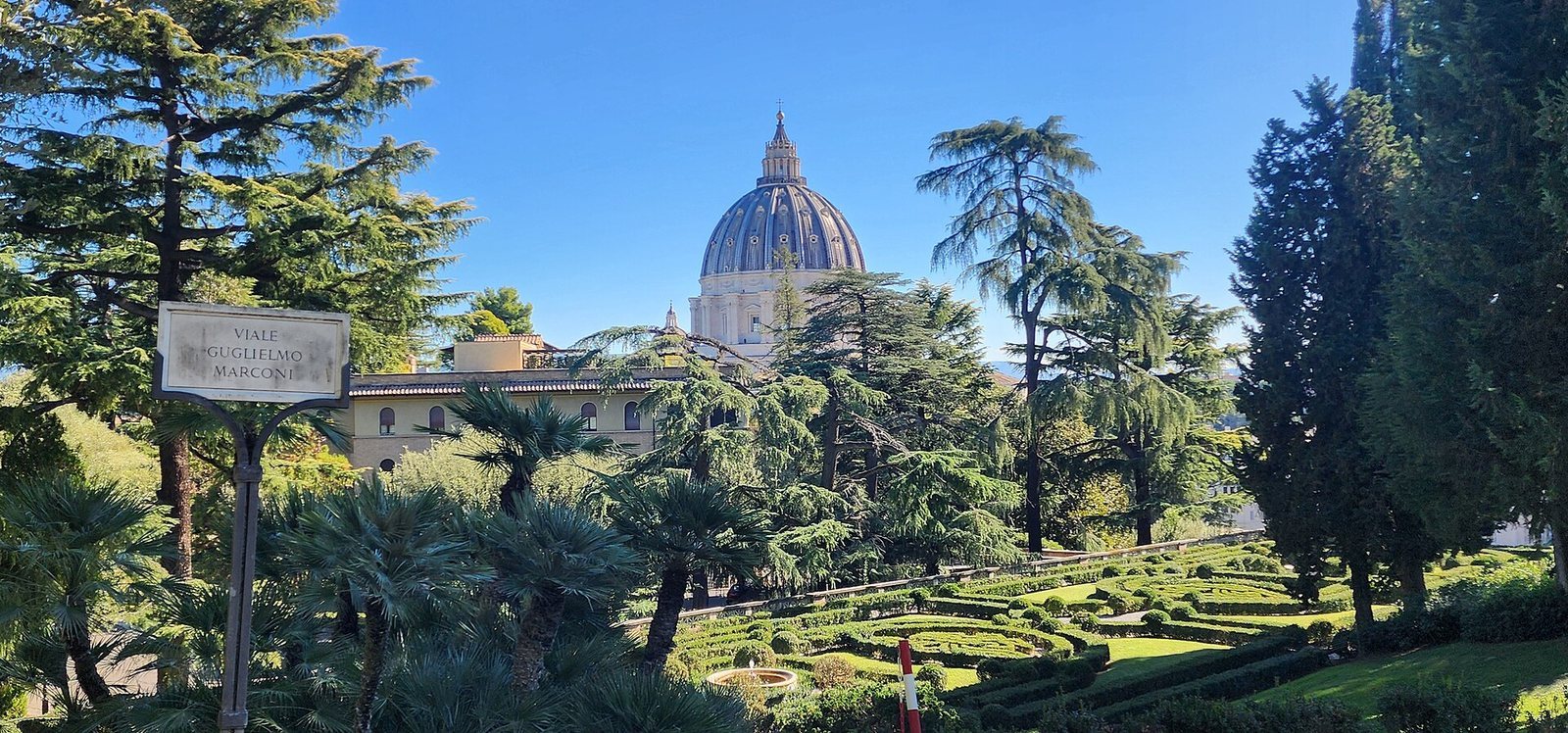
The landscape combines flowerbeds, clipped shrubs, lawns, sculptures, medieval fortifications, buildings, monuments, and a woodland patch of about three hectares. A broad network of paths crosses the grounds. Much of the terrain is artificial; the less cultivated area between the Leonine Wall and the Vatican administration includes hilly woodland with Italian stone pines, other pines, holm oaks, cypresses, cedars, and palms. Bats, birds such as parrots, and reptiles including lizards and snakes also inhabit the gardens.
Porous volcanic rock called tufa lies beneath the western part of the Vatican. Springs below it once supplied water and supported dense subtropical vegetation. An olive tree donated by the government of Israel is among the garden features.
Renaissance gardens and buildings
Bramante’s courtyards and galleries
Bramante’s plan comprised the Belvedere Courtyard, the Library Courtyard, and the Pinecone Courtyard. A large rectangular labyrinth of clipped boxwood was framed by Italian stone pines and cedars of Lebanon. Near Sant’Egidio Hill, the Palazzetto del Belvedere stands in the area of the early gardens. Two parallel galleries, each two storeys high and with terraces, connect the Apostolic Palace and the Belvedere.
Casina of Pius IV and nearby features
The Casina of Pius IV lies east of the English Garden. Designed by Pirro Ligorio and Sallustio Peruzzi, it was built between 1558 and 1561 and stands within a garden of flowerbeds. An elliptical courtyard separates the villa from a covered, open-sided gallery. The gallery’s lower part forms a water shrine designed to resemble a grotto, with a large statue of Cybele, an ancient mother goddess adopted into Roman religion. Paintings by Federico Zuccari, Santi di Tito, and Federico Barocci decorate the vaulted ceilings inside. The building houses the Pontifical Academy of Sciences.
The Tower of the Winds housed the Vatican’s first astronomical observatory. A botanical garden was laid out beside the Casina during Pius V’s pontificate. The Square Garden, in front of the Vatican Pinacoteca, survives from the Secret Garden associated with Pope Paul III.
Squares and institutional buildings
First Martyrs’ Square
First Martyrs’ Square lies just inside the gardens, beneath the Bell Arch and to the left of the monumental stairs leading to Saint Peter’s Basilica. It occupies part of the former Circus of Nero. A marble slab marks the place where an Egyptian obelisk stood until 1584, when it was moved to the centre of Saint Peter’s Square. The Teutonic College and its Campo Santo Teutonico cemetery adjoin the square to the south; a canons’ residence and sacristy lie to the west, and the basilica is to the north.
Saint Martha’s Square
West of First Martyrs’ Square, Saint Martha’s Square takes its name from a church dedicated to the saint that no longer exists. The Palaces of Saint Charles and the Tribunal, along with the House of Saint Martha, were built beside it in the 1930s. The Mosaic Studio and Vatican railway station lie west of the Tribunal Palace, while the Abyssinian Church of Saint Stephen is north of the square.
Governorate Palace and Italian Garden
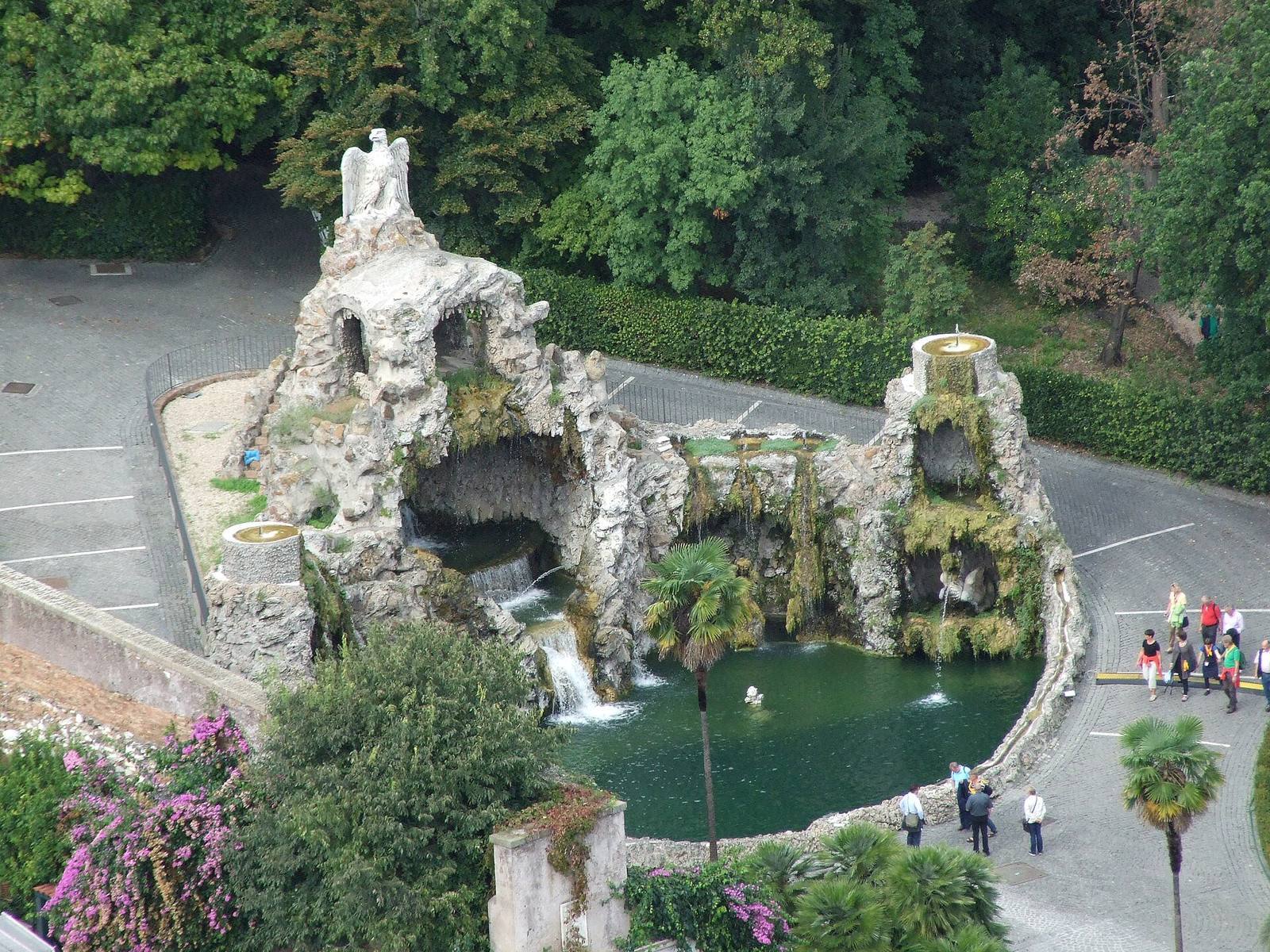
The Governorate Palace has a chapel dedicated to Santa Maria Regina della Famiglia. Gardeners plant seasonal flowers in front of the building in the shape of the reigning pope’s coat of arms. A fountain and statue of Saint Peter stand farther north. A limestone-decorated retaining wall adjoins the palace on the west, beside a rock garden with a fountain shaped like a moss-covered grotto. South of the palace, above the railway tracks, stands a large travertine fountain.
The Italian Garden lies west of the Governorate Palace, between the Ethiopian College and Vatican Radio. Low hedges outline its flowerbeds and lawns, and two circular fountains ornament the grounds. Other institutional facilities within the gardens include the Mater Ecclesiae Monastery, Vatican Radio buildings, and the Vatican heliport.
Hilltop gardens, grottos, and fountains
Tower of Saint John and Saint Thérèse chapel
The Tower of Saint John stands on a hilltop and forms part of the walls associated with Pope Leo IV. Its apartments were used by Pope John XXIII, Patriarch Athenagoras, and Pope John Paul II. John Paul II stayed there after his election in October 1978 while accommodation was being prepared in the Apostolic Palace. Nearby are the Great Jubilee bell of 2000 and a chapel dedicated to Saint Thérèse of Lisieux. The chapel’s statue is a copy of one at the Carmelite convent in Lisieux.
Seasonal flower garden and Lourdes Grotto
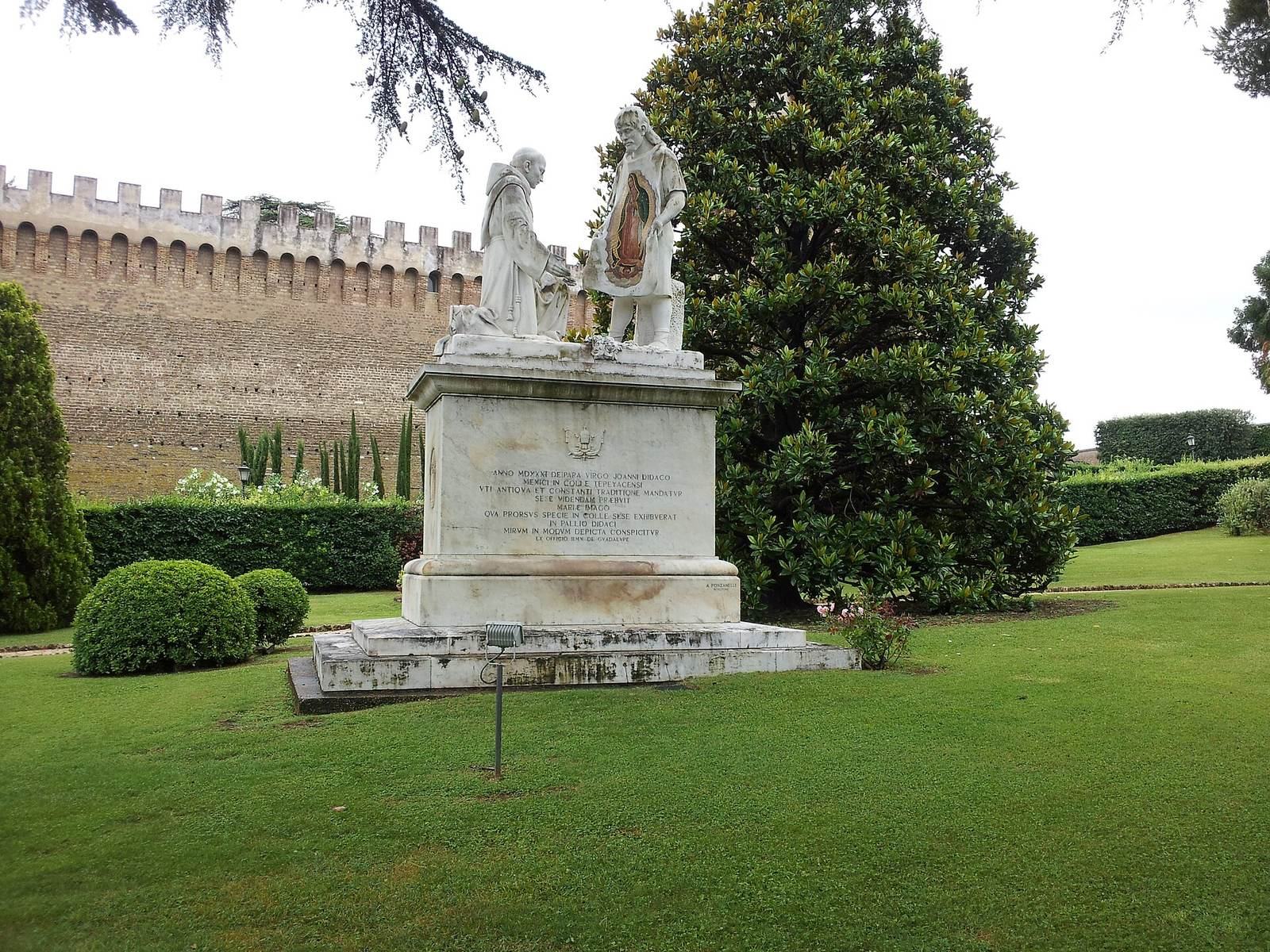
A seasonal flower garden slopes northeast from the heliport. It contains a fountain and a monument to Saint Juan Diego, a sixteenth-century Indigenous Mexican Catholic figure associated with the tradition of Our Lady of Guadalupe. The garden is bounded to the northwest by a sixteenth-century outer wall and to the southeast by a wall dating to Pope Leo IV. At its far end is a 1902 copy of the Lourdes Grotto, an artificial grotto dedicated to Our Lady of Lourdes. A modern sculpture nearby commemorates the 1981 assassination attempt on Pope John Paul II.
Former Tower of Leo XIII and French-style garden
Northeast of the Lourdes Grotto are a section of medieval wall and the former Tower of Leo XIII. Once used as a summer residence, the tower now houses a Vatican Radio studio. The adjoining French-style garden has fountains and arcades planted with roses.
English Garden and water features
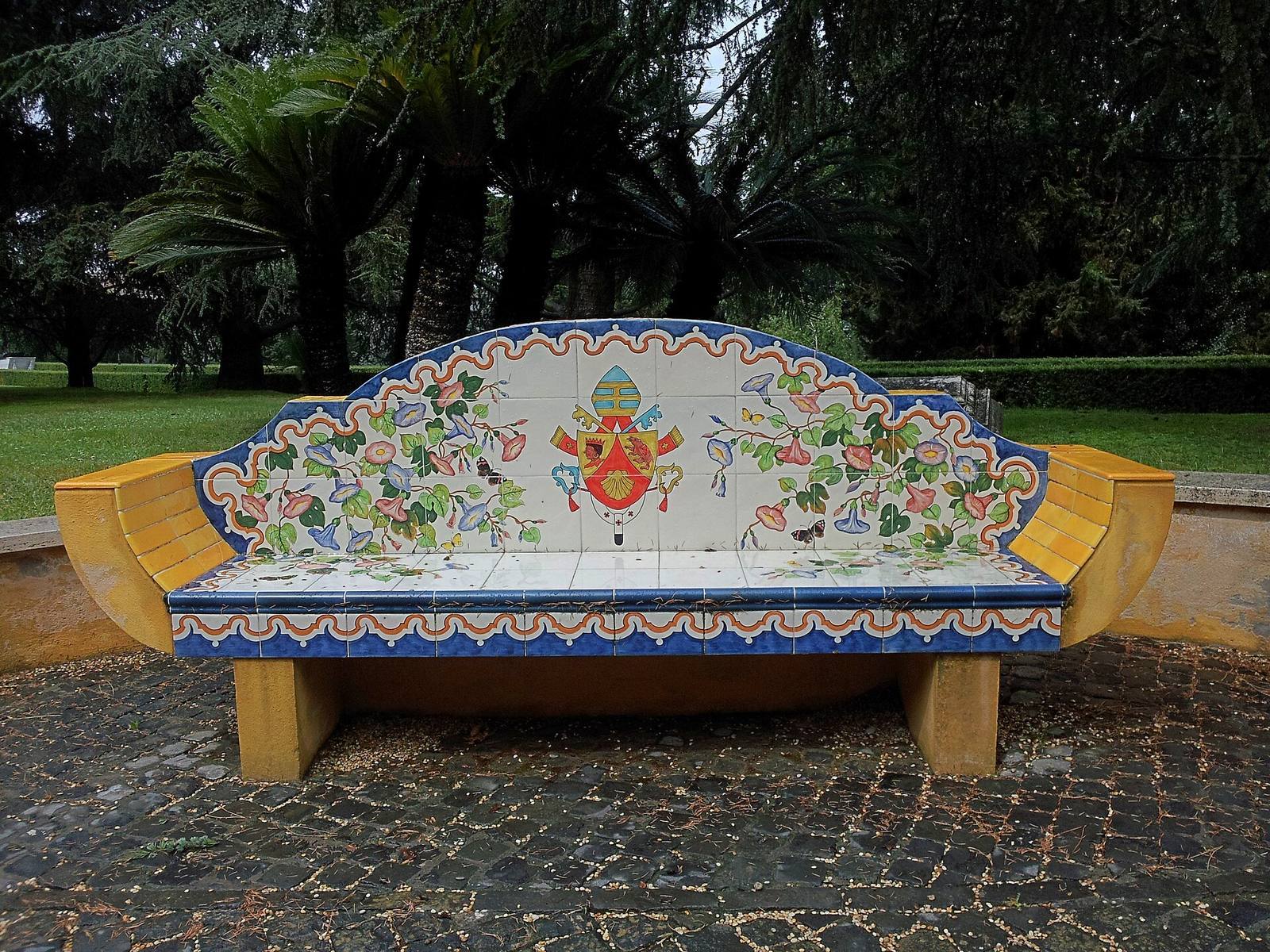
North of the Mater Ecclesiae Monastery, the English Garden retains naturally growing oaks, elms, and Mediterranean shrubs. Paths cross the parkland, which also contains sculptures, marble seating spaces, benches, and fountains. One sculpture depicts Saint Peter in chains. At the park’s edge, the large Fontana dell’Aquilone, designed by Giovanni Vasanzio and funded by Pope Paul V, forms a major feature.
Southeast of the park, the Fontana del Sacramento stands in front of the former mint building. Its water jet spreads outward to imitate a vessel used in Catholic worship to display the consecrated host. Near the stairs to the Apostolic Palace, the small Pompeian-style Fountain of Mirrors has multicoloured mosaic decoration. A small temple-like structure and many other fountains and sculptures are distributed through the gardens.