Frascati Cathedral: Episcopal Seat and Minor Basilica in Italy
Site at a Glance
- Rating
- 4.5
- Popularity
- Medium
- Country
- Italy
- Primary era
- Early Modern
- External website
- Open
- Eras represented
- Early Modern, Modern
- Civilizations
- Italian, Papal States
- Site type
- Religious
- Remains
- Cathedral
On this page14 sections
History
Foundation and construction
Frascati Cathedral is a Roman Catholic cathedral and minor basilica in Frascati, Italy, dedicated to Saint Peter the Apostle. Built from 1599, it serves as the cathedral and episcopal seat of the Suburbicarian Diocese of Frascati, one of the historic dioceses surrounding Rome whose bishop traditionally holds a senior position in the Roman Catholic hierarchy. It is the fifth cathedral associated with the see, following earlier episcopal centers at Labicana Quintanense, Tusculum, Santa Maria in Monastero on Rome’s Esquiline Hill, and Santa Maria in Vivario.
Santa Maria in Vivario had served as Frascati’s cathedral since 1538, but it became too small for the growing population. Cardinal Bishop Alfonso Gesualdo noted the problem on 16 October 1588. On 24 May 1599, Cardinal Bishop Tolomeo Gallio decided with the city governor, the community council, and Pope Clement VIII to construct a new cathedral. Pope Clement VIII provided 1,000 scudi, while additional funds came from the community, private gifts, loans from religious and private institutions, and, from 1608, a tax on wine sold locally.
Ottaviano Nonni, known as Mascherino, designed the building. Financial difficulties slowed the work, and in 1608 Cardinal Bishop Mariano Pierbenedetti proposed that the unfinished structure should be roofed and opened for worship. The proposal was accepted, and the first Mass was celebrated there in 1610 after 8,000 scudi had been spent. Further construction continued, and Cardinal Bishop Fausto Poli consecrated the cathedral in 1636. The final minor altar, in the Chapel of Saint Isidore, was consecrated by Cardinal Bishop Cybo in 1680.
Completion and later alterations
The cathedral still lacked a façade in 1696. On 24 June that year, the community resolved to build one. Girolamo Fontana designed it, and the work was finished by 1698. The two bell towers were added later. Cardinal Bishop Lorenzo Corsini reorganized the presbytery in 1703, clocks were installed on the towers in 1747, and Cardinal Bishop Henry Benedict Stuart, Duke of York, donated a new organ in 1788. Stuart was the younger brother of Charles Edward Stuart and a cardinal who served as bishop of Frascati.
The church’s deteriorated condition led Cardinal Bishop Antonio Maria Cagiano de Azevedo to urge repairs in 1857. The work was completed for the diocesan synod held on 24 May 1858. In 1908, the floor was rearranged with particular care for the many funerary inscriptions set into it.
Destruction, reconstruction, and status
Allied bombing of Frascati on 8 September 1943 severely damaged the cathedral, especially the presbytery, and destroyed the organ. The side chapels suffered less damage, and the Ferrucci relief survived intact. Reconstruction by the Civil Engineering Service and Bishop Biagio Budellacci was completed in 1949. The roof was restored in 1965 and the façade in 2002.
Pope Paul VI granted the cathedral the title of minor basilica on 1 March 1975. This is an honorific papal designation for a church of particular historical or pastoral importance, distinct from the architectural term “basilica.” Frascati Cathedral remains an active cathedral and minor basilica.
Remains
Plan and exterior
The cathedral stands on Piazza San Pietro in Frascati’s historic center. Its plan forms a Greek cross, with four arms of approximately equal length extending from a central crossing, and it has a projecting square apse. The building is about 42.3 meters long, its roof reaches approximately 21.8 meters, and the façade is about 32.1 meters wide.
Façade and bell towers
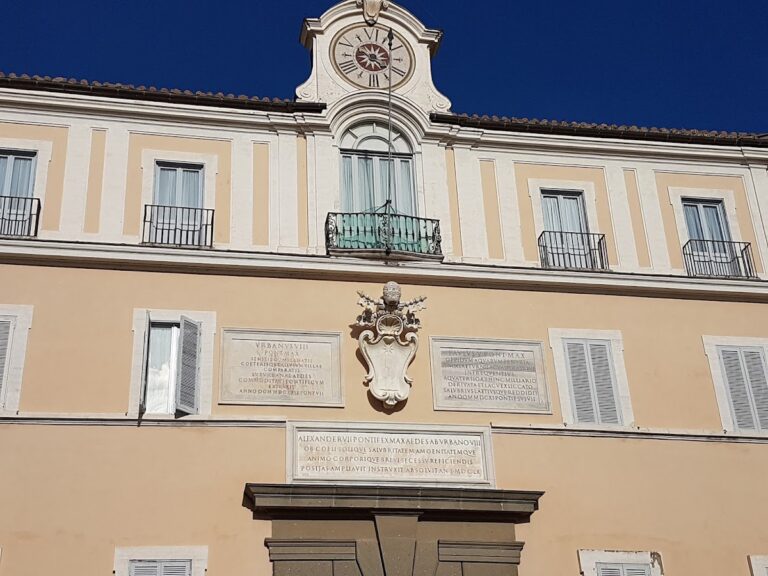
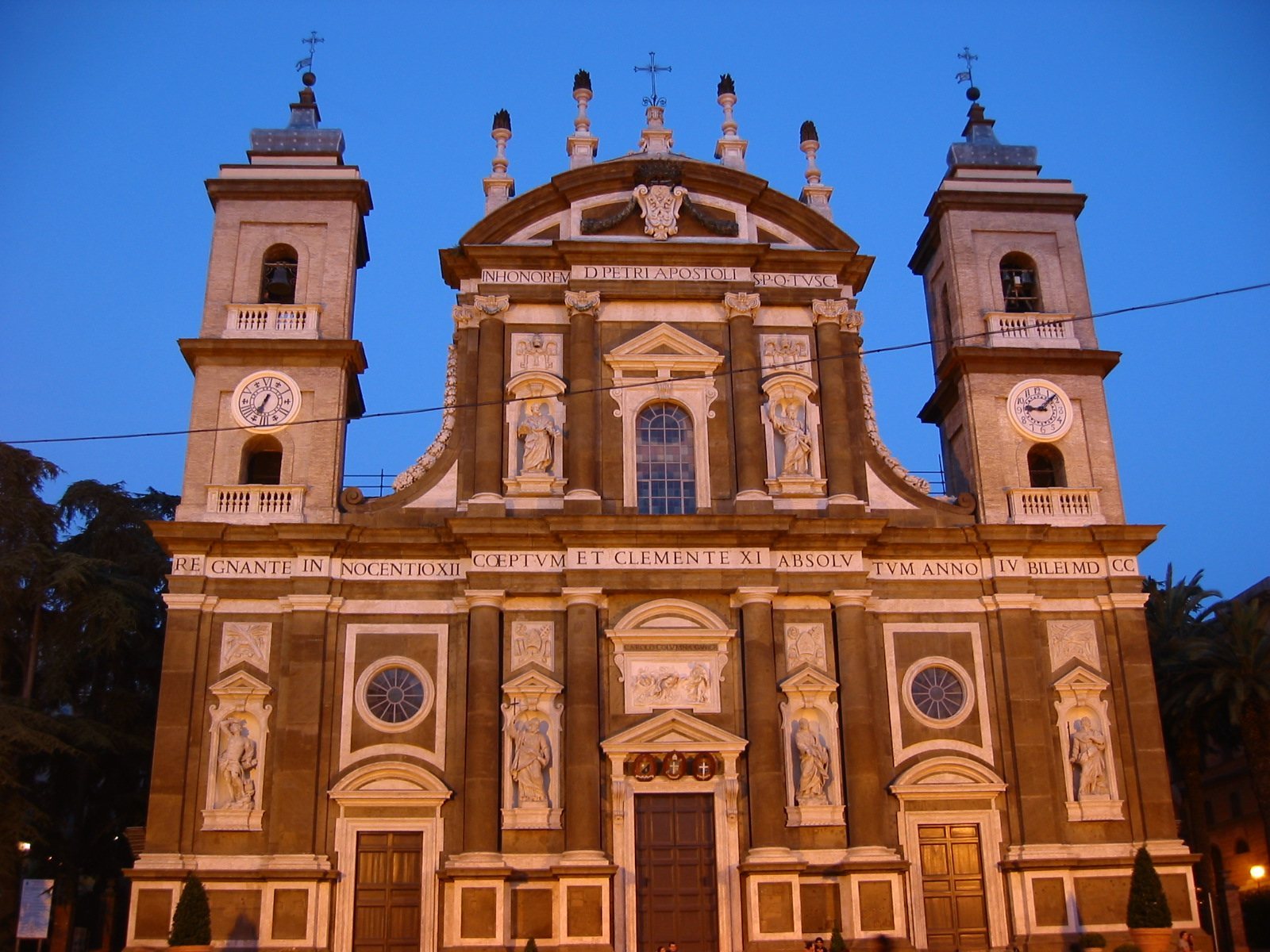
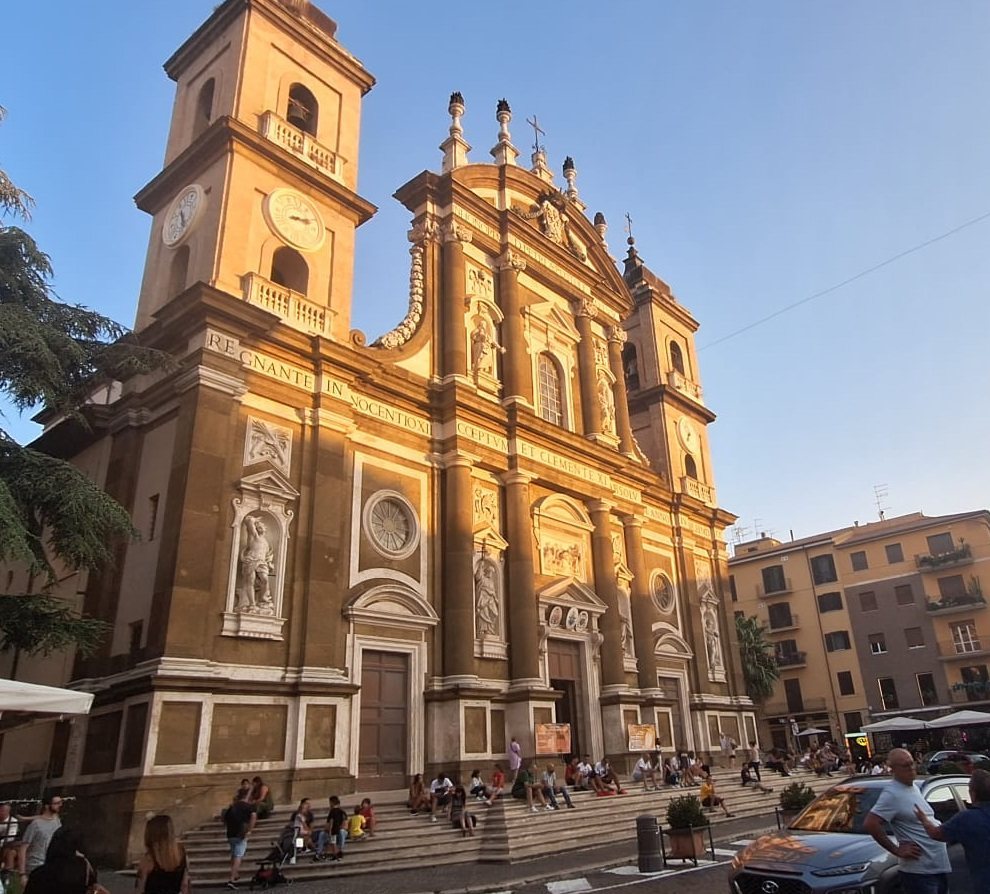
The façade combines Tuscolana stone, quarried at Monte Porzio Catone and Frascati, with travertine from Tivoli. A marble cornice divides it into two superimposed levels, while two bell towers frame the composition. Each tower has a clock on its front. The right-hand clock has a twelve-hour dial, and the left-hand clock has a six-hour dial.
Façade sculpture
Four Tuscan half-columns stand at the center of the lower level, with two pairs of Tuscan pilasters at the sides. Four niches alternate with the three portals. They contain statues of Saint Sebastian by Girolamo Gramignoli, Saint James the Less by Giuseppe Napolini, Saint Philip the Apostle by Vincenzo Felici, and Saint Roch by Pietro Maiuri. Above the central portal is Bernardino Cametti’s marble relief of Jesus reproving Peter for his lack of faith. The upper level contains statues of Saint Peter and Saint Paul by Andrea Fucigna, placed beside the large round-arched window.
Interior and liturgical spaces
The nave and the two transept arms are covered by barrel vaults, which are continuous tunnel-like vaults. The four ambulatory spaces, or internal passage areas, have sail vaults, curved vaults rising from square or polygonal bays. The presbytery, the area around the main altar reserved for the clergy, was modified after the Second Vatican Council and occupies the entire apse, which is also covered by a sail vault.
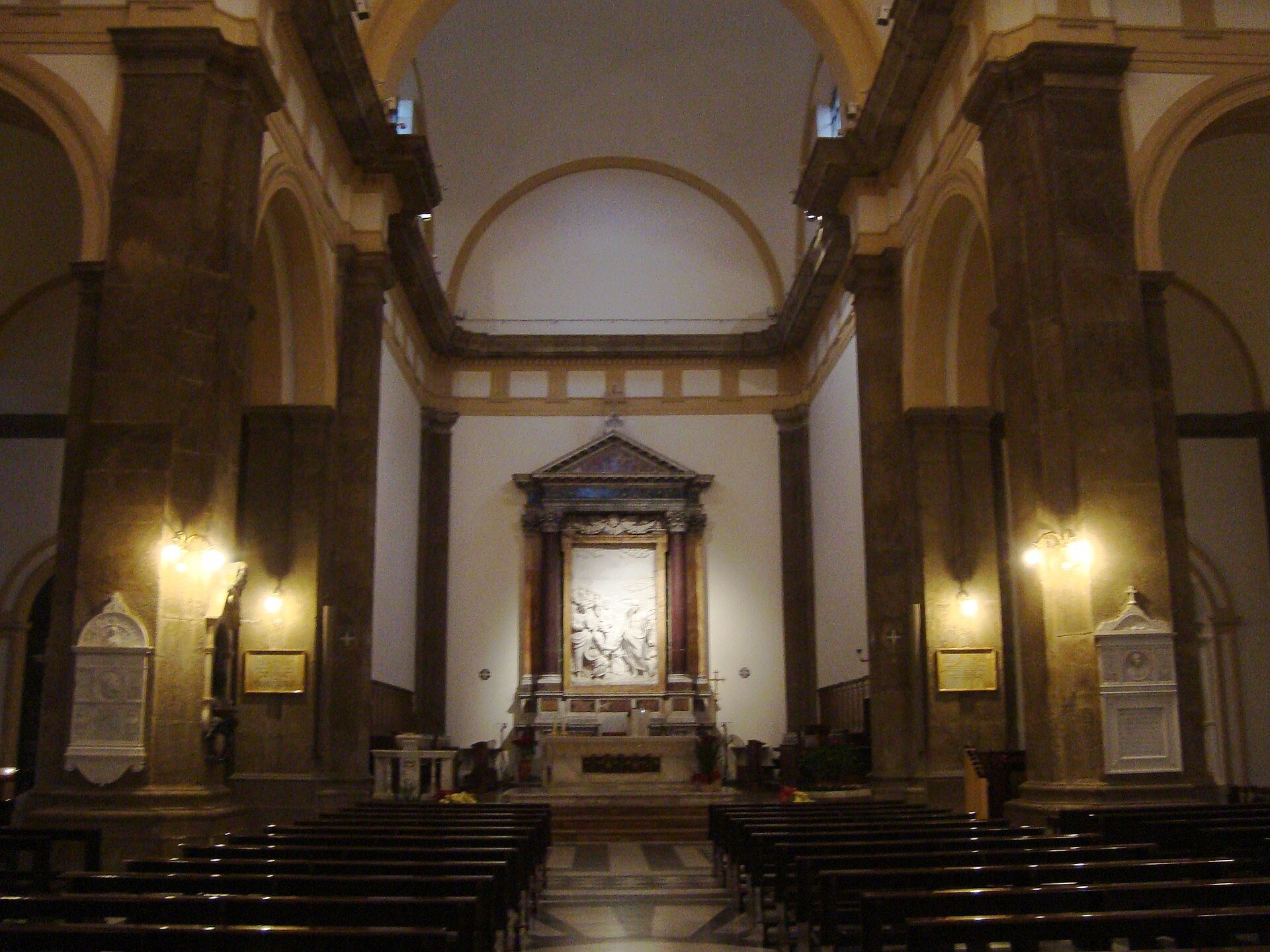
The interior was originally covered with frescoes. After the 1943 bombing, it was rebuilt without ornamental decoration and finished in a simple ivory color. The reconstructed interior consequently has a comparatively bare appearance apart from a small chapel on the right.
Presbytery and former high altar
A marble altar stands at the center of the presbytery. Against the rear wall is the retable, an ornamental structure behind an altar, from the former Baroque high altar. Two Corinthian columns frame it, while its central relief, Pompeo Ferrucci’s Delivery of the Keys to Peter, dates from 1612. The episcopal throne stands at the base of the retable.
Chapels and sacred images
The cathedral contains an eleventh-century wooden crucifix from Tusculum, the ancient city in the Alban Hills southeast of Rome. It also preserves a Madonna of the Mysteries of the Rosary attributed to Domenichino, the common name of the Bolognese painter Domenico Zampieri, and a fourteenth-century Madonna and Child in the Chapel of the Gonfalone, retouched by Domenichino. A bronze Holy Year Cross dating from 1750 stands on the interior side of the west façade.
Memorials and organs
Memorial to Charles Edward Stuart
A white-marble funerary monument with a memorial tablet to Charles Edward Stuart stands in the nave against the inner side of the façade. Charles Edward Stuart, known as the Young Pretender, was the Stuart claimant to the British throne who led the Jacobite rising of 1745. His body was transferred to Saint Peter’s Basilica in 1807, while his heart and praecordia, the organs or bodily region around the heart, remained in the cathedral in a small urn beneath the floor below the monument.
Pipe organs
The wooden choir loft in the counter-façade, the interior wall opposite the main apse, contains a pipe organ built in 2009 by the Bonizzi-Inzoli firm. Its transmission is mechanical for the manuals and pedal and electric for the stops. It has three 58-note keyboards and a 30-note concave-radial pedalboard. A modern positive organ with one keyboard and no pedalboard stands in the second ambulatory on the right.