Frangokastello: A Venetian Fortress on Crete



Site at a Glance
- Rating
- 4.2
- Popularity
- Low
- Country
- Greece
- Primary era
- Medieval
- External website
- Open
- Eras represented
- Medieval, Modern
- Civilizations
- Ottoman, Venetian
- Site type
- Military
- Remains
- Fort
On this page12 sections
History
Frangokastello is a Venetian fortress and dispersed settlement in Greece, on the southern coast of Crete beside the Libyan Sea. The Venetians built the fortress between 1371 and 1374 to protect the coast from pirates and impose authority in Sfakia, a historic region and municipality in southwestern Crete. Its later history includes Ottoman occupation, repeated rebuilding, and the 1828 battle associated with the Cretan struggle for independence.
Early settlement and Venetian rule
Human activity in the wider Frangokastello and Sfakia area reaches back to the Bronze Age. Minoan sites, belonging to the Bronze Age civilization of Crete, date to approximately 1800–1450 BC and include pottery remains. These finds place the later fortress within a much older inhabited landscape.
From the mid-seventh century until AD 824, repeated Arab raids contributed to the gradual abandonment of coastal settlements across Crete. People moved inland for protection from pirates, and the coastal area around Frangokastello was affected by this wider pattern of insecurity.
During the Venetian period, the Skordilis family and its Pateras and Papadopoulos branches controlled Sfakia. Venetian accounts describe violence and oppression by these feudal lords, while local resistance continued. The resulting unrest encouraged demands for a fortified site that could defend the coast and help the Venetian authorities control rebellion.
The Venetian Senate approved the fortress project on 10 February 1371, and construction followed over the next three years. The Venetians named it the Castle of Saint Nikitas after a nearby church. Local people instead called it Frangokastello, meaning “castle of the Franks.” In Greek and Byzantine usage, “Franks” was a general term for Western Europeans or Catholics. The local name eventually became the fortress’s accepted name, including among the Venetians.
Local tradition tells of six brothers from the nearby village of Patsianos, members of the Patsos or Patsia family, who attacked the building works at night. Venetian soldiers and builders supposedly constructed the fortress by day, while the brothers destroyed their work after dark. The brothers were eventually betrayed, captured, and hanged.
Repairs, Ottoman occupation, and rebellion
Frangokastello did not fully achieve its original strategic purpose. Sfakia remained difficult for Venetian authorities to control, and the fortress sometimes stood without a garrison. A major renovation took place from 1593 to 1597 under Nicolò Donà, the superintendent-general. Further repairs followed in 1645, when Ottoman forces occupied the fortress and established a new phase in its military history.
The fortress was later involved in the failed Orlov Revolt of 1770, an uprising connected with Russian efforts to encourage rebellion against Ottoman rule. Daskalogiannis, the Sfakian rebel leader also known as Ioannis Vlachos, surrendered at or in connection with Frangokastello with about 70 followers. He was taken to Heraklion and executed. Traditions differ over the precise circumstances of his surrender.
The battle of 1828 and later history
In early 1828, Hadzi Michalis Dalianis occupied Frangokastello with approximately 600 infantrymen and 100 cavalrymen. He aimed to extend the Greek struggle for independence to Crete, and local Sfakians supported his force with provisions and money.
Ottoman troops commanded by Mustafa Naili Pasha then besieged the fortress. Mustafa Naili Pasha was the Ottoman governor of Crete, serving the Egyptian khedive Mehmet Ali. Estimates of the Ottoman force range from approximately 5,000 to 8,000 soldiers, with one estimate including about 300 cavalry.
The attack began at dawn on 17 May 1828. Most of the rebels who left the fortress to fight in the open were killed, including Dalianis, and approximately 335 rebels died. The remaining defenders held out inside until 24 May before surrendering. The surviving defenders were released, while Ottoman losses were also substantial. Later ambushes targeted Ottoman troops in the surrounding gorges.
After the battle, Mustafa Naili Pasha ordered the damaged fortress demolished so that rebels could not use it again. During the Cretan Revolt of 1866–1869, an uprising against Ottoman rule, the Ottomans rebuilt Frangokastello to control this part of the island. The fortress was abandoned after Ottoman rule ended and later became a memorial and historical site. It is officially classified as a cultural monument.
Local tradition preserves the memory of the 1828 battle through the Drosoulites, traditionally understood as the souls or shadowy forms of the Cretan and Epirote fighters who died there. Epirote refers to people from Epirus, a historical region in northwestern Greece. The figures are said to appear around the battle’s anniversary, usually in late May or on 17 May. In 1890, Ottoman soldiers allegedly fled after seeing them, and during the Second World War a German patrol reportedly fired on the shadows. Proposed explanations include atmospheric and optical effects, but no single interpretation has been established.
Remains
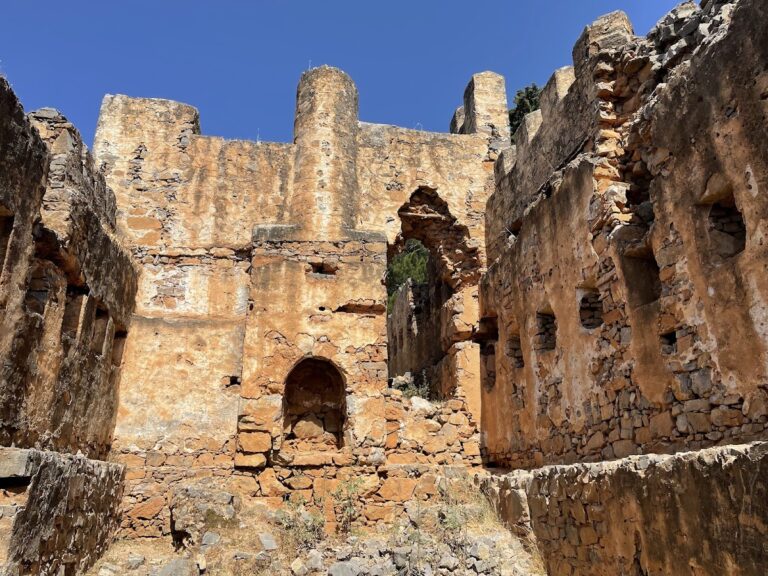
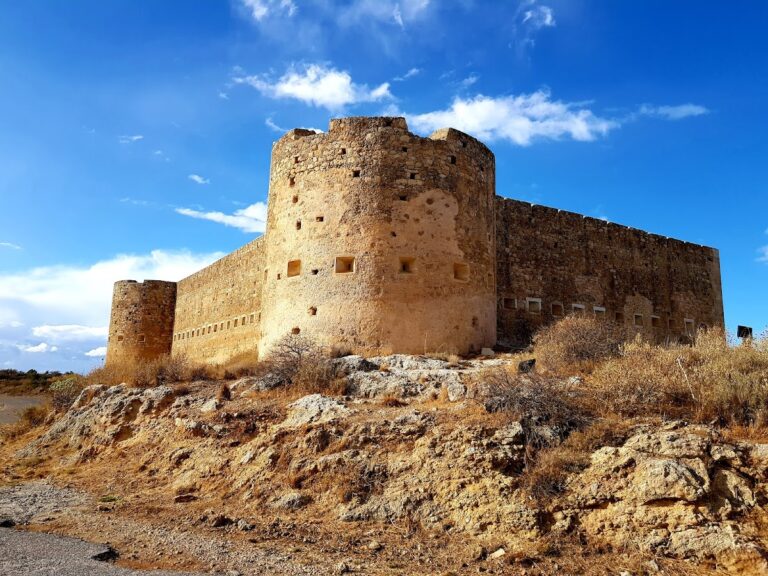
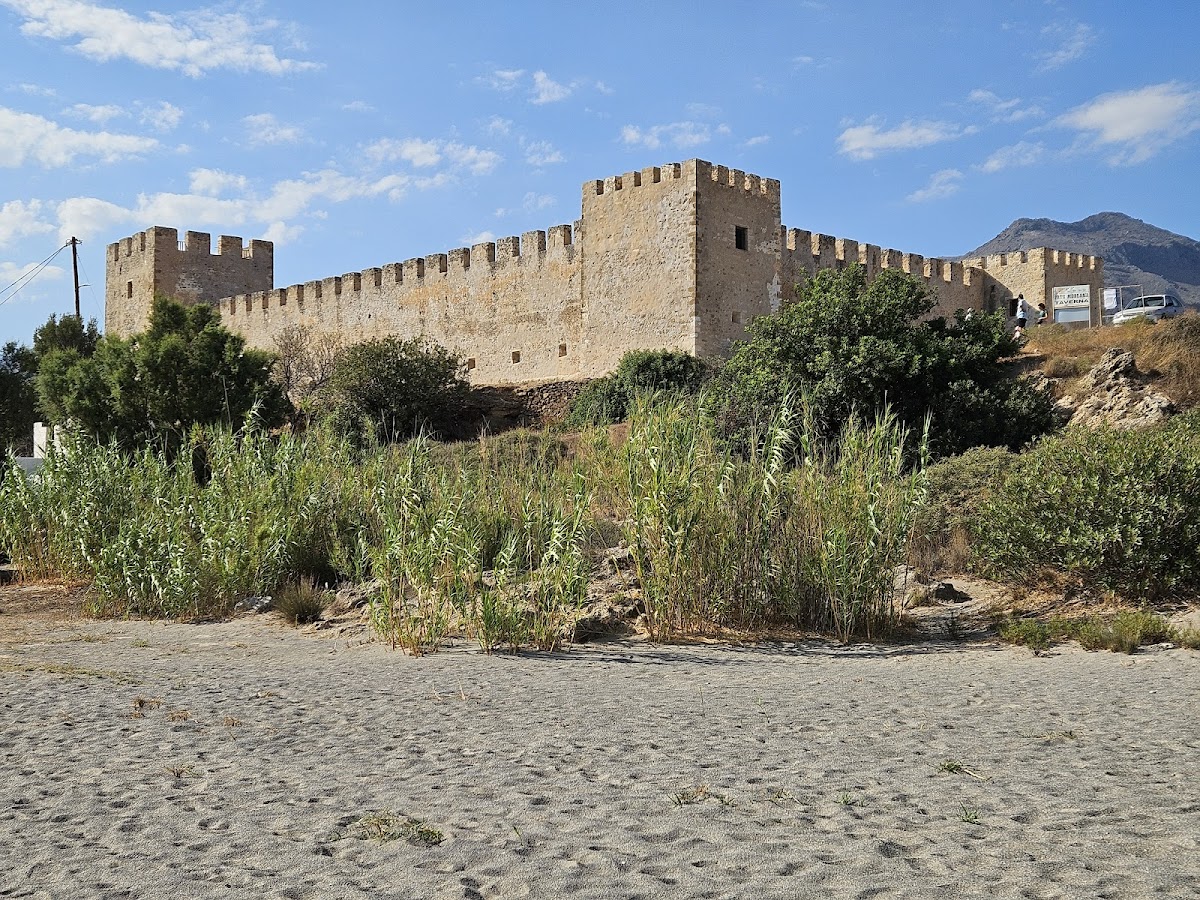
Frangokastello occupies a coastal plain beside a large sandy beach, with mountain slopes behind it. The settlement around the fortress is dispersed, with few or no conventional streets or public squares. The fortress itself has a simple rectangular plan, formed by four square corner towers joined by curtain walls. Much of the surviving fabric consists of these outer walls.
Walls, towers, and entrances
South tower and main gateway
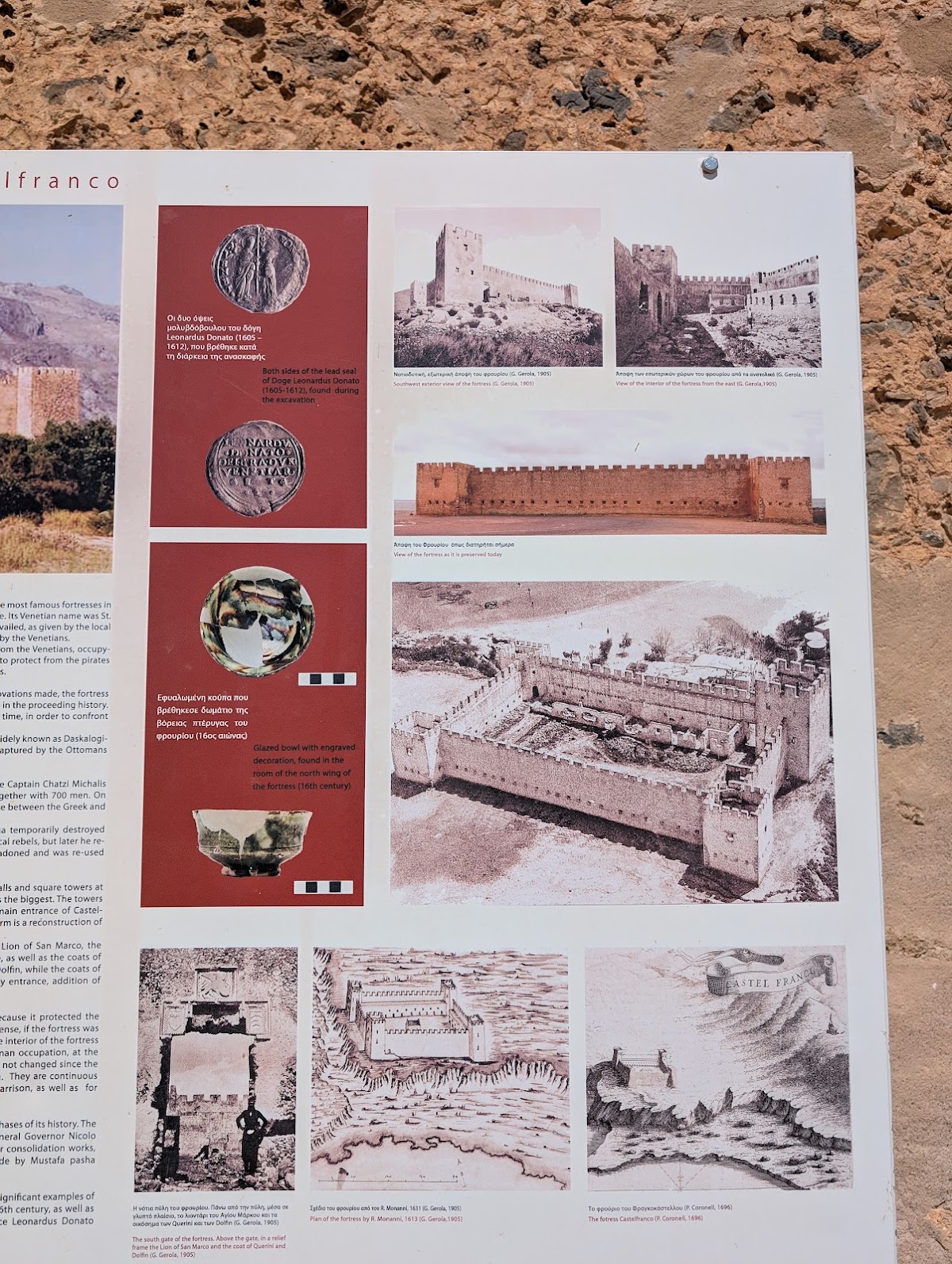
The southern tower, described in one account as the south-western tower, is larger and higher than the other corner towers. It guarded the principal entrance and provided a final defensive position if the fortress came under siege. The main gateway is on the south side and is a reconstruction of a nineteenth-century entrance. Venetian heraldic remains above it include the Lion of Saint Mark, the emblem of Saint Mark and a sign of Venice, together with the arms of Venetian noble families such as the Quirini and Dolfin.
Eastern doorway and defensive walls
A smaller arched doorway opens on the eastern side. Remains of battlements survive above the towers, while the Ottoman rebuilding added crenellated walls with loopholes for firearms. These features reflect the fortress’s continued adaptation to changing military needs after its original Venetian construction.
Interior buildings and earlier remains
Service buildings
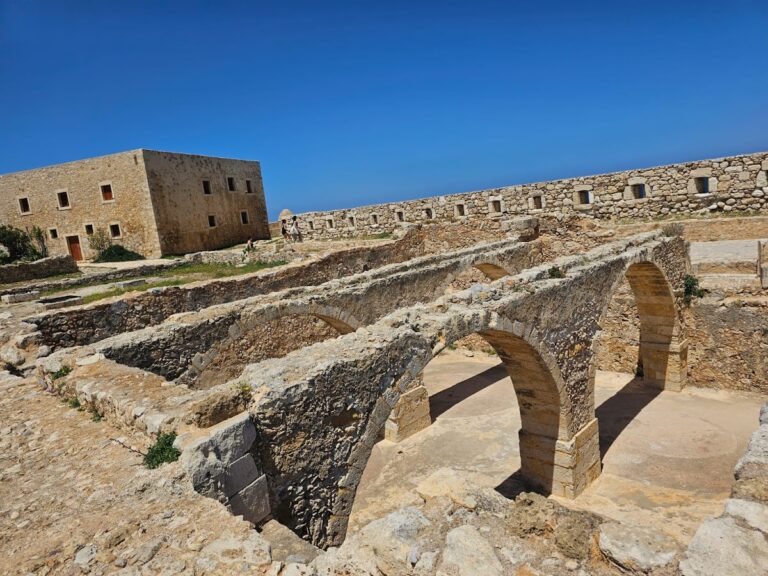
Rectangular buildings once lined the inner sides of the walls. They served as stables, storehouses, barracks, and other service facilities. Most survive as poorly preserved ruins. The interior buildings were rebuilt during the final Ottoman phase of occupation in the late nineteenth century, giving the inner compound a fabric shaped by both Venetian and Ottoman building phases.
Stone from the ancient settlement
Stone from the ancient settlement of Nikita was used in constructing the fortress. The nearby Church of Agios Nikitas is identified as the principal surviving remnant of that earlier settlement, linking the medieval defensive complex with the older archaeological landscape around it.
Drosoulites tradition
The Drosoulites are described as human-like shadows that may appear to walk or ride horses while carrying weapons. They are said to move from the direction of the Church of Agios Charalambos toward the old fortress, visible from the valley at a distance of approximately 1,000 metres. The phenomenon is reportedly seen before full sunrise when the sea is calm and the air is humid, and it usually lasts about ten minutes. Suggested explanations include a mirage or the refraction of sunlight through morning dew.
Nearby sites