Santa Croce: A Basilica and Former Synagogue in Cagliari


Site at a Glance
- Rating
- 4.6
- Popularity
- Low
- Country
- Italy
- Primary era
- Early Modern
- External website
- Open
- Eras represented
- Medieval, Early Modern, Modern
- Civilizations
- Crown of Aragon, Kingdom of Sardinia, Spanish
- Site type
- Religious
- Remains
- Basilica
On this page8 sections
History
Santa Croce is a basilica in Cagliari, Italy, whose origins lie in a synagogue established by the city’s medieval Jewish community in the thirteenth century. It stood within the Giudaria, the Jewish quarter in the Castello district, which expanded particularly during Aragonese rule in the fourteenth and fifteenth centuries.
From synagogue to Catholic church
In 1492, Ferdinand II of Aragon and Isabella of Castile issued an expulsion decree against Jews and Muslims who did not convert to Christianity. The measure brought about the expulsion of Cagliari’s Jewish community, after which the synagogue was converted into a Catholic church dedicated to the Holy Cross.
In 1530, Santa Croce was granted to the newly established Archconfraternity of the Holy Mount of Piety. Its exclusively noble members were chiefly responsible for comforting condemned prisoners who were awaiting execution.
The Jesuit period
At the request of Archbishop Parraguez, the Jesuits, a Catholic religious order founded in the sixteenth century and known for educational and missionary institutions, arrived in Cagliari in 1564. They received Santa Croce and several adjoining houses, creating the first nucleus of their college. The church and college became state property in 1773, following the suppression of the Society of Jesus.
The church was enlarged and stylistically renewed in 1661 through the benefaction of Anna Brondo, a noblewoman of the marquises of Villacidro. She left the Jesuits a substantial inheritance for the work, which was completed through the initiative of her great-grandson, Felice Brondo, Marquis of Villacidro.
Basilica and parish
During King Victor Emmanuel I’s stay in Cagliari in 1809, he granted Santa Croce to the Order of Saints Maurice and Lazarus and raised it to the status of a magistral basilica. This title reflects the church’s institutional connection with the dynastic Catholic chivalric order associated with the Savoy monarchy.
Bombing in 1943 damaged the basilica, which was repaired in 1946. After about twenty years of closure, Santa Croce reopened for worship on 22 December 2007 in a Mass celebrated by Giuseppe Mani, then Archbishop of Cagliari. The restoration treated the wall decorations, four chapels, the presbytery, the interior and exterior plasterwork of the church and sacristies, five marble altars, the pulpit, and the holy-water font.
Since 2008, Mass has normally been celebrated on Sunday mornings according to the extraordinary form of the Roman rite, the pre-reform form of the Latin Catholic liturgy authorized for particular communities. On 16 July 2018, Santa Croce became a personal parish for faithful of that rite. Unlike a territorial parish, it serves a defined category of faithful rather than a geographically bounded congregation, and its members are drawn from within the Archdiocese of Cagliari. The basilica remains associated with the former Jesuit college, now occupied by the Faculty of Architecture of the University of Cagliari, and belongs to the Order of Saints Maurice and Lazarus.
Remains
Exterior and entrance
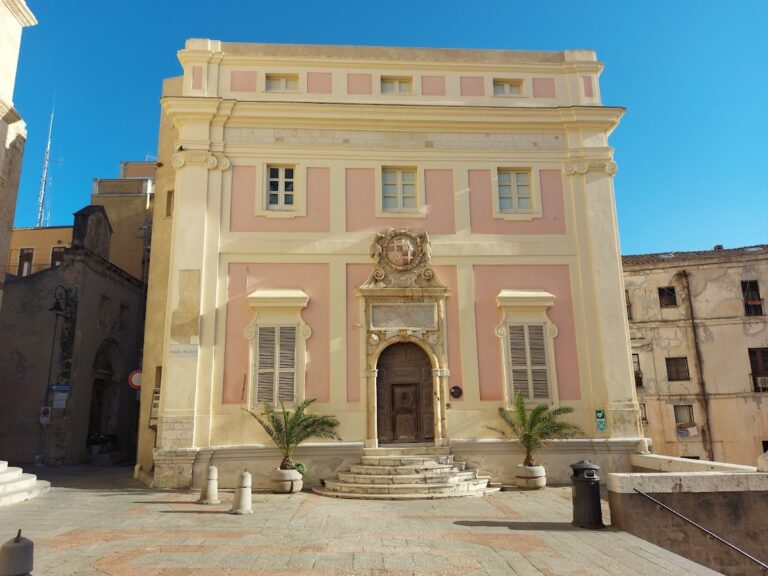
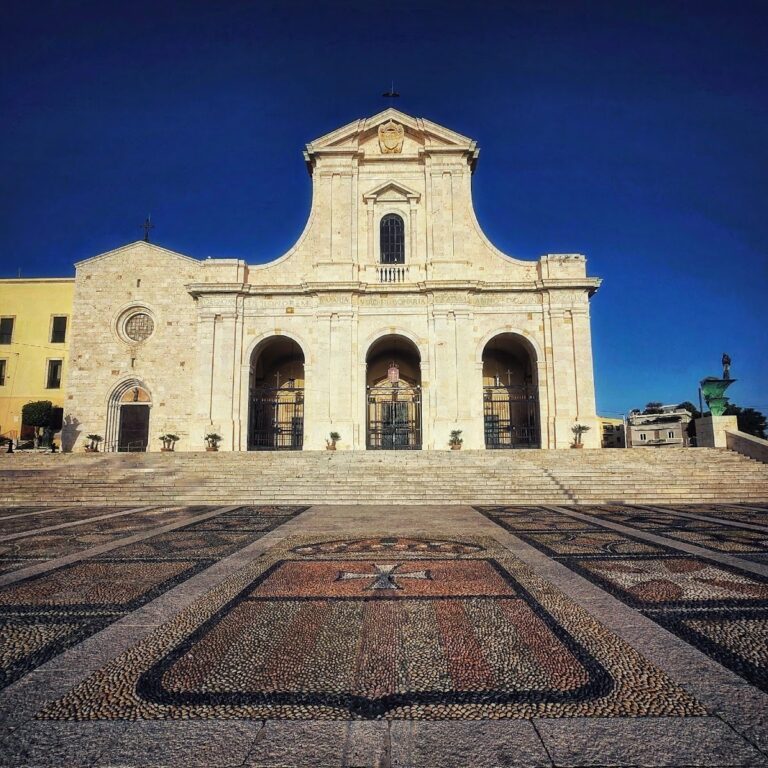
The basilica stands on the Santa Croce bastion in the Castello district, within the area bounded by Santa Croce Street, Court of Appeal Street, and Santa Croce Square. Its principal entrance opens onto the square. Along the side facing Santa Croce Street, a small square-plan bell tower rises beneath an oriental-style cupola.
The tall main facade is arranged in two levels, separated by an intermediate band framed by two cornices. The band bears the Jesuit coat of arms. On the lower level, the entrance portal is crowned by a broken curved pediment containing the Brondo coat of arms and an inscription commemorating Anna Brondo and the completion of the 1661 work through Felice Brondo’s initiative. The upper level is more articulated, with pilasters, flat wall-attached supports, and two decorative obelisks at its ends.
Nave and chapels
Inside, Santa Croce has a neoclassical appearance. A single nave is covered by a barrel vault, a continuous semicircular or near-semicircular vault, and three chapels open on each side. A moulded cornice supported by pilasters runs around the interior. The side chapels contain Baroque altars of polychrome marble, whose twisted columns and spiral volutes frame sculptural and painted works from the seventeenth and eighteenth centuries.
Ludovico Crespi frescoed the vault in the nineteenth century with an imitation-coffer motif. The short presbytery, the area reserved for the altar and clergy, ends in a semicircular apse, the rounded termination of the sanctuary. Its marble high altar displays an artistic wooden Crucifix, while frescoes of Saints Maurice and Lazarus cover the apse wall. Antonio Caboni, a Sardinian artist, painted these frescoes in 1842.
Sacristy and adjoining college
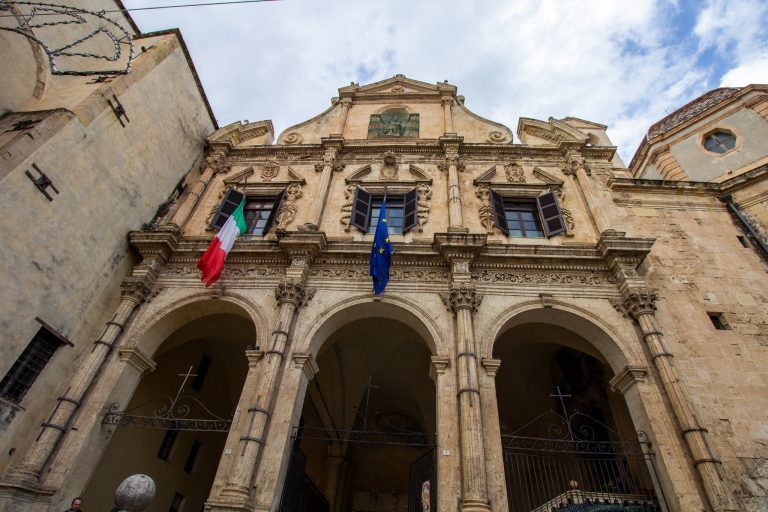
The sacristy contains numerous works of art. A polychrome and gilded wooden statue of Saint Michael was made for Santa Croce by the Neapolitan artist Aniello Stellato and completed in 1620 by his compatriot Giuseppe De Rosa, who applied the gilding and coloring. The statue is now in the Church of San Michele.
The former Jesuit college forms an extensive complex physically annexed to the basilica. Its adjoining relationship with Santa Croce preserves the architectural connection created when the Jesuits received the church and neighboring houses in the sixteenth century.