Fort XIII: A Main Artillery Fort of the Toruń Fortress


Site at a Glance
- Rating
- 4.4
- Popularity
- Low
- Country
- Poland
- Primary era
- Modern
- Eras represented
- Modern
- Civilizations
- German
- Site type
- Military
- Remains
- Fort
On this page5 sections
History
Fort XIII is a main artillery fort in Toruń, Poland, built between 1880 and 1885 as part of the first construction phase of the Toruń Fortress, a system of military fortifications around the city. It was constructed alongside Forts II, V, VII, XI, and XV, and formed part of the fortress’s artillery defenses.
Construction and Modernization
The fort was initially known as Fort VI Winrich von Kniprode, named after a fourteenth-century grand master of the Teutonic Order. It was modernized in 1889–1893, around 1905, and again in 1914. The construction cost was 2,219,479 German marks.
After 1920, the fort was renamed Fort Karol Kniaziewicz in honor of Karol Kniaziewicz, a Polish military commander and general active during the late eighteenth and early nineteenth centuries.
War and Prisoner Use
In September 1939, Fort XIII housed the command post of the Polish Army’s “Pomeranian” Army during the German invasion of Poland. Its military role led Nazi German forces to bomb the fort.
In 1941, German authorities used the fort first for Polish prisoners of war. Later, it held some British prisoners of war associated with Stalag XXA, the German designation for a prisoner-of-war camp in the Toruń area during the Second World War.
Continued Military Use
Fort XIII is the only fort of the Toruń Fortress that remains in use by the Polish Army. The structure has undergone no major alterations in this period. It was entered in Poland’s heritage register as A/304 on 5 October 1971.
Remains
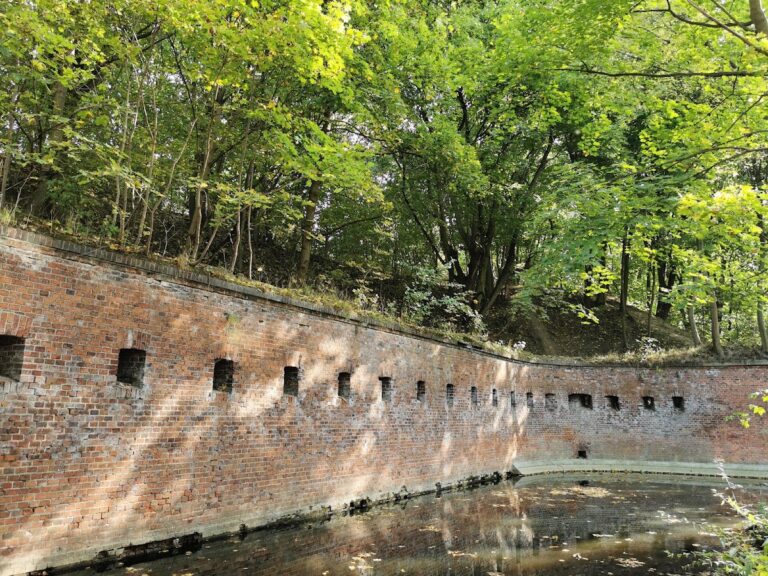
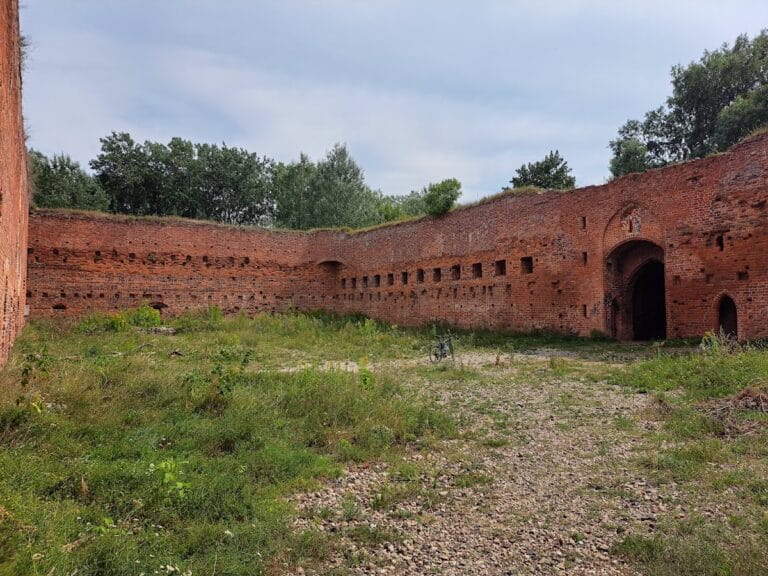
Fort XIII occupies 5.02 hectares and survives as a fortified artillery installation. Its remaining military construction includes blast-resistant doors and steel covers that protected ammunition niches. Informational inscriptions remain on the walls, preserving evidence of the fort’s practical use and later history.
Nearby sites