Fort of São João Baptista: A Coastal Fortress on Terceira
Site at a Glance
- Popularity
- Medium
- Country
- Portugal
- Primary era
- Early Modern
- Eras represented
- Early Modern, Modern
- Civilizations
- Portuguese, Spanish
- Site type
- Military
- Remains
- Fort
On this page20 sections
History
Spanish planning and construction
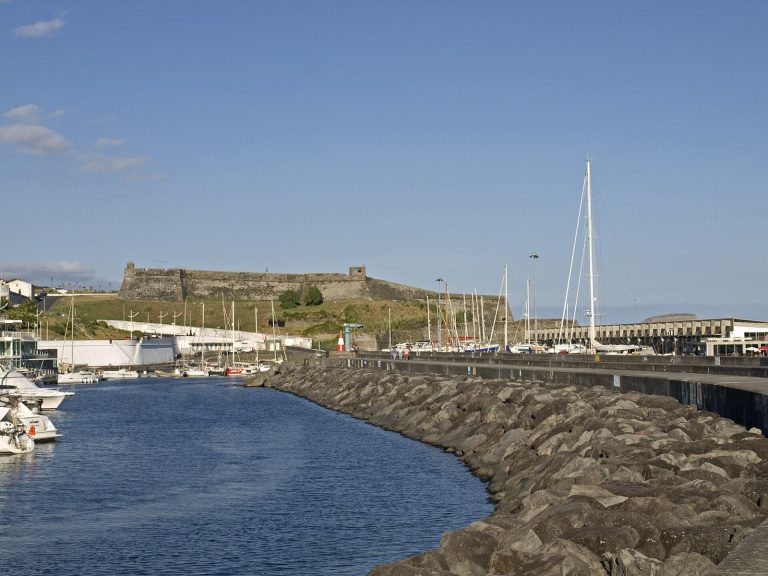
The Fort of São João Baptista is a coastal fortress on Monte Brasil in Angra, Terceira, Portugal. Spanish authorities began building it in 1593, and construction was probably complete around 1636. It was designed to defend Angra’s port and colonial fleets from pirates and privateers, and to house Spanish troops. The fortress formed part of a wider defense system protecting an Atlantic staging point for ships returning from India and other overseas territories.
Plans to strengthen the Azores predated the fortress. In 1543, military engineer Bartolomeu Ferraz urged King John III to protect the islands’ ports and settlements from English, French, and Dutch attacks. A broader defense plan followed in 1567, concentrating fortifications at ports and anchorages. After Spanish forces under Álvaro de Bazán retook Terceira from António, Prior of Crato, Philip II authorized new plans. Portugal and Spain shared a monarch during the Iberian Union, from 1580 to 1640; Philip II ruled Portugal as Philip I.
Tibúrcio Spannocchi developed a defensive scheme after visiting the site in 1583 and 1584. Giovanni Vicenzo Casale and his assistants, Spannocchi and Anton Coll, prepared the final design in 1590. Coll selected the fort’s position on Monte Brasil and worked on the project until his death in 1618. Girolamo Francès and Giovanni Battista Cairati also took part. The fort was initially named São Filipe in honor of Philip II. Its construction began with the first cornerstone at Santa Catarina Bastion in 1593, in a ceremony attended by military governor António de la Puebla and Bishop of Angra Manuel Gouveia.
Work continued under Governor Diogo Fajardo, whose tenure lasted from 1628 to 1639. Local stoneworkers and masons, condemned men, and soldiers assigned to labor as punishment worked on the project. Compulsory work by soldiers began under Governor Diogo de Miranda Queiroz and increased under Fajardo. Claims that hundreds of islanders were also forced to work remain disputed; their contribution through taxes and tithes is known. The fortifications were strengthened amid the Anglo-Spanish War, and Angra’s defenses formed part of a wider Atlantic system compared with those of Havana and Cartagena.
Siege, Portuguese rule, and garrison life
During the Portuguese Restoration, the movement to recover independence that began in 1640, the Spanish garrison endured a siege from 27 March 1641 to 4 March 1642. Portuguese forces under Francisco Ornelas da Câmara and João de Bettencourt faced the Spanish commander Álvaro de Viveiros. The garrison surrendered with military honors and departed with personal arms and two bronze artillery pieces. It left 138 steel and bronze cannons, 392 arquebuses, or early firearms, 400 muskets, and their ammunition. Contaminated water in the cisterns may have caused an epidemic among the defenders and helped bring about the surrender.
After the Portuguese recapture, the fort was renamed São João Baptista in honor of King John IV; the change is dated to 1643. A church dedicated to John the Baptist was built inside in the mid-1640s. Tradition identifies it as the first church built in Portugal after the restoration of independence. A bastion was repaired in 1658, though its identity is uncertain, and a broader rebuilding and renovation campaign was completed in 1662. In the second half of the seventeenth century, the fort’s gunpowder store supplied other island defenses.
The citadel housed soldiers, married couples and their families, and retired military personnel. Groups also cultivated plots on the flanks of Monte Brasil, while the Brotherhood of the Holy Spirit became one of Angra’s wealthiest. Parts of the fort were used for military training during the eighteenth century, a practice that continued into the nineteenth. Remodeling of the church was complete by 1720, when the fort had 60 active artillery positions.
Liberal movements and nineteenth-century use
On 2 April 1821, during Portugal’s constitutional liberal movement, the fort became the first place on Terceira where Liberal forces took power. The action was led by Captain-General and Brigadier Francisco António de Araújo e Azevedo. A counterrevolutionary attempt followed on 3 and 4 April. On 7 May, a fire destroyed an older artillery laboratory and killed five people.
In 1829, the Liberal government established a mint in the fort to produce malucos, coins worth 100 réis, for Prince Regent John, the future King John VI. Their design followed coins struck in Rio de Janeiro during the royal family’s exile. That year, the fort and the Fort of São Sebastião repelled a Miguelist squadron attacking Angra Bay. During the later civil conflict between supporters of Peter IV and his brother Miguel, the Fifth Infantry Battalion restored Peter IV’s rights and constitutional monarchy at the fort. The battalion raised the constitutionalists’ white-and-blue flag; Queen Maria II later embroidered a flag for it in gold thread in recognition of its service.
Prisons, military service, and conservation
Gungunhana, king of Gaza in southeastern Africa, was held at the fort as a political prisoner from 1896 until his death there on 23 December 1906. During the First World War, German nationals were transferred to the fort for detention from 1916 to 1919, following Britain’s request for their arrest. Germany declared war on Portugal, and Portugal declared war on Germany on 9 March 1916.
The fort continued to serve as a place of political imprisonment under the Estado Novo, Portugal’s twentieth-century authoritarian regime. A military prison was established in 1933 and an Angra prison depot in 1943. In the mid-twentieth century, the Armed Forces infrastructure commission ordered the demolition of buildings west of the fort and east of the church. The complex later became a Portuguese Armed Forces communications center, with a radio antenna installed to support Pico Rádio. It remains the headquarters of the Angra garrison regiment and is regarded as Portugal’s oldest continuously operating troop barracks.
The complex received national recognition as a Property of Public Interest in 1943 and became part of the Historic Centre of Angra do Heroísmo UNESCO World Heritage Site in 1983. Conservation included work on the church in 1956 and the fort in 1959. The walls were consolidated and strengthened in three projects from 1995 to 1997, and the church underwent interior and exterior renovation in 1997. The wall along Fanal Bay was rebuilt from 2000 to 2001, and work to restore the roof of the Santa Catarina hermitage began in 2001.
Remains
Setting and principal enclosure
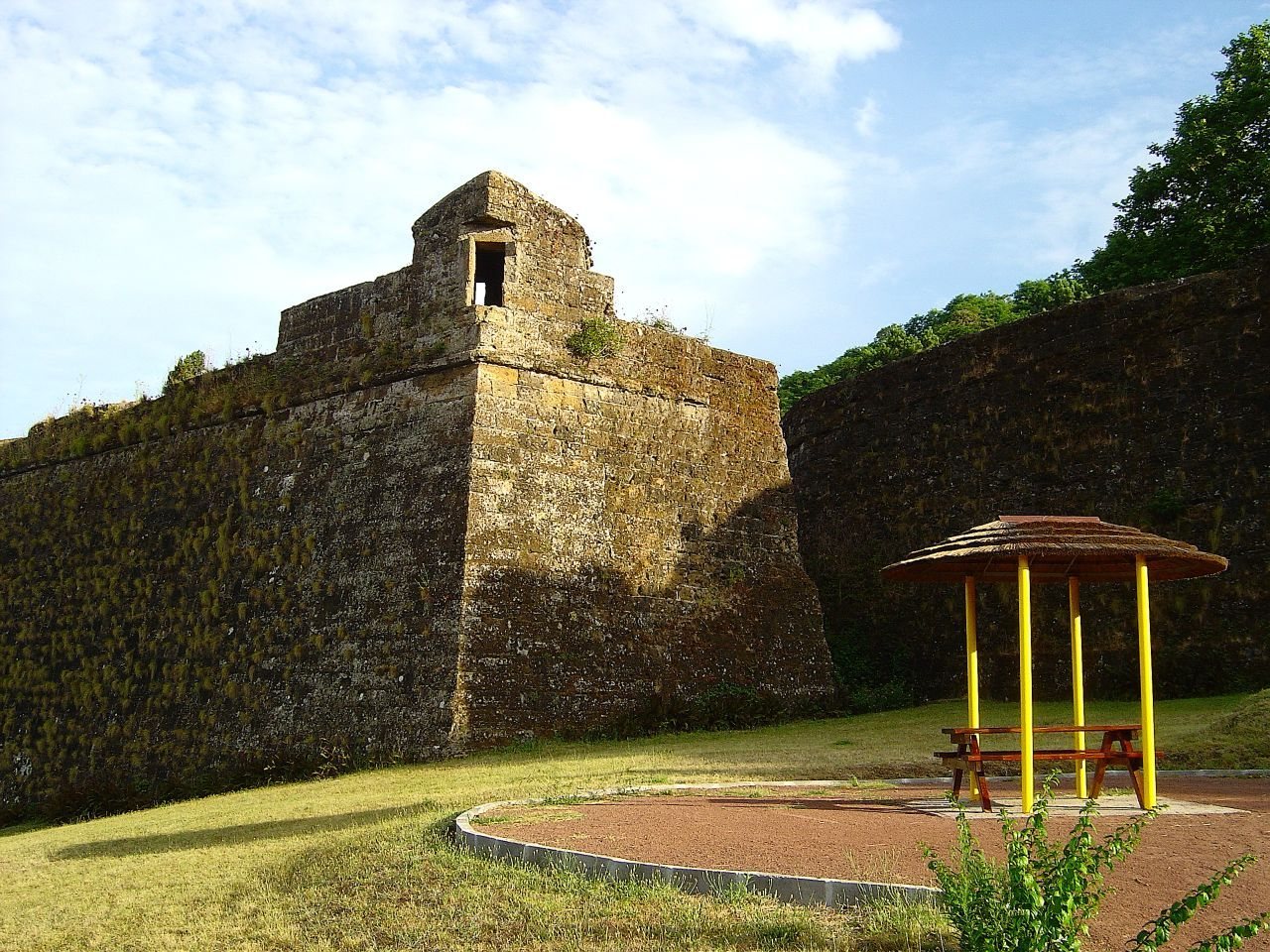
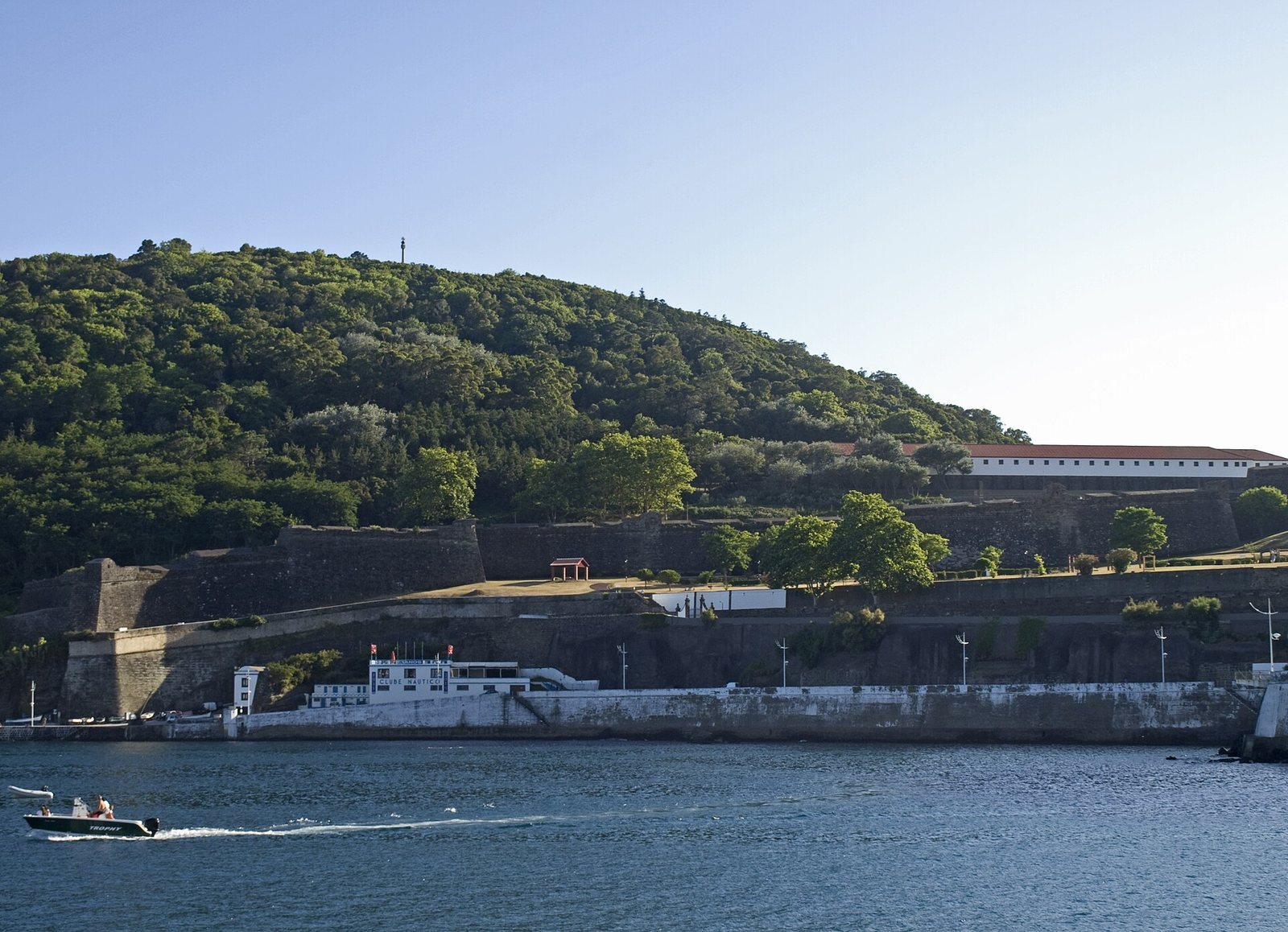
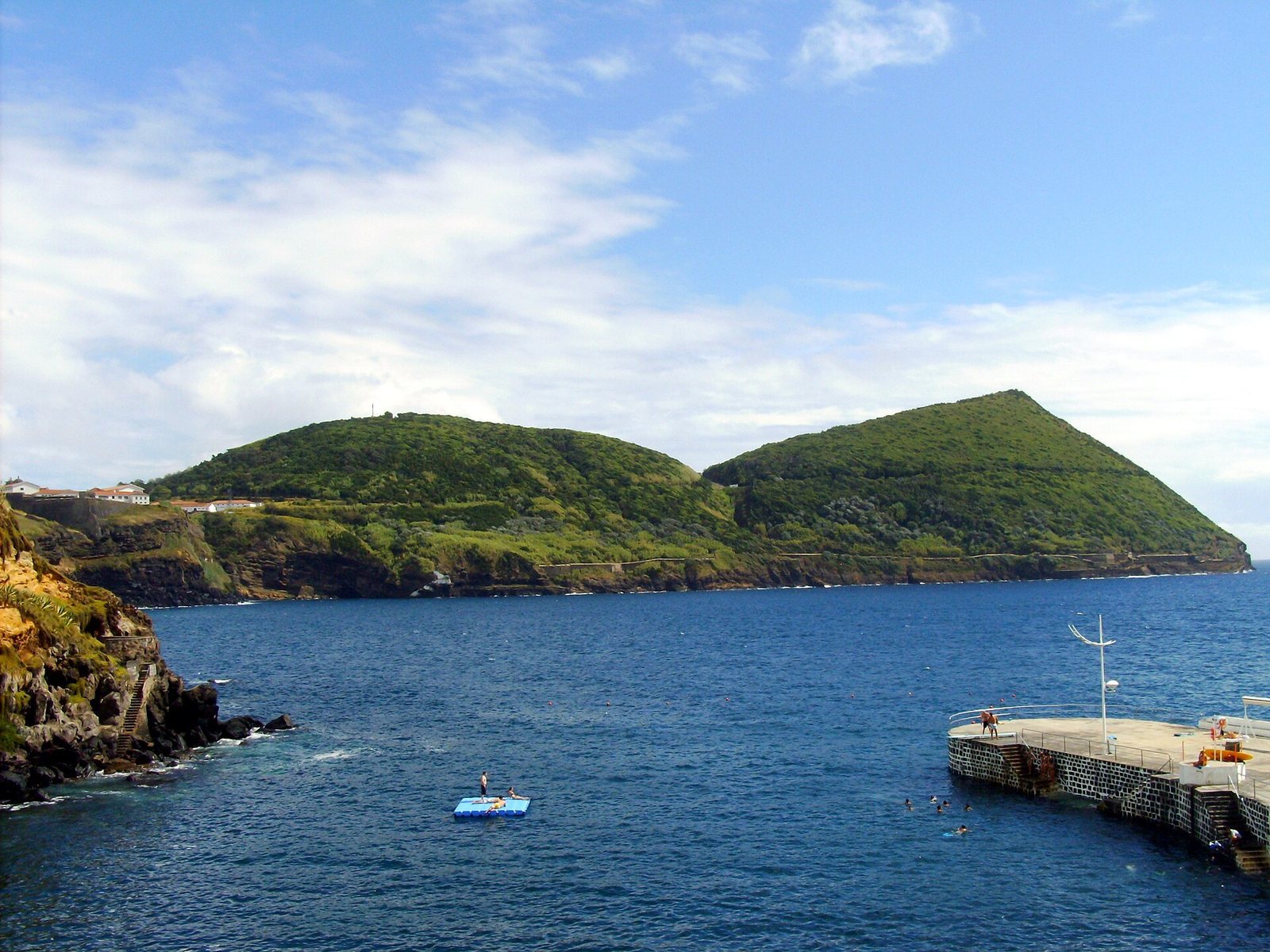
The fortress occupies about three square kilometres on Monte Brasil, a volcanic cone and peninsula on Terceira’s southern coast. It stands on the narrow land connection between the promontory and Angra, with the Atlantic Ocean, Fanal Bay, and Angra Bay around the peninsula. The principal enclosure extends about 570 metres; its northern defensive wall is 111.5 metres long. The walls rise about 15 metres and reach 2.6 metres in thickness. The ground within them was cut down by as much as 10 metres in places, and an outer ditch averages about 10 metres wide and reaches a similar depth. Two more curtain walls, meaning defensive walls joining separate works, extend around the peninsula.
The principal rampart combines three full bastions, projecting defenses that let guns cover the approaches to a wall, with two half-bastions, or reduced bastions. Five named bastions run from west to east. The wider defensive system also uses batteries, fixed artillery positions, and redoubts, detached or enclosed defensive works.
Main rampart and batteries
Santa Catarina and São Pedro bastions
Santa Catarina Bastion overlooks the cliffs of Fanal and has seven gun positions. Its rounded lookout, Torreão dos Mosquitos, was used to observe the batteries and contains a powder magazine, a store for gunpowder. Two levels of embankments, with four gun positions, connect Santa Catarina to São Pedro Bastion. To the left of the Gate of Arms, São Pedro has 15 gun positions and its own powder magazine. In 1766, six additional positions were established on one side of the main gate and seven on the other.
Boa Nova Bastion and adjoining batteries
Boa Nova Bastion has 16 gun positions and two powder magazines. Its lookout, Torreão da Bandeira, was also used to raise the imperial flag. A marble inscription names the bastion’s front facing Angra Bay as Peter IV Battery. The adjoining Maria II Battery has six gun positions. At the southern end, Malaca Battery once held a 36-calibre bronze cannon from the Fort of Diu; the cannon was returned to Lisbon on 22 July 1771. A stairway from Malaca passes through an arch at the Gate of Arms and descends to an old garden.
Espírito Santo and Santa Luzia bastions
Espírito Santo Bastion overlooks Campo do Relvão. It has four gun positions and three powder magazines, and a curtain wall with six gun positions links it to Santa Luzia Bastion. Santa Luzia has five gun positions and a magazine. From it, two descending walls continue toward the coast, each with a gun position and a magazine. Paiol Novo, a further magazine, was built there in 1849. The artillery laboratory also occupies the bastion.
Arsenal Battery
Arsenal Battery has five gun positions on the fort’s western flank, near Santa Catarina Bastion and Fanal Bay.
Coastal defenses
Eastern and southeastern works
Santo António Wall runs for about a kilometre along Monte Brasil’s eastern coast and connects to Santa Luzia Bastion. From north to south, the works associated with it are Portinho Novo Gate, Cais da Figueirinha Gate, Dois Paus Redoubt, São Francisco Redoubt, São Benedito do Monte Brasil Fort, also called Três Paus Redoubt, Santo Inácio Redoubt, and Santo António do Monte Brasil Fort. On the peninsula’s southeastern side, facing the open sea, Quebrada Fort is watched from above by the Vigia da Baleia lookout.
Western coastal works
The coastal defenses on the west extend for about a kilometre. From south to north they comprise Constituição Battery; São Diogo do Monte Brasil Fort, also known as Zimbreiro Fort; Fidelidade Battery; General Saldanha Redoubt; São Gonçalo Redoubt; Santa Cruz Redoubt; Santa Teresa Redoubt; and Cais do Castelo.
Entrance, internal buildings, and water storage
Gate and guardroom
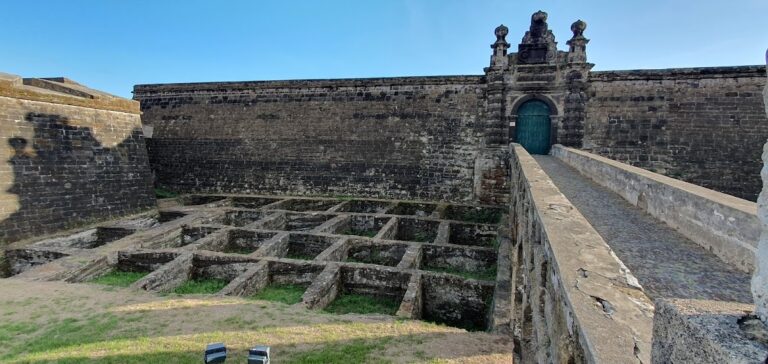
The original approach crossed the ditch on a wooden footbridge. A ten-arch stone bridge later replaced it and leads to a drawbridge. The Gate of Arms is carved from volcanic stone in the Mannerist style, a form of late Renaissance architecture. A plaque at the gate commemorates the fort’s consecration to the Immaculate Conception. Just inside, the guardroom is cut into volcanic rock. It incorporates former Spanish-period dungeons, which ceased to be used in the eighteenth century and later returned to service as a prison.
Governor’s Palace and military buildings
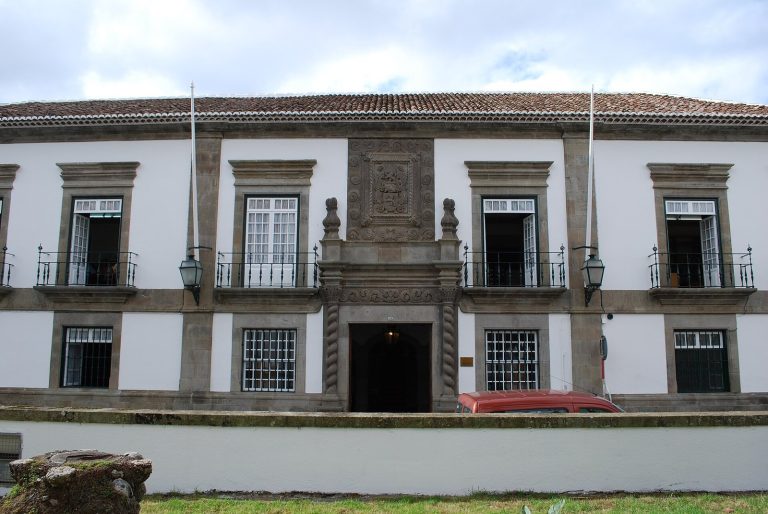
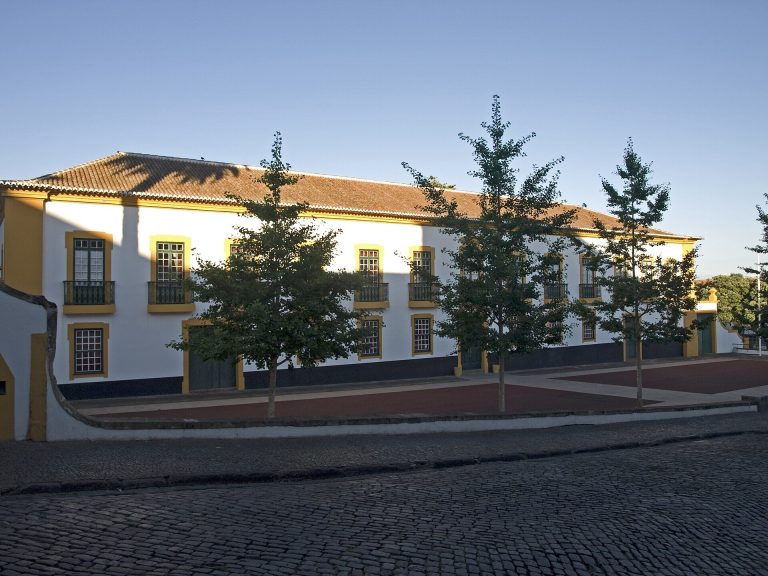
The Governor’s Palace stands on a platform cut into the rock in the Parade Ground and was built over the former stables. An adjoining building also belongs to the palace complex. Several other buildings within the fort serve as barracks, and the complex contains anti-aircraft batteries dating from the Second World War.
Churches and hermitages
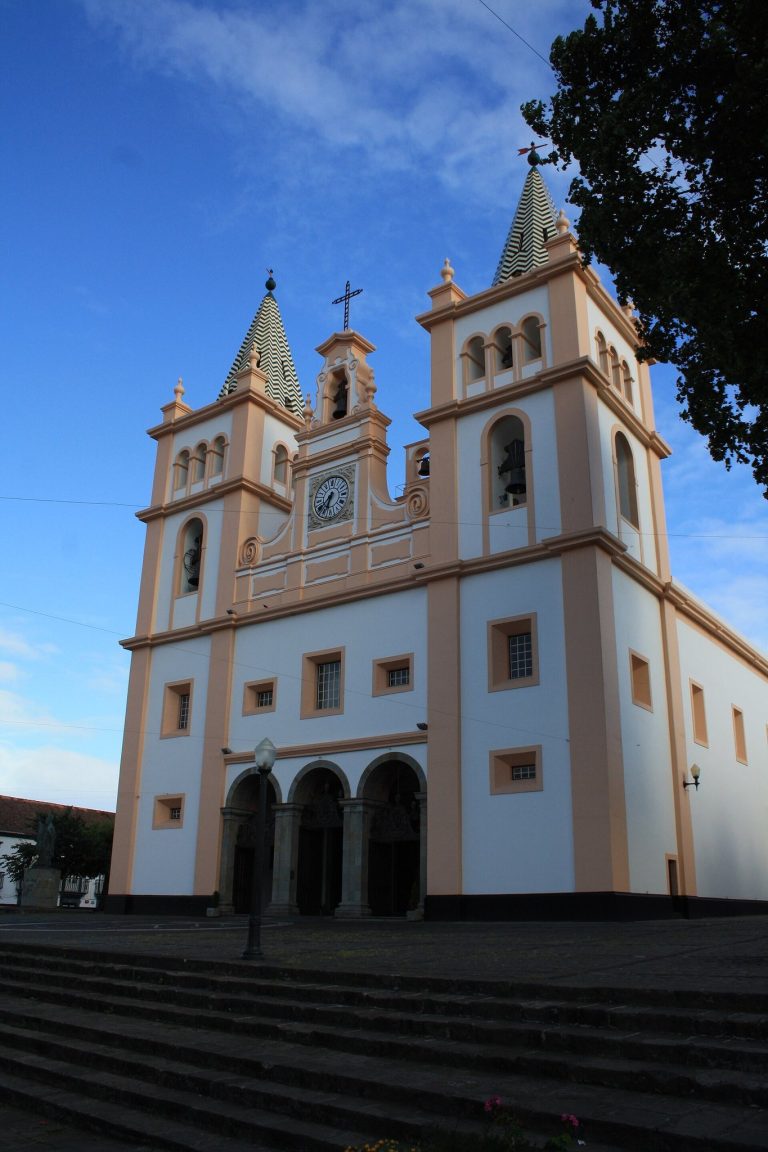
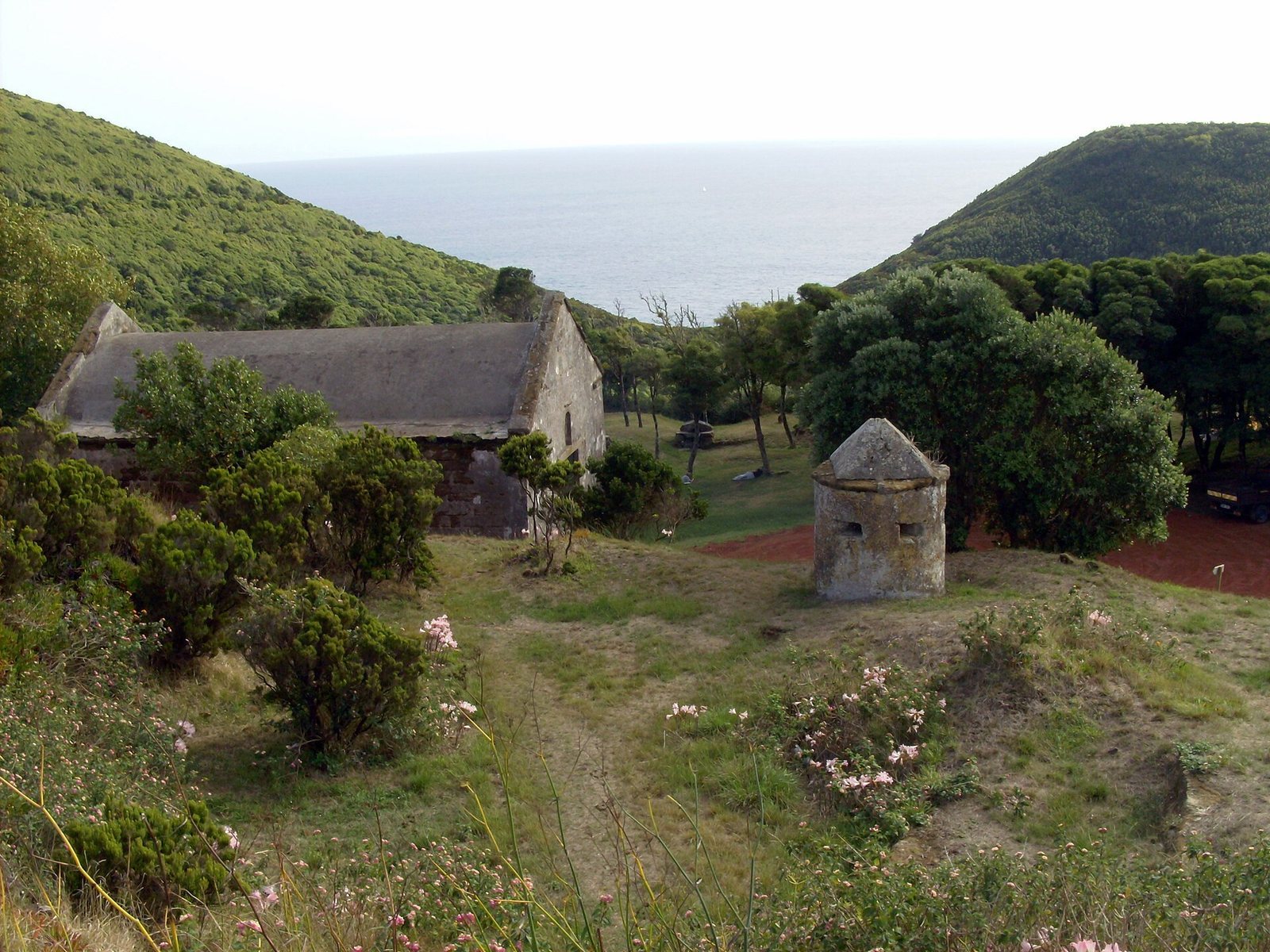
The Church of São João Baptista shares an alignment with the main gate. The Santa Catarina de Sena chapel was later dedicated to the Holy Spirit, and a separate Santa Catarina hermitage is also associated with the fort.
Cisterns
Four cisterns, or water-storage tanks, served the arsenal and troops. One lies inside the principal castle and holds 1,500 cubic metres; others are at Santo António Fort and Quebrada Fort, while another is built into the wall of Zimbreiro Fort, where a grotto gathers water throughout the year. The construction phase also included three interconnected cisterns with a stated capacity of 750,000 kilograms.