Fort Jazuicki: A Prussian Detached Fort in Gdańsk
Site at a Glance
- Popularity
- Medium
- Country
- Poland
- Primary era
- Modern
- Eras represented
- Early Modern, Modern
- Civilizations
- Kingdom of Prussia, Polish–Lithuanian Commonwealth
- Site type
- Military
- Remains
- Fort
On this page12 sections
History
Fort Jazuicki is a detached fort on the Anielinki rise in Gdańsk, Poland, built to defend high ground south of the city. An earth rampart and masonry inner strongpoint were built from 1829 to 1832. After 1840, the position was developed in the New Prussian manner, a nineteenth-century Prussian fortification design, with changing construction plans from 1843 to 1867. The fort was intended to be the first of nine in a ring of defenses around Gdańsk, a plan that was never completed.
Early defenses and the 1807 to 1813 fighting
Fortifications had occupied the hill since the early eighteenth century. The name Szaniec Jezuicki, meaning Jesuit Redoubt, refers to a nearby Jesuit college beside St. Ignatius Church and to earlier defenses on the site. The Jesuits are a Catholic religious order founded by St. Ignatius of Loyola. The high ground was strategically important because enemy artillery placed there could threaten southern Gdańsk, including warehouses on Granary Island.
Earlier defenses included earthwork outworks open at the rear. Their limitations became clear during the French-Prussian fighting of 1807, which ended in a Prussian defeat. French forces captured the provisional position in March 1807, and it was rebuilt by 1813. Russian forces took it on 10 October 1813 and used it to bombard Granary Island.
Expansion and demilitarization
The fort was enlarged in stages, with repeated changes to its plans. It remained garrisoned until the fortress was demilitarized in 1920. An infantry regiment was based at Wiebe Barracks near Żabi Kruk. The demilitarization followed the 1919 Treaty of Versailles, the peace settlement after the First World War, which included demilitarization provisions.
Wartime service and later use
During the Second World War, an anti-aircraft battery at the fort defended Gdańsk from the south. Fighting in 1945 destroyed the cross-shaped inner strongpoint.
The fort was converted to warehouse use in 1956, and its storage areas remained in commercial use until 2000. Two large halls were built in the moat for storage. In March 2000, the city took over management, carried out safety work and cleared the grounds, including by demolishing the warehouses. A telecommunications mast erected on the fort in 1975 remained there until 2012.
Remains
Setting and overall layout
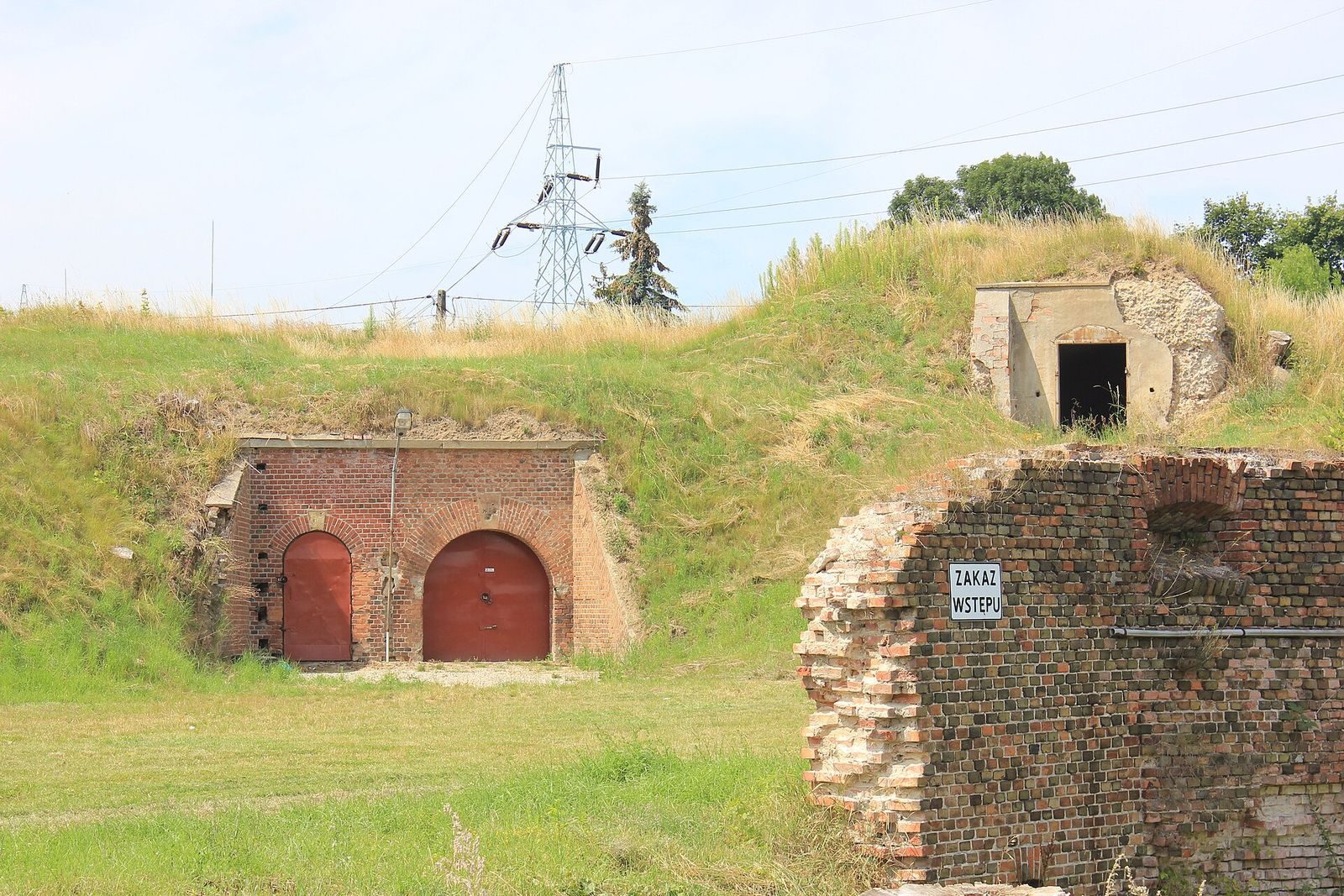
The fort stands at the edge of upland overlooking Stare Szkoty, on Anielinki, a glacial-moraine rise 53 metres high. Its trapezoidal compound covers approximately 10,000 square metres, with the longer side facing the city. Brick forms the main construction material, alongside experimental use of concrete. A purpose-built road called Neuweinberg once connected the fort with the city.
Moat and outer defenses
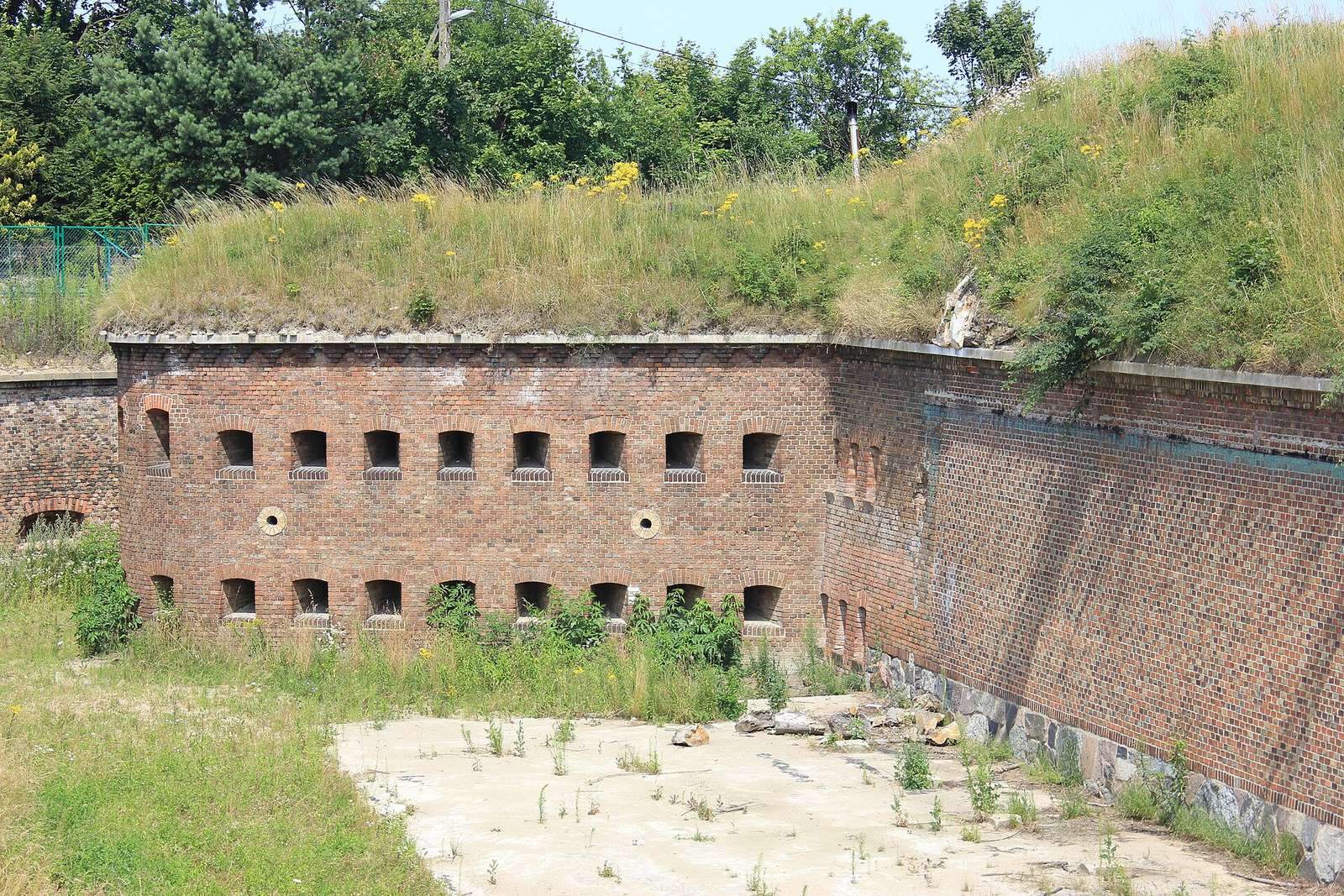
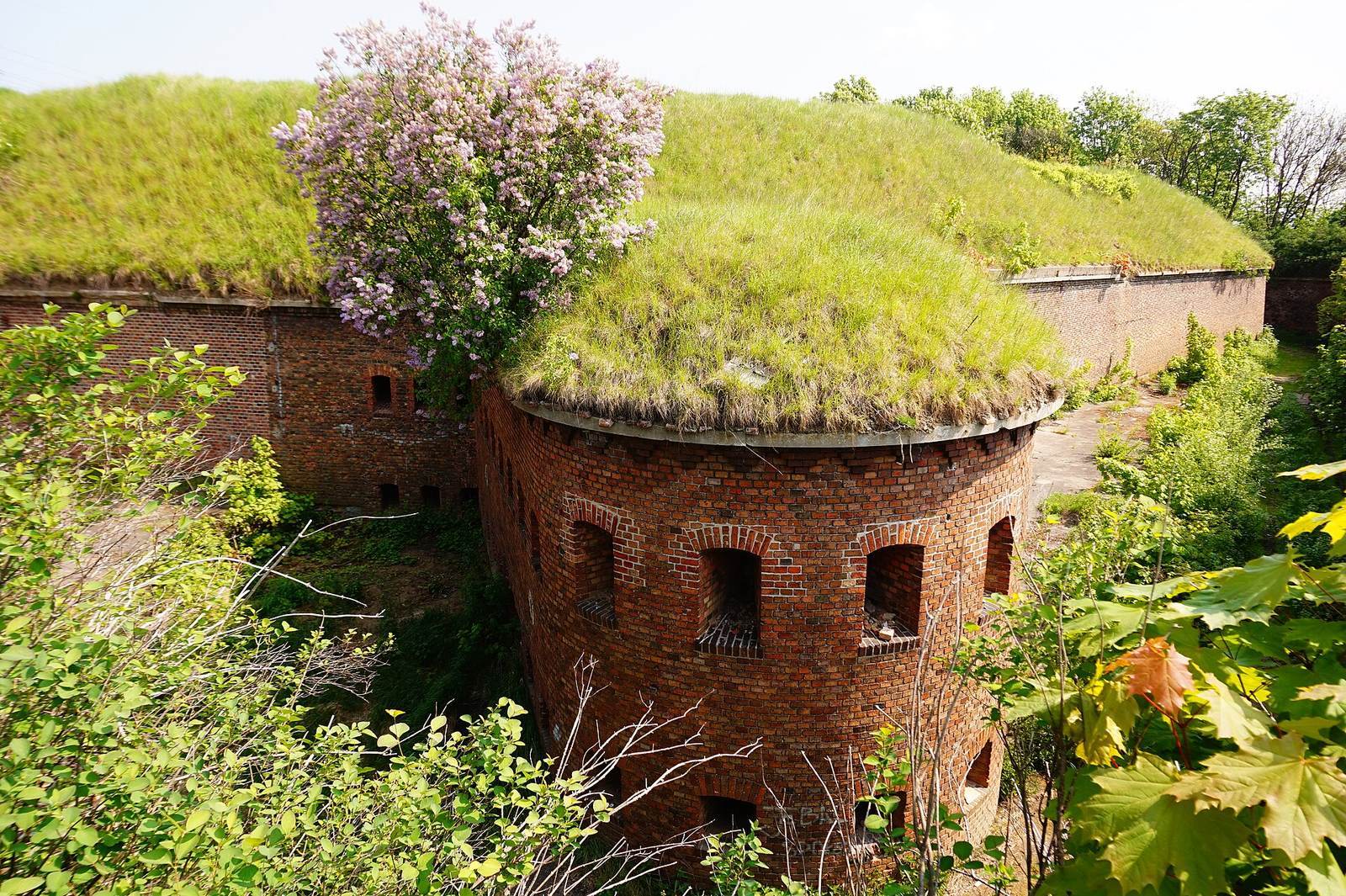
A dry moat surrounds the fort on every side. Both its inner and outer faces are lined with masonry. Two caponiers, protected positions for firing along a moat, were completed in 1858. Each had firing openings on two levels. Firing galleries also ran along the moat’s outer face, and two covered passages through the fortification were added in 1859.
Rampart and internal structures
Earth rampart, magazines and laboratory
The earth rampart incorporated powder magazines, an ammunition laboratory and guardhouses. The powder store and laboratory had ceilings made with steel and concrete.
Concrete guardhouses
Built in 1867, the guardhouses used a prototype form of single-piece concrete construction. They are among the earliest reinforced-concrete structures in Prussia.
Inner strongpoint
The masonry strongpoint had a cross-shaped plan and was later expanded to two storeys. It was designed as the final place of resistance during a siege and served as a powder store in peacetime.
Retaining wall
Part of the retaining wall beside Kolonia Anielinki street collapsed on 3 September 2014. Rebuilding began that December.