Fort Ebersberg: A Swiss Rhine Border Fortress


Site at a Glance
- Rating
- 5
- Popularity
- Very Low
- Country
- Switzerland
- Primary era
- Modern
- External website
- Open
- Eras represented
- Modern
- Civilizations
- Swiss
- Site type
- Military
- Remains
- Fort
On this page13 sections
History
Fort Ebersberg, also known as Fort Rüdlingen, is a Swiss military fortress near Berg am Irchel on the left bank of the Rhine. Built as an artillery work, a fortified position for protected guns and underground support facilities, between 1938 and 1940, it formed part of Switzerland’s border defenses at the beginning of the Second World War. Its purpose was to prevent or delay an enemy advance, particularly a German crossing of the Rhine. Fort Ebersberg is integrated into the Rüdlingen barrier system and is the only fortress installation in the Canton of Zurich.
Earlier defensive use and wartime construction
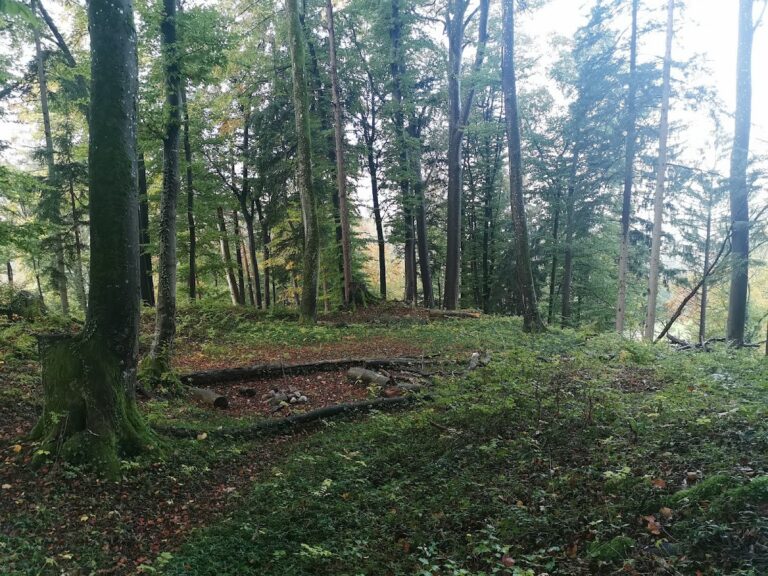
Ebersberg had a defensive installation in prehistoric times, but the present fort belongs to Switzerland’s twentieth-century effort to protect its frontiers and important crossing points. The Swiss Border Line was a system of fortifications intended to resist invasion, including attacks directed across the Rhine. Fort Ebersberg was constructed by hand in the sandstone of the north-facing slope between 1938 and 1940.
The fort belonged to barrier system no. 654/694, which included more than 20 installations. Alongside the artillery work were an infantry work, a machine-gun position, later positions associated with Border Brigade 6, and three close-defense positions built in 1941. During the 1960s, standardized atomic-protection shelters were added to the works. These shelters, known in Swiss military usage as ASU, were designed to protect personnel and equipment from the effects of nuclear weapons.
Military operation and later use
During a combat deployment, Fortress Artillery Company 96 manned the fort with 65 soldiers, non-commissioned officers, and officers. The installation carried enough drinking water, food, emergency-generator fuel, and ammunition for ten days of autonomous operation. Its two artillery pieces were removed in 1978, although the fort continued to serve other military purposes after the guns had gone. It was declassified in April 2003.
The previously secret installation was opened to public inspection for the first time in May 2003. In 2006, Swiss military authorities transferred it to the municipality of Berg am Irchel, which granted the Military Historical Society of the Canton of Zurich a long-term lease. The stated aim of the arrangement is to preserve the fort as far as possible in its original condition rather than transform it into a conventional museum. Fort Ebersberg is regarded as a military-historical monument of national importance.
Remains
Buried fortress and internal facilities
Fort Ebersberg is deeply excavated and buried in the sandstone of Ebersberg’s north-facing slope. Its surface installations survive and are accessible, while the subterranean sections are not generally open to the public. The remaining equipment includes an operable ventilation system and two diesel engines capable of generating electricity.
An entrance work contained a guard room and an internal-defense section, while a cavern housed a fine-dust and atomic filter. Fresh air entered through a shaft 30 meters deep. The energy center held two diesel generator units, the ventilation plant, and a workshop. These technical spaces supported the fort’s ability to function independently during a combat deployment.
Personnel and service areas
The fort included an ammunition magazine and a two-story personnel block with 66 sleeping places, including four in the guard room. Each soldier had an individual bed. The lower floor contained a doctor’s room, examination room, multi-patient sickroom, patients’ bathroom, washroom, officers’ dining room, dining room for non-commissioned officers and soldiers, provisions and storage rooms, a kitchen above a drinking-water reservoir, and soldiers’ toilets above a sewage tank.
The upper floor contained the fire-control station and officers’ workroom, a ten-person sleeping room for non-commissioned officers, a company office with one sleeping place, a private-call telephone booth, a telephone exchange with one sleeping place, the commander’s workroom, a four-person officers’ sleeping room, and a 46-person soldiers’ sleeping room. Officers’ toilets, a magazine, and a library completed this level.
Artillery and observation positions
Gun emplacements
The artillery positions consisted of two separate gun emplacements. Each originally housed a semi-automatic 7.5-centimeter artillery bunker gun. The guns could fire 20 shells per minute each, with a stated field of action extending from Rüdlingen to Schaffhausen. The weapons were removed in 1978, but the protected gun positions remain part of the preserved fortress complex.
Observation posts
The artillery arrangement included an observation post at Teufelskanzel, Observation Post 1 with an emergency exit, Gun Position 1, and Gun Position 2 combined with Observation Post 2. Observation Post 1 was later camouflaged. Together, these positions connected observation and fire control with the two protected artillery emplacements.
Associated outer defenses
Infantry Work A 5439
Infantry Work A 5439 stood at the foot of Ebersberg as part of the artillery work’s outer defense. It was equipped with an infantry gun. A machine-gun position served as its opposing work, and the two positions could provide mutual protection for their embrasures.
Rüdlingen barrier installations
The wider barrier system included half-platoon shelter A 5435 Ebersberg South, small shelters A 5436 Ebersberg East and A 5437 Ebersberg North, Artillery Work A 5438 Rüdlingen, Infantry Work A 5439 at the Rüdlingen bridge, machine-gun position A 5440, Infantry Work A 5441 at Ziegelhütte, the Rüdlingen Rhine-bridge guard, the Rüdlingen bridge infantry work, the Ziegelhütte opposing work, and atomic-protection shelters.
Infantry Work Ziegelhütte
Infantry Work Ziegelhütte A 5441 lies approximately 250 meters upstream from the bridge, near the Rhine bank on the opposite side of the Langwisenbach. It served as the opposing work of Infantry Work A 5439, extending the defensive arrangement beyond the main artillery position and linking it to the barrier’s bridge defenses.
Nearby sites