Church of Notre-Dame of Dijon: A Gothic Parish Church and Civic Landmark


Site at a Glance
- Rating
- 4.6
- Popularity
- Medium
- Country
- France
- Primary era
- Medieval
- External website
- Open
- Eras represented
- Medieval, Early Modern, Modern
- Civilizations
- Duchy of Burgundy, French
- Site type
- Religious
- Remains
- Church
On this page12 sections
History
The Church of Notre-Dame of Dijon is a Gothic Roman Catholic parish church in Dijon, France, begun around 1229 and built mainly during the thirteenth century. Construction continued until about 1250, and the church was consecrated in 1334. Built in a densely settled quarter of the medieval city, it became both a place of worship and a setting for important civic traditions.
From chapel to parish church
Before the second half of the twelfth century, the site was occupied by a small chapel called Sainte-Marie outside Dijon’s walls. It became an inner-city parish in 1137 and was rebuilt in the Romanesque style around 1150. The chapel gained a wider civic role after Dijon received communal status in 1187. The newly appointed mayor swore the municipal oath there, while the town’s archives were kept above the porch.
Dijon’s inhabitants began constructing the present church during the 1220s, with the work more specifically dated to around 1229. Its architect is unknown. The restricted building site shaped the design: instead of using flying buttresses to carry the roof’s weight, the builders transferred that weight through the pillars. This solution preserved as much interior floor space as possible within the crowded neighborhood.
Devotion to Notre-Dame de Bon-Espoir
The church became closely associated with devotion to Notre-Dame de Bon-Espoir, a title that developed from the history of its Marian statue. During the Swiss siege and bombardment of Dijon in September 1513, the statue was carried through the city in procession on 11 September. The Swiss forces withdrew unexpectedly on 13 September, and Dijon’s citizens attributed their deliverance to the Virgin’s intervention.
A tapestry commemorating the liberation was woven around 1515 and remained in the church until the French Revolution. Dijon’s mayor bought it back in 1803, and it passed from the town hall to the Musée des Beaux-Arts de Dijon in 1832. The statue itself had earlier been called Notre-Dame de l’Apport, meaning “Our Lady of the Market,” and also Notre-Dame de l’Espoir. After the events of 1513, the second title became predominant, and the name Notre-Dame de Bon-Espoir was established in the seventeenth century.
The devotion was renewed during the German occupation of Dijon in September 1944. At a ceremony in the church on 10 September, the bishop publicly invoked Notre-Dame de Bon-Espoir. German troops departed during the night of 10 to 11 September, and French forces entered the city on 11 September. Believers again interpreted the sequence as a miraculous deliverance. A second tapestry, Terribilis, was commissioned from Dom Robert, produced at the Gobelins Manufactory between 1946 and 1950, and installed beneath the organ in 1950.
Admiration and restoration
From the eighteenth century onward, the church attracted the attention of figures such as the military engineer and marshal Vauban and the Dijon Academy. In the nineteenth century, Eugène Viollet-le-Duc called it a “masterpiece of reason.” The church was restored between 1865 and 1884 by Émile Boeswillwald, Eugène Millet, and Charles Laisné. Their work aimed to recover what was considered the building’s original appearance by removing later additions, rebuilding the crossing tower as a lantern tower, and remaking damaged sculptures. Viollet-le-Duc did not carry out this restoration, despite an attribution that is sometimes repeated.
The lantern tower’s spire was restored in 1969 and 1970. The church itself was protected as a French historic monument in 1840. The Assumption chapel, sacristy, and connecting gallery received protection in 2002. Notre-Dame also stands within Dijon’s 97-hectare preserved historic sector, which became part of the UNESCO World Heritage property “Climats of the Burgundy vineyards” in 2015.
Music and civic memory
An organ stood on the western gallery from the sixteenth century. Jean-Philippe Rameau played it between 1709 and 1713. The instrument was dismantled when the gallery was restored in 1874. A replacement organ was built in 1893 and inaugurated in 1895, continuing the church’s musical role within its altered nineteenth-century interior.
Remains
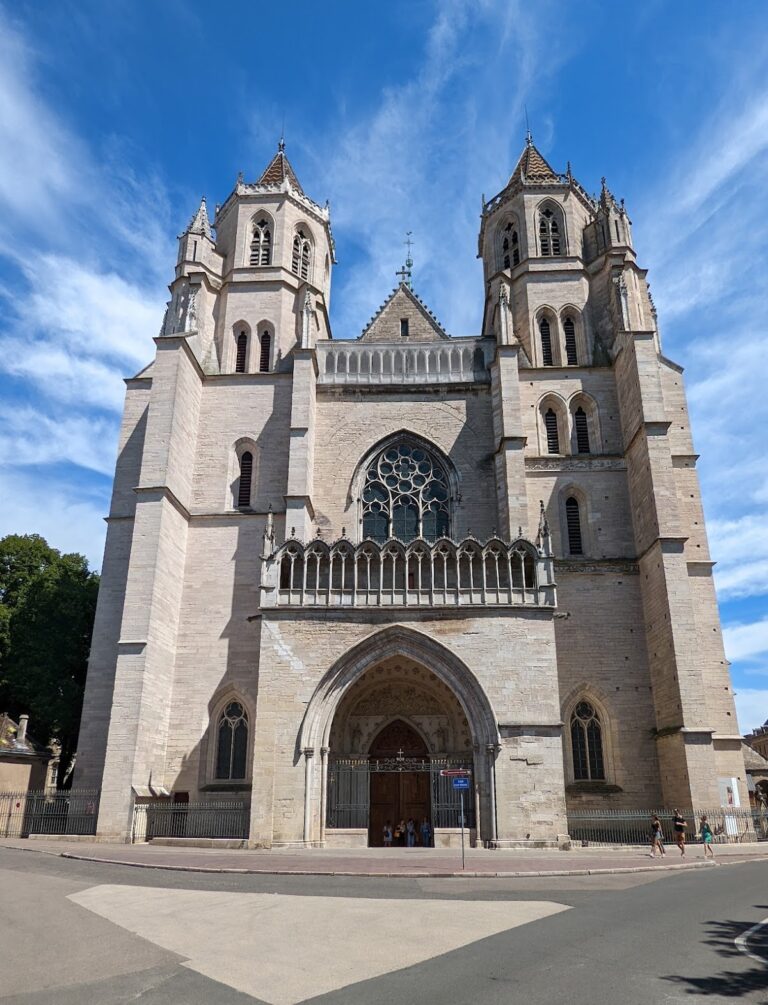
The church has an oriented Latin-cross plan, with a western porch before the nave, two aisles alongside the central vessel, a pronounced transept, a choir, and a lantern tower above the crossing. It measures about 65 metres in length. The western façade is 19.5 metres wide and 28.6 metres high, while the spire reaches 83.6 metres. The porch extends 6.2 metres, and the interior is approximately 46.7 metres long and 17.2 metres wide. At the transept crossing, the interior width reaches 27.3 metres. The nave and choir vaults rise 18.5 metres, compared with 8.7 metres for the aisle vaults.
Nave, crossing, and choir
The nave is arranged in three levels. Six broad arcades rest on cylindrical piers at the lower level. Above them, a triforium, an upper passage opening through arcades toward the central vessel, has a slab covering that forms a circulation gallery in front of the high windows. The seventeenth century also recorded a rood screen, probably associated with the community of chaplains who served the parish.
The transept has solid lower sections, five narrow pointed lancet windows, and a rose window in each gable. Above the crossing stands the lantern tower, a tower designed to admit light into the church. Its triforium is surmounted by eight large windows. Two small apses, or apsidioles, occupy the angles between the transept arms and the choir.
The choir has four levels. Blind trefoil arcades decorate its base, above which rises a band of lancet windows. The triforium contains seven large circular openings, or oculi, inserted in the seventeenth century, and a final tier of high windows completes the elevation. The alternation of openings and solid wall surfaces, combined with sexpartite vaults, gives the modestly proportioned interior a monumental character.
Western façade and sculptural decoration
The western façade is unusually flat and forms a screen that conceals the arrangement of the interior. Its distinctive design has been associated with the church’s place within French Gothic architecture. The lowest level contains three large arcades opening into a porch. Two rows of pillars support the porch vaults, which lead to the church’s three doors.
The archivolts, tympana, and jambs of the doors were originally covered with statues and other sculptures. These were destroyed in January 1794. Above the porch are two arcaded galleries placed one above the other. Each gallery rests on seventeen single-piece colonnettes with capitals. Three bands composed of alternating metopes and decorative false gargoyles emphasize the horizontal arrangement.
Corner buttresses frame the façade, and each is topped by a stair turret with a conical roof. Two square towers were planned above the façade, but only their lower beginnings were completed. A campanile, or bell-supporting tower, rises from the base of the southern tower and carries the Jacquemart clock.
False gargoyles and the façade’s legends
The façade has fifty-one decorative false gargoyles, also called chimerae, depicting people, animals, and monsters. Unlike functional gargoyles, they do not carry rainwater away from the building. The working gargoyles are positioned on the side walls and apse. The present figures were made between 1880 and 1882 during the nineteenth-century restoration by seven Parisian sculptors: Chapot, Corbel, Geoffroy, Lagoule, also known as Delagoule, Pascal, Thiébault, and Tournier.
A medieval account by the monk Étienne de Bourbon describes the removal of the original façade gargoyles around 1240. In his story, a stone figure representing a usurer fell and killed a man on the forecourt. The episode has also been treated as a moralizing legend, while the removal of unstable stonework offers a practical explanation. One gargoyle at the upper right survived until the 1960s, when it was replaced. Other figures on the sides and rear of the façade also survived.
The Jacquemart clock
The Jacquemart is a public clock with mechanical figures that strike bells. It stands on the campanile above the unfinished base of the southern tower. Four metal automatons form the mechanism. Jacquemart and Jacqueline strike the hours on a large bell, while Jacquelinet and Jacquelinette strike the quarter hours on two smaller bells.
Jacquemart and the large bell came from Kortrijk, also known as Courtrai in Belgium, after Philip the Bold’s forces looted the town in 1382. Dijon had supplied the duke with one thousand armed men for the campaign. The clock and automaton were installed above Notre-Dame’s western façade in 1383 through contributions from the ducal family and Dijon’s inhabitants. The bell broke during transport, was recast in Dijon, and was named for its godmother, Marguerite of Flanders. The origin of the name Jacquemart is uncertain, and the term is attested for Dijon’s automaton from 1458.
Jacqueline was added in 1651 so that she could alternate with Jacquemart when striking the hours. Jacquelinet joined the mechanism in 1714 or shortly afterward to mark the half-hours. Jacquelinette was added in 1884 and strikes the quarter hours with her brother.
Stained glass and the Marian statue
Five medieval stained-glass windows survive in the north transept. Made around 1235, they occupy lancets. The first two depict episodes from the life of Saint Peter, one of the leading apostles in Christian tradition, while the other three show episodes from the life of Saint Andrew. Between 1874 and 1897, the Parisian glass painter Édouard Didron created fifty-eight additional windows inspired by these thirteenth-century examples. The two largest are the north and south transept rose windows, each six metres in diameter.
The wooden statue of Notre-Dame de Bon-Espoir stands in the southern apsidiole above an altar made with goldsmith’s work. Dating from the eleventh or twelfth century, it is regarded as one of the oldest Virgin statues in France. It originally showed the seated Virgin on a throne with the infant Jesus on her knees. The throne was removed at an earlier date, the back was sawn away and replaced with another piece of wood, and the infant Jesus disappeared in 1794. Both hands had already been lost by the eighteenth century, while the face remains almost entirely intact.
The statue first had Romanesque polychromy, with colored clothing and a light brown face. It was painted black during the sixteenth or seventeenth century for an unknown reason. The black layer was removed in 1945, revealing the earlier colors. A slight black tint was left on the face to preserve the tradition, but this was removed in 1963. The statue is therefore regarded as a former Black Madonna rather than a Black Madonna in its current appearance.
The owl carving
On the north side, beside rue de la Chouette, a chapel buttress bears a worn medium-relief carving identified as an owl. The bird is about 35 centimetres high and is positioned roughly 1.80 metres above ground level. Its carving is technically simple, and repeated touching has worn away most of the details, including the feathers, wings, eyes, and beak. A salamander sculpture about two metres away forms part of the same local superstition.
The chapel carrying the carving was built in the late fifteenth or early sixteenth century, several centuries after the main church. The owl consequently cannot be the signature of Notre-Dame’s original architect. Its association with the street name rue de la Chouette appears on a plan from 1759, and a manuscript from the Revolutionary period describes the remains of bird sculpture at the church.
The owl’s meaning remains uncertain. It has been interpreted as a stonemason’s mark, a reference to the dukes of Burgundy, a religious or pagan symbol, or an allegory of the Holy Spirit. Local belief holds that touching it with the left hand while making a wish brings good fortune. A vandal struck the sculpture with a hammer on 5 January 2001. Repairs were carried out in late January and early February using a 1988 Louvre mould as a model, and the restored carving was inaugurated on 12 May 2001. Video surveillance was later installed, but the owl was painted in February 2017 and marked with a pen inscription in April 2022.
Nearby sites