Fort 49 “Krzesławice”: An Austro-Hungarian Artillery Fort in Kraków


Site at a Glance
- Rating
- 4.7
- Popularity
- Low
- Country
- Poland
- Primary era
- Modern
- External website
- Open
- Eras represented
- Modern
- Civilizations
- Austria-Hungary, Habsburg
- Site type
- Military
- Remains
- Fort
On this page8 sections
History
Fort 49 “Krzesławice” is an Austro-Hungarian artillery fort in Kraków, Poland, built as part of the nineteenth-century expansion of Krakow Fortress. It formed an important element of the fortress’s northeastern third ring, the outer belt of forts surrounding the city. The first works, carried out between 1872 and 1878, produced semi-permanent wooden-and-earth fieldworks. The Austro-Hungarian Army completely rebuilt the position as an artillery fort between 1881 and 1886.
Construction and the First World War
By the summer of 1914, Fort 49 “Krzesławice” was ready for combat. During the first phase of the Battle of Krakow, its artillery fired on leading units of the approaching Russian forces from 18 to 20 November 1914. Two neighboring positions strengthened this part of the defensive network in the early twentieth century: armored Fort 49a “Dłubnia” to the west and Fort 49¼ “Grębałów” to the east.
From Polish storage depot to wartime execution site
During the interwar period, the Polish Army retained the fort and used it for storage. Around 1930, a radio-listening mast was installed for Polish counterintelligence. The material gathered through this work contributed, among other purposes, to the deciphering of the Enigma machine, a cipher device used by German military and government organizations.
German forces took over the fort at the beginning of the Second World War and removed the ammunition stored there. From 11 November 1939 to 15 October 1941, German authorities carried out executions of Polish patriots in the fort’s ditches. The victims included prisoners from Montelupich Prison and from the prison housed in the former Monastery of Saint Michael on Senacka Street in Kraków.
Exhumation, commemoration, and renewed use
Between 15 October and 6 December 1945, 440 bodies from 29 graves were exhumed and transferred to a mass grave behind the fort. A commemorative plaque was unveiled there on 27 May 1957, although its dates for the executions were incorrect. In 1958, a monument honoring the Krzesławice victims of Nazi terror was erected near the fort.
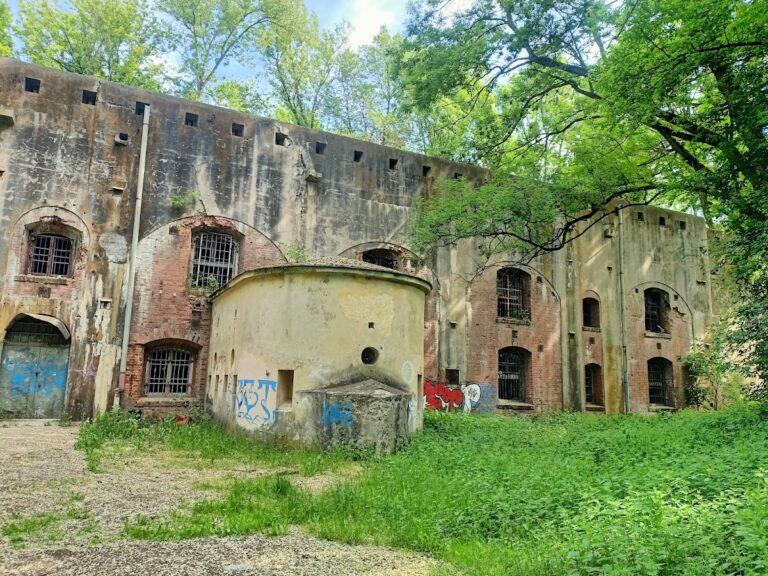
The execution area deteriorated severely during the following three decades. Residents had already begun using the surroundings as allotment gardens in the 1960s, and in 1978 the area was transferred to local estate authorities for that purpose. During the mid-1970s, the northern and eastern caponiers, fortified structures projecting into or defending a ditch, were buried, while the western caponier was destroyed by an explosion. The buried ditches became overgrown with self-seeded trees and shrubs, and parts of the area were used for rubbish dumping. Readiness shelters were buried and converted into cellars, allotment sheds were erected above ground, and the former barracks and main shelter served as storage facilities.
In 1993, Stanisław Owca, chair of the Council of Kraków’s District XVII, and Franciszek Dziadoń, director of the Youth Cultural Centre, prepared a plan to transfer the fort to the centre. The official handover took place in May 1994. Fort 49 “Krzesławice” entered the heritage register as A-830 on 10 November 1995. Security and renovation work continued until the end of 1999, and the Youth Cultural Centre began operating in the right-hand part of the barracks on 5 January 2000. The centre, a civic institution providing educational and cultural activities for young people, continues to use the fort.
Remains
Ramparts, ditches, and caponiers
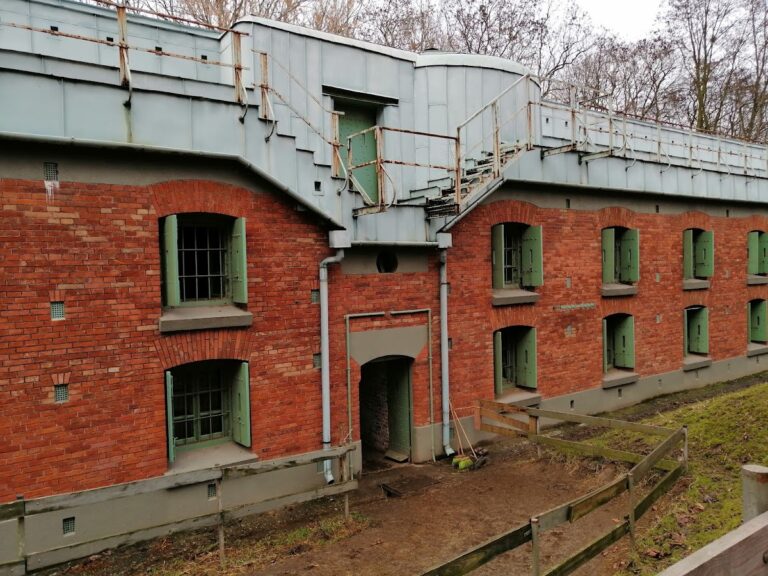
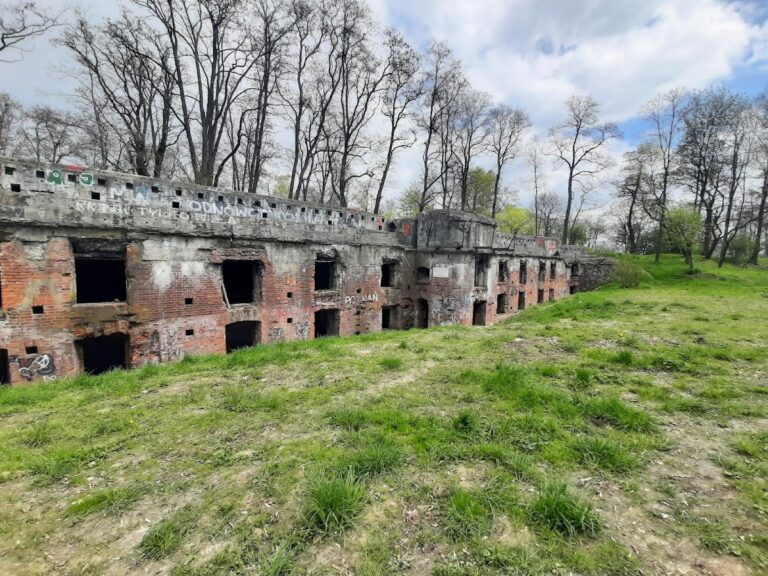
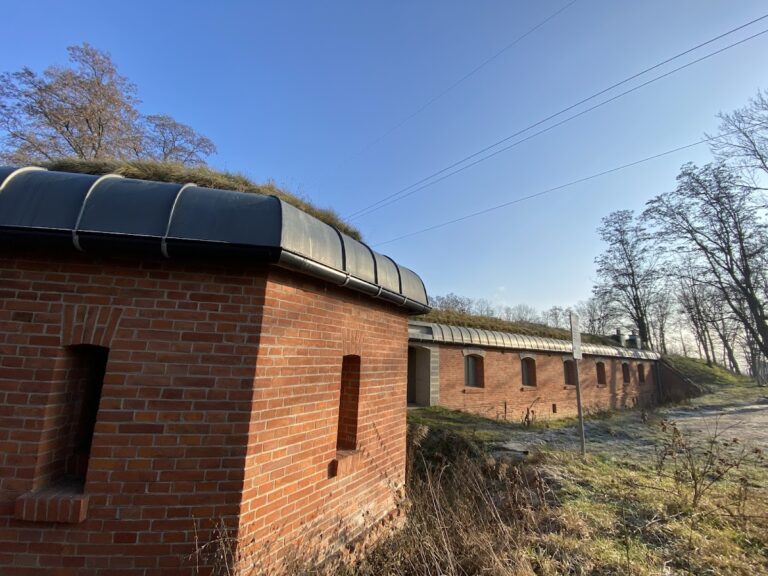
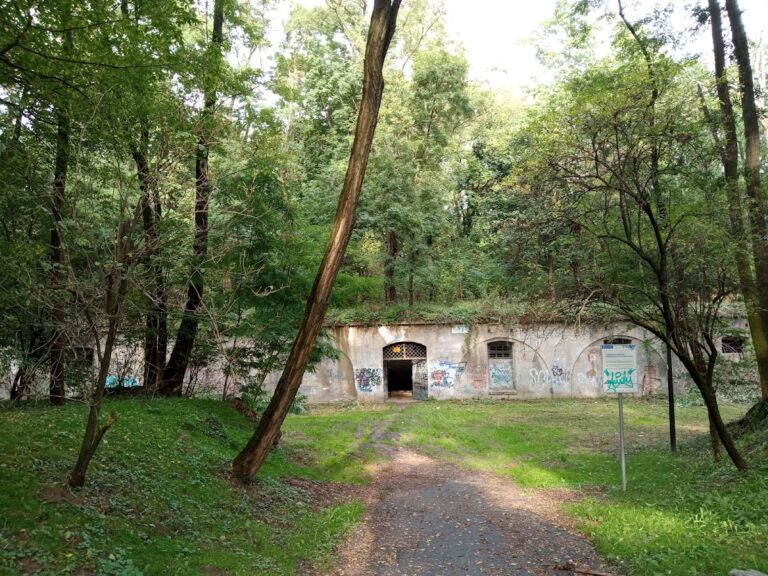
Fort 49 “Krzesławice” is a typical single-rampart artillery fort in the present-day Na Stoku estate, near Architektów Street in Kraków’s District XVII, Wzgórza Krzesławickie. Its surviving complex includes the fortification ramparts and ditches, caponiers, barracks, a main shelter, readiness shelters, the former barracks yard, internal rainwater drainage, and a western exit. The northern and eastern caponiers were buried in the mid-1970s, and the western caponier was destroyed by an explosion. Conservation has progressively uncovered the buried caponiers, ditches, and ramparts, while work since 2011 has focused on exposing and securing the walls of the eastern caponier.
Barracks and restored infrastructure
The barracks now contain the Youth Cultural Centre Fort 49 “Krzesławice.” The right-hand section entered use in 2000. By December 2003, 356 square metres on the left side had been brought into use, followed by another 171 square metres in September 2004. From 2005 to 2007, the final 341-square-metre section of the left-hand gorge barracks was renovated, and the western exit was reconstructed. The right side of the barracks roof was modernized in 2008. The former barracks yard received a renewed surface, and the internal rainwater drainage system was rebuilt between 2009 and 2010.
Execution area and memorials
The fort’s ditches are associated with the executions carried out during the German occupation. Behind the fort, the mass grave contains the 440 bodies transferred there after the 1945 exhumations from 29 graves. The grave has a commemorative plaque, and the nearby monument honors the Krzesławice victims of Nazi terror. A 75-metre enclosure was built along the southeastern side of the ditch in 2008. The surrounding area functions as a recreational park with paths and benches, while continuing to include the fort’s surviving structures and memorial landscape.
Nearby sites