Fidenza Cathedral: Romanesque Cathedral and Pilgrimage Church in Italy


Site at a Glance
- Rating
- 4.6
- Popularity
- Low
- Country
- Italy
- Primary era
- Medieval
- Eras represented
- Classical, Medieval
- Civilizations
- Carolingian, Holy Roman Empire, Lombard
- Site type
- Religious
- Remains
- Cathedral
On this page23 sections
History
Fidenza Cathedral is a Roman Catholic cathedral in Italy, dedicated to Saint Donninus and built in the Romanesque period. It is the mother church of the Diocese of Fidenza and remains the seat of a parish within the Fidenza vicariate. Its history combines the ancient settlement at the Stirone crossing, the cult of a local martyr, the growth of medieval pilgrimage, and a major sculptural program associated with Benedetto Antelami, a leading northern Italian sculptor and architect of the late twelfth and early thirteenth centuries.
Roman settlement and the cult of Saint Donninus
In the second century BC, a Roman colony occupied the area and controlled a bridge over the Stirone, a watercourse whose crossing shaped the settlement’s early development. During the first century BC, the town grew around this strategic point on the Via Aemilia, the Roman road crossing northern Italy.
According to the cathedral’s tradition, Donninus was an imperial official serving Maximian Herculeus who converted to Christianity. Around AD 300, he was beheaded near the bridge. The settlement was subsequently named Castrum Burgi Sancti Donnini in his honor, and the town became known during the Middle Ages as Borgo San Donnino.
An oratory was built in the fourth century to preserve the martyr’s remains. An eleventh-century manuscript indicates that a basilica later replaced or enlarged this early building. The town’s religious importance increased when it became a stopping place on the Via Francigena, the major medieval pilgrimage route leading toward Rome.
From early church to Romanesque cathedral
The earlier church is described as having been built in the fifth century and enlarged during the Lombard and Carolingian periods. The present cathedral took shape after the earthquake of 1117, with reconstruction beginning in that year or during the twelfth century. The building campaign unfolded during a turbulent period, when Fidenza was alternately subject to Parma and Piacenza from the late eleventh through the twelfth century.
During the Investiture Controversy, a major medieval conflict over the appointment of church officials by secular rulers and ecclesiastical authorities, the town was destroyed several times. The church was also affected by these upheavals. Reconstruction was under way by 1179, when the relics of Saint Donninus were transferred to another church, probably to allow building work to proceed. Documents from the final years of the twelfth century were signed in the church, showing that it was already in active use. The relics returned to the crypt in 1207.
By at least 1106, the church’s provostship had become a church nullius, a church or prelature governed directly by its own ecclesiastical authority rather than incorporated into a surrounding diocese. This small territorial prelature lay between the dioceses of Parma, Piacenza, and Cremona. In 1601, its jurisdiction was enlarged to include twenty-five parishes south of the Po that had previously belonged to the Diocese of Cremona. The church then became the cathedral of the Diocese of Fidenza.
Antelami’s sculptural program
Benedetto Antelami’s work at Fidenza is generally placed between the completion of his pulpit at Parma Cathedral in 1178 and the beginning of the Parma Baptistery project in 1196. He was later recalled to Parma, leaving the cathedral’s sculptural program unfinished. Much of the remaining work was completed by his workshop or school, while the statues of David and Ezekiel beside the main portal are generally regarded as particularly refined works executed directly by Antelami.
The sculpture was conceived to instruct pilgrims and worshippers through images. It brings together scenes from the Old and New Testaments, the glory of Christ, the life and miracles of Saint Donninus, medieval historical traditions, legends, hunting imagery, and fantastic creatures. The program addressed pilgrims and local worshippers who spoke different languages and possessed different levels of literacy.
Fidenza’s place on the Via Francigena is especially clear in the statue of the apostle Simon, whose scroll indicates that the road to Rome passes through Borgo San Donnino. The cathedral therefore connected the local saint’s cult with the wider movement of medieval pilgrimage.
Later development and continuing identity
The cathedral survived the looting and destruction of Fidenza in 1268. The apse and lower façade were completed several decades later, although the upper façade remained unfinished. Side chapels continued to be added until the sixteenth century.
Later additions also included an altar painting of the Purification of Mary, made for the church around 1600 by Andrea Mainardi, known as Il Chiaveghino. The cathedral’s episcopal function and the preservation of Saint Donninus’s relics remain central to its institutional identity.
The city resumed the name Fidenza in 1927, and the Diocese of Borgo San Donnino likewise became the Diocese of Fidenza. The cathedral’s surviving sculpture, including works by Antelami and his school from the late twelfth and early thirteenth centuries, continues to preserve the building’s medieval religious and artistic character.
Remains
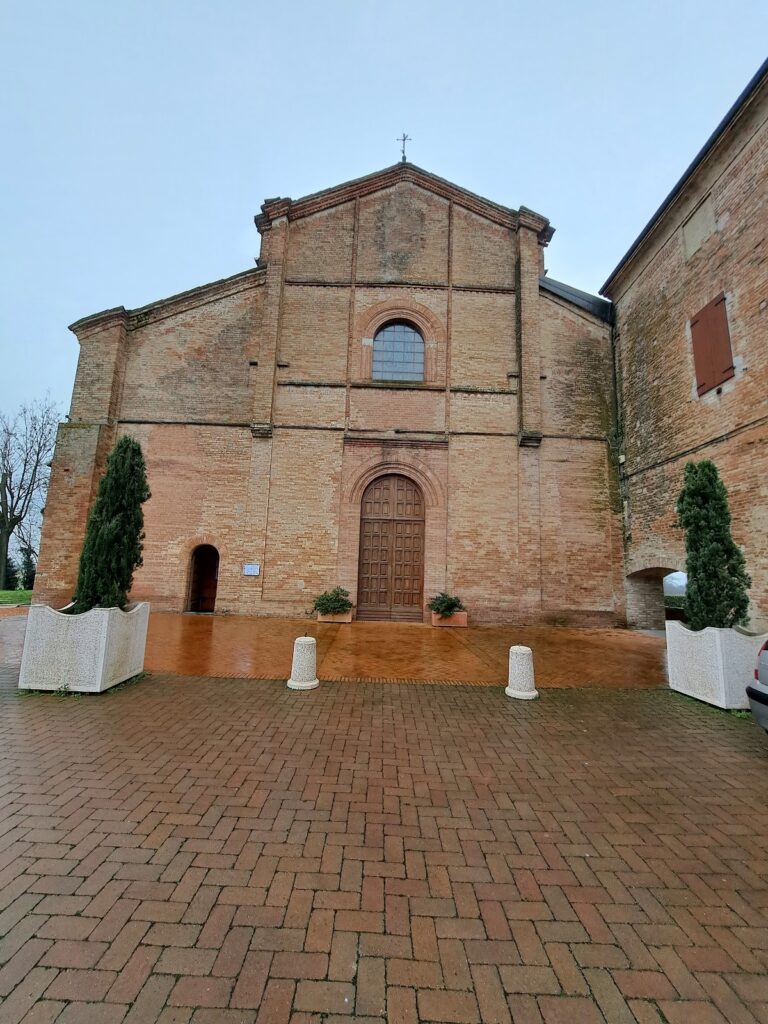
Fidenza Cathedral is a Romanesque complex organized around a three-aisled church without a transept. Its principal artistic feature is the façade, whose lower section is faced with finely carved marble and whose upper section is built in sandstone. The façade’s sculpture reflects the development of northern Italian Romanesque art from the late twelfth to the early thirteenth century. The central lower portion and the two flanking towers retain their definitive appearance, while the upper façade still shows exposed construction brick, unfinished facing, and uncompleted putlog holes.
Façade and stair towers
Façade composition
The façade is divided into three zones corresponding to the internal aisles by two substantial half-columns. They stop abruptly near the level of the main portal’s architrave. The possibility that they were intended to continue higher remains hypothetical. Three portals with porches organize the front, with the central entrance slightly raised and projecting farther forward than the two lateral portals.
Elf or Stork Tower
The northern façade tower, also called the Elf or Stork Tower, is a stair tower rather than a bell tower. It provides access to the internal galleries. Two framed relief panels are preserved on it, although their original positions are uncertain and the surviving number appears incomplete. One shows Herod ordering the Massacre of the Innocents, the Gospel episode in which the ruler orders the killing of children. The other depicts the Magi riding at a gallop, with trampled grass intensifying the sense of movement.
Trabucco Tower
The southern stair tower, known as the Trabucco Tower, contains the heavily eroded relief popularly called “Berta che filava.” Measuring approximately 77 by 80 centimetres, it shows a figure holding two elongated objects between two indistinct animals. The scene has been interpreted, with uncertainty, as an episode from the Alexander Romance, a legendary literary tradition about Alexander the Great. In this reading, Alexander attempts to rise into the sky using griffins attracted by meat.
A five-panel frieze on the front of the southern tower is read from right to left as the legend of Roland’s birth. The scenes show Pepin the Short fighting a lion to save two men; Milon and Berthe being seduced while Charlemagne hunts; Milon fighting a bandit attempting to abduct the pregnant Berthe; Milon and his son Roland leaving to hunt; and a lion cub seizing a horse by the throat. The final image symbolizes Roland’s youthful strength. The flanking lion reflects the medieval belief that lion cubs were born dead and revived by their parents’ breath.
A six-panel frieze on the southern tower’s side was formerly understood as pilgrims traveling toward Rome and became associated with the Via Francigena. It is now more plausibly read as Charlemagne’s procession returning to France after liberating Rome from the Saracens. The central rider holds a horse and a hunting cheetah; the leftmost rider may be Charlemagne, while the leader may represent Roland.
The central portal
Porch and supporting sculpture
The central porch is supported by two stylophore lions, sculpted lions that carry columns, attributed to Antelami. The lion on the left holds a winged dragon, while the one on the right supports a bovine figure. Small dragons run along both lions’ backs, and cavities in their eyes once held glass eyes for solemn festivals. Their columns are made of red Verona marble and end in historiated capitals, carved capitals containing narrative scenes. The left capital shows episodes from the life of the Virgin, while the right represents the four Evangelists through human-animal symbolic forms.
Two sculpted beams support the porch vault. Abraham appears enthroned on one, with three human heads on his knees, perhaps representing souls issuing from Abraham’s bosom. On the other, a horned devil torments Job. Two carved consoles fixed against the façade show bearded figures in long tunics, kneeling as telamons, human figures used as architectural supports, beneath the weight of the structure.
The porch’s fronton, the gable above the entrance, contains three scenes. Charlemagne appears enthroned with imperial symbols and an armed squire; Pope Adrian II gives the archpriest of San Donnino a mitre and pastoral staff as signs of episcopal dignity; and a healed man thanks Saint Donninus for restoring his health and returning his horse. The scenes are crowned by the Lamb of God.
The porch supports include eroded telamons and capitals topped by bull heads. A decorative band follows the arch and contains fourteen diamond-shaped panels filled with animals, including lions, griffins, hares, storks, deer, and roosters.
Archivolt and Saint Donninus reliefs
At the top of the central porch archivolt, Christ sits enthroned as the link between the Old and New Testaments. Six prophets, beginning with Moses, and six apostles, beginning with Saint Peter, rise toward him along the inner curve of the arch. Each holds a carved scroll. The prophets wear Phrygian caps, while the apostles have haloes. Two inscribed panels refer to passages from Baruch 3:9 and Matthew 5:3.
The central portal’s jambs contain half-columns and pilasters, while reliefs beside and above the wooden door narrate the life and martyrdom of Saint Donninus. The sequence shows Donninus crowning the emperor, asking permission to serve God, being condemned with other Christians, fleeing on horseback toward Piacenza, and being beheaded beside the Stirone. Further scenes show him carrying his severed head across the watercourse. Inscriptions identify Maximian, Piacenza, Saint Donninus, the martyr’s soul being carried to heaven, and the Stirone.
Additional panels show Donninus’s body in the forest, the first chapel erected at the site, a sick man healed while a thief steals his horse, and the saint intervening to recover it. A final scene shows a pregnant woman surviving the collapse of a wooden footbridge during a procession to recover the saint’s rediscovered relics.
David and the left portal niche
The niche to the left of the central entrance contains a statue of King David, attributed to Antelami. His scroll identifies the portal as the gate of the Lord. The canopy above him contains the Presentation of Jesus in the Temple, with Mary presenting the child to Simeon and a woman carrying two doves. Above a capricorn and a griffin, the archangel Gabriel gestures toward the cathedral entrance.
Reliefs beside the niche show the Adoration of the Magi, the crowned Christ child seated on Mary’s lap, Joseph asleep, an angel speaking to Joseph in a dream, and two doves drinking from a fountain as an allegory of Egypt. The names of the Magi, Mary, Jesus, and Joseph, together with the command to flee to Egypt, are carved above the scenes.
Ezekiel and the right portal niche
The niche to the right contains a statue of the prophet Ezekiel, also attributed to Antelami. His scroll identifies the closed gate of the house of the Lord. The canopy shows the Virgin and Child holding roses. A vine rises between the Virgin’s feet, with flowering branches behind her, while an inscription refers to the rod of virtue and salvation.
Beside this niche, the archangel Raphael holds a pilgrim’s staff and invites a group toward the main entrance. He stands above a harpy and a centaur. Nearby reliefs show Elijah carried upward in a fiery chariot, Elisha behind him, and Enoch in Paradise between two fruit-bearing trees.
Prophets and the route to Rome
The left half-column has a sculpted half-capital showing Daniel in the lions’ den, the prophet Habakkuk bringing him food, and an angel carrying Habakkuk to the scene. Above it stands the apostle Simon with a scroll directing travelers toward Rome through Borgo San Donnino. The right half-column has a Corinthian half-capital, while its corresponding statue is missing or may never have been made.
Lateral portals and exterior sculpture
Portal of Life
The lateral entrance known as the Portal of Life has columns supported by rams. Its tympanum shows the Virgin and Child surrounded by two groups of supplicants, a composition traditionally called the Madonna della Misericordia. Twenty vegetal and animal representations decorate the arch, including bears, sheep, panthers, ibexes, lions, donkeys, boars, and saddled horses. One horse carries a monkey, while two confronted griffins occupy the keystone.
The fronton bears a mitred figure with a pastoral staff, perhaps the archpriest of San Donnino. Its upper edge also carries an acroterion, a decorative element set near the edge of a gable, showing the “poor Raimondino,” whose name is carved on the base. Reliefs beneath the porch depict Hercules wearing an animal skin and holding the Nemean lion by the tail, together with a griffin attacking a deer.
Portal of Death
The other lateral entrance, known as the Portal of Death, has columns supported by telamons. Its tympanum shows Saint Michael defeating a dragon while holding a cross. The architrave contains a rosette surrounding a blessing hand.
Apse and seasonal imagery
Sculpture continues along the cathedral’s sides and includes biblical episodes, saints’ stories, religious images, hunting scenes, and a cycle of the months. The surviving reliefs on the apse appear to have been moved from their original positions. On the southeastern side, a collared dog pursues a deer.
Other panels show January as the two-faced Janus beside a fire with a hanging pot and smoking sausages; March sounding a horn; April as a flowering prince; and May as a mounted knight leaving for war, with Spring and Gemini above. A woman gathering figs is traditionally associated with Virgo and September, and appears beside a vine.
A groove cut into one corner of the façade was used by merchants to measure cloth sold from nearby stalls. Additional reliefs associated with Antelami’s school are found on the exterior of the apse and inside the cathedral, while other pieces are preserved in the Diocesan Museum of Fidenza.
Interior and crypt
Nave and altar
The interior has three aisles and no transept. Columns divide the aisles, which are joined by groin vaults. The space is described as simple and well proportioned. On the first pillar on the right side of the central nave, a three-panel relief shows the rebellious angels expelled from Paradise after God’s judgment, represented above in a mandorla, an almond-shaped frame surrounding a sacred figure. The interior also contains a Christ Pantocrator, an image of Christ as the all-powerful ruler of the universe.
The raised altar is approached by smooth white-marble steps leading to the choir. The episcopal chair stands west of the altar rather than in the more usual southern position. This arrangement reflects the cathedral’s continuing role as the center of the diocese.
Crypt and relics
Two stairways beside the altar descend to the crypt. There the relics of Saint Donninus are preserved and visible, with purple curtains marking the entrances. The crypt maintains the physical connection between the present cathedral and the martyr’s early shrine, whose preservation shaped the religious identity of Fidenza from late antiquity onward.
Nearby sites